SUBSCRIBE TO OUR FREE NEWSLETTER
Daily news & progressive opinion—funded by the people, not the corporations—delivered straight to your inbox.
5
#000000
#FFFFFF
To donate by check, phone, or other method, see our More Ways to Give page.
Daily news & progressive opinion—funded by the people, not the corporations—delivered straight to your inbox.

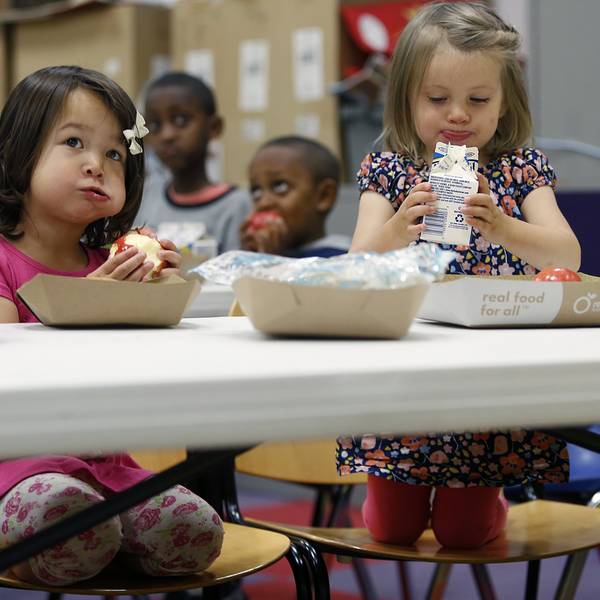
Let's transform school food so that it nourishes kids' health and creates new opportunities for farmers and a better climate future. (Photo: Getty/Stock Photo: Javier Zayas Photography)
As California's schools prepare to reopen, protecting childrens' health must be a top priority. One surprising way to achieve this, along with rigorous Covid-19 protocols, is to make school food more accessible and healthful. Two bills in the state Legislature provide a booster shot in that direction.
One measure, Senate Bill 364, would make California the first state to provide universal access to school meals. The other, Assembly Bill 558, would provide incentives for healthier plant-based meals. Access and quality nutrition are essential to bolstering kids' health during the pandemic and beyond.
This glut of factory farm meat and dairy in school meals may carry a low sticker price, but the costs for public health are unacceptable--especially for low-income and children of color who rely on school lunch as a main source of nutrition.
Despite improvements over the last decade, a new report by Friends of the Earth finds that the most widely offered meals include ultra-processed and fast food items such as chicken nuggets, cheeseburgers, meat pizzas, hotdogs and deli meat sandwiches. Analyzing more than 1,300 lunch entrees across California's 25 largest school districts, the report found that 94% of school lunch entrees feature meat and dairy, and 16% of meals include processed meats considered carcinogenic by the World Health Organization; only 4% are plant-based.
These meat and dairy centric meals are out of step with leading public health guidance around healthy eating. The American Medical Association, the American Cancer Society and the Harvard T.H. Chan School of Public Health all urge more consumption of plant-based foods and less meat, especially processed meat. Even the 2020-25 USDA Dietary Guidelines for Americans, a document intended to guide school meal patterns, has linked red and processed meat to detrimental health outcomes.
Dedicated school food-service workers do their best to nourish our kids, but the USDA Foods program provides ready and low-cost access to subsidized and processed industrial meat and dairy products that cash-strapped school districts can't resist. This artificially cheap USDA food primarily benefits giant companies like Arkansas-based Tyson Foods and makes it difficult for California's sustainable farmers and ranchers to compete.
This glut of factory farm meat and dairy in school meals may carry a low sticker price, but the costs for public health are unacceptable--especially for low-income and children of color who rely on school lunch as a main source of nutrition. Black and Brown children, who face increasing levels of diabetes and have obesity at three times the rate of white kids in California, would be much better served by fresh, healthy, plant-forward, local sourced meals.
Shifting to lower-carbon plant-forward meals would also benefit our environment and climate future. As the Friends of the Earth report documents, animal products, which rely on large quantities of pesticides, fertilizer and water comprise a whopping 96% of the carbon footprint of all USDA Foods products purchased by schools across the state.
If every school district in California replaced a beef burger with a black bean burger just once a month, that would slash nearly 222 million pounds of carbon emissions - equivalent to not burning 11.4 million gallons of gasoline or taking 22,000 cars off the road each year.
As California schools emerge from the pandemic's deep-freeze, state and federal policymakers have the opportunity to improve the quality and sustainability of meals, generating a triple-win for kids' health, farmers and our climate.
Congress must help reform USDA Foods and the National School Lunch Program in the upcoming Child Nutrition Reauthorization. California legislators can do their part by passing SB 364 and AB 558 to provide incentives for plant-based meals. California should also continue funding the $10 million Farm to School initiative championed by the First Partner, Jennifer Siebel Newsom. This program educates kids about food and farming, and enables schools to source more sustainable foods from local farmers.
With public health being paramount, we must prioritize the nourishment and long-term health of all children. Our public schools and the food they serve are central to that task. Let's transform school food so that it nourishes kids' health and creates new opportunities for farmers and a better climate future.
Dear Common Dreams reader, It’s been nearly 30 years since I co-founded Common Dreams with my late wife, Lina Newhouser. We had the radical notion that journalism should serve the public good, not corporate profits. It was clear to us from the outset what it would take to build such a project. No paid advertisements. No corporate sponsors. No millionaire publisher telling us what to think or do. Many people said we wouldn't last a year, but we proved those doubters wrong. Together with a tremendous team of journalists and dedicated staff, we built an independent media outlet free from the constraints of profits and corporate control. Our mission has always been simple: To inform. To inspire. To ignite change for the common good. Building Common Dreams was not easy. Our survival was never guaranteed. When you take on the most powerful forces—Wall Street greed, fossil fuel industry destruction, Big Tech lobbyists, and uber-rich oligarchs who have spent billions upon billions rigging the economy and democracy in their favor—the only bulwark you have is supporters who believe in your work. But here’s the urgent message from me today. It's never been this bad out there. And it's never been this hard to keep us going. At the very moment Common Dreams is most needed, the threats we face are intensifying. We need your support now more than ever. We don't accept corporate advertising and never will. We don't have a paywall because we don't think people should be blocked from critical news based on their ability to pay. Everything we do is funded by the donations of readers like you. When everyone does the little they can afford, we are strong. But if that support retreats or dries up, so do we. Will you donate now to make sure Common Dreams not only survives but thrives? —Craig Brown, Co-founder |
As California's schools prepare to reopen, protecting childrens' health must be a top priority. One surprising way to achieve this, along with rigorous Covid-19 protocols, is to make school food more accessible and healthful. Two bills in the state Legislature provide a booster shot in that direction.
One measure, Senate Bill 364, would make California the first state to provide universal access to school meals. The other, Assembly Bill 558, would provide incentives for healthier plant-based meals. Access and quality nutrition are essential to bolstering kids' health during the pandemic and beyond.
This glut of factory farm meat and dairy in school meals may carry a low sticker price, but the costs for public health are unacceptable--especially for low-income and children of color who rely on school lunch as a main source of nutrition.
Despite improvements over the last decade, a new report by Friends of the Earth finds that the most widely offered meals include ultra-processed and fast food items such as chicken nuggets, cheeseburgers, meat pizzas, hotdogs and deli meat sandwiches. Analyzing more than 1,300 lunch entrees across California's 25 largest school districts, the report found that 94% of school lunch entrees feature meat and dairy, and 16% of meals include processed meats considered carcinogenic by the World Health Organization; only 4% are plant-based.
These meat and dairy centric meals are out of step with leading public health guidance around healthy eating. The American Medical Association, the American Cancer Society and the Harvard T.H. Chan School of Public Health all urge more consumption of plant-based foods and less meat, especially processed meat. Even the 2020-25 USDA Dietary Guidelines for Americans, a document intended to guide school meal patterns, has linked red and processed meat to detrimental health outcomes.
Dedicated school food-service workers do their best to nourish our kids, but the USDA Foods program provides ready and low-cost access to subsidized and processed industrial meat and dairy products that cash-strapped school districts can't resist. This artificially cheap USDA food primarily benefits giant companies like Arkansas-based Tyson Foods and makes it difficult for California's sustainable farmers and ranchers to compete.
This glut of factory farm meat and dairy in school meals may carry a low sticker price, but the costs for public health are unacceptable--especially for low-income and children of color who rely on school lunch as a main source of nutrition. Black and Brown children, who face increasing levels of diabetes and have obesity at three times the rate of white kids in California, would be much better served by fresh, healthy, plant-forward, local sourced meals.
Shifting to lower-carbon plant-forward meals would also benefit our environment and climate future. As the Friends of the Earth report documents, animal products, which rely on large quantities of pesticides, fertilizer and water comprise a whopping 96% of the carbon footprint of all USDA Foods products purchased by schools across the state.
If every school district in California replaced a beef burger with a black bean burger just once a month, that would slash nearly 222 million pounds of carbon emissions - equivalent to not burning 11.4 million gallons of gasoline or taking 22,000 cars off the road each year.
As California schools emerge from the pandemic's deep-freeze, state and federal policymakers have the opportunity to improve the quality and sustainability of meals, generating a triple-win for kids' health, farmers and our climate.
Congress must help reform USDA Foods and the National School Lunch Program in the upcoming Child Nutrition Reauthorization. California legislators can do their part by passing SB 364 and AB 558 to provide incentives for plant-based meals. California should also continue funding the $10 million Farm to School initiative championed by the First Partner, Jennifer Siebel Newsom. This program educates kids about food and farming, and enables schools to source more sustainable foods from local farmers.
With public health being paramount, we must prioritize the nourishment and long-term health of all children. Our public schools and the food they serve are central to that task. Let's transform school food so that it nourishes kids' health and creates new opportunities for farmers and a better climate future.
As California's schools prepare to reopen, protecting childrens' health must be a top priority. One surprising way to achieve this, along with rigorous Covid-19 protocols, is to make school food more accessible and healthful. Two bills in the state Legislature provide a booster shot in that direction.
One measure, Senate Bill 364, would make California the first state to provide universal access to school meals. The other, Assembly Bill 558, would provide incentives for healthier plant-based meals. Access and quality nutrition are essential to bolstering kids' health during the pandemic and beyond.
This glut of factory farm meat and dairy in school meals may carry a low sticker price, but the costs for public health are unacceptable--especially for low-income and children of color who rely on school lunch as a main source of nutrition.
Despite improvements over the last decade, a new report by Friends of the Earth finds that the most widely offered meals include ultra-processed and fast food items such as chicken nuggets, cheeseburgers, meat pizzas, hotdogs and deli meat sandwiches. Analyzing more than 1,300 lunch entrees across California's 25 largest school districts, the report found that 94% of school lunch entrees feature meat and dairy, and 16% of meals include processed meats considered carcinogenic by the World Health Organization; only 4% are plant-based.
These meat and dairy centric meals are out of step with leading public health guidance around healthy eating. The American Medical Association, the American Cancer Society and the Harvard T.H. Chan School of Public Health all urge more consumption of plant-based foods and less meat, especially processed meat. Even the 2020-25 USDA Dietary Guidelines for Americans, a document intended to guide school meal patterns, has linked red and processed meat to detrimental health outcomes.
Dedicated school food-service workers do their best to nourish our kids, but the USDA Foods program provides ready and low-cost access to subsidized and processed industrial meat and dairy products that cash-strapped school districts can't resist. This artificially cheap USDA food primarily benefits giant companies like Arkansas-based Tyson Foods and makes it difficult for California's sustainable farmers and ranchers to compete.
This glut of factory farm meat and dairy in school meals may carry a low sticker price, but the costs for public health are unacceptable--especially for low-income and children of color who rely on school lunch as a main source of nutrition. Black and Brown children, who face increasing levels of diabetes and have obesity at three times the rate of white kids in California, would be much better served by fresh, healthy, plant-forward, local sourced meals.
Shifting to lower-carbon plant-forward meals would also benefit our environment and climate future. As the Friends of the Earth report documents, animal products, which rely on large quantities of pesticides, fertilizer and water comprise a whopping 96% of the carbon footprint of all USDA Foods products purchased by schools across the state.
If every school district in California replaced a beef burger with a black bean burger just once a month, that would slash nearly 222 million pounds of carbon emissions - equivalent to not burning 11.4 million gallons of gasoline or taking 22,000 cars off the road each year.
As California schools emerge from the pandemic's deep-freeze, state and federal policymakers have the opportunity to improve the quality and sustainability of meals, generating a triple-win for kids' health, farmers and our climate.
Congress must help reform USDA Foods and the National School Lunch Program in the upcoming Child Nutrition Reauthorization. California legislators can do their part by passing SB 364 and AB 558 to provide incentives for plant-based meals. California should also continue funding the $10 million Farm to School initiative championed by the First Partner, Jennifer Siebel Newsom. This program educates kids about food and farming, and enables schools to source more sustainable foods from local farmers.
With public health being paramount, we must prioritize the nourishment and long-term health of all children. Our public schools and the food they serve are central to that task. Let's transform school food so that it nourishes kids' health and creates new opportunities for farmers and a better climate future.