SUBSCRIBE TO OUR FREE NEWSLETTER
Daily news & progressive opinion—funded by the people, not the corporations—delivered straight to your inbox.
5
#000000
#FFFFFF
To donate by check, phone, or other method, see our More Ways to Give page.
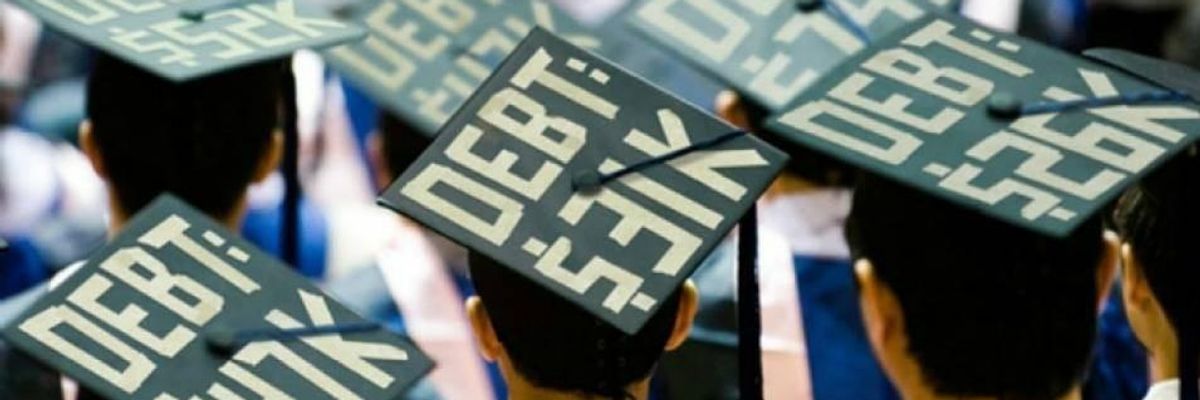
The more than 40 million Americans who've lost their jobs under the pandemic include many people who are saddled with college debt. And yet Congress has done nothing to reduce the $1.68 trillion in student debts. Meanwhile, for-profit colleges that have loaded up students with heavy debt burdens are raking in taxpayer-subsidized emergency assistance.
The $2.2 trillion CARES Act passed in March includes hundreds of billions of dollars in assistance for businesses. Good Jobs First has been tracking the recipients of these billions, and among them are 10 of the largest for-profit universities. Together, they've received over $32 million in direct cash assistance.
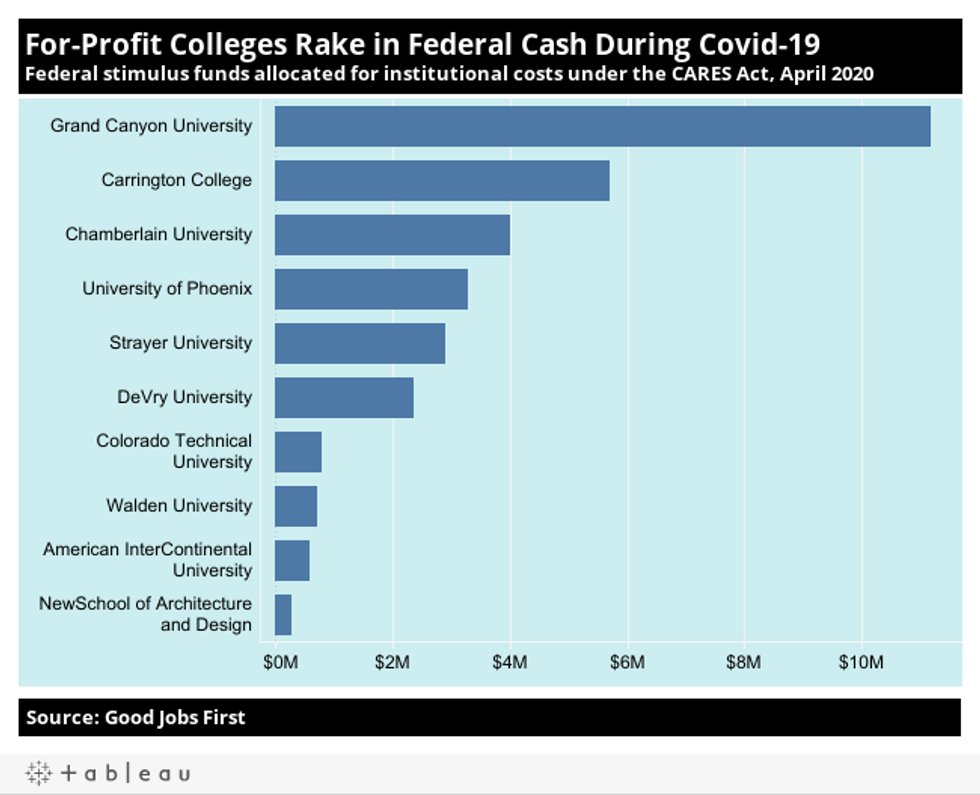
The list includes the notorious University of Phoenix, which received $3.2 million in taxpayer support -- despite having racked up hundreds of millions of dollars in penalties for its deceptive practices in recruiting students. The University of Phoenix is owned by the massive Apollo Global Management private equity firm.
The largest recipient among the for-profit colleges is Grand Canyon University, with $11.1 million. This is an evangelical Christian college that is renowned for allowing conservative firebrands like Ben Shapiro to speak on campus. It has also been accused of defrauding its students.
These schools also received an equal amount for emergency student aid for qualifying students. However, that cash assistance was a one-time payment to compensate for disruptions due to campuses being closed. None was allocated to giving assistance to students who may have lost jobs or homes.
Compared to the payouts to for-profit colleges, the CARES Act was far less generous with student debt holders, allowing only deferment of interest and payments on Federal student loans through September 2020. This just kicks the can down the road, rather than providing real debt relief. The House Democrats' proposed HEROES Act would go a bit further to forgive $10,000 of federal loans to economically distressed borrowers.
A more sensible and just approach, especially in the middle of an economic crisis, would be to cancel all student debt. This would help people survive with a roof over their heads during the economic crisis and lessen the crushing financial stress that student loans cause.
Sen. Bernie Sanders and Rep. Ilhan Omar introduced a bill to cancel all student debt last year, and Rep. Omar recently stressed its importance during this pandemic: "Student debt was a crisis before the coronavirus. And it's an even deeper crisis now... We must not force Americans to choose between putting food on the table and paying off exorbitant student loans."
Cancellation of student debt would also boost the broader economy by creating a huge financial stimulus. It would free up money for people to spend on housing and goods to help get the economy going again.
Unlike proposals that limit debt relief to those who fall below certain income thresholds, the Sanders-Omar plan would wipe out all outstanding student debt. Going forward, they would make public college and university education free for all. Supporters argue this universal approach would build broader political support and reinforce the principle that education, like health care, is a human right.
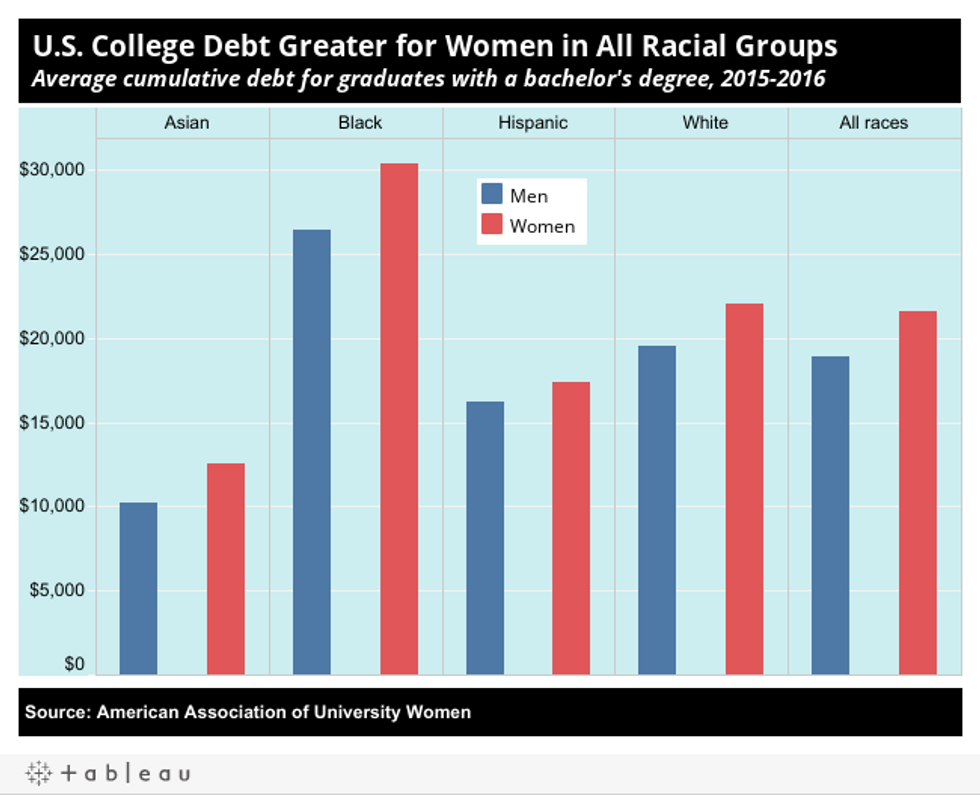
The benefits of student debt cancellation would be especially important for people of color and women. First, as Tressie McMillan Cottom illustrates, these for-profit universities specifically target and recruit people of color, using euphemistic language to suggest they can fix the inequality in non-profit higher education. Second, Black people are saddled with higher levels of student debt than other races, and women--across all races--have more student debt than men.
These are the same segments of the U.S. population that has been most affected by the Covid-19 pandemic. Black people are dying at twice the rate of other races, Latinx and Black people are more likely to have faced job and wage losses due to the pandemic, and women are both more likely to lose their jobs and to be in jobs deemed as essential.
Over time, student debt cancellation could also help reduce racial disparities in home ownership. Student loan payments are a major hindrance to buying a home -- on top of the many forms of systemic racism that make it more difficult to accumulate the wealth necessary to buy a house. Experts estimate that 300,000 more homes would be sold each year if student debt was eliminated.
Why should a "school" like the University of Phoenix get a government handout while struggling students get no real relief?
Let's level the playing field. Let's cancel student debt.
The more than 40 million Americans who've lost their jobs under the pandemic include many people who are saddled with college debt. And yet Congress has done nothing to reduce the $1.68 trillion in student debts. Meanwhile, for-profit colleges that have loaded up students with heavy debt burdens are raking in taxpayer-subsidized emergency assistance.
The $2.2 trillion CARES Act passed in March includes hundreds of billions of dollars in assistance for businesses. Good Jobs First has been tracking the recipients of these billions, and among them are 10 of the largest for-profit universities. Together, they've received over $32 million in direct cash assistance.
The list includes the notorious University of Phoenix, which received $3.2 million in taxpayer support -- despite having racked up hundreds of millions of dollars in penalties for its deceptive practices in recruiting students. The University of Phoenix is owned by the massive Apollo Global Management private equity firm.
The largest recipient among the for-profit colleges is Grand Canyon University, with $11.1 million. This is an evangelical Christian college that is renowned for allowing conservative firebrands like Ben Shapiro to speak on campus. It has also been accused of defrauding its students.
These schools also received an equal amount for emergency student aid for qualifying students. However, that cash assistance was a one-time payment to compensate for disruptions due to campuses being closed. None was allocated to giving assistance to students who may have lost jobs or homes.
Compared to the payouts to for-profit colleges, the CARES Act was far less generous with student debt holders, allowing only deferment of interest and payments on Federal student loans through September 2020. This just kicks the can down the road, rather than providing real debt relief. The House Democrats' proposed HEROES Act would go a bit further to forgive $10,000 of federal loans to economically distressed borrowers.
A more sensible and just approach, especially in the middle of an economic crisis, would be to cancel all student debt. This would help people survive with a roof over their heads during the economic crisis and lessen the crushing financial stress that student loans cause.
Sen. Bernie Sanders and Rep. Ilhan Omar introduced a bill to cancel all student debt last year, and Rep. Omar recently stressed its importance during this pandemic: "Student debt was a crisis before the coronavirus. And it's an even deeper crisis now... We must not force Americans to choose between putting food on the table and paying off exorbitant student loans."
Cancellation of student debt would also boost the broader economy by creating a huge financial stimulus. It would free up money for people to spend on housing and goods to help get the economy going again.
Unlike proposals that limit debt relief to those who fall below certain income thresholds, the Sanders-Omar plan would wipe out all outstanding student debt. Going forward, they would make public college and university education free for all. Supporters argue this universal approach would build broader political support and reinforce the principle that education, like health care, is a human right.
The benefits of student debt cancellation would be especially important for people of color and women. First, as Tressie McMillan Cottom illustrates, these for-profit universities specifically target and recruit people of color, using euphemistic language to suggest they can fix the inequality in non-profit higher education. Second, Black people are saddled with higher levels of student debt than other races, and women--across all races--have more student debt than men.
These are the same segments of the U.S. population that has been most affected by the Covid-19 pandemic. Black people are dying at twice the rate of other races, Latinx and Black people are more likely to have faced job and wage losses due to the pandemic, and women are both more likely to lose their jobs and to be in jobs deemed as essential.
Over time, student debt cancellation could also help reduce racial disparities in home ownership. Student loan payments are a major hindrance to buying a home -- on top of the many forms of systemic racism that make it more difficult to accumulate the wealth necessary to buy a house. Experts estimate that 300,000 more homes would be sold each year if student debt was eliminated.
Why should a "school" like the University of Phoenix get a government handout while struggling students get no real relief?
Let's level the playing field. Let's cancel student debt.
The more than 40 million Americans who've lost their jobs under the pandemic include many people who are saddled with college debt. And yet Congress has done nothing to reduce the $1.68 trillion in student debts. Meanwhile, for-profit colleges that have loaded up students with heavy debt burdens are raking in taxpayer-subsidized emergency assistance.
The $2.2 trillion CARES Act passed in March includes hundreds of billions of dollars in assistance for businesses. Good Jobs First has been tracking the recipients of these billions, and among them are 10 of the largest for-profit universities. Together, they've received over $32 million in direct cash assistance.
The list includes the notorious University of Phoenix, which received $3.2 million in taxpayer support -- despite having racked up hundreds of millions of dollars in penalties for its deceptive practices in recruiting students. The University of Phoenix is owned by the massive Apollo Global Management private equity firm.
The largest recipient among the for-profit colleges is Grand Canyon University, with $11.1 million. This is an evangelical Christian college that is renowned for allowing conservative firebrands like Ben Shapiro to speak on campus. It has also been accused of defrauding its students.
These schools also received an equal amount for emergency student aid for qualifying students. However, that cash assistance was a one-time payment to compensate for disruptions due to campuses being closed. None was allocated to giving assistance to students who may have lost jobs or homes.
Compared to the payouts to for-profit colleges, the CARES Act was far less generous with student debt holders, allowing only deferment of interest and payments on Federal student loans through September 2020. This just kicks the can down the road, rather than providing real debt relief. The House Democrats' proposed HEROES Act would go a bit further to forgive $10,000 of federal loans to economically distressed borrowers.
A more sensible and just approach, especially in the middle of an economic crisis, would be to cancel all student debt. This would help people survive with a roof over their heads during the economic crisis and lessen the crushing financial stress that student loans cause.
Sen. Bernie Sanders and Rep. Ilhan Omar introduced a bill to cancel all student debt last year, and Rep. Omar recently stressed its importance during this pandemic: "Student debt was a crisis before the coronavirus. And it's an even deeper crisis now... We must not force Americans to choose between putting food on the table and paying off exorbitant student loans."
Cancellation of student debt would also boost the broader economy by creating a huge financial stimulus. It would free up money for people to spend on housing and goods to help get the economy going again.
Unlike proposals that limit debt relief to those who fall below certain income thresholds, the Sanders-Omar plan would wipe out all outstanding student debt. Going forward, they would make public college and university education free for all. Supporters argue this universal approach would build broader political support and reinforce the principle that education, like health care, is a human right.
The benefits of student debt cancellation would be especially important for people of color and women. First, as Tressie McMillan Cottom illustrates, these for-profit universities specifically target and recruit people of color, using euphemistic language to suggest they can fix the inequality in non-profit higher education. Second, Black people are saddled with higher levels of student debt than other races, and women--across all races--have more student debt than men.
These are the same segments of the U.S. population that has been most affected by the Covid-19 pandemic. Black people are dying at twice the rate of other races, Latinx and Black people are more likely to have faced job and wage losses due to the pandemic, and women are both more likely to lose their jobs and to be in jobs deemed as essential.
Over time, student debt cancellation could also help reduce racial disparities in home ownership. Student loan payments are a major hindrance to buying a home -- on top of the many forms of systemic racism that make it more difficult to accumulate the wealth necessary to buy a house. Experts estimate that 300,000 more homes would be sold each year if student debt was eliminated.
Why should a "school" like the University of Phoenix get a government handout while struggling students get no real relief?
Let's level the playing field. Let's cancel student debt.