

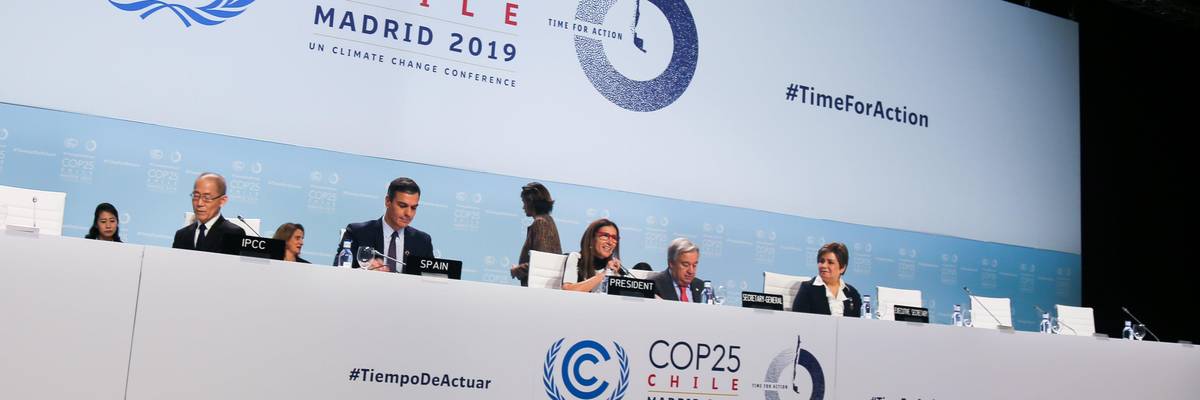
The result of this corporate omnipresence is clear--the negotiations move at a snail's pace and more often than not reflect the interests of global corporations, not people and the planet. (Photo: UN Climate Change/Twitter)
Meet the Big Polluters Sponsoring COP25
Whether it’s subsidies or the global response to this crisis, around the world, the influence of industries like the fossil fuel industry continues to hamper our policymaking to face the ecological and climate crisis.
This week, the 2019 UN Climate Change Conference (COP25) will descend upon Madrid following an ad-hoc relocation from Santiago, Chile, after huge protests erupted against the government. These international negotiations are expensive events to organize and corporate sponsorship has become an unfortunate norm for host governments to pursue and Spain is no exception. For Santiago, the Chilean government had secured the financial backing of the country's mining, manufacturing and employers associations. For Madrid, the acting Minister for Ecological Transition, Teresa Ribera, has knocked on the doors of the large companies of the Ibex35 and the Spanish employers' association for the financing of the Conference. An excellent opportunity for "greenwashing" of the main companies emitting greenhouse gases and responsible for numerous socio-environmental conflicts around the world.
They will not only improve their corporate image, they will also obtain economic advantages, such as the tax breaks the Spanish government is considering giving to those who help foot the bill. These types of measures are common in the privileged relationship that exists between the Spanish government and transnational companies. The tariff policy in favour of electricity companies, the barriers to energy self-production and the stop of promotion of energies such as photovoltaics respond to the constant movement of "revolving doors" between the Spanish executive and the large energy companies. The two best-known examples were former presidents Felipe Gonzalez and Jose Maria Aznar, signed by Gas Natural and Endesa respectively, with the latter officially announced as a COP25 sponsor. In addition, they have the capacity to influence the negotiations that, according this year's agenda that could fundamentally impact the business models of many of the global industries the sponsors represent.
Last year in Poland, the conference was bankrolled by some of the region's largest fossil fuel corporations and financiers. And this year, Iberdrola, Endesa, Santander and Telefonica have agreed to be sponsors among others. Iberdrola, a global power utility, has gas operations around the globe, a fossil fuel that industry wants to sell as a solution to climate change but with devastating social and environmental consequences. Iberdrola has also invested in megadam project Belo Monte in Brazil, which has displaced some 25,000 people including indigenous groups. Endesa, also a big utility in Spain, operates coal, oil and gas power plants and was responsible for emitting 61.9 million tons of CO2 equivalent in 2018. The sponsors' business models are inextricably linked with fossil fuels and therefore help to drive the climate crisis.
The mere presence of these polluters--their lobbyists or simply their logos--calls into question the legitimacy of the outcomes of the negotiations and should concern all involved.
Sponsorship is a symptom of a larger problem of corporate capture at the UNFCCC. Inside the talks, trade associations representing the interests of the fossil fuel industry and other Big Polluters stalk the halls and push their members' agenda. The result of this corporate omnipresence is clear--the negotiations move at a snail's pace and more often than not reflect the interests of global corporations, not people and the planet.
One area on the agenda for COP25 of particular interest to global corporations is the finalization of the guidelines on Article 6, which includes carbon markets as one of the means of implementing the Paris Agreement. Corporations, led by the International Emissions Trading Association (IETA), have lobbied heavily to make this article's carbon trading scheme devoid of limits or protections. IETA's members include Endesa's parent company Enel, Iberdrola, Naturgy and Repsol, who are all sponsors or have been approached. If they get their way, the Paris Agreement usher in a regime under which Global North governments are able to pay their way out of their obligations to cut emissions and saddle the Global South to deal with those cuts instead. Fundamentally, this carbon market scheme could help lock in fossil fuels for decades in the future--ensuring the business prospects of big polluting industries.
The Spanish government has said it is seeking corporate sponsors because it doesn't have the funds itself to host the event. But a closer look reveals it is skewed priorities, not strapped budgets at fault. Each year, the Spanish government gives fossil fuel electricity companies EUR470 million in subsidies. And Spain is no outlier in this. The International Monetary Fund estimates that globally, governments subsidize the fossil fuel industry to the tune of $5.2 trillion annually. Imagine how easily governments could fund a plan for the energy transition to clean source and a meeting like COP25, if they weren't giving more than a million euros a day to fossil fuel corporations.
Whether it's subsidies or the global response to this crisis, around the world, the influence of industries like the fossil fuel industry continues to hamper our policymaking to face the ecological and climate crisis. The reality is that meetings like COP25 will continue to fall short of the response the science demands, especially if corporations continue to influence their outcomes be it through sponsorship or lobbying on the inside. The mere presence of these polluters--their lobbyists or simply their logos--calls into question the legitimacy of the outcomes of the negotiations and should concern all involved. That's why there's a robust movement among some governments and civil society groups to change the rules and finally kick polluters out of the talks. That movement is based on a simple principle: you can't let the fox guard the hen house.
With the climate emergency upon us, drying up Spain, and causing floods, fires, and disastrous storms all around the world, it is time to take on the industries driving this crisis, not allow them to shape the policymaking around the crisis many of them are responsible for driving. If these meetings are meant to pave the way for real solutions, not industry schemes, and meaningfully address this crisis, surely we can agree they mustn't be bankrolled and influenced by those most responsible for it.
We are at a crossroads
This country and this world are at a monumental crossroads. In a few short weeks, US voters will have an opportunity to beat back the forces of fascism and confront the billionaires who are rigging the economy, our media system, and our democracy, making it increasingly impossible for ordinary people to get by. We’re not just talking about the election. We’re talking about what must be done once these fascist elements are vanquished from power. We need a bolder set of solutions than what either major party has so far been willing to offer and a working-class movement ready to fight like hell for it. Trump didn't emerge from nowhere. The conditions that fueled MAGA authoritarianism were created by decades of radical neoliberal economic policies and a corrupt political system dominated by corporate interests. They slashed taxes on the super-rich, promising that the benefits would trickle down. They said giveaways to the corporate titans would make life more affordable for the rest of us. It was all bullshit. And when a bitter, betrayed populace searches for someone to blame, right-wing demagogues have little trouble finding scapegoats. People know when they're being lied to, but you won't hear any of this from the corporate media. Only independent journalism—powered and funded by people who believe in building a better world—can deliver truly trustworthy daily news. Our Fall Campaign is underway, and we need your help. To power our newsroom through the rest of the year, we need to raise $125,000 by midnight on October 31. So if you share our vision, please contribute whatever you can to sustain our work. |
This week, the 2019 UN Climate Change Conference (COP25) will descend upon Madrid following an ad-hoc relocation from Santiago, Chile, after huge protests erupted against the government. These international negotiations are expensive events to organize and corporate sponsorship has become an unfortunate norm for host governments to pursue and Spain is no exception. For Santiago, the Chilean government had secured the financial backing of the country's mining, manufacturing and employers associations. For Madrid, the acting Minister for Ecological Transition, Teresa Ribera, has knocked on the doors of the large companies of the Ibex35 and the Spanish employers' association for the financing of the Conference. An excellent opportunity for "greenwashing" of the main companies emitting greenhouse gases and responsible for numerous socio-environmental conflicts around the world.
They will not only improve their corporate image, they will also obtain economic advantages, such as the tax breaks the Spanish government is considering giving to those who help foot the bill. These types of measures are common in the privileged relationship that exists between the Spanish government and transnational companies. The tariff policy in favour of electricity companies, the barriers to energy self-production and the stop of promotion of energies such as photovoltaics respond to the constant movement of "revolving doors" between the Spanish executive and the large energy companies. The two best-known examples were former presidents Felipe Gonzalez and Jose Maria Aznar, signed by Gas Natural and Endesa respectively, with the latter officially announced as a COP25 sponsor. In addition, they have the capacity to influence the negotiations that, according this year's agenda that could fundamentally impact the business models of many of the global industries the sponsors represent.
Last year in Poland, the conference was bankrolled by some of the region's largest fossil fuel corporations and financiers. And this year, Iberdrola, Endesa, Santander and Telefonica have agreed to be sponsors among others. Iberdrola, a global power utility, has gas operations around the globe, a fossil fuel that industry wants to sell as a solution to climate change but with devastating social and environmental consequences. Iberdrola has also invested in megadam project Belo Monte in Brazil, which has displaced some 25,000 people including indigenous groups. Endesa, also a big utility in Spain, operates coal, oil and gas power plants and was responsible for emitting 61.9 million tons of CO2 equivalent in 2018. The sponsors' business models are inextricably linked with fossil fuels and therefore help to drive the climate crisis.
The mere presence of these polluters--their lobbyists or simply their logos--calls into question the legitimacy of the outcomes of the negotiations and should concern all involved.
Sponsorship is a symptom of a larger problem of corporate capture at the UNFCCC. Inside the talks, trade associations representing the interests of the fossil fuel industry and other Big Polluters stalk the halls and push their members' agenda. The result of this corporate omnipresence is clear--the negotiations move at a snail's pace and more often than not reflect the interests of global corporations, not people and the planet.
One area on the agenda for COP25 of particular interest to global corporations is the finalization of the guidelines on Article 6, which includes carbon markets as one of the means of implementing the Paris Agreement. Corporations, led by the International Emissions Trading Association (IETA), have lobbied heavily to make this article's carbon trading scheme devoid of limits or protections. IETA's members include Endesa's parent company Enel, Iberdrola, Naturgy and Repsol, who are all sponsors or have been approached. If they get their way, the Paris Agreement usher in a regime under which Global North governments are able to pay their way out of their obligations to cut emissions and saddle the Global South to deal with those cuts instead. Fundamentally, this carbon market scheme could help lock in fossil fuels for decades in the future--ensuring the business prospects of big polluting industries.
The Spanish government has said it is seeking corporate sponsors because it doesn't have the funds itself to host the event. But a closer look reveals it is skewed priorities, not strapped budgets at fault. Each year, the Spanish government gives fossil fuel electricity companies EUR470 million in subsidies. And Spain is no outlier in this. The International Monetary Fund estimates that globally, governments subsidize the fossil fuel industry to the tune of $5.2 trillion annually. Imagine how easily governments could fund a plan for the energy transition to clean source and a meeting like COP25, if they weren't giving more than a million euros a day to fossil fuel corporations.
Whether it's subsidies or the global response to this crisis, around the world, the influence of industries like the fossil fuel industry continues to hamper our policymaking to face the ecological and climate crisis. The reality is that meetings like COP25 will continue to fall short of the response the science demands, especially if corporations continue to influence their outcomes be it through sponsorship or lobbying on the inside. The mere presence of these polluters--their lobbyists or simply their logos--calls into question the legitimacy of the outcomes of the negotiations and should concern all involved. That's why there's a robust movement among some governments and civil society groups to change the rules and finally kick polluters out of the talks. That movement is based on a simple principle: you can't let the fox guard the hen house.
With the climate emergency upon us, drying up Spain, and causing floods, fires, and disastrous storms all around the world, it is time to take on the industries driving this crisis, not allow them to shape the policymaking around the crisis many of them are responsible for driving. If these meetings are meant to pave the way for real solutions, not industry schemes, and meaningfully address this crisis, surely we can agree they mustn't be bankrolled and influenced by those most responsible for it.
This week, the 2019 UN Climate Change Conference (COP25) will descend upon Madrid following an ad-hoc relocation from Santiago, Chile, after huge protests erupted against the government. These international negotiations are expensive events to organize and corporate sponsorship has become an unfortunate norm for host governments to pursue and Spain is no exception. For Santiago, the Chilean government had secured the financial backing of the country's mining, manufacturing and employers associations. For Madrid, the acting Minister for Ecological Transition, Teresa Ribera, has knocked on the doors of the large companies of the Ibex35 and the Spanish employers' association for the financing of the Conference. An excellent opportunity for "greenwashing" of the main companies emitting greenhouse gases and responsible for numerous socio-environmental conflicts around the world.
They will not only improve their corporate image, they will also obtain economic advantages, such as the tax breaks the Spanish government is considering giving to those who help foot the bill. These types of measures are common in the privileged relationship that exists between the Spanish government and transnational companies. The tariff policy in favour of electricity companies, the barriers to energy self-production and the stop of promotion of energies such as photovoltaics respond to the constant movement of "revolving doors" between the Spanish executive and the large energy companies. The two best-known examples were former presidents Felipe Gonzalez and Jose Maria Aznar, signed by Gas Natural and Endesa respectively, with the latter officially announced as a COP25 sponsor. In addition, they have the capacity to influence the negotiations that, according this year's agenda that could fundamentally impact the business models of many of the global industries the sponsors represent.
Last year in Poland, the conference was bankrolled by some of the region's largest fossil fuel corporations and financiers. And this year, Iberdrola, Endesa, Santander and Telefonica have agreed to be sponsors among others. Iberdrola, a global power utility, has gas operations around the globe, a fossil fuel that industry wants to sell as a solution to climate change but with devastating social and environmental consequences. Iberdrola has also invested in megadam project Belo Monte in Brazil, which has displaced some 25,000 people including indigenous groups. Endesa, also a big utility in Spain, operates coal, oil and gas power plants and was responsible for emitting 61.9 million tons of CO2 equivalent in 2018. The sponsors' business models are inextricably linked with fossil fuels and therefore help to drive the climate crisis.
The mere presence of these polluters--their lobbyists or simply their logos--calls into question the legitimacy of the outcomes of the negotiations and should concern all involved.
Sponsorship is a symptom of a larger problem of corporate capture at the UNFCCC. Inside the talks, trade associations representing the interests of the fossil fuel industry and other Big Polluters stalk the halls and push their members' agenda. The result of this corporate omnipresence is clear--the negotiations move at a snail's pace and more often than not reflect the interests of global corporations, not people and the planet.
One area on the agenda for COP25 of particular interest to global corporations is the finalization of the guidelines on Article 6, which includes carbon markets as one of the means of implementing the Paris Agreement. Corporations, led by the International Emissions Trading Association (IETA), have lobbied heavily to make this article's carbon trading scheme devoid of limits or protections. IETA's members include Endesa's parent company Enel, Iberdrola, Naturgy and Repsol, who are all sponsors or have been approached. If they get their way, the Paris Agreement usher in a regime under which Global North governments are able to pay their way out of their obligations to cut emissions and saddle the Global South to deal with those cuts instead. Fundamentally, this carbon market scheme could help lock in fossil fuels for decades in the future--ensuring the business prospects of big polluting industries.
The Spanish government has said it is seeking corporate sponsors because it doesn't have the funds itself to host the event. But a closer look reveals it is skewed priorities, not strapped budgets at fault. Each year, the Spanish government gives fossil fuel electricity companies EUR470 million in subsidies. And Spain is no outlier in this. The International Monetary Fund estimates that globally, governments subsidize the fossil fuel industry to the tune of $5.2 trillion annually. Imagine how easily governments could fund a plan for the energy transition to clean source and a meeting like COP25, if they weren't giving more than a million euros a day to fossil fuel corporations.
Whether it's subsidies or the global response to this crisis, around the world, the influence of industries like the fossil fuel industry continues to hamper our policymaking to face the ecological and climate crisis. The reality is that meetings like COP25 will continue to fall short of the response the science demands, especially if corporations continue to influence their outcomes be it through sponsorship or lobbying on the inside. The mere presence of these polluters--their lobbyists or simply their logos--calls into question the legitimacy of the outcomes of the negotiations and should concern all involved. That's why there's a robust movement among some governments and civil society groups to change the rules and finally kick polluters out of the talks. That movement is based on a simple principle: you can't let the fox guard the hen house.
With the climate emergency upon us, drying up Spain, and causing floods, fires, and disastrous storms all around the world, it is time to take on the industries driving this crisis, not allow them to shape the policymaking around the crisis many of them are responsible for driving. If these meetings are meant to pave the way for real solutions, not industry schemes, and meaningfully address this crisis, surely we can agree they mustn't be bankrolled and influenced by those most responsible for it.