SUBSCRIBE TO OUR FREE NEWSLETTER
Daily news & progressive opinion—funded by the people, not the corporations—delivered straight to your inbox.
5
#000000
#FFFFFF
To donate by check, phone, or other method, see our More Ways to Give page.
Daily news & progressive opinion—funded by the people, not the corporations—delivered straight to your inbox.
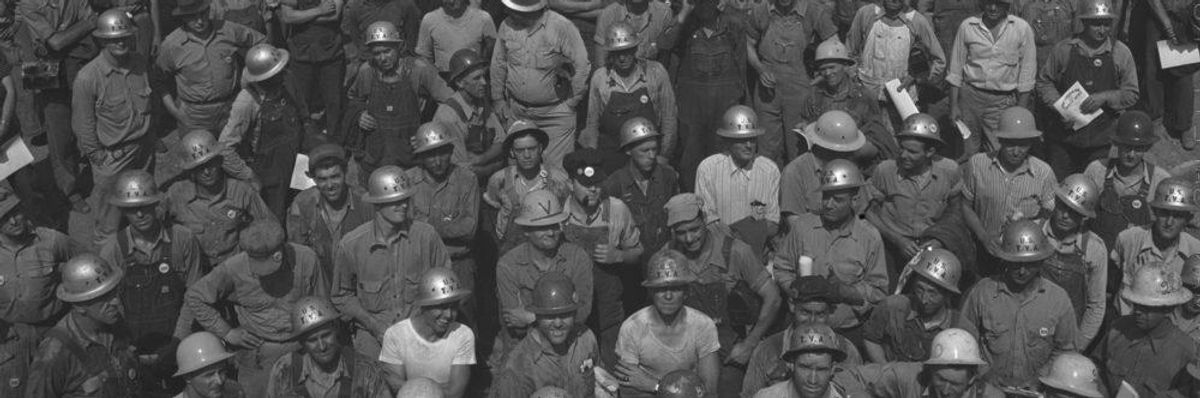
Construction workers employed by the Tennessee Valley Authority, 1942. (Photo: Shutterstock)
From single-payer health care to climate change, the 2020 Democrats have ambitious plans. But these new, grand, and green deals aren't as radical as some make them sound. In fact, big public projects are what made America great.
When President Dwight "Ike" Eisenhower took office in 1953, America had been buffeted by the Great Depression of the 1930s and World War II in the 1940s. The Cold War put us in competition with Soviet "5-Year Plans" and Chinese "Great Leaps Forward."
Eisenhower was concerned that soldiers would return home to closing factories. So Ike pushed for massive infrastructure spending, creating the "Dwight D. Eisenhower System of Interstate and Defense Highways."
Congress funded a half-century of highway construction, building 47,000 miles--the biggest public works project in the history of the world. It cost $500 billion in today's dollars, with 90 percent coming from Washington and 10 percent from the states.
The interstate highways transformed America.
In 1919, it took a month or more to drive cross-country; the record today is a little over 24 hours. Automobile ownership skyrocketed, gas sales jumped, motels mushroomed, the suburbs flourished, and malls were built. Construction companies, automakers, and oil companies flourished, too, along with their workers.
There was a downside, of course. Rail and mass transit were marginalized, urban sprawl spread across the land, the daily commute grew longer, and our carbon footprint grew bigger, as multi-lane highways destroyed urban communities.
Still, it puts lie to the chant that "the U.S. has never been a socialist country!" After all, we drive on socialist, government-owned roads.
Meanwhile there's almost universal support for Social Security, our government insurance. And half the country--including Medicare and Medicaid recipients, veterans, and federal elected officials -- receives some form of socialist, government-funded health care.
Consider also the Tennessee Valley Authority, a federally owned corporation created by Congress in 1933. Tennessee and five nearby states were devastated by poverty, hunger, and ill health. Only 1 percent of farm families had indoor plumbing, and about a third of the population in the valley had malaria.
Starting in 1933, our taxes paid to build TVA power plants, flood control, and river navigation systems. In 1942 alone, the construction of 12 hydroelectric and one coal steam plant employed a total of 28,000 workers.
Today the TVA is a federally-owned corporation with assets worth over $34 trillion, according to the SEC. And while Republican Senate Majority Leader Mitch McConnell rails against socialism, half of his constituents in Kentucky buy cheap, publicly produced TVA electricity. Free-market, for-profit, capitalist power states often pay twice as much.
Like our highway system, we need to change our TVA to meet the challenges of climate change. But that means better priorities and more investment, not less.
Federal taxes paid for the highways and the TVA, which are now supported by gas taxes and electric bills. In those years of great public works projects, the wealthy elite paid a much greater share of their income in taxes, with the highest marginal tax rate reaching 94 percent.
Claiming that government is the problem, not the solution, administrations since the 1970s have reduced that top rate over and over. The 2017 tax law again reduced the top rate for billionaires, creating great fortunes for a few, and great national debt, but not great public works.
Let's get past the S-word--socialism--and have a real discussion on how to build an America that's great for all of us.
Dear Common Dreams reader, It’s been nearly 30 years since I co-founded Common Dreams with my late wife, Lina Newhouser. We had the radical notion that journalism should serve the public good, not corporate profits. It was clear to us from the outset what it would take to build such a project. No paid advertisements. No corporate sponsors. No millionaire publisher telling us what to think or do. Many people said we wouldn't last a year, but we proved those doubters wrong. Together with a tremendous team of journalists and dedicated staff, we built an independent media outlet free from the constraints of profits and corporate control. Our mission has always been simple: To inform. To inspire. To ignite change for the common good. Building Common Dreams was not easy. Our survival was never guaranteed. When you take on the most powerful forces—Wall Street greed, fossil fuel industry destruction, Big Tech lobbyists, and uber-rich oligarchs who have spent billions upon billions rigging the economy and democracy in their favor—the only bulwark you have is supporters who believe in your work. But here’s the urgent message from me today. It's never been this bad out there. And it's never been this hard to keep us going. At the very moment Common Dreams is most needed, the threats we face are intensifying. We need your support now more than ever. We don't accept corporate advertising and never will. We don't have a paywall because we don't think people should be blocked from critical news based on their ability to pay. Everything we do is funded by the donations of readers like you. When everyone does the little they can afford, we are strong. But if that support retreats or dries up, so do we. Will you donate now to make sure Common Dreams not only survives but thrives? —Craig Brown, Co-founder |
From single-payer health care to climate change, the 2020 Democrats have ambitious plans. But these new, grand, and green deals aren't as radical as some make them sound. In fact, big public projects are what made America great.
When President Dwight "Ike" Eisenhower took office in 1953, America had been buffeted by the Great Depression of the 1930s and World War II in the 1940s. The Cold War put us in competition with Soviet "5-Year Plans" and Chinese "Great Leaps Forward."
Eisenhower was concerned that soldiers would return home to closing factories. So Ike pushed for massive infrastructure spending, creating the "Dwight D. Eisenhower System of Interstate and Defense Highways."
Congress funded a half-century of highway construction, building 47,000 miles--the biggest public works project in the history of the world. It cost $500 billion in today's dollars, with 90 percent coming from Washington and 10 percent from the states.
The interstate highways transformed America.
In 1919, it took a month or more to drive cross-country; the record today is a little over 24 hours. Automobile ownership skyrocketed, gas sales jumped, motels mushroomed, the suburbs flourished, and malls were built. Construction companies, automakers, and oil companies flourished, too, along with their workers.
There was a downside, of course. Rail and mass transit were marginalized, urban sprawl spread across the land, the daily commute grew longer, and our carbon footprint grew bigger, as multi-lane highways destroyed urban communities.
Still, it puts lie to the chant that "the U.S. has never been a socialist country!" After all, we drive on socialist, government-owned roads.
Meanwhile there's almost universal support for Social Security, our government insurance. And half the country--including Medicare and Medicaid recipients, veterans, and federal elected officials -- receives some form of socialist, government-funded health care.
Consider also the Tennessee Valley Authority, a federally owned corporation created by Congress in 1933. Tennessee and five nearby states were devastated by poverty, hunger, and ill health. Only 1 percent of farm families had indoor plumbing, and about a third of the population in the valley had malaria.
Starting in 1933, our taxes paid to build TVA power plants, flood control, and river navigation systems. In 1942 alone, the construction of 12 hydroelectric and one coal steam plant employed a total of 28,000 workers.
Today the TVA is a federally-owned corporation with assets worth over $34 trillion, according to the SEC. And while Republican Senate Majority Leader Mitch McConnell rails against socialism, half of his constituents in Kentucky buy cheap, publicly produced TVA electricity. Free-market, for-profit, capitalist power states often pay twice as much.
Like our highway system, we need to change our TVA to meet the challenges of climate change. But that means better priorities and more investment, not less.
Federal taxes paid for the highways and the TVA, which are now supported by gas taxes and electric bills. In those years of great public works projects, the wealthy elite paid a much greater share of their income in taxes, with the highest marginal tax rate reaching 94 percent.
Claiming that government is the problem, not the solution, administrations since the 1970s have reduced that top rate over and over. The 2017 tax law again reduced the top rate for billionaires, creating great fortunes for a few, and great national debt, but not great public works.
Let's get past the S-word--socialism--and have a real discussion on how to build an America that's great for all of us.
From single-payer health care to climate change, the 2020 Democrats have ambitious plans. But these new, grand, and green deals aren't as radical as some make them sound. In fact, big public projects are what made America great.
When President Dwight "Ike" Eisenhower took office in 1953, America had been buffeted by the Great Depression of the 1930s and World War II in the 1940s. The Cold War put us in competition with Soviet "5-Year Plans" and Chinese "Great Leaps Forward."
Eisenhower was concerned that soldiers would return home to closing factories. So Ike pushed for massive infrastructure spending, creating the "Dwight D. Eisenhower System of Interstate and Defense Highways."
Congress funded a half-century of highway construction, building 47,000 miles--the biggest public works project in the history of the world. It cost $500 billion in today's dollars, with 90 percent coming from Washington and 10 percent from the states.
The interstate highways transformed America.
In 1919, it took a month or more to drive cross-country; the record today is a little over 24 hours. Automobile ownership skyrocketed, gas sales jumped, motels mushroomed, the suburbs flourished, and malls were built. Construction companies, automakers, and oil companies flourished, too, along with their workers.
There was a downside, of course. Rail and mass transit were marginalized, urban sprawl spread across the land, the daily commute grew longer, and our carbon footprint grew bigger, as multi-lane highways destroyed urban communities.
Still, it puts lie to the chant that "the U.S. has never been a socialist country!" After all, we drive on socialist, government-owned roads.
Meanwhile there's almost universal support for Social Security, our government insurance. And half the country--including Medicare and Medicaid recipients, veterans, and federal elected officials -- receives some form of socialist, government-funded health care.
Consider also the Tennessee Valley Authority, a federally owned corporation created by Congress in 1933. Tennessee and five nearby states were devastated by poverty, hunger, and ill health. Only 1 percent of farm families had indoor plumbing, and about a third of the population in the valley had malaria.
Starting in 1933, our taxes paid to build TVA power plants, flood control, and river navigation systems. In 1942 alone, the construction of 12 hydroelectric and one coal steam plant employed a total of 28,000 workers.
Today the TVA is a federally-owned corporation with assets worth over $34 trillion, according to the SEC. And while Republican Senate Majority Leader Mitch McConnell rails against socialism, half of his constituents in Kentucky buy cheap, publicly produced TVA electricity. Free-market, for-profit, capitalist power states often pay twice as much.
Like our highway system, we need to change our TVA to meet the challenges of climate change. But that means better priorities and more investment, not less.
Federal taxes paid for the highways and the TVA, which are now supported by gas taxes and electric bills. In those years of great public works projects, the wealthy elite paid a much greater share of their income in taxes, with the highest marginal tax rate reaching 94 percent.
Claiming that government is the problem, not the solution, administrations since the 1970s have reduced that top rate over and over. The 2017 tax law again reduced the top rate for billionaires, creating great fortunes for a few, and great national debt, but not great public works.
Let's get past the S-word--socialism--and have a real discussion on how to build an America that's great for all of us.