SUBSCRIBE TO OUR FREE NEWSLETTER
Daily news & progressive opinion—funded by the people, not the corporations—delivered straight to your inbox.
5
#000000
#FFFFFF
To donate by check, phone, or other method, see our More Ways to Give page.
Daily news & progressive opinion—funded by the people, not the corporations—delivered straight to your inbox.
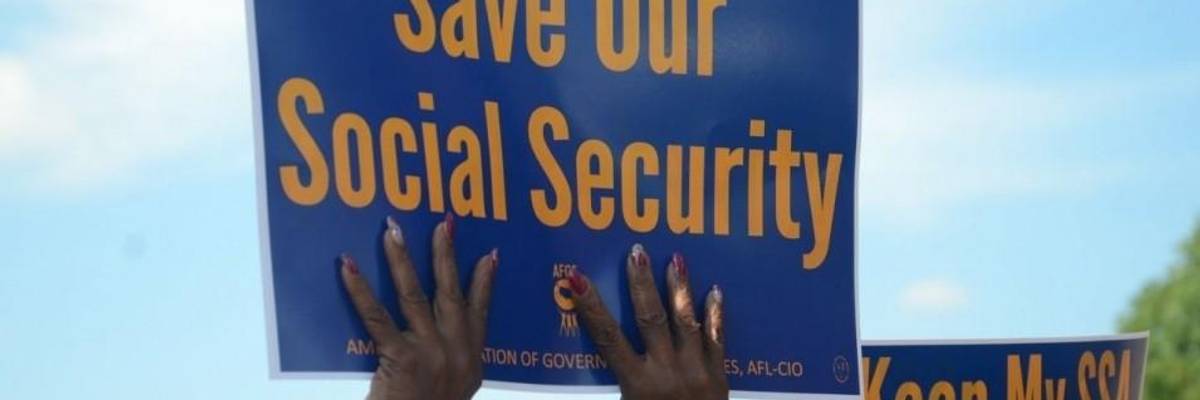
Congress should address our nation's looming retirement income crisis by increasing Social Security's modest benefits. (Photo: Courtesy of AFGE, Flickr | CC 2.0)
Senator Joni Ernst (R-IA) just said out loud what Republican politicians usually only talk about in secret meetings with their billionaire donors: The GOP wants to cut our earned Social Security benefits--and they want to do it behind closed doors so that they don't have to pay the political price.
At a recent town hall, Ernst stated that Congress needs to "sit down behind closed doors" to "address Social Security." She vaguely asserted, "A lot of changes need to be made in this system going forward." But, she complained, if these changes were proposed in public, she would be accused of pushing "granny over a cliff." It is not hard to figure out what "changes" she has in mind.
There are many "changes" that should be made to strengthen Social Security and make it even better than it already is. But none of those have to be done secretly.
Congress should address our nation's looming retirement income crisis by increasing Social Security's modest benefits. Congress should combat rising income and wealth inequality, by requiring the wealthiest Americans to contribute to Social Security at the same rate as the rest of us.
Congress should enact caregiver credits for those who perform essential but unpaid labor caring for their children, aged parents, and other family members. Those crucial caregivers should receive credit toward future Social Security benefits so they don't retire into poverty.
In addition, Congress should update the way that Social Security's benefits are adjusted so that they reflect the high health care and prescription drug costs that beneficiaries experience. The annual cost of living adjustment is intended to keep benefits from eroding, to allow beneficiaries to tread water. But without updating the measure of inflation, those benefits are losing value each year.
Those are just some of the improvements that Congress should make. But those are not the "changes" Ernst has in mind, because none of those changes need to be done behind closed doors. Numerous pieces of legislation proposing those changes have been introduced in Congress--though none by Senator Ernst or her Republican colleagues.
Indeed, 210 House Democrats have co-sponsored the Social Security 2100 Act, which expands Social Security's modest benefits, while ensuring that all benefits can be paid in full and on time through the year 2100 and beyond. Every Democratic presidential candidate opposes cutting Social Security benefits, and nearly all support expanding them. Meanwhile, neither Donald Trump nor a single Republican member of Congress is sponsoring or cosponsoring any legislation that increases benefits or even ensures that they can be paid in full and on time beyond 2035.
No action is the same as supporting cuts. As Representative John Larson (D-CT), chairman of the House's Social Security Subcommittee and the author of the Social Security 2100 Act, has explained, "The hard truth of the matter is that Republicans want to cut Social Security, and doing nothing achieves their goal."
Larson and his Democratic colleagues are calling Republicans' bluff. Under Democratic control, Congress has held numerous hearings on Social Security and the importance of protecting and expanding it. Larson and his Democratic colleagues are planning to have a recorded, public vote on the Social Security 2100 Act this fall.
The legislation has enough votes to pass the House of Representatives. But don't expect Majority Leader Mitch McConnell (R-KY) to bring it to a vote in the Senate. And don't expect Senator Ernst or her other Republican colleagues to urge him to do so.
With respect to Social Security, just as with the issue of legislating background checks and other overwhelmingly popular commonsense legislation to reduce the epidemic of gun violence, Republican politicians will not say what they are for. In the case of gun legislation, they block action. In the case of Social Security, they block action unless Democrats agree to go behind closed doors so the public doesn't know who pushed the cuts.
We should not let Republican politicians get by with platitudes about "saving" and "fixing" Social Security. And we certainly shouldn't let them hide behind closed doors and undermine our Social Security.
As polarized as the American people are over many issues, we are not polarized about Social Security. Republicans, Democrats and Independents, of all ages, races and genders, overwhelmingly agree. We understand that Social Security is more important than ever. We overwhelmingly reject any cuts to its modest benefits.
The only group that disagrees is Republican Party donors. As an ideological matter, they hate Social Security because it puts the lie to their assertions that government can't work. They do not want to pay their fair share. Indeed, they would love to get their hands on the money now flowing to Social Security.
When President George W. Bush proposed destroying Social Security by privatizing it, the American people overwhelmingly rejected his plan. But Republican politicians learned the wrong lesson. As unpopular as Bush's proposal was, he was at least willing to advocate for it publicly. Rather than recognize the proposal was the problem, Ernst and her fellow Republicans think the problem was being honest with the American people.
Like Bush, they want to enact a Social Security proposal that is deeply unpopular. But unlike Bush, they want to enact it in the dark of night. Fortunately, their Democratic colleagues won't let them get away with that undemocratic act. Nor should the American people.
All of us who have a stake in Social Security--which is every one of us--should insist that those seeking our vote tell us if they support expanding or cutting Social Security. If they refuse to tell us, if they ramble on about their desire to "save" or "fix" or "strengthen" Social Security in secret, we should draw the obvious inference: They want to cut Social Security. We should use the election to ensure they do not have the power to do that--and certainly not behind closed doors.
This article was produced by Economy for All, a project of the Independent Media Institute.
Dear Common Dreams reader, It’s been nearly 30 years since I co-founded Common Dreams with my late wife, Lina Newhouser. We had the radical notion that journalism should serve the public good, not corporate profits. It was clear to us from the outset what it would take to build such a project. No paid advertisements. No corporate sponsors. No millionaire publisher telling us what to think or do. Many people said we wouldn't last a year, but we proved those doubters wrong. Together with a tremendous team of journalists and dedicated staff, we built an independent media outlet free from the constraints of profits and corporate control. Our mission has always been simple: To inform. To inspire. To ignite change for the common good. Building Common Dreams was not easy. Our survival was never guaranteed. When you take on the most powerful forces—Wall Street greed, fossil fuel industry destruction, Big Tech lobbyists, and uber-rich oligarchs who have spent billions upon billions rigging the economy and democracy in their favor—the only bulwark you have is supporters who believe in your work. But here’s the urgent message from me today. It's never been this bad out there. And it's never been this hard to keep us going. At the very moment Common Dreams is most needed, the threats we face are intensifying. We need your support now more than ever. We don't accept corporate advertising and never will. We don't have a paywall because we don't think people should be blocked from critical news based on their ability to pay. Everything we do is funded by the donations of readers like you. When everyone does the little they can afford, we are strong. But if that support retreats or dries up, so do we. Will you donate now to make sure Common Dreams not only survives but thrives? —Craig Brown, Co-founder |
Nancy Altman is president of Social Security Works and chair of the Strengthen Social Security Coalition. She is co-author of two books and author of three, including her most recent, The Road to Medicare for All: A Call to Action.
Senator Joni Ernst (R-IA) just said out loud what Republican politicians usually only talk about in secret meetings with their billionaire donors: The GOP wants to cut our earned Social Security benefits--and they want to do it behind closed doors so that they don't have to pay the political price.
At a recent town hall, Ernst stated that Congress needs to "sit down behind closed doors" to "address Social Security." She vaguely asserted, "A lot of changes need to be made in this system going forward." But, she complained, if these changes were proposed in public, she would be accused of pushing "granny over a cliff." It is not hard to figure out what "changes" she has in mind.
There are many "changes" that should be made to strengthen Social Security and make it even better than it already is. But none of those have to be done secretly.
Congress should address our nation's looming retirement income crisis by increasing Social Security's modest benefits. Congress should combat rising income and wealth inequality, by requiring the wealthiest Americans to contribute to Social Security at the same rate as the rest of us.
Congress should enact caregiver credits for those who perform essential but unpaid labor caring for their children, aged parents, and other family members. Those crucial caregivers should receive credit toward future Social Security benefits so they don't retire into poverty.
In addition, Congress should update the way that Social Security's benefits are adjusted so that they reflect the high health care and prescription drug costs that beneficiaries experience. The annual cost of living adjustment is intended to keep benefits from eroding, to allow beneficiaries to tread water. But without updating the measure of inflation, those benefits are losing value each year.
Those are just some of the improvements that Congress should make. But those are not the "changes" Ernst has in mind, because none of those changes need to be done behind closed doors. Numerous pieces of legislation proposing those changes have been introduced in Congress--though none by Senator Ernst or her Republican colleagues.
Indeed, 210 House Democrats have co-sponsored the Social Security 2100 Act, which expands Social Security's modest benefits, while ensuring that all benefits can be paid in full and on time through the year 2100 and beyond. Every Democratic presidential candidate opposes cutting Social Security benefits, and nearly all support expanding them. Meanwhile, neither Donald Trump nor a single Republican member of Congress is sponsoring or cosponsoring any legislation that increases benefits or even ensures that they can be paid in full and on time beyond 2035.
No action is the same as supporting cuts. As Representative John Larson (D-CT), chairman of the House's Social Security Subcommittee and the author of the Social Security 2100 Act, has explained, "The hard truth of the matter is that Republicans want to cut Social Security, and doing nothing achieves their goal."
Larson and his Democratic colleagues are calling Republicans' bluff. Under Democratic control, Congress has held numerous hearings on Social Security and the importance of protecting and expanding it. Larson and his Democratic colleagues are planning to have a recorded, public vote on the Social Security 2100 Act this fall.
The legislation has enough votes to pass the House of Representatives. But don't expect Majority Leader Mitch McConnell (R-KY) to bring it to a vote in the Senate. And don't expect Senator Ernst or her other Republican colleagues to urge him to do so.
With respect to Social Security, just as with the issue of legislating background checks and other overwhelmingly popular commonsense legislation to reduce the epidemic of gun violence, Republican politicians will not say what they are for. In the case of gun legislation, they block action. In the case of Social Security, they block action unless Democrats agree to go behind closed doors so the public doesn't know who pushed the cuts.
We should not let Republican politicians get by with platitudes about "saving" and "fixing" Social Security. And we certainly shouldn't let them hide behind closed doors and undermine our Social Security.
As polarized as the American people are over many issues, we are not polarized about Social Security. Republicans, Democrats and Independents, of all ages, races and genders, overwhelmingly agree. We understand that Social Security is more important than ever. We overwhelmingly reject any cuts to its modest benefits.
The only group that disagrees is Republican Party donors. As an ideological matter, they hate Social Security because it puts the lie to their assertions that government can't work. They do not want to pay their fair share. Indeed, they would love to get their hands on the money now flowing to Social Security.
When President George W. Bush proposed destroying Social Security by privatizing it, the American people overwhelmingly rejected his plan. But Republican politicians learned the wrong lesson. As unpopular as Bush's proposal was, he was at least willing to advocate for it publicly. Rather than recognize the proposal was the problem, Ernst and her fellow Republicans think the problem was being honest with the American people.
Like Bush, they want to enact a Social Security proposal that is deeply unpopular. But unlike Bush, they want to enact it in the dark of night. Fortunately, their Democratic colleagues won't let them get away with that undemocratic act. Nor should the American people.
All of us who have a stake in Social Security--which is every one of us--should insist that those seeking our vote tell us if they support expanding or cutting Social Security. If they refuse to tell us, if they ramble on about their desire to "save" or "fix" or "strengthen" Social Security in secret, we should draw the obvious inference: They want to cut Social Security. We should use the election to ensure they do not have the power to do that--and certainly not behind closed doors.
This article was produced by Economy for All, a project of the Independent Media Institute.
Nancy Altman is president of Social Security Works and chair of the Strengthen Social Security Coalition. She is co-author of two books and author of three, including her most recent, The Road to Medicare for All: A Call to Action.
Senator Joni Ernst (R-IA) just said out loud what Republican politicians usually only talk about in secret meetings with their billionaire donors: The GOP wants to cut our earned Social Security benefits--and they want to do it behind closed doors so that they don't have to pay the political price.
At a recent town hall, Ernst stated that Congress needs to "sit down behind closed doors" to "address Social Security." She vaguely asserted, "A lot of changes need to be made in this system going forward." But, she complained, if these changes were proposed in public, she would be accused of pushing "granny over a cliff." It is not hard to figure out what "changes" she has in mind.
There are many "changes" that should be made to strengthen Social Security and make it even better than it already is. But none of those have to be done secretly.
Congress should address our nation's looming retirement income crisis by increasing Social Security's modest benefits. Congress should combat rising income and wealth inequality, by requiring the wealthiest Americans to contribute to Social Security at the same rate as the rest of us.
Congress should enact caregiver credits for those who perform essential but unpaid labor caring for their children, aged parents, and other family members. Those crucial caregivers should receive credit toward future Social Security benefits so they don't retire into poverty.
In addition, Congress should update the way that Social Security's benefits are adjusted so that they reflect the high health care and prescription drug costs that beneficiaries experience. The annual cost of living adjustment is intended to keep benefits from eroding, to allow beneficiaries to tread water. But without updating the measure of inflation, those benefits are losing value each year.
Those are just some of the improvements that Congress should make. But those are not the "changes" Ernst has in mind, because none of those changes need to be done behind closed doors. Numerous pieces of legislation proposing those changes have been introduced in Congress--though none by Senator Ernst or her Republican colleagues.
Indeed, 210 House Democrats have co-sponsored the Social Security 2100 Act, which expands Social Security's modest benefits, while ensuring that all benefits can be paid in full and on time through the year 2100 and beyond. Every Democratic presidential candidate opposes cutting Social Security benefits, and nearly all support expanding them. Meanwhile, neither Donald Trump nor a single Republican member of Congress is sponsoring or cosponsoring any legislation that increases benefits or even ensures that they can be paid in full and on time beyond 2035.
No action is the same as supporting cuts. As Representative John Larson (D-CT), chairman of the House's Social Security Subcommittee and the author of the Social Security 2100 Act, has explained, "The hard truth of the matter is that Republicans want to cut Social Security, and doing nothing achieves their goal."
Larson and his Democratic colleagues are calling Republicans' bluff. Under Democratic control, Congress has held numerous hearings on Social Security and the importance of protecting and expanding it. Larson and his Democratic colleagues are planning to have a recorded, public vote on the Social Security 2100 Act this fall.
The legislation has enough votes to pass the House of Representatives. But don't expect Majority Leader Mitch McConnell (R-KY) to bring it to a vote in the Senate. And don't expect Senator Ernst or her other Republican colleagues to urge him to do so.
With respect to Social Security, just as with the issue of legislating background checks and other overwhelmingly popular commonsense legislation to reduce the epidemic of gun violence, Republican politicians will not say what they are for. In the case of gun legislation, they block action. In the case of Social Security, they block action unless Democrats agree to go behind closed doors so the public doesn't know who pushed the cuts.
We should not let Republican politicians get by with platitudes about "saving" and "fixing" Social Security. And we certainly shouldn't let them hide behind closed doors and undermine our Social Security.
As polarized as the American people are over many issues, we are not polarized about Social Security. Republicans, Democrats and Independents, of all ages, races and genders, overwhelmingly agree. We understand that Social Security is more important than ever. We overwhelmingly reject any cuts to its modest benefits.
The only group that disagrees is Republican Party donors. As an ideological matter, they hate Social Security because it puts the lie to their assertions that government can't work. They do not want to pay their fair share. Indeed, they would love to get their hands on the money now flowing to Social Security.
When President George W. Bush proposed destroying Social Security by privatizing it, the American people overwhelmingly rejected his plan. But Republican politicians learned the wrong lesson. As unpopular as Bush's proposal was, he was at least willing to advocate for it publicly. Rather than recognize the proposal was the problem, Ernst and her fellow Republicans think the problem was being honest with the American people.
Like Bush, they want to enact a Social Security proposal that is deeply unpopular. But unlike Bush, they want to enact it in the dark of night. Fortunately, their Democratic colleagues won't let them get away with that undemocratic act. Nor should the American people.
All of us who have a stake in Social Security--which is every one of us--should insist that those seeking our vote tell us if they support expanding or cutting Social Security. If they refuse to tell us, if they ramble on about their desire to "save" or "fix" or "strengthen" Social Security in secret, we should draw the obvious inference: They want to cut Social Security. We should use the election to ensure they do not have the power to do that--and certainly not behind closed doors.
This article was produced by Economy for All, a project of the Independent Media Institute.