SUBSCRIBE TO OUR FREE NEWSLETTER
Daily news & progressive opinion—funded by the people, not the corporations—delivered straight to your inbox.
5
#000000
#FFFFFF
To donate by check, phone, or other method, see our More Ways to Give page.
Daily news & progressive opinion—funded by the people, not the corporations—delivered straight to your inbox.
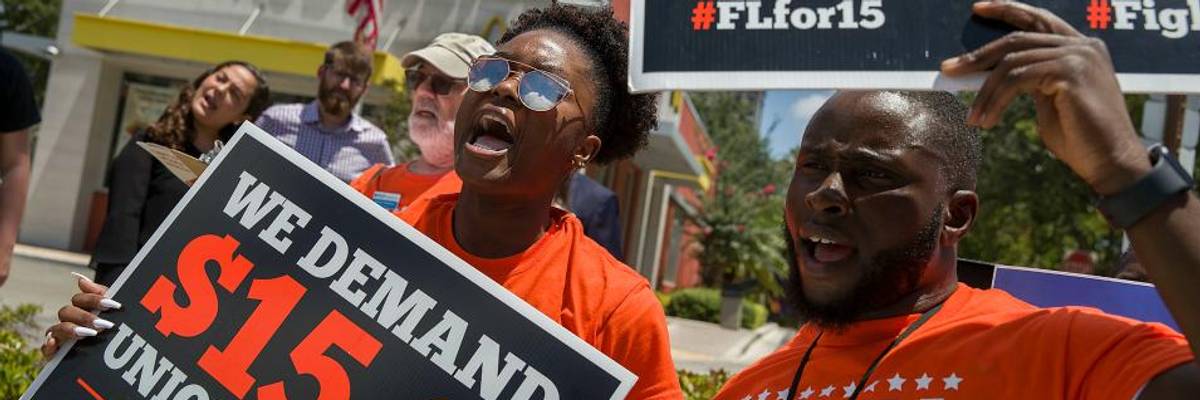
People gather together to ask the McDonald's corporation to raise workers wages to a $15 minimum wage as well as demanding the right to a union on May 23, 2019 in Fort Lauderdale, Florida. The nation wide protest at McDonald's was held on the day of the company's shareholder meeting. (Photo: Joe Raedle/Getty Images)
On Monday afternoon, Congressional Budget Office (CBO) released a report assessing the economic impact of raising the minimum wage to $15 in 2025 in six steps (this is a similar policy to the Raise the Wage Act, which would increase the minimum wage to $15 in 2024). The key fact coming out of the report is that CBO finds that the benefits to low wage workers of a $15 minimum wage far exceed the costs. The report finds that a $15 minimum wage would increase the wages of millions of low wage workers, increase the average incomes of low and lower-middle-income families, reduce poverty, shift money from corporate profits to the wages of low-wage workers, and reduce inequality.
In particular, CBO finds that $15 in 2025 could raise the wages of 27.3 million low-wage workers, would increase the income of families who earn below three times the poverty rate by $21.9 billion, and would reduce the number of people living in poverty by 1.3 million, nearly half of them age 0-18. CBO finds that the overwhelming share of low-wage workers would benefit from a $15 minimum wage and that as a group, low-wage workers would be unambiguously better off.
While CBO's bottom line is that the benefits to low-wage workers of a $15 minimum wage would outweigh the costs, CBO nevertheless substantially overstates the costs. CBO finds that the policy would lead to a decline in employment of 1.3 million--though in choosing the parameters that resulted in that conclusion it failed to appropriately weight the highest quality studies in the vast academic literature on this issue. As a result, policymakers must be skeptical of their assessment of the employment impact, given that other careful reviews of the minimum wage literature have shown that the average study finds small-to-no employment effects of minimum wage increases.
It is not a stretch to say that a new consensus has emerged among economists that minimum wage increases have raised wages without substantial job loss (even the Cato institute acknowledges this "new conventional wisdom"). More and more, economists are recognizing that simple, dated models of the economy that always predict job loss when the minimum wage is increased are based on assumptions that have little bearing on the low-wage labor market (like the genuinely laughable assumption that in the absence of a meaningful minimum wage, low-wage employers still have no power to set wages below the full value of their workers' "worth" to the firm). Well over 100 mainstream economists signed on to this letter in support of increasing the min wage to $15 in 2024. CBO's assessment of the literature has simply not yet caught up.
Finally, CBO egregiously relegates to an appendix any discussion of what an employment decline as a result of a $15 minimum wage would really mean on the ground. The crucial fact is that an employment decline as a result of a minimum wage increase doesn't necessarily mean any worker is actually worse off. For a wide variety of reasons, a sizeable share of low-wage workers routinely cycle in an out of employment; each quarter, more than 20 percent of the lowest-wage workers leave or start job. This means that even if employment does decline as CBO predicts, workers who work less can still come out ahead because they earn much more when they are working. Consider the case of someone who now works a full-time job at $7.25 an hour for ten months a year, but can only find work for eight months when the minimum wage is increased to $15. This worker experiences a strong negative employment impact of the minimum wage increase, but actually has substantially higher annual earnings. In other words, if you take CBO's employment estimate at face value, it is important to keep in mind that the top-line number vastly overstates any adverse impact on the living standards of the low wage workers who experience the negative employment effects.
It has been more than 10 years since congress raised the minimum wage--the longest stretch in history. This is a shameful benchmark, reducing the living standards of working families in this country and exacerbating poverty and inequality. Congress should immediately pass the Raise the Wage Act and give this country's lowest wage workers a raise.
Dear Common Dreams reader, It’s been nearly 30 years since I co-founded Common Dreams with my late wife, Lina Newhouser. We had the radical notion that journalism should serve the public good, not corporate profits. It was clear to us from the outset what it would take to build such a project. No paid advertisements. No corporate sponsors. No millionaire publisher telling us what to think or do. Many people said we wouldn't last a year, but we proved those doubters wrong. Together with a tremendous team of journalists and dedicated staff, we built an independent media outlet free from the constraints of profits and corporate control. Our mission has always been simple: To inform. To inspire. To ignite change for the common good. Building Common Dreams was not easy. Our survival was never guaranteed. When you take on the most powerful forces—Wall Street greed, fossil fuel industry destruction, Big Tech lobbyists, and uber-rich oligarchs who have spent billions upon billions rigging the economy and democracy in their favor—the only bulwark you have is supporters who believe in your work. But here’s the urgent message from me today. It's never been this bad out there. And it's never been this hard to keep us going. At the very moment Common Dreams is most needed, the threats we face are intensifying. We need your support now more than ever. We don't accept corporate advertising and never will. We don't have a paywall because we don't think people should be blocked from critical news based on their ability to pay. Everything we do is funded by the donations of readers like you. When everyone does the little they can afford, we are strong. But if that support retreats or dries up, so do we. Will you donate now to make sure Common Dreams not only survives but thrives? —Craig Brown, Co-founder |
On Monday afternoon, Congressional Budget Office (CBO) released a report assessing the economic impact of raising the minimum wage to $15 in 2025 in six steps (this is a similar policy to the Raise the Wage Act, which would increase the minimum wage to $15 in 2024). The key fact coming out of the report is that CBO finds that the benefits to low wage workers of a $15 minimum wage far exceed the costs. The report finds that a $15 minimum wage would increase the wages of millions of low wage workers, increase the average incomes of low and lower-middle-income families, reduce poverty, shift money from corporate profits to the wages of low-wage workers, and reduce inequality.
In particular, CBO finds that $15 in 2025 could raise the wages of 27.3 million low-wage workers, would increase the income of families who earn below three times the poverty rate by $21.9 billion, and would reduce the number of people living in poverty by 1.3 million, nearly half of them age 0-18. CBO finds that the overwhelming share of low-wage workers would benefit from a $15 minimum wage and that as a group, low-wage workers would be unambiguously better off.
While CBO's bottom line is that the benefits to low-wage workers of a $15 minimum wage would outweigh the costs, CBO nevertheless substantially overstates the costs. CBO finds that the policy would lead to a decline in employment of 1.3 million--though in choosing the parameters that resulted in that conclusion it failed to appropriately weight the highest quality studies in the vast academic literature on this issue. As a result, policymakers must be skeptical of their assessment of the employment impact, given that other careful reviews of the minimum wage literature have shown that the average study finds small-to-no employment effects of minimum wage increases.
It is not a stretch to say that a new consensus has emerged among economists that minimum wage increases have raised wages without substantial job loss (even the Cato institute acknowledges this "new conventional wisdom"). More and more, economists are recognizing that simple, dated models of the economy that always predict job loss when the minimum wage is increased are based on assumptions that have little bearing on the low-wage labor market (like the genuinely laughable assumption that in the absence of a meaningful minimum wage, low-wage employers still have no power to set wages below the full value of their workers' "worth" to the firm). Well over 100 mainstream economists signed on to this letter in support of increasing the min wage to $15 in 2024. CBO's assessment of the literature has simply not yet caught up.
Finally, CBO egregiously relegates to an appendix any discussion of what an employment decline as a result of a $15 minimum wage would really mean on the ground. The crucial fact is that an employment decline as a result of a minimum wage increase doesn't necessarily mean any worker is actually worse off. For a wide variety of reasons, a sizeable share of low-wage workers routinely cycle in an out of employment; each quarter, more than 20 percent of the lowest-wage workers leave or start job. This means that even if employment does decline as CBO predicts, workers who work less can still come out ahead because they earn much more when they are working. Consider the case of someone who now works a full-time job at $7.25 an hour for ten months a year, but can only find work for eight months when the minimum wage is increased to $15. This worker experiences a strong negative employment impact of the minimum wage increase, but actually has substantially higher annual earnings. In other words, if you take CBO's employment estimate at face value, it is important to keep in mind that the top-line number vastly overstates any adverse impact on the living standards of the low wage workers who experience the negative employment effects.
It has been more than 10 years since congress raised the minimum wage--the longest stretch in history. This is a shameful benchmark, reducing the living standards of working families in this country and exacerbating poverty and inequality. Congress should immediately pass the Raise the Wage Act and give this country's lowest wage workers a raise.
On Monday afternoon, Congressional Budget Office (CBO) released a report assessing the economic impact of raising the minimum wage to $15 in 2025 in six steps (this is a similar policy to the Raise the Wage Act, which would increase the minimum wage to $15 in 2024). The key fact coming out of the report is that CBO finds that the benefits to low wage workers of a $15 minimum wage far exceed the costs. The report finds that a $15 minimum wage would increase the wages of millions of low wage workers, increase the average incomes of low and lower-middle-income families, reduce poverty, shift money from corporate profits to the wages of low-wage workers, and reduce inequality.
In particular, CBO finds that $15 in 2025 could raise the wages of 27.3 million low-wage workers, would increase the income of families who earn below three times the poverty rate by $21.9 billion, and would reduce the number of people living in poverty by 1.3 million, nearly half of them age 0-18. CBO finds that the overwhelming share of low-wage workers would benefit from a $15 minimum wage and that as a group, low-wage workers would be unambiguously better off.
While CBO's bottom line is that the benefits to low-wage workers of a $15 minimum wage would outweigh the costs, CBO nevertheless substantially overstates the costs. CBO finds that the policy would lead to a decline in employment of 1.3 million--though in choosing the parameters that resulted in that conclusion it failed to appropriately weight the highest quality studies in the vast academic literature on this issue. As a result, policymakers must be skeptical of their assessment of the employment impact, given that other careful reviews of the minimum wage literature have shown that the average study finds small-to-no employment effects of minimum wage increases.
It is not a stretch to say that a new consensus has emerged among economists that minimum wage increases have raised wages without substantial job loss (even the Cato institute acknowledges this "new conventional wisdom"). More and more, economists are recognizing that simple, dated models of the economy that always predict job loss when the minimum wage is increased are based on assumptions that have little bearing on the low-wage labor market (like the genuinely laughable assumption that in the absence of a meaningful minimum wage, low-wage employers still have no power to set wages below the full value of their workers' "worth" to the firm). Well over 100 mainstream economists signed on to this letter in support of increasing the min wage to $15 in 2024. CBO's assessment of the literature has simply not yet caught up.
Finally, CBO egregiously relegates to an appendix any discussion of what an employment decline as a result of a $15 minimum wage would really mean on the ground. The crucial fact is that an employment decline as a result of a minimum wage increase doesn't necessarily mean any worker is actually worse off. For a wide variety of reasons, a sizeable share of low-wage workers routinely cycle in an out of employment; each quarter, more than 20 percent of the lowest-wage workers leave or start job. This means that even if employment does decline as CBO predicts, workers who work less can still come out ahead because they earn much more when they are working. Consider the case of someone who now works a full-time job at $7.25 an hour for ten months a year, but can only find work for eight months when the minimum wage is increased to $15. This worker experiences a strong negative employment impact of the minimum wage increase, but actually has substantially higher annual earnings. In other words, if you take CBO's employment estimate at face value, it is important to keep in mind that the top-line number vastly overstates any adverse impact on the living standards of the low wage workers who experience the negative employment effects.
It has been more than 10 years since congress raised the minimum wage--the longest stretch in history. This is a shameful benchmark, reducing the living standards of working families in this country and exacerbating poverty and inequality. Congress should immediately pass the Raise the Wage Act and give this country's lowest wage workers a raise.