SUBSCRIBE TO OUR FREE NEWSLETTER
Daily news & progressive opinion—funded by the people, not the corporations—delivered straight to your inbox.
5
#000000
#FFFFFF
To donate by check, phone, or other method, see our More Ways to Give page.


Daily news & progressive opinion—funded by the people, not the corporations—delivered straight to your inbox.

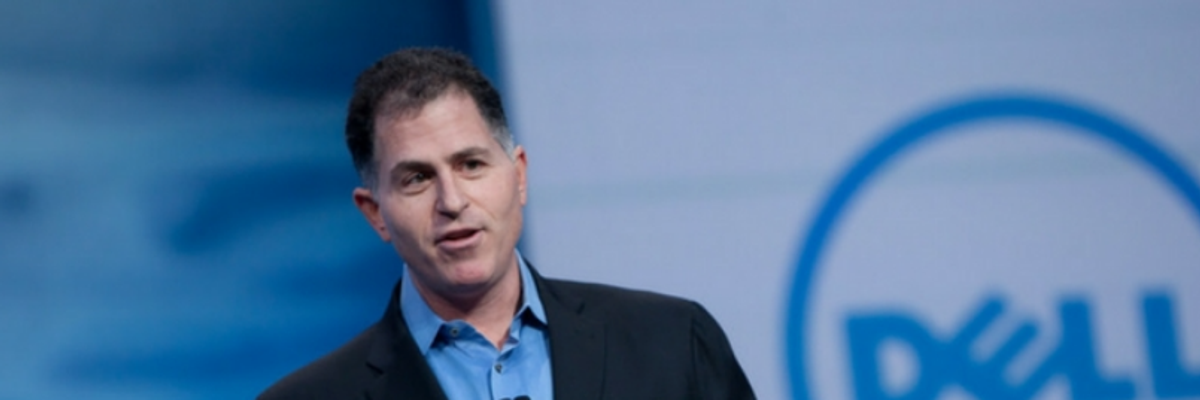
Michael Dell, America's 17th-richest man. (Photo: Flickr)
At the recent World Economic Forum in Davos, Switzerland, a panel moderator asked Michael Dell, America's 17th-richest man, what he thought about the idea of raising the top marginal tax rate to 70 percent.
This idea has been in the headlines since Rep. Alexandria Ocasio-Cortez floated it in a 60 Minutes interview on January 6 as a way to pay for a Green New Deal.
The Davos panel found the question hilarious. When the laughing died down, Dell, the founder and CEO of Dell Technologies, dismissed the idea out of hand, claiming it would harm U.S. economic growth.
"Name a country where that has worked, ever," the mega-billionaire said.
Dell knows a lot about computers, but he doesn't seem to know much about history. Otherwise he'd know that one country where such a top marginal tax rate that high -- and even higher -- has worked is the United States.
Back in the 1960s, our top marginal tax rate ranged from 70 percent to 91 percent. That was also the decade when our country had its highest average economic growth rate.
More importantly, it was an era when workers generally shared in the country's prosperity. Since the 1970s, wages for most U.S. workers have flatlined, even as productivity has steadily increased. But back in the 1950s and 1960s, wage growth kept pace with productivity.
High top tax rates are one reason economic gains were shared more equitably. Business leaders back then didn't bother demanding insanely large paychecks because much of that pay would've been taxed away anyway. That left more money for workers and productive investment.
Revenue from fair taxes on the rich also helped pay for public works projects that created good jobs and built the infrastructure for a strong economy.
But we don't need to just look back at history. In the real world right now, Sweden has a 70 percent marginal tax rate and one of the world's most vibrant economies. Ordinary Swedes enjoy universal health care, free college, and more than a year of paid parental leave.
And on indicators that business leaders like Michael Dell should care about because they make for a strong labor pool - like engineers per capita and public health - the Swedes kick American butt.
In 1953, the CEO of GM, Charles Wilson, famously said that "what was good for our country was good for General Motors, and vice versa." Back then, there was a lot of truth to that.
Big U.S. corporations contributed much more to the country through taxes and good jobs. Wilson himself paid more than 70% of his total income in taxes in 1950.
Today, at Dell Technologies, which makes most of its computers outside the United States, what's good for the company is certainly very good for Michael Dell. Is it good for the country? That's not so clear.
Dear Common Dreams reader, It’s been nearly 30 years since I co-founded Common Dreams with my late wife, Lina Newhouser. We had the radical notion that journalism should serve the public good, not corporate profits. It was clear to us from the outset what it would take to build such a project. No paid advertisements. No corporate sponsors. No millionaire publisher telling us what to think or do. Many people said we wouldn't last a year, but we proved those doubters wrong. Together with a tremendous team of journalists and dedicated staff, we built an independent media outlet free from the constraints of profits and corporate control. Our mission has always been simple: To inform. To inspire. To ignite change for the common good. Building Common Dreams was not easy. Our survival was never guaranteed. When you take on the most powerful forces—Wall Street greed, fossil fuel industry destruction, Big Tech lobbyists, and uber-rich oligarchs who have spent billions upon billions rigging the economy and democracy in their favor—the only bulwark you have is supporters who believe in your work. But here’s the urgent message from me today. It's never been this bad out there. And it's never been this hard to keep us going. At the very moment Common Dreams is most needed, the threats we face are intensifying. We need your support now more than ever. We don't accept corporate advertising and never will. We don't have a paywall because we don't think people should be blocked from critical news based on their ability to pay. Everything we do is funded by the donations of readers like you. When everyone does the little they can afford, we are strong. But if that support retreats or dries up, so do we. Will you donate now to make sure Common Dreams not only survives but thrives? —Craig Brown, Co-founder |
At the recent World Economic Forum in Davos, Switzerland, a panel moderator asked Michael Dell, America's 17th-richest man, what he thought about the idea of raising the top marginal tax rate to 70 percent.
This idea has been in the headlines since Rep. Alexandria Ocasio-Cortez floated it in a 60 Minutes interview on January 6 as a way to pay for a Green New Deal.
The Davos panel found the question hilarious. When the laughing died down, Dell, the founder and CEO of Dell Technologies, dismissed the idea out of hand, claiming it would harm U.S. economic growth.
"Name a country where that has worked, ever," the mega-billionaire said.
Dell knows a lot about computers, but he doesn't seem to know much about history. Otherwise he'd know that one country where such a top marginal tax rate that high -- and even higher -- has worked is the United States.
Back in the 1960s, our top marginal tax rate ranged from 70 percent to 91 percent. That was also the decade when our country had its highest average economic growth rate.
More importantly, it was an era when workers generally shared in the country's prosperity. Since the 1970s, wages for most U.S. workers have flatlined, even as productivity has steadily increased. But back in the 1950s and 1960s, wage growth kept pace with productivity.
High top tax rates are one reason economic gains were shared more equitably. Business leaders back then didn't bother demanding insanely large paychecks because much of that pay would've been taxed away anyway. That left more money for workers and productive investment.
Revenue from fair taxes on the rich also helped pay for public works projects that created good jobs and built the infrastructure for a strong economy.
But we don't need to just look back at history. In the real world right now, Sweden has a 70 percent marginal tax rate and one of the world's most vibrant economies. Ordinary Swedes enjoy universal health care, free college, and more than a year of paid parental leave.
And on indicators that business leaders like Michael Dell should care about because they make for a strong labor pool - like engineers per capita and public health - the Swedes kick American butt.
In 1953, the CEO of GM, Charles Wilson, famously said that "what was good for our country was good for General Motors, and vice versa." Back then, there was a lot of truth to that.
Big U.S. corporations contributed much more to the country through taxes and good jobs. Wilson himself paid more than 70% of his total income in taxes in 1950.
Today, at Dell Technologies, which makes most of its computers outside the United States, what's good for the company is certainly very good for Michael Dell. Is it good for the country? That's not so clear.

At the recent World Economic Forum in Davos, Switzerland, a panel moderator asked Michael Dell, America's 17th-richest man, what he thought about the idea of raising the top marginal tax rate to 70 percent.
This idea has been in the headlines since Rep. Alexandria Ocasio-Cortez floated it in a 60 Minutes interview on January 6 as a way to pay for a Green New Deal.
The Davos panel found the question hilarious. When the laughing died down, Dell, the founder and CEO of Dell Technologies, dismissed the idea out of hand, claiming it would harm U.S. economic growth.
"Name a country where that has worked, ever," the mega-billionaire said.
Dell knows a lot about computers, but he doesn't seem to know much about history. Otherwise he'd know that one country where such a top marginal tax rate that high -- and even higher -- has worked is the United States.
Back in the 1960s, our top marginal tax rate ranged from 70 percent to 91 percent. That was also the decade when our country had its highest average economic growth rate.
More importantly, it was an era when workers generally shared in the country's prosperity. Since the 1970s, wages for most U.S. workers have flatlined, even as productivity has steadily increased. But back in the 1950s and 1960s, wage growth kept pace with productivity.
High top tax rates are one reason economic gains were shared more equitably. Business leaders back then didn't bother demanding insanely large paychecks because much of that pay would've been taxed away anyway. That left more money for workers and productive investment.
Revenue from fair taxes on the rich also helped pay for public works projects that created good jobs and built the infrastructure for a strong economy.
But we don't need to just look back at history. In the real world right now, Sweden has a 70 percent marginal tax rate and one of the world's most vibrant economies. Ordinary Swedes enjoy universal health care, free college, and more than a year of paid parental leave.
And on indicators that business leaders like Michael Dell should care about because they make for a strong labor pool - like engineers per capita and public health - the Swedes kick American butt.
In 1953, the CEO of GM, Charles Wilson, famously said that "what was good for our country was good for General Motors, and vice versa." Back then, there was a lot of truth to that.
Big U.S. corporations contributed much more to the country through taxes and good jobs. Wilson himself paid more than 70% of his total income in taxes in 1950.
Today, at Dell Technologies, which makes most of its computers outside the United States, what's good for the company is certainly very good for Michael Dell. Is it good for the country? That's not so clear.