SUBSCRIBE TO OUR FREE NEWSLETTER
Daily news & progressive opinion—funded by the people, not the corporations—delivered straight to your inbox.
5
#000000
#FFFFFF
To donate by check, phone, or other method, see our More Ways to Give page.
Daily news & progressive opinion—funded by the people, not the corporations—delivered straight to your inbox.
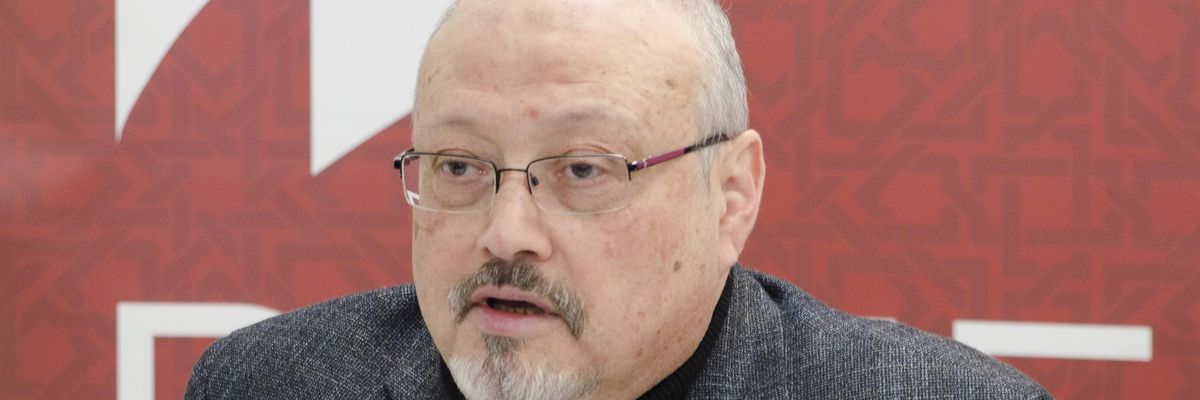
Jamal Khashoggi speaks during POMED's "Mohammed bin Salman's Saudi Arabia: A Deeper Look." (Photo: April Brady/Project on Middle East Democracy via flickr/cc)
" Saudi Arabia must face the damage from the past three-plus years of war in Yemen." These words opened the last column by Washington Post journalist Jamal Khashoggi published while he was still alive. Three weeks later, on Oct. 2, Khashoggi walked into the Saudi Arabian consulate in Istanbul, Turkey, and was never seen again. Khashoggi was instructed to go there by the Saudi ambassador to the U.S., the brother of Saudi Crown Prince Mohammed bin Salman, to pick up documents allowing him to remarry. It was a ruse. Immediately after entering, Khashoggi was grabbed by a 15-member Saudi "kill team," tortured, killed and dismembered.
An audio recording of the gruesome murder, reportedly captured by the Turkish government, left little doubt about his fate. Turkey gave the recording to Saudi Arabia, the U.S., Germany, France and the U.K. When asked by Fox News if he had listened to it, President Donald Trump said, "It's a suffering tape ... There's no reason for me to hear it."
The CIA did listen to it, and, in conjunction with other intelligence, reportedly concluded with high confidence that Crown Prince Mohammed bin Salman personally ordered Khashoggi's murder. Facing increasing bipartisan pressure to sanction Saudi Arabia, Trump issued a rambling statement this week, "It could very well be that the crown prince had knowledge of this tragic event -- maybe he did and maybe he didn't!" It's not that Trump doesn't know the truth. He simply declared this week, "America first!"
Trump says he's protecting U.S. jobs by securing $110 billion in weapons sales to Saudi Arabia. William Hartung of the Center for International Policy writes that the $110 billion figure "is wildly exaggerated ... most of [the deals] were either [from] the Obama administration, or are projections ... that are unlikely to ever occur." He notes a State Department figure putting the actual total at $14.5 billion, and that many of any potential jobs created would actually be in Saudi Arabia itself, not in the U.S.
Regardless of the dollar amount of any promised weapons deal, Donald Trump has made it very clear: Spend enough money with the U.S., and you can get away with murder. It shouldn't be a surprising position for a man who said, on the campaign trail, "I could stand in the middle of Fifth Avenue and shoot somebody, and I wouldn't lose voters."
Khashoggi may achieve through death what he sought in life. As he wrote in his column: "The longer this cruel war lasts in Yemen, the more permanent the damage will be. ... The crown prince must bring an end to the violence." Instead of heeding his words, the crown prince had the journalist killed.
Yemen, one of the poorest countries in the Middle East, has been subjected to a brutal bombing campaign since 2015. By one recent estimate, 57,000 Yemenis have been killed. The U.S.-backed Saudi and UAE bombing has provoked widespread food shortages, with 14 million of the country's population of 22 million on the verge of famine. Save The Children estimates that 85,000 children have starved to death since 2015.
The destruction of water, sanitation, hospitals and other health facilities has caused the largest cholera outbreak in modern history, with at least 1.2 million cases reported in the last 18 months. The United Nations estimates that a child dies of preventable causes in Yemen every 10 minutes. Yemen's currency has now collapsed, driving up prices of food, fuel and other medicines that manage to get through the port city of Hodeidah, which Saudi Arabia has subjected to relentless bombing.
The U.S. Constitution grants Congress, not the president, the power to declare war. California Democratic Rep. Ro Khanna recently attempted to force a House debate on the U.S. role in Saudi Arabia's war on Yemen, but was thwarted by House Republican leaders. In January, when Democrats take control of the House, Khanna will be joined by many new progressive members, including Alexandria Ocasio-Cortez of New York, and Rashida Tlaib of Michigan and Ilhan Omar of Minnesota, the first two Muslim women ever elected to Congress.
Under Democratic control, a War Powers Resolution debate is likely to pass the House. And, despite continuing Republican control of the Senate, the murder of Jamal Khashoggi may sway enough Republican senators to join Democrats in voting to block further U.S. support for Saudi Arabia's destruction of Yemen, and to suspend arms sales to the kingdom, essentially shutting down the bombing.
Such a rejection of war would be a truly fitting, if overdue, tribute to the memory of Jamal Khashoggi, and a chance at life for the surviving population of Yemen.
Dear Common Dreams reader, It’s been nearly 30 years since I co-founded Common Dreams with my late wife, Lina Newhouser. We had the radical notion that journalism should serve the public good, not corporate profits. It was clear to us from the outset what it would take to build such a project. No paid advertisements. No corporate sponsors. No millionaire publisher telling us what to think or do. Many people said we wouldn't last a year, but we proved those doubters wrong. Together with a tremendous team of journalists and dedicated staff, we built an independent media outlet free from the constraints of profits and corporate control. Our mission has always been simple: To inform. To inspire. To ignite change for the common good. Building Common Dreams was not easy. Our survival was never guaranteed. When you take on the most powerful forces—Wall Street greed, fossil fuel industry destruction, Big Tech lobbyists, and uber-rich oligarchs who have spent billions upon billions rigging the economy and democracy in their favor—the only bulwark you have is supporters who believe in your work. But here’s the urgent message from me today. It's never been this bad out there. And it's never been this hard to keep us going. At the very moment Common Dreams is most needed, the threats we face are intensifying. We need your support now more than ever. We don't accept corporate advertising and never will. We don't have a paywall because we don't think people should be blocked from critical news based on their ability to pay. Everything we do is funded by the donations of readers like you. When everyone does the little they can afford, we are strong. But if that support retreats or dries up, so do we. Will you donate now to make sure Common Dreams not only survives but thrives? —Craig Brown, Co-founder |
" Saudi Arabia must face the damage from the past three-plus years of war in Yemen." These words opened the last column by Washington Post journalist Jamal Khashoggi published while he was still alive. Three weeks later, on Oct. 2, Khashoggi walked into the Saudi Arabian consulate in Istanbul, Turkey, and was never seen again. Khashoggi was instructed to go there by the Saudi ambassador to the U.S., the brother of Saudi Crown Prince Mohammed bin Salman, to pick up documents allowing him to remarry. It was a ruse. Immediately after entering, Khashoggi was grabbed by a 15-member Saudi "kill team," tortured, killed and dismembered.
An audio recording of the gruesome murder, reportedly captured by the Turkish government, left little doubt about his fate. Turkey gave the recording to Saudi Arabia, the U.S., Germany, France and the U.K. When asked by Fox News if he had listened to it, President Donald Trump said, "It's a suffering tape ... There's no reason for me to hear it."
The CIA did listen to it, and, in conjunction with other intelligence, reportedly concluded with high confidence that Crown Prince Mohammed bin Salman personally ordered Khashoggi's murder. Facing increasing bipartisan pressure to sanction Saudi Arabia, Trump issued a rambling statement this week, "It could very well be that the crown prince had knowledge of this tragic event -- maybe he did and maybe he didn't!" It's not that Trump doesn't know the truth. He simply declared this week, "America first!"
Trump says he's protecting U.S. jobs by securing $110 billion in weapons sales to Saudi Arabia. William Hartung of the Center for International Policy writes that the $110 billion figure "is wildly exaggerated ... most of [the deals] were either [from] the Obama administration, or are projections ... that are unlikely to ever occur." He notes a State Department figure putting the actual total at $14.5 billion, and that many of any potential jobs created would actually be in Saudi Arabia itself, not in the U.S.
Regardless of the dollar amount of any promised weapons deal, Donald Trump has made it very clear: Spend enough money with the U.S., and you can get away with murder. It shouldn't be a surprising position for a man who said, on the campaign trail, "I could stand in the middle of Fifth Avenue and shoot somebody, and I wouldn't lose voters."
Khashoggi may achieve through death what he sought in life. As he wrote in his column: "The longer this cruel war lasts in Yemen, the more permanent the damage will be. ... The crown prince must bring an end to the violence." Instead of heeding his words, the crown prince had the journalist killed.
Yemen, one of the poorest countries in the Middle East, has been subjected to a brutal bombing campaign since 2015. By one recent estimate, 57,000 Yemenis have been killed. The U.S.-backed Saudi and UAE bombing has provoked widespread food shortages, with 14 million of the country's population of 22 million on the verge of famine. Save The Children estimates that 85,000 children have starved to death since 2015.
The destruction of water, sanitation, hospitals and other health facilities has caused the largest cholera outbreak in modern history, with at least 1.2 million cases reported in the last 18 months. The United Nations estimates that a child dies of preventable causes in Yemen every 10 minutes. Yemen's currency has now collapsed, driving up prices of food, fuel and other medicines that manage to get through the port city of Hodeidah, which Saudi Arabia has subjected to relentless bombing.
The U.S. Constitution grants Congress, not the president, the power to declare war. California Democratic Rep. Ro Khanna recently attempted to force a House debate on the U.S. role in Saudi Arabia's war on Yemen, but was thwarted by House Republican leaders. In January, when Democrats take control of the House, Khanna will be joined by many new progressive members, including Alexandria Ocasio-Cortez of New York, and Rashida Tlaib of Michigan and Ilhan Omar of Minnesota, the first two Muslim women ever elected to Congress.
Under Democratic control, a War Powers Resolution debate is likely to pass the House. And, despite continuing Republican control of the Senate, the murder of Jamal Khashoggi may sway enough Republican senators to join Democrats in voting to block further U.S. support for Saudi Arabia's destruction of Yemen, and to suspend arms sales to the kingdom, essentially shutting down the bombing.
Such a rejection of war would be a truly fitting, if overdue, tribute to the memory of Jamal Khashoggi, and a chance at life for the surviving population of Yemen.
" Saudi Arabia must face the damage from the past three-plus years of war in Yemen." These words opened the last column by Washington Post journalist Jamal Khashoggi published while he was still alive. Three weeks later, on Oct. 2, Khashoggi walked into the Saudi Arabian consulate in Istanbul, Turkey, and was never seen again. Khashoggi was instructed to go there by the Saudi ambassador to the U.S., the brother of Saudi Crown Prince Mohammed bin Salman, to pick up documents allowing him to remarry. It was a ruse. Immediately after entering, Khashoggi was grabbed by a 15-member Saudi "kill team," tortured, killed and dismembered.
An audio recording of the gruesome murder, reportedly captured by the Turkish government, left little doubt about his fate. Turkey gave the recording to Saudi Arabia, the U.S., Germany, France and the U.K. When asked by Fox News if he had listened to it, President Donald Trump said, "It's a suffering tape ... There's no reason for me to hear it."
The CIA did listen to it, and, in conjunction with other intelligence, reportedly concluded with high confidence that Crown Prince Mohammed bin Salman personally ordered Khashoggi's murder. Facing increasing bipartisan pressure to sanction Saudi Arabia, Trump issued a rambling statement this week, "It could very well be that the crown prince had knowledge of this tragic event -- maybe he did and maybe he didn't!" It's not that Trump doesn't know the truth. He simply declared this week, "America first!"
Trump says he's protecting U.S. jobs by securing $110 billion in weapons sales to Saudi Arabia. William Hartung of the Center for International Policy writes that the $110 billion figure "is wildly exaggerated ... most of [the deals] were either [from] the Obama administration, or are projections ... that are unlikely to ever occur." He notes a State Department figure putting the actual total at $14.5 billion, and that many of any potential jobs created would actually be in Saudi Arabia itself, not in the U.S.
Regardless of the dollar amount of any promised weapons deal, Donald Trump has made it very clear: Spend enough money with the U.S., and you can get away with murder. It shouldn't be a surprising position for a man who said, on the campaign trail, "I could stand in the middle of Fifth Avenue and shoot somebody, and I wouldn't lose voters."
Khashoggi may achieve through death what he sought in life. As he wrote in his column: "The longer this cruel war lasts in Yemen, the more permanent the damage will be. ... The crown prince must bring an end to the violence." Instead of heeding his words, the crown prince had the journalist killed.
Yemen, one of the poorest countries in the Middle East, has been subjected to a brutal bombing campaign since 2015. By one recent estimate, 57,000 Yemenis have been killed. The U.S.-backed Saudi and UAE bombing has provoked widespread food shortages, with 14 million of the country's population of 22 million on the verge of famine. Save The Children estimates that 85,000 children have starved to death since 2015.
The destruction of water, sanitation, hospitals and other health facilities has caused the largest cholera outbreak in modern history, with at least 1.2 million cases reported in the last 18 months. The United Nations estimates that a child dies of preventable causes in Yemen every 10 minutes. Yemen's currency has now collapsed, driving up prices of food, fuel and other medicines that manage to get through the port city of Hodeidah, which Saudi Arabia has subjected to relentless bombing.
The U.S. Constitution grants Congress, not the president, the power to declare war. California Democratic Rep. Ro Khanna recently attempted to force a House debate on the U.S. role in Saudi Arabia's war on Yemen, but was thwarted by House Republican leaders. In January, when Democrats take control of the House, Khanna will be joined by many new progressive members, including Alexandria Ocasio-Cortez of New York, and Rashida Tlaib of Michigan and Ilhan Omar of Minnesota, the first two Muslim women ever elected to Congress.
Under Democratic control, a War Powers Resolution debate is likely to pass the House. And, despite continuing Republican control of the Senate, the murder of Jamal Khashoggi may sway enough Republican senators to join Democrats in voting to block further U.S. support for Saudi Arabia's destruction of Yemen, and to suspend arms sales to the kingdom, essentially shutting down the bombing.
Such a rejection of war would be a truly fitting, if overdue, tribute to the memory of Jamal Khashoggi, and a chance at life for the surviving population of Yemen.