SUBSCRIBE TO OUR FREE NEWSLETTER
Daily news & progressive opinion—funded by the people, not the corporations—delivered straight to your inbox.
5
#000000
#FFFFFF
To donate by check, phone, or other method, see our More Ways to Give page.
Daily news & progressive opinion—funded by the people, not the corporations—delivered straight to your inbox.
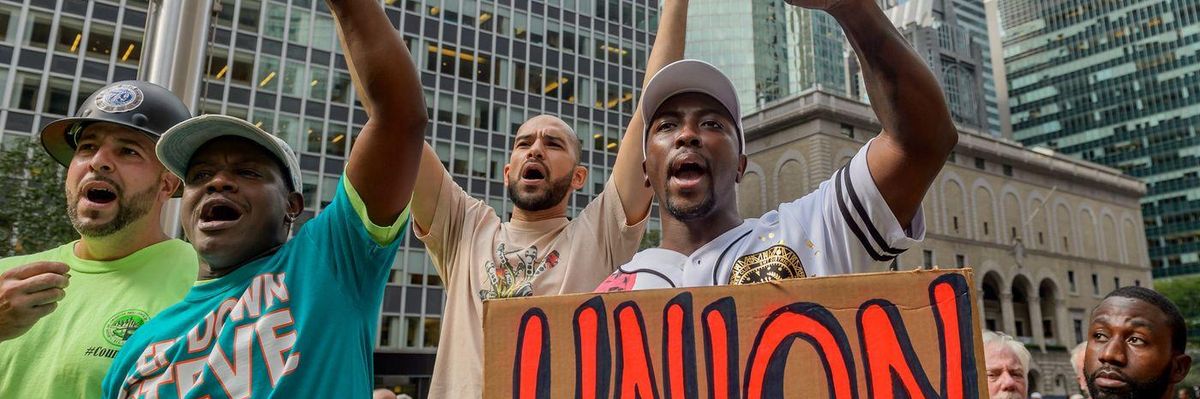
A Gallup poll reveals that Americans' support for unions has been increasing -- from 48% in 2009 to 61% today. (Photo: Pacific Press / LightRocket via Getty Images)
Here's a Labor Day quiz:
Most Americans support unions, but just over 10% are union members. What gives?
Business leaders claim that American workers don't want or need unions anymore. But the Gallup poll reveals that Americans' support for unions has been increasing -- from 48% in 2009 to 62% today.
Researchers at MIT found that if nonunion workers who wanted to join a union could do so, union membership would skyrocket from its current 15 million to 70 million.
So why do unions have such a hard time recruiting new members? The answer is fear.
America's labor laws are so stacked against workers that it is extremely difficult for even the most committed workers and talented organizers to win union elections. Big business spends big bucks hiring anti-union consultants. Employers can force workers to attend meetings that feature anti-union speeches, films and literature.
Try wearing a union button at a mandated Walmart employee meeting and see what happens.
Union organizers are banned from company property. To reach employees, they must visit their homes or hold secret meetings. One-third of all employers illegally fire at least one worker -- typically union leaders -- during union organizing drives, scaring other workers from joining the campaign. Federal penalties are so small that companies treat them as a minor cost of doing business.
The 30 years after World War II were the golden age of American capitalism. Prosperity was widely shared. Unions allowed many working people to achieve the American Dream. They could buy homes and cars, take vacations, send their kids to college, afford health insurance and retire with dignity.
Since the 1970s, union membership has plummeted from about one-quarter of all workers, to one-fifth in the 1980s, to one-tenth today.
Among private sector workers, union membership is now a dismal 6.5%. Big business' assault on workers' rights has had real consequences. Income inequality has widened, wages for working people have stagnated, the middle class has shrunk and American families are deeper in debt.
Right-wing politicians and their corporate backers aren't through; they want unions completely crushed. he anti-union billionaire Koch brothers, for example, have spent tens of millions of dollars to support misnamed "right-to-work" laws designed to weaken organized labor and help elect anti-union Republicans.
In June, in the Janus decision, the Supreme Court ruled by a 5-4 majority that public sector employees who benefit from their unions' collective-bargaining efforts owe no obligation to financially support those unions.
It's like allowing people equal police and fire protection even though they refuse to pay taxes.
Fortunately, help for the labor movement could be on the way. Last month, Missouri voters rescinded a right-to-work law by a two-to-one margin.
And earlier this year in Washington, 13 Democratic senators -- including Elizabeth Warren, Bernie Sanders, Kirsten Gillibrand and Cory Booker -- unveiled the Workplace Democracy Act.
It would help union organizers by banning state right-to-work laws (there are now 27 states that have them), providing "card check" provisions (similar to in Canada, where one-quarter of workers are in unions) that limit employer intimidation during union drives, and help exploited workers who are currently miscategorized as "independent contractors."
The proposal won't pass unless Democrats win back the White House and Congress.
To do that, they should make labor empowerment a priority. A stronger union movement would not only mean better lives for working families but also provide support for progressive goals like single-payer health care, tuition-free college and paid family leave.
The battle is joined. Americans are asking politicians: Which side are you on?
Dear Common Dreams reader, It’s been nearly 30 years since I co-founded Common Dreams with my late wife, Lina Newhouser. We had the radical notion that journalism should serve the public good, not corporate profits. It was clear to us from the outset what it would take to build such a project. No paid advertisements. No corporate sponsors. No millionaire publisher telling us what to think or do. Many people said we wouldn't last a year, but we proved those doubters wrong. Together with a tremendous team of journalists and dedicated staff, we built an independent media outlet free from the constraints of profits and corporate control. Our mission has always been simple: To inform. To inspire. To ignite change for the common good. Building Common Dreams was not easy. Our survival was never guaranteed. When you take on the most powerful forces—Wall Street greed, fossil fuel industry destruction, Big Tech lobbyists, and uber-rich oligarchs who have spent billions upon billions rigging the economy and democracy in their favor—the only bulwark you have is supporters who believe in your work. But here’s the urgent message from me today. It's never been this bad out there. And it's never been this hard to keep us going. At the very moment Common Dreams is most needed, the threats we face are intensifying. We need your support now more than ever. We don't accept corporate advertising and never will. We don't have a paywall because we don't think people should be blocked from critical news based on their ability to pay. Everything we do is funded by the donations of readers like you. When everyone does the little they can afford, we are strong. But if that support retreats or dries up, so do we. Will you donate now to make sure Common Dreams not only survives but thrives? —Craig Brown, Co-founder |
Here's a Labor Day quiz:
Most Americans support unions, but just over 10% are union members. What gives?
Business leaders claim that American workers don't want or need unions anymore. But the Gallup poll reveals that Americans' support for unions has been increasing -- from 48% in 2009 to 62% today.
Researchers at MIT found that if nonunion workers who wanted to join a union could do so, union membership would skyrocket from its current 15 million to 70 million.
So why do unions have such a hard time recruiting new members? The answer is fear.
America's labor laws are so stacked against workers that it is extremely difficult for even the most committed workers and talented organizers to win union elections. Big business spends big bucks hiring anti-union consultants. Employers can force workers to attend meetings that feature anti-union speeches, films and literature.
Try wearing a union button at a mandated Walmart employee meeting and see what happens.
Union organizers are banned from company property. To reach employees, they must visit their homes or hold secret meetings. One-third of all employers illegally fire at least one worker -- typically union leaders -- during union organizing drives, scaring other workers from joining the campaign. Federal penalties are so small that companies treat them as a minor cost of doing business.
The 30 years after World War II were the golden age of American capitalism. Prosperity was widely shared. Unions allowed many working people to achieve the American Dream. They could buy homes and cars, take vacations, send their kids to college, afford health insurance and retire with dignity.
Since the 1970s, union membership has plummeted from about one-quarter of all workers, to one-fifth in the 1980s, to one-tenth today.
Among private sector workers, union membership is now a dismal 6.5%. Big business' assault on workers' rights has had real consequences. Income inequality has widened, wages for working people have stagnated, the middle class has shrunk and American families are deeper in debt.
Right-wing politicians and their corporate backers aren't through; they want unions completely crushed. he anti-union billionaire Koch brothers, for example, have spent tens of millions of dollars to support misnamed "right-to-work" laws designed to weaken organized labor and help elect anti-union Republicans.
In June, in the Janus decision, the Supreme Court ruled by a 5-4 majority that public sector employees who benefit from their unions' collective-bargaining efforts owe no obligation to financially support those unions.
It's like allowing people equal police and fire protection even though they refuse to pay taxes.
Fortunately, help for the labor movement could be on the way. Last month, Missouri voters rescinded a right-to-work law by a two-to-one margin.
And earlier this year in Washington, 13 Democratic senators -- including Elizabeth Warren, Bernie Sanders, Kirsten Gillibrand and Cory Booker -- unveiled the Workplace Democracy Act.
It would help union organizers by banning state right-to-work laws (there are now 27 states that have them), providing "card check" provisions (similar to in Canada, where one-quarter of workers are in unions) that limit employer intimidation during union drives, and help exploited workers who are currently miscategorized as "independent contractors."
The proposal won't pass unless Democrats win back the White House and Congress.
To do that, they should make labor empowerment a priority. A stronger union movement would not only mean better lives for working families but also provide support for progressive goals like single-payer health care, tuition-free college and paid family leave.
The battle is joined. Americans are asking politicians: Which side are you on?
Here's a Labor Day quiz:
Most Americans support unions, but just over 10% are union members. What gives?
Business leaders claim that American workers don't want or need unions anymore. But the Gallup poll reveals that Americans' support for unions has been increasing -- from 48% in 2009 to 62% today.
Researchers at MIT found that if nonunion workers who wanted to join a union could do so, union membership would skyrocket from its current 15 million to 70 million.
So why do unions have such a hard time recruiting new members? The answer is fear.
America's labor laws are so stacked against workers that it is extremely difficult for even the most committed workers and talented organizers to win union elections. Big business spends big bucks hiring anti-union consultants. Employers can force workers to attend meetings that feature anti-union speeches, films and literature.
Try wearing a union button at a mandated Walmart employee meeting and see what happens.
Union organizers are banned from company property. To reach employees, they must visit their homes or hold secret meetings. One-third of all employers illegally fire at least one worker -- typically union leaders -- during union organizing drives, scaring other workers from joining the campaign. Federal penalties are so small that companies treat them as a minor cost of doing business.
The 30 years after World War II were the golden age of American capitalism. Prosperity was widely shared. Unions allowed many working people to achieve the American Dream. They could buy homes and cars, take vacations, send their kids to college, afford health insurance and retire with dignity.
Since the 1970s, union membership has plummeted from about one-quarter of all workers, to one-fifth in the 1980s, to one-tenth today.
Among private sector workers, union membership is now a dismal 6.5%. Big business' assault on workers' rights has had real consequences. Income inequality has widened, wages for working people have stagnated, the middle class has shrunk and American families are deeper in debt.
Right-wing politicians and their corporate backers aren't through; they want unions completely crushed. he anti-union billionaire Koch brothers, for example, have spent tens of millions of dollars to support misnamed "right-to-work" laws designed to weaken organized labor and help elect anti-union Republicans.
In June, in the Janus decision, the Supreme Court ruled by a 5-4 majority that public sector employees who benefit from their unions' collective-bargaining efforts owe no obligation to financially support those unions.
It's like allowing people equal police and fire protection even though they refuse to pay taxes.
Fortunately, help for the labor movement could be on the way. Last month, Missouri voters rescinded a right-to-work law by a two-to-one margin.
And earlier this year in Washington, 13 Democratic senators -- including Elizabeth Warren, Bernie Sanders, Kirsten Gillibrand and Cory Booker -- unveiled the Workplace Democracy Act.
It would help union organizers by banning state right-to-work laws (there are now 27 states that have them), providing "card check" provisions (similar to in Canada, where one-quarter of workers are in unions) that limit employer intimidation during union drives, and help exploited workers who are currently miscategorized as "independent contractors."
The proposal won't pass unless Democrats win back the White House and Congress.
To do that, they should make labor empowerment a priority. A stronger union movement would not only mean better lives for working families but also provide support for progressive goals like single-payer health care, tuition-free college and paid family leave.
The battle is joined. Americans are asking politicians: Which side are you on?