SUBSCRIBE TO OUR FREE NEWSLETTER
Daily news & progressive opinion—funded by the people, not the corporations—delivered straight to your inbox.
5
#000000
#FFFFFF
To donate by check, phone, or other method, see our More Ways to Give page.
Daily news & progressive opinion—funded by the people, not the corporations—delivered straight to your inbox.
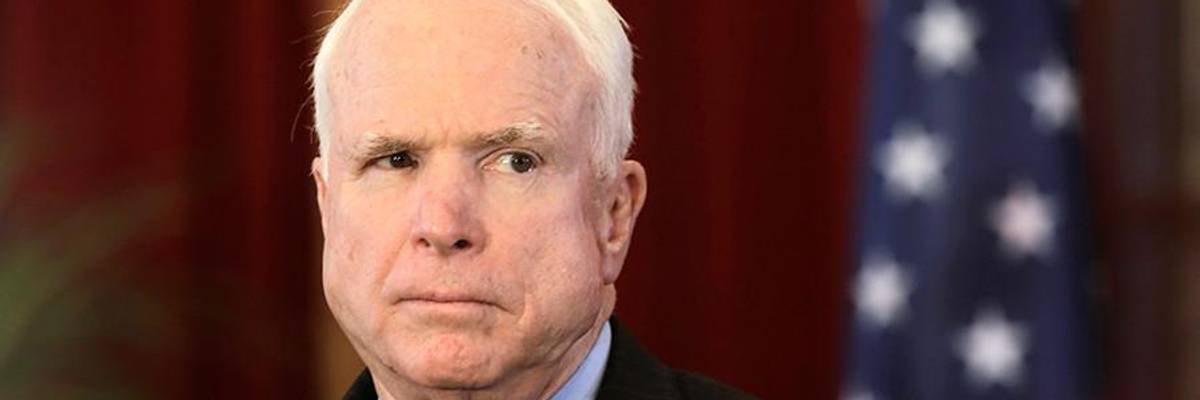
The most controversial thing about the monstrous military spending bill named after him, to hear most of the media tell it, is that President Trump refused to thank John McCain when he signed it.
On an otherwise sleepy August day, President Trump signed the John McCain National Defense Authorization Act. Named for the dying Arizona senator who's championed military budgets for his entire career, the bill increases U.S. military spending to an astonishing $717 billion.
According to my Institute for Policy Studies colleague Lindsay Koshgarian, that's about double what American taxpayers were spending at the end of the Cold War, and upwards of $300 billion more than what we spent before the War on Terror.
The bill also contains language encouraging a confrontation with Iran, while also making it possible for the administration to continue offering weapons and support to the Saudi-led coalition that's bombing Yemen. (Where, the very week the bill was signed, they bombed a school bus, killing 51 people -- 40 of them children.)
You'd expect a bill of this magnitude to generate lots of critical coverage -- and you'd be right! But only kind of.
The most controversial thing about this bill, to hear most of the media tell it, is that the president refused to thank John McCain when he signed it.
Countless outlets, from Newsweek to TIME to the Washington Post, reported the omission as a "snub" against the bill's namesake senator, an occasional Trump critic. CNN's Jake Tapper used an entire segment on his show to scold the president about it -- and even sanctimoniously thanked McCain himself.
The New York Times ran the numbers: Trump spoke for 28 minutes about the bill, with 0 mentions of McCain.
I ran some numbers of my own: A Google news search on the story turned up nearly 150,000 pieces like this. That's almost 3 times the number of results I got when I searched the same story, but replaced "John McCain" with the actual price tag of the bill: $717 billion.
To put it kindly, this is garbage.
If the media deems a petty snub more controversial than a massive, war-mongering spending bill, you can be sure Congress will follow. The bill passed by huge bipartisan margins in both the House and Senate.
I can assure you, Trump's not going to speak more kindly of John McCain as a result of this coverage. But more school buses are probably going to get blown up -- and so are more pressing human needs in our own communities.
For instance, my home state of Ohio has, by some measures, the most student debt of any state. According to Koshgarian, taxpayers there spent $15.5 billion on the Pentagon base budget alone this past year. For that money, we could've funded nearly 700,000 four-year Pell grants.
For Texas, the most uninsured state in the union, their $45 billion in Pentagon dollars could've covered 15 million adults and 16 million kids. That's the entire state -- and then some.
Flint, Michigan taxpayers, Koshgarian calculates, spent some $38 million. That could've paid for nearly 700 infrastructure jobs to fix things like, say, lead in their water pipes.
Nationally, that money could've provided solar power to the entire country. Or funded universal health care. Or debt-free higher education. Instead, we'll be shelling out more money on fruitless, destructive wars and boondoggle weapons systems like the F-35 (which McCain himself has called "a scandal and a tragedy").
The real scandal is that such expenditures aren't deemed controversial -- not by our lawmakers, and not by many of the outlets that cover them. Next time they say McCain's name, they should report what his bill costs the rest of us.
Dear Common Dreams reader, It’s been nearly 30 years since I co-founded Common Dreams with my late wife, Lina Newhouser. We had the radical notion that journalism should serve the public good, not corporate profits. It was clear to us from the outset what it would take to build such a project. No paid advertisements. No corporate sponsors. No millionaire publisher telling us what to think or do. Many people said we wouldn't last a year, but we proved those doubters wrong. Together with a tremendous team of journalists and dedicated staff, we built an independent media outlet free from the constraints of profits and corporate control. Our mission has always been simple: To inform. To inspire. To ignite change for the common good. Building Common Dreams was not easy. Our survival was never guaranteed. When you take on the most powerful forces—Wall Street greed, fossil fuel industry destruction, Big Tech lobbyists, and uber-rich oligarchs who have spent billions upon billions rigging the economy and democracy in their favor—the only bulwark you have is supporters who believe in your work. But here’s the urgent message from me today. It's never been this bad out there. And it's never been this hard to keep us going. At the very moment Common Dreams is most needed, the threats we face are intensifying. We need your support now more than ever. We don't accept corporate advertising and never will. We don't have a paywall because we don't think people should be blocked from critical news based on their ability to pay. Everything we do is funded by the donations of readers like you. When everyone does the little they can afford, we are strong. But if that support retreats or dries up, so do we. Will you donate now to make sure Common Dreams not only survives but thrives? —Craig Brown, Co-founder |
On an otherwise sleepy August day, President Trump signed the John McCain National Defense Authorization Act. Named for the dying Arizona senator who's championed military budgets for his entire career, the bill increases U.S. military spending to an astonishing $717 billion.
According to my Institute for Policy Studies colleague Lindsay Koshgarian, that's about double what American taxpayers were spending at the end of the Cold War, and upwards of $300 billion more than what we spent before the War on Terror.
The bill also contains language encouraging a confrontation with Iran, while also making it possible for the administration to continue offering weapons and support to the Saudi-led coalition that's bombing Yemen. (Where, the very week the bill was signed, they bombed a school bus, killing 51 people -- 40 of them children.)
You'd expect a bill of this magnitude to generate lots of critical coverage -- and you'd be right! But only kind of.
The most controversial thing about this bill, to hear most of the media tell it, is that the president refused to thank John McCain when he signed it.
Countless outlets, from Newsweek to TIME to the Washington Post, reported the omission as a "snub" against the bill's namesake senator, an occasional Trump critic. CNN's Jake Tapper used an entire segment on his show to scold the president about it -- and even sanctimoniously thanked McCain himself.
The New York Times ran the numbers: Trump spoke for 28 minutes about the bill, with 0 mentions of McCain.
I ran some numbers of my own: A Google news search on the story turned up nearly 150,000 pieces like this. That's almost 3 times the number of results I got when I searched the same story, but replaced "John McCain" with the actual price tag of the bill: $717 billion.
To put it kindly, this is garbage.
If the media deems a petty snub more controversial than a massive, war-mongering spending bill, you can be sure Congress will follow. The bill passed by huge bipartisan margins in both the House and Senate.
I can assure you, Trump's not going to speak more kindly of John McCain as a result of this coverage. But more school buses are probably going to get blown up -- and so are more pressing human needs in our own communities.
For instance, my home state of Ohio has, by some measures, the most student debt of any state. According to Koshgarian, taxpayers there spent $15.5 billion on the Pentagon base budget alone this past year. For that money, we could've funded nearly 700,000 four-year Pell grants.
For Texas, the most uninsured state in the union, their $45 billion in Pentagon dollars could've covered 15 million adults and 16 million kids. That's the entire state -- and then some.
Flint, Michigan taxpayers, Koshgarian calculates, spent some $38 million. That could've paid for nearly 700 infrastructure jobs to fix things like, say, lead in their water pipes.
Nationally, that money could've provided solar power to the entire country. Or funded universal health care. Or debt-free higher education. Instead, we'll be shelling out more money on fruitless, destructive wars and boondoggle weapons systems like the F-35 (which McCain himself has called "a scandal and a tragedy").
The real scandal is that such expenditures aren't deemed controversial -- not by our lawmakers, and not by many of the outlets that cover them. Next time they say McCain's name, they should report what his bill costs the rest of us.
On an otherwise sleepy August day, President Trump signed the John McCain National Defense Authorization Act. Named for the dying Arizona senator who's championed military budgets for his entire career, the bill increases U.S. military spending to an astonishing $717 billion.
According to my Institute for Policy Studies colleague Lindsay Koshgarian, that's about double what American taxpayers were spending at the end of the Cold War, and upwards of $300 billion more than what we spent before the War on Terror.
The bill also contains language encouraging a confrontation with Iran, while also making it possible for the administration to continue offering weapons and support to the Saudi-led coalition that's bombing Yemen. (Where, the very week the bill was signed, they bombed a school bus, killing 51 people -- 40 of them children.)
You'd expect a bill of this magnitude to generate lots of critical coverage -- and you'd be right! But only kind of.
The most controversial thing about this bill, to hear most of the media tell it, is that the president refused to thank John McCain when he signed it.
Countless outlets, from Newsweek to TIME to the Washington Post, reported the omission as a "snub" against the bill's namesake senator, an occasional Trump critic. CNN's Jake Tapper used an entire segment on his show to scold the president about it -- and even sanctimoniously thanked McCain himself.
The New York Times ran the numbers: Trump spoke for 28 minutes about the bill, with 0 mentions of McCain.
I ran some numbers of my own: A Google news search on the story turned up nearly 150,000 pieces like this. That's almost 3 times the number of results I got when I searched the same story, but replaced "John McCain" with the actual price tag of the bill: $717 billion.
To put it kindly, this is garbage.
If the media deems a petty snub more controversial than a massive, war-mongering spending bill, you can be sure Congress will follow. The bill passed by huge bipartisan margins in both the House and Senate.
I can assure you, Trump's not going to speak more kindly of John McCain as a result of this coverage. But more school buses are probably going to get blown up -- and so are more pressing human needs in our own communities.
For instance, my home state of Ohio has, by some measures, the most student debt of any state. According to Koshgarian, taxpayers there spent $15.5 billion on the Pentagon base budget alone this past year. For that money, we could've funded nearly 700,000 four-year Pell grants.
For Texas, the most uninsured state in the union, their $45 billion in Pentagon dollars could've covered 15 million adults and 16 million kids. That's the entire state -- and then some.
Flint, Michigan taxpayers, Koshgarian calculates, spent some $38 million. That could've paid for nearly 700 infrastructure jobs to fix things like, say, lead in their water pipes.
Nationally, that money could've provided solar power to the entire country. Or funded universal health care. Or debt-free higher education. Instead, we'll be shelling out more money on fruitless, destructive wars and boondoggle weapons systems like the F-35 (which McCain himself has called "a scandal and a tragedy").
The real scandal is that such expenditures aren't deemed controversial -- not by our lawmakers, and not by many of the outlets that cover them. Next time they say McCain's name, they should report what his bill costs the rest of us.