Our Missing $10 Trillion
Tax cuts from the Bush, Obama, and Trump years have left a massive gap in the public coffers. This hurts everyone
A trillion dollars, a figure with twelve zeros after a one, is by any measure a ton of money. It's near impossible to comprehend how much a trillion is.
So, it's admittedly hard to comprehend a new report that tallies the combined tax cuts of the Bush, Obama, and Trump administrations from the year 2000 to the time they're fully implemented in 2025 at over $10 trillion. Of that $10 trillion, the Institute on Taxation and Economic Policy found, a whopping $2 trillion will have gone exclusively to the top 1 percent.
Sounds like big numbers, huh?
The Endowment for Human Development offers some tidy tips for visualizing a trillion. They point out that if you took a trillion one-dollar bills and laid them end-to-end, it would measure longer than the distance from the earth to the sun.
Of that $10 trillion, the Institute on Taxation and Economic Policy found, a whopping $2 trillion will have gone exclusively to the top 1 percent.
Spending a trillion dollars, at a rapid-fire clip of $20 per second, would take more than 1,500 years before you ran out of money.
So yes, when we're talking about trillions, we're talking about a lot, a lot, a lot of money. And what this new report really shows is a metric-crap-ton of cash going to the already exceptionally wealthy. That's a problem.
The past four decades have seen a dramatic increase in income and wealth inequality as the rich have continued to get richer while the rest of the economy has stagnated. The lopsided tilt of the tax code plays no small part.
As this new report points out, it's not just the Trump tax cuts. Bush cut taxes too, especially for the rich, and Obama extended many of the Bush tax cuts.
And at last the results have arrived. Put very simply, the top 1 percent of households will pay $111 billion less this year alone in federal taxes combined than they would have if the laws had remained unchanged since 2000.
The wealthiest households and most profitable corporations have gotten big tax breaks while everyone else remains relatively stagnant.
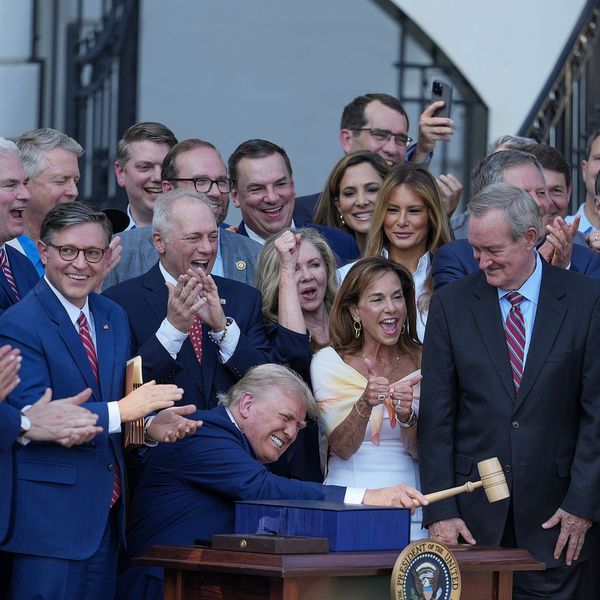
The Trump tax cuts have rightfully generated a tremendous amount of press coverage. A lot of that press coverage has accurately pointed out that the tax cuts overwhelmingly benefit the rich. Trump's claims that his tax package would usher in wage and job growth have been proven utterly false. Instead, the wealthiest households and most profitable corporations have gotten big tax breaks while everyone else remains relatively stagnant.
Why should you care about the tax status of the ultra-wealthy?
Consider what gets lost when funds are diverted from the public good to private fortunes.
Since the Trump cuts were passed last December, Congress has debated a budget that includes major cuts to Medicaid, Medicare, and Social Security. They've considered cuts to programs families depend on to live -- like Supplemental Nutrition Assistance Program (SNAP) and the Women, Infants, and Children (WIC) program, which provides nutrition assistance to half the babies born in the United States.
It's not an exaggeration to say that choosing to cut taxes on the rich while cutting vital programs is taking food out of babies' mouths.
Meanwhile, our nation's transportation infrastructure is in shambles. The American Society of Civil Engineers gives the country's infrastructure a D+ and calls for $2 trillion in increased investment over ten years to get back up to a passing grade. That number sounds familiar doesn't it?
So, ask yourself, would you rather have the wealthiest 1 percent be $2 trillion wealthier, or would you rather have safe and sound roads and bridges?
Hindsight is helpful, but only if we put its lessons into practice. Will we repeat our mistakes of the past 20 years and head further towards extreme inequality? Or will we invest in our public good and ask those at the top pay their fair share?
Urgent. It's never been this bad.
Dear Common Dreams reader, It’s been nearly 30 years since I co-founded Common Dreams with my late wife, Lina Newhouser. We had the radical notion that journalism should serve the public good, not corporate profits. It was clear to us from the outset what it would take to build such a project. No paid advertisements. No corporate sponsors. No millionaire publisher telling us what to think or do. Many people said we wouldn't last a year, but we proved those doubters wrong. Together with a tremendous team of journalists and dedicated staff, we built an independent media outlet free from the constraints of profits and corporate control. Our mission from the outset was simple. To inform. To inspire. To ignite change for the common good. Building Common Dreams was not easy. Our survival was never guaranteed. When you take on the most powerful forces—Wall Street greed, fossil fuel industry destruction, Big Tech lobbyists, and uber-rich oligarchs who have spent billions upon billions rigging the economy and democracy in their favor—the only bulwark you have is supporters who believe in your work. But here’s the urgent message from me today. It’s never been this bad out there. And it’s never been this hard to keep us going. At the very moment Common Dreams is most needed and doing some of its best and most important work, the threats we face are intensifying. Right now, with just three days to go in our Spring Campaign, we're falling short of our make-or-break goal. When everyone does the little they can afford, we are strong. But if that support retreats or dries up, so do we. Can you make a gift right now to make sure Common Dreams not only survives but thrives? There is no backup plan or rainy day fund. There is only you. —Craig Brown, Co-founder |
A trillion dollars, a figure with twelve zeros after a one, is by any measure a ton of money. It's near impossible to comprehend how much a trillion is.
So, it's admittedly hard to comprehend a new report that tallies the combined tax cuts of the Bush, Obama, and Trump administrations from the year 2000 to the time they're fully implemented in 2025 at over $10 trillion. Of that $10 trillion, the Institute on Taxation and Economic Policy found, a whopping $2 trillion will have gone exclusively to the top 1 percent.
Sounds like big numbers, huh?
The Endowment for Human Development offers some tidy tips for visualizing a trillion. They point out that if you took a trillion one-dollar bills and laid them end-to-end, it would measure longer than the distance from the earth to the sun.
Of that $10 trillion, the Institute on Taxation and Economic Policy found, a whopping $2 trillion will have gone exclusively to the top 1 percent.
Spending a trillion dollars, at a rapid-fire clip of $20 per second, would take more than 1,500 years before you ran out of money.
So yes, when we're talking about trillions, we're talking about a lot, a lot, a lot of money. And what this new report really shows is a metric-crap-ton of cash going to the already exceptionally wealthy. That's a problem.
The past four decades have seen a dramatic increase in income and wealth inequality as the rich have continued to get richer while the rest of the economy has stagnated. The lopsided tilt of the tax code plays no small part.
As this new report points out, it's not just the Trump tax cuts. Bush cut taxes too, especially for the rich, and Obama extended many of the Bush tax cuts.
And at last the results have arrived. Put very simply, the top 1 percent of households will pay $111 billion less this year alone in federal taxes combined than they would have if the laws had remained unchanged since 2000.
The wealthiest households and most profitable corporations have gotten big tax breaks while everyone else remains relatively stagnant.
The Trump tax cuts have rightfully generated a tremendous amount of press coverage. A lot of that press coverage has accurately pointed out that the tax cuts overwhelmingly benefit the rich. Trump's claims that his tax package would usher in wage and job growth have been proven utterly false. Instead, the wealthiest households and most profitable corporations have gotten big tax breaks while everyone else remains relatively stagnant.
Why should you care about the tax status of the ultra-wealthy?
Consider what gets lost when funds are diverted from the public good to private fortunes.
Since the Trump cuts were passed last December, Congress has debated a budget that includes major cuts to Medicaid, Medicare, and Social Security. They've considered cuts to programs families depend on to live -- like Supplemental Nutrition Assistance Program (SNAP) and the Women, Infants, and Children (WIC) program, which provides nutrition assistance to half the babies born in the United States.
It's not an exaggeration to say that choosing to cut taxes on the rich while cutting vital programs is taking food out of babies' mouths.
Meanwhile, our nation's transportation infrastructure is in shambles. The American Society of Civil Engineers gives the country's infrastructure a D+ and calls for $2 trillion in increased investment over ten years to get back up to a passing grade. That number sounds familiar doesn't it?
So, ask yourself, would you rather have the wealthiest 1 percent be $2 trillion wealthier, or would you rather have safe and sound roads and bridges?
Hindsight is helpful, but only if we put its lessons into practice. Will we repeat our mistakes of the past 20 years and head further towards extreme inequality? Or will we invest in our public good and ask those at the top pay their fair share?
A trillion dollars, a figure with twelve zeros after a one, is by any measure a ton of money. It's near impossible to comprehend how much a trillion is.
So, it's admittedly hard to comprehend a new report that tallies the combined tax cuts of the Bush, Obama, and Trump administrations from the year 2000 to the time they're fully implemented in 2025 at over $10 trillion. Of that $10 trillion, the Institute on Taxation and Economic Policy found, a whopping $2 trillion will have gone exclusively to the top 1 percent.
Sounds like big numbers, huh?
The Endowment for Human Development offers some tidy tips for visualizing a trillion. They point out that if you took a trillion one-dollar bills and laid them end-to-end, it would measure longer than the distance from the earth to the sun.
Of that $10 trillion, the Institute on Taxation and Economic Policy found, a whopping $2 trillion will have gone exclusively to the top 1 percent.
Spending a trillion dollars, at a rapid-fire clip of $20 per second, would take more than 1,500 years before you ran out of money.
So yes, when we're talking about trillions, we're talking about a lot, a lot, a lot of money. And what this new report really shows is a metric-crap-ton of cash going to the already exceptionally wealthy. That's a problem.
The past four decades have seen a dramatic increase in income and wealth inequality as the rich have continued to get richer while the rest of the economy has stagnated. The lopsided tilt of the tax code plays no small part.
As this new report points out, it's not just the Trump tax cuts. Bush cut taxes too, especially for the rich, and Obama extended many of the Bush tax cuts.
And at last the results have arrived. Put very simply, the top 1 percent of households will pay $111 billion less this year alone in federal taxes combined than they would have if the laws had remained unchanged since 2000.
The wealthiest households and most profitable corporations have gotten big tax breaks while everyone else remains relatively stagnant.
The Trump tax cuts have rightfully generated a tremendous amount of press coverage. A lot of that press coverage has accurately pointed out that the tax cuts overwhelmingly benefit the rich. Trump's claims that his tax package would usher in wage and job growth have been proven utterly false. Instead, the wealthiest households and most profitable corporations have gotten big tax breaks while everyone else remains relatively stagnant.
Why should you care about the tax status of the ultra-wealthy?
Consider what gets lost when funds are diverted from the public good to private fortunes.
Since the Trump cuts were passed last December, Congress has debated a budget that includes major cuts to Medicaid, Medicare, and Social Security. They've considered cuts to programs families depend on to live -- like Supplemental Nutrition Assistance Program (SNAP) and the Women, Infants, and Children (WIC) program, which provides nutrition assistance to half the babies born in the United States.
It's not an exaggeration to say that choosing to cut taxes on the rich while cutting vital programs is taking food out of babies' mouths.
Meanwhile, our nation's transportation infrastructure is in shambles. The American Society of Civil Engineers gives the country's infrastructure a D+ and calls for $2 trillion in increased investment over ten years to get back up to a passing grade. That number sounds familiar doesn't it?
So, ask yourself, would you rather have the wealthiest 1 percent be $2 trillion wealthier, or would you rather have safe and sound roads and bridges?
Hindsight is helpful, but only if we put its lessons into practice. Will we repeat our mistakes of the past 20 years and head further towards extreme inequality? Or will we invest in our public good and ask those at the top pay their fair share?