SUBSCRIBE TO OUR FREE NEWSLETTER
Daily news & progressive opinion—funded by the people, not the corporations—delivered straight to your inbox.
5
#000000
#FFFFFF
To donate by check, phone, or other method, see our More Ways to Give page.
Daily news & progressive opinion—funded by the people, not the corporations—delivered straight to your inbox.
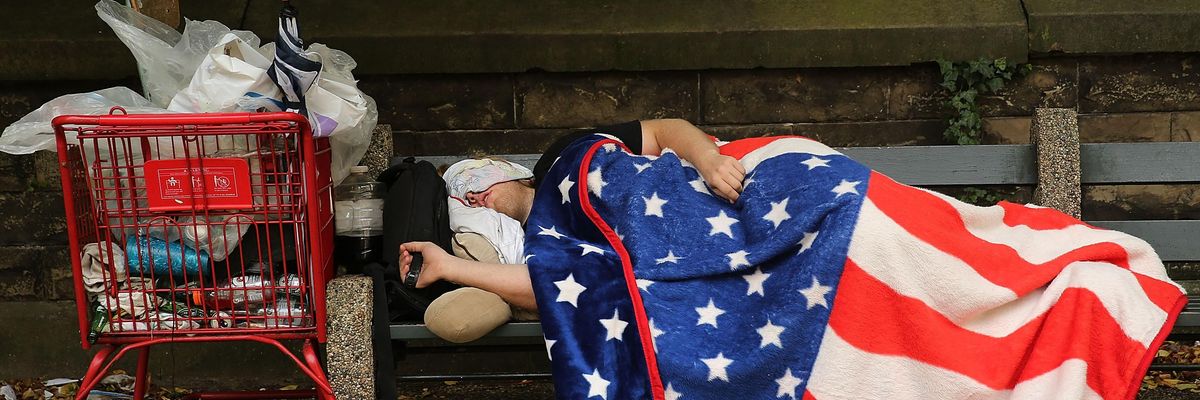
A homeless man sleeps under an American Flag blanket on a park bench on September 10, 2013 in the Brooklyn borough of New York City. (Photo: Spencer Platt/Getty Images)
The United Nations has released a scathing report on poverty and inequality in the United States. The findings, which will be presented to the U.N. Human Rights Council on June 21, follow an official visit to the United States by Philip Alston, the U.N. special rapporteur on extreme poverty and human rights, to investigate whether economic insecurity in the country undermines human rights.
The conclusions are damning. "The United States already leads the developed world in income and wealth inequality, and it is now moving full steam ahead to make itself even more unequal," the report concludes. "High child and youth poverty rates perpetuate the intergenerational transmission of poverty very effectively, and ensure that the American dream is rapidly becoming the American illusion."
The U.N. explicitly lays blame with the Trump administration for policies that actively increase poverty and inequality in the country. "The $1.5 trillion in tax cuts in December 2017 overwhelmingly benefited the wealthy and worsened inequality. The consequences of neglecting poverty and promoting inequality are clear," it concludes. "The policies pursued over the past year seem deliberately designed to remove basic protections from the poorest, punish those who are not in employment and make even basic health care into a privilege to be earned rather than a right of citizenship."
"The $1.5 trillion in tax cuts in December 2017 overwhelmingly benefited the wealthy and worsened inequality"
In December, Alston visited seven locations throughout the country--ranging from Los Angeles's Skid Row neighborhood to rural Alabama, West Virginia, and Puerto Rico--to meet with people experiencing deep poverty, along with experts and civil society groups.
In an interview with TalkPoverty ahead of the release, Alston characterized the United States as an outlier among the developed world.
"If you said to most Americans, 'Look at what country X does to its ethnic minority or to a particular religious minority' ... your average American with any knowledge of that situation is going to shake her head and say, 'This is a disgrace,'" Alston said. "But of course there's a direct parallel in the United States and it affects not just a small ethnic minority but a very large racial group of African Americans in particular, where they just come out worse on every possible indicator and policies are clearly designed to hit them harder."
Alston described meeting "people who had lost all of their teeth because adult dental care is not covered by the vast majority of programs available to the very poor," and people in Puerto Rico "living next to a mountain of completely unprotected coal ash, which rains down upon them bringing illness, disability, and death." In Lowndes County, Alabama, the U.N. found cesspools of sewage that flowed out of dysfunctional (or nonexistent) septic systems, which has led to a resurgence in diseases that officials believed were eradicated. A recent study found that more than one-third of people surveyed in Alabama tested positive for hookworm--a parasite that thrives in areas of poor sanitation, which has not been well-documented in the United States since the 1950s.
The reactions to the visit from the Trump administration and Republicans in Congress ahead of the report have ranged from indifference to hostility. Alston requested meetings with House Speaker Paul Ryan and a range of Republican committee chairs--all of whom declined the request. Senators Cory Booker, Bernie Sanders, Rep. Terri Sewell, and Elizabeth Warren's staff, on the other hand, all met with Alston. Alston also got a mixed result from the Trump administration. While some agencies were cooperative, "the Justice Department ... basically refused all requests to meet and that was pretty striking. It's not the sort of thing that normally happens on a mission like this," Alston says.
The Human Rights Council oversees human rights protection around the world. Though the United States is an elected member of the council, it doesn't have the friendliest relationship with the body. President George W. Bush boycotted the council at its founding in 2006 (a decision the Obama administration later reversed), and U.N. Ambassador Nikki Haley has been a relentless critic of the council under Trump. Notably, the United States and Cuba are the only countries in North America not to offer standing invitations from the Human Rights Council.
As for the odds that the report will force the administration to change course, Alston was not hopeful. During the visit, "The U.S. was visibly debating what to do with $1.5 trillion [in tax cuts]. And its proposals in relation to those living in poverty was essentially to cut back on existing benefits in order to help fund the tax reforms. That made for a pretty dramatic contrast for the approach that I have found elsewhere."
Dear Common Dreams reader, It’s been nearly 30 years since I co-founded Common Dreams with my late wife, Lina Newhouser. We had the radical notion that journalism should serve the public good, not corporate profits. It was clear to us from the outset what it would take to build such a project. No paid advertisements. No corporate sponsors. No millionaire publisher telling us what to think or do. Many people said we wouldn't last a year, but we proved those doubters wrong. Together with a tremendous team of journalists and dedicated staff, we built an independent media outlet free from the constraints of profits and corporate control. Our mission has always been simple: To inform. To inspire. To ignite change for the common good. Building Common Dreams was not easy. Our survival was never guaranteed. When you take on the most powerful forces—Wall Street greed, fossil fuel industry destruction, Big Tech lobbyists, and uber-rich oligarchs who have spent billions upon billions rigging the economy and democracy in their favor—the only bulwark you have is supporters who believe in your work. But here’s the urgent message from me today. It's never been this bad out there. And it's never been this hard to keep us going. At the very moment Common Dreams is most needed, the threats we face are intensifying. We need your support now more than ever. We don't accept corporate advertising and never will. We don't have a paywall because we don't think people should be blocked from critical news based on their ability to pay. Everything we do is funded by the donations of readers like you. When everyone does the little they can afford, we are strong. But if that support retreats or dries up, so do we. Will you donate now to make sure Common Dreams not only survives but thrives? —Craig Brown, Co-founder |
The United Nations has released a scathing report on poverty and inequality in the United States. The findings, which will be presented to the U.N. Human Rights Council on June 21, follow an official visit to the United States by Philip Alston, the U.N. special rapporteur on extreme poverty and human rights, to investigate whether economic insecurity in the country undermines human rights.
The conclusions are damning. "The United States already leads the developed world in income and wealth inequality, and it is now moving full steam ahead to make itself even more unequal," the report concludes. "High child and youth poverty rates perpetuate the intergenerational transmission of poverty very effectively, and ensure that the American dream is rapidly becoming the American illusion."
The U.N. explicitly lays blame with the Trump administration for policies that actively increase poverty and inequality in the country. "The $1.5 trillion in tax cuts in December 2017 overwhelmingly benefited the wealthy and worsened inequality. The consequences of neglecting poverty and promoting inequality are clear," it concludes. "The policies pursued over the past year seem deliberately designed to remove basic protections from the poorest, punish those who are not in employment and make even basic health care into a privilege to be earned rather than a right of citizenship."
"The $1.5 trillion in tax cuts in December 2017 overwhelmingly benefited the wealthy and worsened inequality"
In December, Alston visited seven locations throughout the country--ranging from Los Angeles's Skid Row neighborhood to rural Alabama, West Virginia, and Puerto Rico--to meet with people experiencing deep poverty, along with experts and civil society groups.
In an interview with TalkPoverty ahead of the release, Alston characterized the United States as an outlier among the developed world.
"If you said to most Americans, 'Look at what country X does to its ethnic minority or to a particular religious minority' ... your average American with any knowledge of that situation is going to shake her head and say, 'This is a disgrace,'" Alston said. "But of course there's a direct parallel in the United States and it affects not just a small ethnic minority but a very large racial group of African Americans in particular, where they just come out worse on every possible indicator and policies are clearly designed to hit them harder."
Alston described meeting "people who had lost all of their teeth because adult dental care is not covered by the vast majority of programs available to the very poor," and people in Puerto Rico "living next to a mountain of completely unprotected coal ash, which rains down upon them bringing illness, disability, and death." In Lowndes County, Alabama, the U.N. found cesspools of sewage that flowed out of dysfunctional (or nonexistent) septic systems, which has led to a resurgence in diseases that officials believed were eradicated. A recent study found that more than one-third of people surveyed in Alabama tested positive for hookworm--a parasite that thrives in areas of poor sanitation, which has not been well-documented in the United States since the 1950s.
The reactions to the visit from the Trump administration and Republicans in Congress ahead of the report have ranged from indifference to hostility. Alston requested meetings with House Speaker Paul Ryan and a range of Republican committee chairs--all of whom declined the request. Senators Cory Booker, Bernie Sanders, Rep. Terri Sewell, and Elizabeth Warren's staff, on the other hand, all met with Alston. Alston also got a mixed result from the Trump administration. While some agencies were cooperative, "the Justice Department ... basically refused all requests to meet and that was pretty striking. It's not the sort of thing that normally happens on a mission like this," Alston says.
The Human Rights Council oversees human rights protection around the world. Though the United States is an elected member of the council, it doesn't have the friendliest relationship with the body. President George W. Bush boycotted the council at its founding in 2006 (a decision the Obama administration later reversed), and U.N. Ambassador Nikki Haley has been a relentless critic of the council under Trump. Notably, the United States and Cuba are the only countries in North America not to offer standing invitations from the Human Rights Council.
As for the odds that the report will force the administration to change course, Alston was not hopeful. During the visit, "The U.S. was visibly debating what to do with $1.5 trillion [in tax cuts]. And its proposals in relation to those living in poverty was essentially to cut back on existing benefits in order to help fund the tax reforms. That made for a pretty dramatic contrast for the approach that I have found elsewhere."
The United Nations has released a scathing report on poverty and inequality in the United States. The findings, which will be presented to the U.N. Human Rights Council on June 21, follow an official visit to the United States by Philip Alston, the U.N. special rapporteur on extreme poverty and human rights, to investigate whether economic insecurity in the country undermines human rights.
The conclusions are damning. "The United States already leads the developed world in income and wealth inequality, and it is now moving full steam ahead to make itself even more unequal," the report concludes. "High child and youth poverty rates perpetuate the intergenerational transmission of poverty very effectively, and ensure that the American dream is rapidly becoming the American illusion."
The U.N. explicitly lays blame with the Trump administration for policies that actively increase poverty and inequality in the country. "The $1.5 trillion in tax cuts in December 2017 overwhelmingly benefited the wealthy and worsened inequality. The consequences of neglecting poverty and promoting inequality are clear," it concludes. "The policies pursued over the past year seem deliberately designed to remove basic protections from the poorest, punish those who are not in employment and make even basic health care into a privilege to be earned rather than a right of citizenship."
"The $1.5 trillion in tax cuts in December 2017 overwhelmingly benefited the wealthy and worsened inequality"
In December, Alston visited seven locations throughout the country--ranging from Los Angeles's Skid Row neighborhood to rural Alabama, West Virginia, and Puerto Rico--to meet with people experiencing deep poverty, along with experts and civil society groups.
In an interview with TalkPoverty ahead of the release, Alston characterized the United States as an outlier among the developed world.
"If you said to most Americans, 'Look at what country X does to its ethnic minority or to a particular religious minority' ... your average American with any knowledge of that situation is going to shake her head and say, 'This is a disgrace,'" Alston said. "But of course there's a direct parallel in the United States and it affects not just a small ethnic minority but a very large racial group of African Americans in particular, where they just come out worse on every possible indicator and policies are clearly designed to hit them harder."
Alston described meeting "people who had lost all of their teeth because adult dental care is not covered by the vast majority of programs available to the very poor," and people in Puerto Rico "living next to a mountain of completely unprotected coal ash, which rains down upon them bringing illness, disability, and death." In Lowndes County, Alabama, the U.N. found cesspools of sewage that flowed out of dysfunctional (or nonexistent) septic systems, which has led to a resurgence in diseases that officials believed were eradicated. A recent study found that more than one-third of people surveyed in Alabama tested positive for hookworm--a parasite that thrives in areas of poor sanitation, which has not been well-documented in the United States since the 1950s.
The reactions to the visit from the Trump administration and Republicans in Congress ahead of the report have ranged from indifference to hostility. Alston requested meetings with House Speaker Paul Ryan and a range of Republican committee chairs--all of whom declined the request. Senators Cory Booker, Bernie Sanders, Rep. Terri Sewell, and Elizabeth Warren's staff, on the other hand, all met with Alston. Alston also got a mixed result from the Trump administration. While some agencies were cooperative, "the Justice Department ... basically refused all requests to meet and that was pretty striking. It's not the sort of thing that normally happens on a mission like this," Alston says.
The Human Rights Council oversees human rights protection around the world. Though the United States is an elected member of the council, it doesn't have the friendliest relationship with the body. President George W. Bush boycotted the council at its founding in 2006 (a decision the Obama administration later reversed), and U.N. Ambassador Nikki Haley has been a relentless critic of the council under Trump. Notably, the United States and Cuba are the only countries in North America not to offer standing invitations from the Human Rights Council.
As for the odds that the report will force the administration to change course, Alston was not hopeful. During the visit, "The U.S. was visibly debating what to do with $1.5 trillion [in tax cuts]. And its proposals in relation to those living in poverty was essentially to cut back on existing benefits in order to help fund the tax reforms. That made for a pretty dramatic contrast for the approach that I have found elsewhere."