SUBSCRIBE TO OUR FREE NEWSLETTER
Daily news & progressive opinion—funded by the people, not the corporations—delivered straight to your inbox.
5
#000000
#FFFFFF
To donate by check, phone, or other method, see our More Ways to Give page.
Daily news & progressive opinion—funded by the people, not the corporations—delivered straight to your inbox.
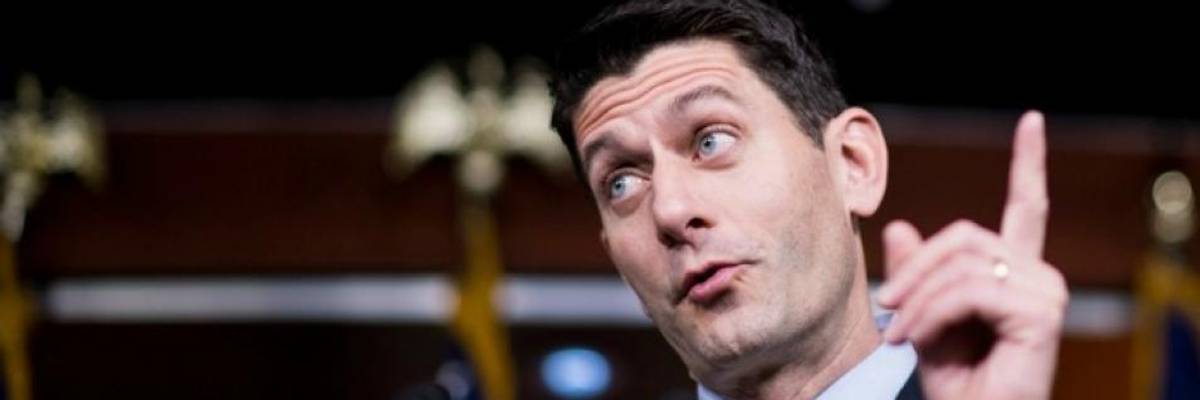
Speaker of the House Paul Ryan and his fellow congressional Republicans have a very simple plan: now that they've further ballooned the national deficit with a massive tax giveaway to the rich, they want to slash spending on the safety net in the name of fiscal responsibility. Don't buy it for a second. (Photo: Bill Clark/CQ Roll Call file photo)
I have a simple request to journalists, columnist, pundits, and others writing about forthcoming efforts of Republicans to cut Medicare, Medicaid, Social Security, and the anti-poverty programs that make up our safety net. Call such efforts "cuts." Do not call them "reforms," "changes," "overhauls," "fixes," "reshaping," "modernizing," or any other euphemism that could easily be misconstrued. At least, do not do so without also clearly defining what they really are, which is cuts.
While D.C. insiders speak the unique creole of our swamp, there's no reason to expect general readers to intuitively understand that when House Speaker Paul D. Ryan (R-Wis.) says he plans to "reform" entitlements, he means to cut them. Journalists, in particular, should not do Ryan et al.'s bidding by assuming readers get the meaning behind the words.
Examples abound. To be fair, these are often otherwise informative pieces, but they sometimes adapt the intentionally obfuscating language of those who would cut these programs.
A recent Congressional Quarterly piece (no public link) probed the interesting political disagreement between Ryan and Senate Majority Leader Mitch McConnell (R-Ky.) on the wisdom of going after the safety net in an election year. In describing Ryan's agenda, the piece noted (my bold, in all cases below) that "the Wisconsin Republican has detailed an ambitious effort to dramatically reshape Medicare, Medicaid and welfare programs that the GOP has long targeted as ripe for reforms. ... Ryan has said he plans to use the budget reconciliation process for entitlement changes."
CNN: "The House GOP caucus plans to work on entitlement reform next year as a way to 'tackle the debt and the deficit,' according to House Speaker Paul Ryan. ... Ryan also noted that, in addition to health care, the GOP plans to work on reforming the US welfare system." To its credit, the piece later cites Sen. Bernie Sanders (I-Vt.) saying these reforms are really cuts, but why set this up as "he said, she said?" Ryan is talking about cuts, plain and simple, but lacks to courage to say so. His position should not be accommodated.
This Politico report talks about Ryan's "obsession" with "fixing" the "ballooning entitlement state" and "tinkering with the social safety net." Who could possibly be against "fixing" something! And "tinkering" certainly sounds awfully benign, especially in contrast to Ryan and the Republican's actual, articulated plans to significantly cut programs that help low-income households.
Let me be clear. I'm not arguing against such cuts, at least not yet (that comes in a moment). Those advocating cuts to these programs have every right to make their case. But they've no right to mislead, which is, of course, the reason they employ such gilded language. And the media has no right to help them do so. To the contrary, it has an obligation to cut through their linguistic fog.
Along with the euphemisms for cuts, here are some other words and arguments politicians use to prevent us from understanding what they're actually talking about.
Unsustainable: This is one the most misused, misunderstood words in budget debates. To say a program is unsustainable is almost always meaningless. Instead, what's really being said here is that the politician is not willing to advocate for the resources necessary to meet the obligations of a program he disfavors, compared with one he likes. Medicare is unsustainable. Defense spending must go up.
It is unquestionably the case that our aging demographics mean that for a period, the costs of fully funding Social Security and Medicare will rise in a way that by 2035, they will require another 3 percentage points of GDP (1.3 for Social Security and 1.7 for Medicare/Medicaid). We can and should have good arguments as to whether that's the best use of 3 more points of GDP, but there is no coherent argument that it would be impossible to do so.
The deficit, the debt! President Trump and the Republicans just added at least $1 trillion to the 10-year deficit with their deficit financed tax plan. Based on their rhetoric of extending tax cuts they themselves scheduled to expire, the hit to the debt could be twice as large. By so doing, they sacrificed their tactic of using bigger deficits as leverage to cut spending programs they oppose. Yes, I know they argue that the tax cuts will more than pay for themselves through higher growth rates, but that just makes my final point.
Cherry picking the scores. During the tax debate, the blogger Kevin Drum made an important point: If the tax cuts are going to lift growth as much as the Republicans say, then revenue generated by that growth can also help pay for social insurance and safety net programs. True, they cooked up those growth effects to sell the tax cuts, but they should be pressed to explain why, if they really believe the economy will now be growing much faster, the new revenue flooding in should only pay for regressive tax cuts as opposed to progressive social programs.
I've long maintained that the policy media has seriously picked up its game in the age of Trump. Both on health care and taxes, more often than not, journalists cut through the phony language and clearly identified who was expected to win and lose from the proposals.
They say here at The Washington Post that "Democracy Dies in Darkness." That's surely true, and when we force the powerful to speak plainly, we light a match in the darkness.
With that, bye-bye 2017! Don't let the door hit you on the way out.
Dear Common Dreams reader, It’s been nearly 30 years since I co-founded Common Dreams with my late wife, Lina Newhouser. We had the radical notion that journalism should serve the public good, not corporate profits. It was clear to us from the outset what it would take to build such a project. No paid advertisements. No corporate sponsors. No millionaire publisher telling us what to think or do. Many people said we wouldn't last a year, but we proved those doubters wrong. Together with a tremendous team of journalists and dedicated staff, we built an independent media outlet free from the constraints of profits and corporate control. Our mission has always been simple: To inform. To inspire. To ignite change for the common good. Building Common Dreams was not easy. Our survival was never guaranteed. When you take on the most powerful forces—Wall Street greed, fossil fuel industry destruction, Big Tech lobbyists, and uber-rich oligarchs who have spent billions upon billions rigging the economy and democracy in their favor—the only bulwark you have is supporters who believe in your work. But here’s the urgent message from me today. It's never been this bad out there. And it's never been this hard to keep us going. At the very moment Common Dreams is most needed, the threats we face are intensifying. We need your support now more than ever. We don't accept corporate advertising and never will. We don't have a paywall because we don't think people should be blocked from critical news based on their ability to pay. Everything we do is funded by the donations of readers like you. When everyone does the little they can afford, we are strong. But if that support retreats or dries up, so do we. Will you donate now to make sure Common Dreams not only survives but thrives? —Craig Brown, Co-founder |
I have a simple request to journalists, columnist, pundits, and others writing about forthcoming efforts of Republicans to cut Medicare, Medicaid, Social Security, and the anti-poverty programs that make up our safety net. Call such efforts "cuts." Do not call them "reforms," "changes," "overhauls," "fixes," "reshaping," "modernizing," or any other euphemism that could easily be misconstrued. At least, do not do so without also clearly defining what they really are, which is cuts.
While D.C. insiders speak the unique creole of our swamp, there's no reason to expect general readers to intuitively understand that when House Speaker Paul D. Ryan (R-Wis.) says he plans to "reform" entitlements, he means to cut them. Journalists, in particular, should not do Ryan et al.'s bidding by assuming readers get the meaning behind the words.
Examples abound. To be fair, these are often otherwise informative pieces, but they sometimes adapt the intentionally obfuscating language of those who would cut these programs.
A recent Congressional Quarterly piece (no public link) probed the interesting political disagreement between Ryan and Senate Majority Leader Mitch McConnell (R-Ky.) on the wisdom of going after the safety net in an election year. In describing Ryan's agenda, the piece noted (my bold, in all cases below) that "the Wisconsin Republican has detailed an ambitious effort to dramatically reshape Medicare, Medicaid and welfare programs that the GOP has long targeted as ripe for reforms. ... Ryan has said he plans to use the budget reconciliation process for entitlement changes."
CNN: "The House GOP caucus plans to work on entitlement reform next year as a way to 'tackle the debt and the deficit,' according to House Speaker Paul Ryan. ... Ryan also noted that, in addition to health care, the GOP plans to work on reforming the US welfare system." To its credit, the piece later cites Sen. Bernie Sanders (I-Vt.) saying these reforms are really cuts, but why set this up as "he said, she said?" Ryan is talking about cuts, plain and simple, but lacks to courage to say so. His position should not be accommodated.
This Politico report talks about Ryan's "obsession" with "fixing" the "ballooning entitlement state" and "tinkering with the social safety net." Who could possibly be against "fixing" something! And "tinkering" certainly sounds awfully benign, especially in contrast to Ryan and the Republican's actual, articulated plans to significantly cut programs that help low-income households.
Let me be clear. I'm not arguing against such cuts, at least not yet (that comes in a moment). Those advocating cuts to these programs have every right to make their case. But they've no right to mislead, which is, of course, the reason they employ such gilded language. And the media has no right to help them do so. To the contrary, it has an obligation to cut through their linguistic fog.
Along with the euphemisms for cuts, here are some other words and arguments politicians use to prevent us from understanding what they're actually talking about.
Unsustainable: This is one the most misused, misunderstood words in budget debates. To say a program is unsustainable is almost always meaningless. Instead, what's really being said here is that the politician is not willing to advocate for the resources necessary to meet the obligations of a program he disfavors, compared with one he likes. Medicare is unsustainable. Defense spending must go up.
It is unquestionably the case that our aging demographics mean that for a period, the costs of fully funding Social Security and Medicare will rise in a way that by 2035, they will require another 3 percentage points of GDP (1.3 for Social Security and 1.7 for Medicare/Medicaid). We can and should have good arguments as to whether that's the best use of 3 more points of GDP, but there is no coherent argument that it would be impossible to do so.
The deficit, the debt! President Trump and the Republicans just added at least $1 trillion to the 10-year deficit with their deficit financed tax plan. Based on their rhetoric of extending tax cuts they themselves scheduled to expire, the hit to the debt could be twice as large. By so doing, they sacrificed their tactic of using bigger deficits as leverage to cut spending programs they oppose. Yes, I know they argue that the tax cuts will more than pay for themselves through higher growth rates, but that just makes my final point.
Cherry picking the scores. During the tax debate, the blogger Kevin Drum made an important point: If the tax cuts are going to lift growth as much as the Republicans say, then revenue generated by that growth can also help pay for social insurance and safety net programs. True, they cooked up those growth effects to sell the tax cuts, but they should be pressed to explain why, if they really believe the economy will now be growing much faster, the new revenue flooding in should only pay for regressive tax cuts as opposed to progressive social programs.
I've long maintained that the policy media has seriously picked up its game in the age of Trump. Both on health care and taxes, more often than not, journalists cut through the phony language and clearly identified who was expected to win and lose from the proposals.
They say here at The Washington Post that "Democracy Dies in Darkness." That's surely true, and when we force the powerful to speak plainly, we light a match in the darkness.
With that, bye-bye 2017! Don't let the door hit you on the way out.
I have a simple request to journalists, columnist, pundits, and others writing about forthcoming efforts of Republicans to cut Medicare, Medicaid, Social Security, and the anti-poverty programs that make up our safety net. Call such efforts "cuts." Do not call them "reforms," "changes," "overhauls," "fixes," "reshaping," "modernizing," or any other euphemism that could easily be misconstrued. At least, do not do so without also clearly defining what they really are, which is cuts.
While D.C. insiders speak the unique creole of our swamp, there's no reason to expect general readers to intuitively understand that when House Speaker Paul D. Ryan (R-Wis.) says he plans to "reform" entitlements, he means to cut them. Journalists, in particular, should not do Ryan et al.'s bidding by assuming readers get the meaning behind the words.
Examples abound. To be fair, these are often otherwise informative pieces, but they sometimes adapt the intentionally obfuscating language of those who would cut these programs.
A recent Congressional Quarterly piece (no public link) probed the interesting political disagreement between Ryan and Senate Majority Leader Mitch McConnell (R-Ky.) on the wisdom of going after the safety net in an election year. In describing Ryan's agenda, the piece noted (my bold, in all cases below) that "the Wisconsin Republican has detailed an ambitious effort to dramatically reshape Medicare, Medicaid and welfare programs that the GOP has long targeted as ripe for reforms. ... Ryan has said he plans to use the budget reconciliation process for entitlement changes."
CNN: "The House GOP caucus plans to work on entitlement reform next year as a way to 'tackle the debt and the deficit,' according to House Speaker Paul Ryan. ... Ryan also noted that, in addition to health care, the GOP plans to work on reforming the US welfare system." To its credit, the piece later cites Sen. Bernie Sanders (I-Vt.) saying these reforms are really cuts, but why set this up as "he said, she said?" Ryan is talking about cuts, plain and simple, but lacks to courage to say so. His position should not be accommodated.
This Politico report talks about Ryan's "obsession" with "fixing" the "ballooning entitlement state" and "tinkering with the social safety net." Who could possibly be against "fixing" something! And "tinkering" certainly sounds awfully benign, especially in contrast to Ryan and the Republican's actual, articulated plans to significantly cut programs that help low-income households.
Let me be clear. I'm not arguing against such cuts, at least not yet (that comes in a moment). Those advocating cuts to these programs have every right to make their case. But they've no right to mislead, which is, of course, the reason they employ such gilded language. And the media has no right to help them do so. To the contrary, it has an obligation to cut through their linguistic fog.
Along with the euphemisms for cuts, here are some other words and arguments politicians use to prevent us from understanding what they're actually talking about.
Unsustainable: This is one the most misused, misunderstood words in budget debates. To say a program is unsustainable is almost always meaningless. Instead, what's really being said here is that the politician is not willing to advocate for the resources necessary to meet the obligations of a program he disfavors, compared with one he likes. Medicare is unsustainable. Defense spending must go up.
It is unquestionably the case that our aging demographics mean that for a period, the costs of fully funding Social Security and Medicare will rise in a way that by 2035, they will require another 3 percentage points of GDP (1.3 for Social Security and 1.7 for Medicare/Medicaid). We can and should have good arguments as to whether that's the best use of 3 more points of GDP, but there is no coherent argument that it would be impossible to do so.
The deficit, the debt! President Trump and the Republicans just added at least $1 trillion to the 10-year deficit with their deficit financed tax plan. Based on their rhetoric of extending tax cuts they themselves scheduled to expire, the hit to the debt could be twice as large. By so doing, they sacrificed their tactic of using bigger deficits as leverage to cut spending programs they oppose. Yes, I know they argue that the tax cuts will more than pay for themselves through higher growth rates, but that just makes my final point.
Cherry picking the scores. During the tax debate, the blogger Kevin Drum made an important point: If the tax cuts are going to lift growth as much as the Republicans say, then revenue generated by that growth can also help pay for social insurance and safety net programs. True, they cooked up those growth effects to sell the tax cuts, but they should be pressed to explain why, if they really believe the economy will now be growing much faster, the new revenue flooding in should only pay for regressive tax cuts as opposed to progressive social programs.
I've long maintained that the policy media has seriously picked up its game in the age of Trump. Both on health care and taxes, more often than not, journalists cut through the phony language and clearly identified who was expected to win and lose from the proposals.
They say here at The Washington Post that "Democracy Dies in Darkness." That's surely true, and when we force the powerful to speak plainly, we light a match in the darkness.
With that, bye-bye 2017! Don't let the door hit you on the way out.