SUBSCRIBE TO OUR FREE NEWSLETTER
Daily news & progressive opinion—funded by the people, not the corporations—delivered straight to your inbox.
5
#000000
#FFFFFF
To donate by check, phone, or other method, see our More Ways to Give page.
As a perpetual emotion machine -- producing and guzzling its own political fuel -- the "war on terror" continues to normalize itself as a thoroughly American way of life and death. Ongoing warfare has become a matter of default routine, pushed along by mainline media and the leadership of both parties in Washington. Without a clear and effective upsurge of opposition from the grassroots, Americans can expect to remain citizens of a war-driven country for the rest of their lives.
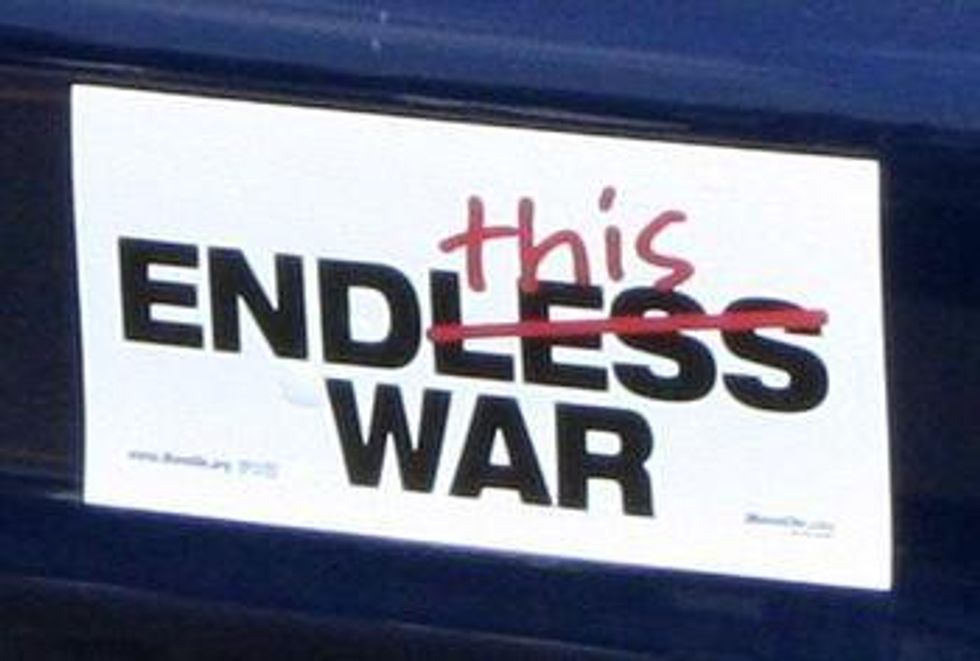
Across the United States, many thousands of peeling bumper stickers on the road say: "End this Endless War." They got mass distribution from MoveOn.org back in 2007, when a Republican was in the White House. Now, a thorough search of the MoveOn website might leave the impression that endless war ended with the end of the George W. Bush presidency.
MoveOn is very big as online groups go, but it is symptomatic of a widespread problem among an array of left-leaning organizations that have made their peace with the warfare state. Such silence assists the Obama administration as it makes the "war on terror" even more resolutely bipartisan and further embedded in the nation's political structures -- while doing immense damage to our economy, siphoning off resources that should go to meet human needs, further militarizing society and undermining civil liberties.
Now, on Capitol Hill, the most overt attempt to call a halt to the "war on terror" is coming from Rep. Barbara Lee, whose bill H.R. 198 would revoke the Authorization for Use of Military Force that Congress approved three days after 9/11. Several months since it was introduced, H.R. 198 only has a dozen co-sponsors. (To send your representative and senators a message of support for Lee's bill, click here.)
Evidently, in Congress, there is sparse support for repealing the September 2001 blanket authorization for war. Instead, there are growing calls for a larger blanket. Bipartisan Washington is warming to the idea that a new congressional resolution may be needed to give War on Terror 2.0 an expansive framework. Even for the law benders and breakers who manage the executive branch's war machinery, the language of the September 2001 resolution doesn't seem stretchable enough to cover the U.S. warfare of impunity that's underway across the globe . . . with more on the drawing boards.
On Tuesday afternoon, when a Senate Judiciary subcommittee held a hearing on "targeted killing," the proceedings underscored the great extent of bipartisan overlap for common killing ground. Republican super-hawk Sen. Lindsey Graham lauded President Obama for "targeting people in a very commander-in-chief-like way." And what passed for senatorial criticism took as a given the need for continuing drone strikes. In the words of the subcommittee's chairman, Sen. Dick Durbin, "More transparency is needed to maintain the support of the American people and the international community" for those attacks.
This is classic tinkering with war machinery. During the first several years of the Vietnam War, very few senators went beyond mild kibitzing about how the war could be better waged. In recent years, during President Obama's escalation of the war in Afghanistan that tripled the U.S. troop levels in that country, senators like John Kerry (now secretary of state) kept offering their helpful hints for how to fine tune the war effort.
The "war on terror" is now engaged in various forms of military intervention in an estimated two-dozen countries, killing and maiming uncounted civilians while creating new enemies. It infuses foreign policy with unhinged messages hidden in plain sight, like a purloined letter proclaiming "What goes around won't come around" and telling the world "Do as we say, not as we do."
Political ripple effects from the Boston Marathon bombings have only begun. While public opinion hasn't gotten carried away with fear, much of the news media -- television in particular -- is stoking the fires of fear but scarcely raising a single question that might challenge the basic assumptions of a forever "war on terror."
After a city has been traumatized and a country has empathized, a constructive takeaway would be that it's terribly wrong to set off bombs that kill and maim. But that outlook is a nonstarter the moment it might be applied to victims of U.S. drones and cruise missiles in Afghanistan, Pakistan, Yemen and elsewhere. The message seems to be that Americans should never be bombed but must keep bombing.
The death of Richie Havens days ago is a loss and reminder. Each of us has only so many days ahead. We may as well live them with deeper meaning, for peace and social justice. To hear Havens performing the song "Lives in the Balance" written by another great musician, Jackson Browne, is to be awakened anew:
I want to know who the men in the shadows are
I want to hear somebody asking them why
They can be counted on to tell us who our enemies are
But they're never the ones to fight or to dieAnd there are lives in the balance
There are people under fire
There are children at the cannons
And there is blood on the wire
As a perpetual emotion machine -- producing and guzzling its own political fuel -- the "war on terror" continues to normalize itself as a thoroughly American way of life and death. Ongoing warfare has become a matter of default routine, pushed along by mainline media and the leadership of both parties in Washington. Without a clear and effective upsurge of opposition from the grassroots, Americans can expect to remain citizens of a war-driven country for the rest of their lives.
Across the United States, many thousands of peeling bumper stickers on the road say: "End this Endless War." They got mass distribution from MoveOn.org back in 2007, when a Republican was in the White House. Now, a thorough search of the MoveOn website might leave the impression that endless war ended with the end of the George W. Bush presidency.
MoveOn is very big as online groups go, but it is symptomatic of a widespread problem among an array of left-leaning organizations that have made their peace with the warfare state. Such silence assists the Obama administration as it makes the "war on terror" even more resolutely bipartisan and further embedded in the nation's political structures -- while doing immense damage to our economy, siphoning off resources that should go to meet human needs, further militarizing society and undermining civil liberties.
Now, on Capitol Hill, the most overt attempt to call a halt to the "war on terror" is coming from Rep. Barbara Lee, whose bill H.R. 198 would revoke the Authorization for Use of Military Force that Congress approved three days after 9/11. Several months since it was introduced, H.R. 198 only has a dozen co-sponsors. (To send your representative and senators a message of support for Lee's bill, click here.)
Evidently, in Congress, there is sparse support for repealing the September 2001 blanket authorization for war. Instead, there are growing calls for a larger blanket. Bipartisan Washington is warming to the idea that a new congressional resolution may be needed to give War on Terror 2.0 an expansive framework. Even for the law benders and breakers who manage the executive branch's war machinery, the language of the September 2001 resolution doesn't seem stretchable enough to cover the U.S. warfare of impunity that's underway across the globe . . . with more on the drawing boards.
On Tuesday afternoon, when a Senate Judiciary subcommittee held a hearing on "targeted killing," the proceedings underscored the great extent of bipartisan overlap for common killing ground. Republican super-hawk Sen. Lindsey Graham lauded President Obama for "targeting people in a very commander-in-chief-like way." And what passed for senatorial criticism took as a given the need for continuing drone strikes. In the words of the subcommittee's chairman, Sen. Dick Durbin, "More transparency is needed to maintain the support of the American people and the international community" for those attacks.
This is classic tinkering with war machinery. During the first several years of the Vietnam War, very few senators went beyond mild kibitzing about how the war could be better waged. In recent years, during President Obama's escalation of the war in Afghanistan that tripled the U.S. troop levels in that country, senators like John Kerry (now secretary of state) kept offering their helpful hints for how to fine tune the war effort.
The "war on terror" is now engaged in various forms of military intervention in an estimated two-dozen countries, killing and maiming uncounted civilians while creating new enemies. It infuses foreign policy with unhinged messages hidden in plain sight, like a purloined letter proclaiming "What goes around won't come around" and telling the world "Do as we say, not as we do."
Political ripple effects from the Boston Marathon bombings have only begun. While public opinion hasn't gotten carried away with fear, much of the news media -- television in particular -- is stoking the fires of fear but scarcely raising a single question that might challenge the basic assumptions of a forever "war on terror."
After a city has been traumatized and a country has empathized, a constructive takeaway would be that it's terribly wrong to set off bombs that kill and maim. But that outlook is a nonstarter the moment it might be applied to victims of U.S. drones and cruise missiles in Afghanistan, Pakistan, Yemen and elsewhere. The message seems to be that Americans should never be bombed but must keep bombing.
The death of Richie Havens days ago is a loss and reminder. Each of us has only so many days ahead. We may as well live them with deeper meaning, for peace and social justice. To hear Havens performing the song "Lives in the Balance" written by another great musician, Jackson Browne, is to be awakened anew:
I want to know who the men in the shadows are
I want to hear somebody asking them why
They can be counted on to tell us who our enemies are
But they're never the ones to fight or to dieAnd there are lives in the balance
There are people under fire
There are children at the cannons
And there is blood on the wire
As a perpetual emotion machine -- producing and guzzling its own political fuel -- the "war on terror" continues to normalize itself as a thoroughly American way of life and death. Ongoing warfare has become a matter of default routine, pushed along by mainline media and the leadership of both parties in Washington. Without a clear and effective upsurge of opposition from the grassroots, Americans can expect to remain citizens of a war-driven country for the rest of their lives.
Across the United States, many thousands of peeling bumper stickers on the road say: "End this Endless War." They got mass distribution from MoveOn.org back in 2007, when a Republican was in the White House. Now, a thorough search of the MoveOn website might leave the impression that endless war ended with the end of the George W. Bush presidency.
MoveOn is very big as online groups go, but it is symptomatic of a widespread problem among an array of left-leaning organizations that have made their peace with the warfare state. Such silence assists the Obama administration as it makes the "war on terror" even more resolutely bipartisan and further embedded in the nation's political structures -- while doing immense damage to our economy, siphoning off resources that should go to meet human needs, further militarizing society and undermining civil liberties.
Now, on Capitol Hill, the most overt attempt to call a halt to the "war on terror" is coming from Rep. Barbara Lee, whose bill H.R. 198 would revoke the Authorization for Use of Military Force that Congress approved three days after 9/11. Several months since it was introduced, H.R. 198 only has a dozen co-sponsors. (To send your representative and senators a message of support for Lee's bill, click here.)
Evidently, in Congress, there is sparse support for repealing the September 2001 blanket authorization for war. Instead, there are growing calls for a larger blanket. Bipartisan Washington is warming to the idea that a new congressional resolution may be needed to give War on Terror 2.0 an expansive framework. Even for the law benders and breakers who manage the executive branch's war machinery, the language of the September 2001 resolution doesn't seem stretchable enough to cover the U.S. warfare of impunity that's underway across the globe . . . with more on the drawing boards.
On Tuesday afternoon, when a Senate Judiciary subcommittee held a hearing on "targeted killing," the proceedings underscored the great extent of bipartisan overlap for common killing ground. Republican super-hawk Sen. Lindsey Graham lauded President Obama for "targeting people in a very commander-in-chief-like way." And what passed for senatorial criticism took as a given the need for continuing drone strikes. In the words of the subcommittee's chairman, Sen. Dick Durbin, "More transparency is needed to maintain the support of the American people and the international community" for those attacks.
This is classic tinkering with war machinery. During the first several years of the Vietnam War, very few senators went beyond mild kibitzing about how the war could be better waged. In recent years, during President Obama's escalation of the war in Afghanistan that tripled the U.S. troop levels in that country, senators like John Kerry (now secretary of state) kept offering their helpful hints for how to fine tune the war effort.
The "war on terror" is now engaged in various forms of military intervention in an estimated two-dozen countries, killing and maiming uncounted civilians while creating new enemies. It infuses foreign policy with unhinged messages hidden in plain sight, like a purloined letter proclaiming "What goes around won't come around" and telling the world "Do as we say, not as we do."
Political ripple effects from the Boston Marathon bombings have only begun. While public opinion hasn't gotten carried away with fear, much of the news media -- television in particular -- is stoking the fires of fear but scarcely raising a single question that might challenge the basic assumptions of a forever "war on terror."
After a city has been traumatized and a country has empathized, a constructive takeaway would be that it's terribly wrong to set off bombs that kill and maim. But that outlook is a nonstarter the moment it might be applied to victims of U.S. drones and cruise missiles in Afghanistan, Pakistan, Yemen and elsewhere. The message seems to be that Americans should never be bombed but must keep bombing.
The death of Richie Havens days ago is a loss and reminder. Each of us has only so many days ahead. We may as well live them with deeper meaning, for peace and social justice. To hear Havens performing the song "Lives in the Balance" written by another great musician, Jackson Browne, is to be awakened anew:
I want to know who the men in the shadows are
I want to hear somebody asking them why
They can be counted on to tell us who our enemies are
But they're never the ones to fight or to dieAnd there are lives in the balance
There are people under fire
There are children at the cannons
And there is blood on the wire