

SUBSCRIBE TO OUR FREE NEWSLETTER
Daily news & progressive opinion—funded by the people, not the corporations—delivered straight to your inbox.
5
#000000
#FFFFFF
To donate by check, phone, or other method, see our More Ways to Give page.
Daily news & progressive opinion—funded by the people, not the corporations—delivered straight to your inbox.
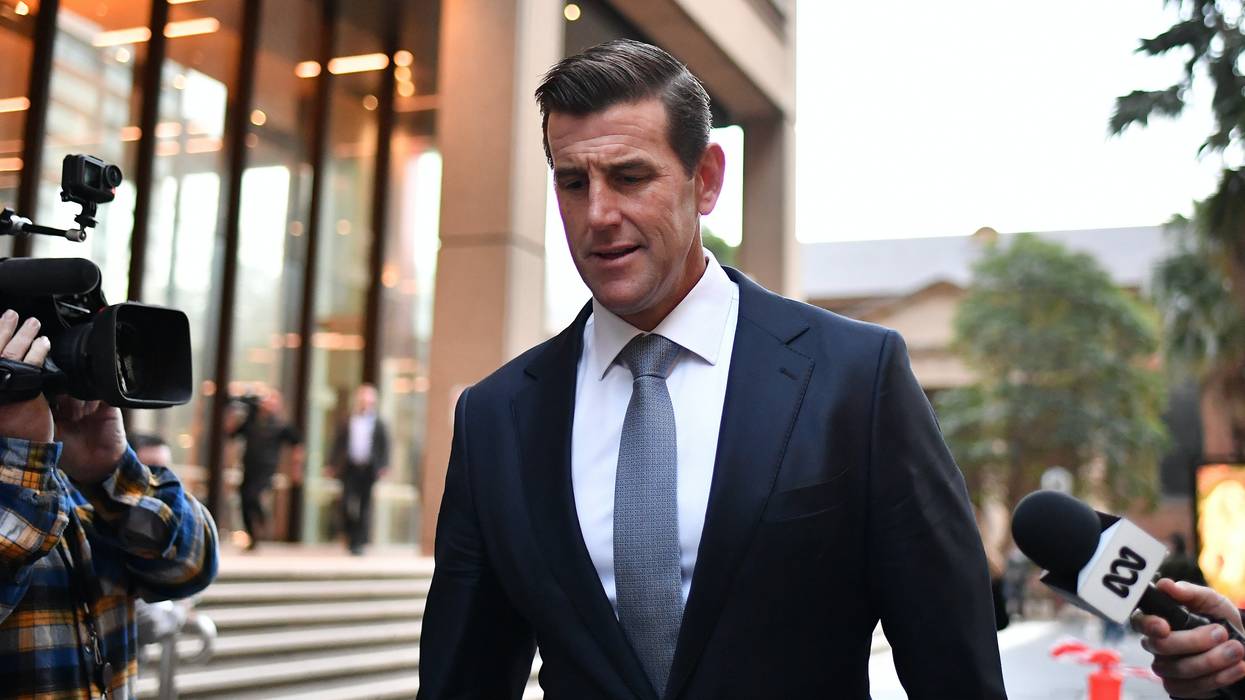
"Today is a day of justice. It's a day of justice for those brave men of the SAS who stood up and told the truth about who Ben Roberts-Smith is—a war criminal, a bully, and a liar," said one of the journalists sued for defamation.
An Australian federal judge on Thursday ruled in favor of three newspapers sued for defamation by the country's most decorated living soldier, who the court found committed war crimes in Afghanistan, including the murder of civilians and unarmed prisoners.
Following harrowing testimony from fellow soldiers, Afghan civilians, and others, Justice Anthony Besanko of the Federal Court of Australia ruled that Fairfax Media newspapers The Age, The Sydney Morning Herald, and The Canberra Times had "established the substantial truth" that former Special Air Service Regiment [SASR] Cpl. Ben Roberts-Smith is a war criminal who murdered four unarmed prisoners in Afghanistan.
Roberts-Smith—whose multimillion-dollar defense was bankrolled by billionaire Australian media mogul Kerry Stokes—is a recipient of the Victoria Cross for Australia, the nation's highest military honor, as well as other awards including the Medal for Gallantry and Commendation for Distinguished Service. He fought in the U.S.-led wars in Afghanistan and Iraq.
"Today is a day of justice. It's a day of justice for those brave men of the SAS who stood up and told the truth about who Ben Roberts-Smith is: a war criminal, a bully, and a liar," Sydney Morning Herald and The Age journalist Nick McKenzie—a defendant in the suit—said following the ruling. "Today is a day of some small justice for the Afghan victims of Ben Roberts-Smith."
Besanko found that in 2012 Roberts-Smith marched a handcuffed civilian prisoner named Ali Jan to a cliff in the southern village of Darwan and kicked him off the edge. Jan survived but was severely injured; Roberts-Smith ordered a subordinate soldier to execute the man.
"Ali Jan was a father, Ali Jan was a husband. He has children who no longer have a father. He was a wife who no longer has a husband," McKenzie said.
While Roberts-Smith argued Jan was a suspected Taliban scout, Besanko wrote that the soldier "murdered an unarmed and defenseless Afghan civilian," that he "broke the moral and legal rules of military engagement and is therefore a criminal," and that he "disgraced his country Australia and the Australian army by his conduct as a member of the SASR in Afghanistan."
In 2009, Roberts-Smith is alleged to have pressured a newly deployed soldier to execute an elderly Afghan man found hiding in a tunnel in order to "blood the rookie," according to the court. Roberts-Smith machine-gunned the man's younger disabled companion to death and then used his prosthetic leg as a novelty beer-drinking vessel, an act the court called "callous and inhumane."
Besanko also found that Roberts-Smith bullied a fellow soldier, while finding that the papers did not prove an allegation that he punched a woman with whom he was having an affair in the face after a 2018 argument in Canberra.
University of Sydney professor David Rolph, a defamation law expert, told the Herald that the court's judgment "is a comprehensive victory for the media outlets" and "a vindication of the journalism in question."
"Defamation losses have a chilling effect for the media, particularly for serious investigative journalism," he added. "This decision should give media outlets some confidence that they can undertake public-interest journalism and prevail."
Sen. David Shoebridge (Green-New South Wales) called Besanko's ruling "an important win for fearless journalism in the public interest."
"It's a tragic fact that private media companies, not any part of the federal government, have taken on the public task of telling the truth about Australia's war record in Afghanistan," Shoebridge told the Herald. "The official silence must now end."
In 2017, the Australian Broadcasting Corporation obtained leaked documents—known as the Afghan Files—detailing SASR war crimes such as the murder of unarmed civilians including children. A subsequent parliamentary probe confirmed the commission of war crimes by Australian troops in Afghanistan between 2005 and 2016.
On Wednesday, Reuters reported Australian defense chief Gen. Angus Campbell was warned by the United States—which has a long history of war crimes in Afghanistan and other countries invaded or attacked during the open-ended War on Terror—that allegations of SAS atrocities could trigger the Leahy Law, which prohibits military assistance to countries that violate human rights with impunity.
Troops from other coalition forces—including Afghans, British, Germans, Polish, and Canadians—have committed or been complicit in atrocities during the Afghan war, as have Taliban, al-Qaeda, and Islamic State fighters.
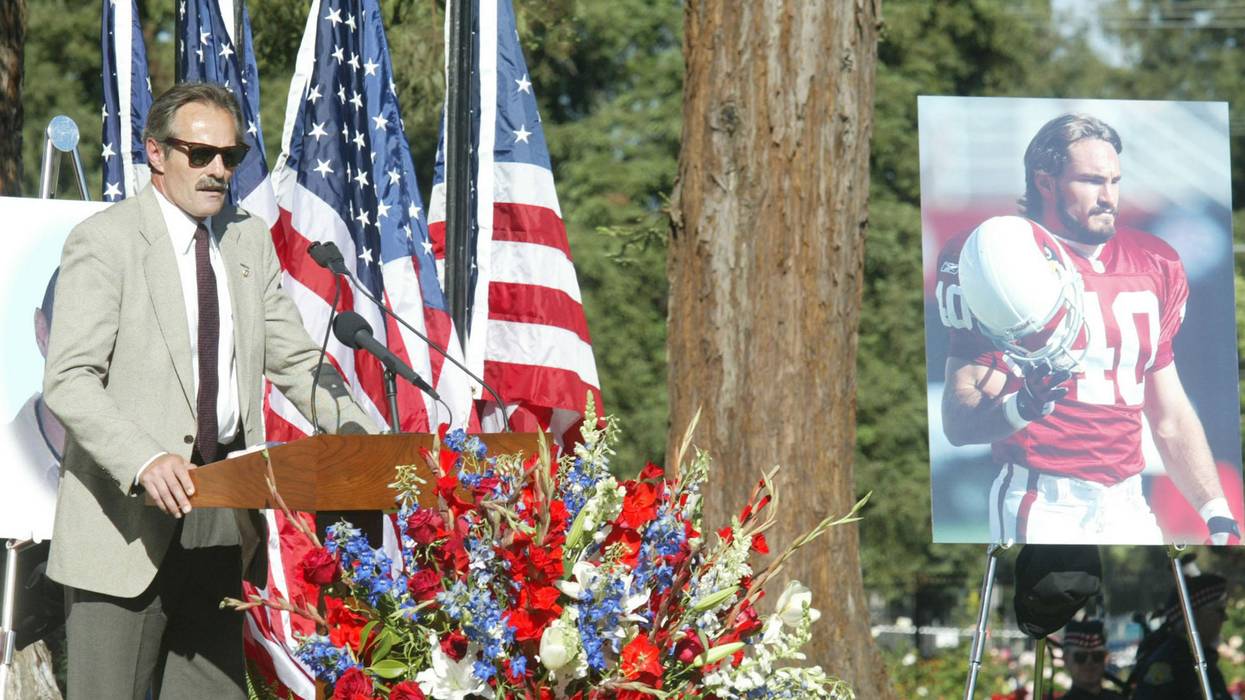
One journalist reminded readers that the NFL star and Army Ranger "called the Iraq invasion and occupation 'fucking illegal' and was killed by friendly fire in an incident the military covered up and tried to hide from his family."
Advocates of peace, truth, and basic human decency on Sunday excoriated the National Football League's "whitewashing" of former Arizona Cardinal and Army Ranger Pat Tillman's death in Afghanistan by so-called "friendly fire" and the military's subsequent cover-up—critical details omitted from a glowingly patriotic Super Bowl salute.
As a group of four Pat Tillman Foundation scholars chosen as honorary coin-toss captains at Super Bowl LVII in Glendale, Arizona were introduced via a video segment narrated by actor Kevin Costner, viewers were told how Tillman "gave up his NFL career to join the Army Rangers and ultimately lost his life in the line of duty."
The video did not say how Tillman died, what he thought about the Iraq war, or how the military lied to his family and the nation about his death. This outraged many viewers.
"Obviously the army killing Pat Tillman and covering it up afterwards is the worst thing the U.S. military did to him, but the years they've spent rolling out his portrait backed by some inspirational music as a recruiting tool is a surprisingly close second," tweeted progressive writer Jay Willis.
"Pat Tillman called the Iraq invasion and occupation 'fucking illegal' and was killed by friendly fire in an incident the military covered up and tried to hide from his family," tweeted Washington Post investigative reporter Evan Hill.
"I'm writing a book for FIRST GRADERS on Pat Tillman that contains more truth about his life and death than the NFL just provided at the Super Bowl," wrote author Andrew Maraniss.
"Another year of hijacking the Pat Tillman story and not telling that he hated the Iraq War and was killed by the military," said one Twitter user.
"Tell the real story of Pat Tillman or get off the screen," fumed yet another.
Tillman, 25 years old at the time, turned down a $3.6 million contract with the Cardinals to enlist in the U.S. Army in May 2002 after the 9/11 attacks on the United States. He expected to be deployed to Afghanistan. Instead, he was sent to invade Iraq—a country that had no ties to 9/11. Tillman quickly came to deplore the "fucking illegal" war, and even made "loose plans" to meet with anti-war intellectual Noam Chomsky, according to The Intercept's Ryan Devereaux.
As Tillman's brother Kevin sardonically wrote:
Somehow we were sent to invade a nation because it was a direct threat to the American people, or to the world, or harbored terrorists, or was involved in the September 11 attacks, or received weapons-grade uranium from Niger, or had mobile weapons labs, or WMD, or had a need to be liberated, or we needed to establish a democracy, or stop an insurgency, or stop a civil war we created that can't be called a civil war even though it is. Something like that.
Pat and Kevin were sent to Afghanistan on April 8, 2004. Stationed at a forward operating base in Khost province, Pat was killed on April 22, 2004 by what the army said was "enemy fire" during a firefight.
However, the army knew in the days immediately following Tillman's death that he had been shot three times in the head from less than 30 feet away by so-called "friendly fire," and that U.S. troops had burned his uniform and body armor in a bid to conceal their fatal error.
"The deception surrounding this case was an insult to the family, but more importantly, its primary purpose was to deceive a whole nation," Kevin Tillman testified before Congress in 2007. "We say these things with disappointment and sadness for our country. Once again, we have been used as props in a Pentagon public relations exercise."
Hearing on Tillman, Lynch Incidents: Kevin Tillman's Openingwww.youtube.com
Tillman's father, Patrick Tillman Sr., told the Washington Post in 2005 that after his son was killed, "all the people in positions of authority went out of their way to script this. They purposely interfered with the investigation, they covered it up."
"I think they thought they could control it, and they realized that their recruiting efforts were going to go to hell in a handbasket if the truth about his death got out," he contended. "They blew up their poster boy."
The following year, Tillman's mother Mary was interviewed by Sports Illustrated and blamed U.S. military and George W. Bush administration officials all the way up to then-Defense Secretary Donald Rumsfeld for covering up her son's killing.
"They attached themselves to his virtue and then threw him under the bus," she said. "They had no regard for him as a person. He'd hate to be used for a lie. I don't care if they put a bullet through my head in the middle of the night. I'm not stopping."
Former Secretary of State Madeleine Albright tried to issue a mea culpa in The New York Times last week for her recent remarks suggesting that women who are not planning to vote for her friend Hillary Clinton should be condemned to hell. Although it was "the wrong context and the wrong time to use that line," Albright wrote, "I so firmly believe that even today, women have an obligation to help one another."
She added:
The battle for gender equality is still being waged, and it will be easier if we have a woman who prioritizes these issues in the Oval Office and if the gender balance among elected officials reflects that of our country. When women are empowered to make decisions, society benefits. They will raise issues, pass bills and put money into projects that men might overlook or oppose.
Of course, the more women make decisions, the more likely it is that women-centered policies will emerge. However, having female politicians in office does not ensure that feminism, progressive values, or compassion are priorities. To assume so is sexist.
Women like Albright and Clinton--who have climbed the ladders of the political establishment--are to be strongly commended for the chauvinist barriers they have undoubtedly faced and overcome. But in breaking through the glass ceiling, they have conducted themselves first and foremost as skillful politicians rather than as progressive women.
Reading Albright's op-ed reminded me of Afghanistan, a different arena in which the same dynamic has played out.
Remember that the war in Afghanistan was supported by liberals and conservatives, Democrats and Republicans alike. After a GOP president started the war, a Democratic president continued it. Rebuilding a post-Taliban Afghanistan that was friendly to women was touted as one of the outstanding post-9/11 U.S. foreign policy achievements--except that it didn't work. Today, Afghanistan is such a hostile place for women that they might as well be living under the Taliban, as the horrific fatal beating of a young woman by a mob showed last year.
In the aftermath of the Taliban's fall in 2001, women in Washington often spoke about rebuilding the country in a way that ensured that "women had a seat at the table." Indeed, this language has become so ubiquitous that it is now shorthand for women's equality and human rights. The image of a sizeable diplomatic roundtable bringing together all the "stakeholders" (another favored term)--armed warlords and Taliban as well as "women" (any women will do)--conjures up an idealistic vision of democracy and peace. It is a vision that has proved to be empty.
As Afghanistan demonstrated, any woman that the country's myriad fundamentalist armed commanders (most of whom have at some point been beneficiaries of U.S. largesse) would accept would be a woman who would not challenge their power. Clinton (along with Laura Bush) upheld such intellectually bankrupt notions of women's rights through her work with the U.S.-Afghan Women's Council. Educated and well-placed liberal Afghan women were trained to speak with the media and thrust into positions of power as placeholders to demonstrate that women's rights had been achieved. Yet it turns out that most Afghan women in the country's new parliament are "sisters and wives of warlords or tribal leaders chosen merely to fill the required quota of women."
One notable exception was Malalai Joya, the fiery young feminist activist who was legitimately elected to parliament by her community and who spoke out forcefully for women's rights and against domestic warlords and foreign occupiers. But Afghanistan's parliament wasn't designed for women like Joya. It was designed (by the U.S.) to achieve a superficial victory for democracy by showcasing the mere presence of women. Any feminist members of parliament who attempted to exercise their rights in the interests of all women--and ordinary Afghans in general--were excoriated, and her nemeses eventually kicked out Joya. You cannot simply seat women at a table full of armed woman-haters and magically produce democracy and justice.
The same sort of women in Washington, D.C.--including Clinton and Albright--want us to believe that placing a woman, specifically a woman who will not rock the boat, in the White House is a panacea for women's rights. Ordinary American women are expected to celebrate this as a victory, whether it impacts their lives positively and practically or not.
This is the type of identity politics that has long been favored by the U.S. liberal establishment precisely because it distracts us from the political demands of progressive and independent voters.
Eight years ago, we saw a similar dynamic play out in the election of Barack Obama. Most Americans voted for him, first and foremost, because he wasn't George W. Bush but also the ideal demographic alternative to Bush--a blank slate upon whom we could write our hopes and dreams. He could be anything to anybody, just about. The fact that he would be the first black president was the best part of it.
However, Obama was never the progressive candidate we imagined him to be, no matter how much we wanted it. Campaign adviser Anita Dunn, in a recent interview with Ezra Klein, said, "Obama had significant establishment support in his campaign, including from the traditional Democratic donor base." She added, "Obama promised change, not a revolution." Obama's former chief strategist David Axelrod told Klein, "Obama's was not an ideological campaign. There was a big difference in the war, but Obama was not the candidate of the left." Obama's nearly two full terms as president reveal how moderate and pragmatic his approach has been.
Clinton is banking on voters seeing her through a similar lens--as a candidate whose female gender will be enough to quell desires for change and distract the electorate from her Wall Street campaign donations, sizeable personal wealth, foreign policy disasters, and former board membership at Walmart.
Clinton wants voters to see her as a successful woman who has broken through the political glass ceiling and earned her credentials as commander-in-chief. Indeed, through the Clinton Foundation, the former secretary of state initiated a program called No Ceilings: The Full Participation Project, aimed at the "full and equal participation of women in political, civil, economic, social and cultural life." Such a program reflects a standard liberal feminist approach to women's rights that ignores the fact that all women need to have the floor raised to break through any ceilings. The full rights of women to food, water, shelter, education, employment, and health care are subservient to tokenism in political arenas that often keep people who are at the bottom well.
No one doubts that Clinton and Albright are brilliant, tough, and experienced women who are probably overqualified for their jobs compared to their male counterparts. However, none means anything to voters tired of prevailing conditions if their political values tend toward preserving the status quo. Feminism cannot be defined solely by helping the highest-achieving women get a "seat at the table."
While the problems that American women face are far smaller echoes of what Afghan women face, as Afghanistan's continued misogyny has shown, putting establishment women into positions of power only ensures one thing--that the establishment view will prevail. That is just as true in the U.S. as it is in Afghanistan.
War on drugs. War on poverty. War in Afghanistan. War in Iraq. War on terror. The biggest mistake in American policy, foreign and domestic, is looking at everything as war. When a war mentality takes over, it chooses the weapons and tactics for you. It limits the terms of debate before you even begin. It answers questions before they're even asked.
When you define something as war, it dictates the use of the military (or militarized police forces, prisons, and other forms of coercion) as the primary instruments of policy. Violence becomes the means of decision, total victory the goal. Anyone who suggests otherwise is labeled a dreamer, an appeaser, or even a traitor.
War, in short, is the great simplifier -- and it may even work when you're fighting existential military threats (as in World War II). But it doesn't work when you define every problem as an existential one and then make war on complex societal problems (crime, poverty, drugs) or ideas and religious beliefs (radical Islam).
America's Omnipresent War Ethos
Consider the Afghan War -- not the one in the 1980s when Washington funneled money and arms to the fundamentalist Mujahideen to inflict on the Soviet Union a Vietnam-style quagmire, but the more recent phase that began soon after 9/11. Keep in mind that what launched it were those attacks by 19 hijackers (15 of whom were Saudi nationals) representing a modest-sized organization lacking the slightest resemblance to a nation, state, or government. There was as well, of course, the fundamentalist Taliban movement that then controlled much of Afghanistan. It had emerged from the rubble of our previous war there and had provided support and sanctuary, though somewhat grudgingly, to Osama bin Laden.
With images of those collapsing towers in New York burned into America's collective consciousness, the idea that the U.S. might respond with an international "policing" action aimed at taking criminals off the global streets was instantly banished from discussion. What arose in the minds of the Bush administration's top officials instead was vengeance via a full-scale, global, and generational "war on terror." Its thoroughly militarized goal was not just to eliminate al-Qaeda but any terror outfits anywhere on Earth, even as the U.S. embarked on a full-fledged experiment in violent nation building in Afghanistan. More than 13 dismal years later, that Afghan War-cum-experiment is ongoing at staggering expense and with the most disappointing of results.
While the mindset of global war was gaining traction, the Bush administration launched its invasion of Iraq. The most technologically advanced military on Earth, one that the president termed "the greatest force for human liberation the world has ever known," was set loose to bring "democracy" and a Pax Americana to the Middle East. Washington had, of course, been in conflict with Iraq since Operation Desert Storm in 1990-1991, but what began as the equivalent of a military coup (aka a "decapitation" operation) by an outside power, an attempt to overthrow Saddam Hussein and eliminate his armed forces and party, soon morphed into a prolonged occupation and another political and social experiment in violent nation-building. As with Afghanistan, the Iraq experiment with war is still ongoing at enormous expense and with even more disastrous results.
Radical Islam has drawn strength from these American-led "wars." Indeed, radical Islamists cite the intrusive and apparently permanent presence of American troops and bases in the Middle East and Central Asia as confirmation of their belief that U.S. forces are leading a crusade against them -- and by extension against Islam itself. (And in a revealing slip of the tongue, President Bush did indeed once call his war on terror a "crusade.") Considered in these terms, such a war is by definition a losing effort because each "success" only strengthens the narrative of Washington's enemies. There's simply no way to win such a war except by stopping it. Yet that course of action is never on the proverbial "table" of options from which officials in Washington are said to choose their strategies. To do so, in the context of war thinking, would mean to admit defeat (even though true defeat arrived the very instant the problem was first defined as war).
Our leaders persist in such violent folly at least in part because they fear the admission of defeat above all else. After all, nothing is more pejorative in American politics or culture than to be labeled a loser in war, someone who "cuts and runs."
In the 1960s, despite his own serious misgivings about the ongoing conflict in Vietnam, President Lyndon B. Johnson set the gold standard in his determination not to be the first American president to lose a war, especially in a "damn little pissant country" like Vietnam. So he persisted -- and the conflict turned him into a loser anyway and destroyed his presidency.
Even as he waged war, as historian George Herring has noted, LBJ did not want to be known as a "war president." Two generations later, another Texan, George W. Bush, grasped the "war president" moniker with genuine enthusiasm. He, too, vowed he would win his war when things started to go sour. Staring down a growing insurgency in Iraq in the summer of 2003, Bush did not shy from the challenge. "Bring 'em on," he said in what was supposed to be a Clint Eastwood/Dirty Harry-style moment. Now, Washington is sending troops back into Iraq for the third time to engage an even more intractable insurgency, the Islamic State's radical version of Islam, a movement originally fed and bred partly in Camp Bucca, an American military prison in Iraq.
And just to set the record straight, President Obama, too, accepted the preeminence of war in American policy in his 2009 Nobel Prize acceptance speech in Oslo. There, he offered a stirring defense of America's role and record as "the world's sole military superpower":
"Whatever mistakes we have made, the plain fact is this: the United States of America has helped underwrite global security for more than six decades with the blood of our citizens and the strength of our arms. The service and sacrifice of our men and women in uniform has promoted peace and prosperity from Germany to Korea, and enabled democracy to take hold in places like the Balkans. We have borne this burden not because we seek to impose our will. We have done so out of enlightened self-interest -- because we seek a better future for our children and grandchildren, and we believe that their lives will be better if other peoples' children and grandchildren can live in freedom and prosperity."
It was a moment that defined the Obama presidency as being remarkably in tune with America's already omnipresent war ethos. It was the very negation of "hope" and "change" and the beginning of Obama's transition, via the CIA's drone assassination program, into the role of assassin-in-chief.
Everything Is Jihad
Recent American leaders have something in common with their extremist Islamic counterparts: all of them define everything, implicitly or explicitly, as a jihad, a crusade, a holy war. But the violent methods used in pursuit of various jihads, whether Islamic or secular, simply serve to perpetuate and often aggravate the struggle.
Think of America's numerous so-called wars and consider if there's been any measurable progress made in any of them. Lyndon Johnson declared a "war on poverty" in 1964. Fifty-one years later, there are still startling numbers of desperately poor people and, in this century, the gap between the poorest many and richest few has widened to a chasm. (Since the days of President Ronald Reagan, in fact, one might speak of a war on the poor, not poverty.) Drugs? Forty-four years after President Richard Nixon proclaimed the war on drugs, there are still millions in jail, billions being spent, and drugs galore on the streets of American cities. Terror? Thirteen years and counting after that "war" was launched, terror groups, minor in numbers and reach in 2001, have proliferated wildly and there is now something like a "caliphate" -- once an Osama bin Laden fantasy -- in the Middle East: ISIS in power in parts of Iraq and Syria, al-Qaeda on the rise in Yemen, Libya destabilized and divvied up among ever more extreme outfits, innocents still dying in U.S. drone strikes. Afghanistan? The opium trade has rebounded big time, the Taliban is resurgent, and the region is being destabilized. Iraq? A cauldron of ethnic and religious rivalries and hatreds, with more U.S. weaponry on the way to fuel the killing, in a country that functionally no longer exists. The only certainty in most of these American "wars" is their violent continuation, even when their original missions lie in tatters.
The very methods the U.S. employs and the mentality its leaders adopt ensure their perpetuation. Why? Because drug addiction and abuse can't be conquered by waging a war. Neither can poverty. Neither can terror. Neither can radical Islam be defeated through armed nation building. Indeed, radical Islam thrives on the very war conditions that Washington helps to create. By fighting in the now familiar fashion, you merely fan its flames and ensure its propagation.
It's the mindset that matters. In places like Iraq and Afghanistan, places that for most Americans exist only within a "war" matrix, the U.S. invades or attacks, gets stuck, throws resources at the problem indiscriminately, and "makes a desert and calls it 'peace'" (to quote the Roman historian Tacitus). After which our leaders act surprised as hell when the problem only grows.
Sadly, the song remains monotonously the same in America: more wars, made worse by impatience for results driven by each new election cycle. It's a formula in which the country is eternally fated to lose.
Two Curious Features of America's New Wars
Historically, when a nation declares war, it does so to mobilize national will, as the U.S. clearly did in World War II. Accompanying our wars of recent decades, however, has been an urge not to mobilize the people, but demobilize them -- even as the "experts" are empowered to fight and taxpayer funds pour into the national security state and the military-industrial complex to keep the conflicts going.
Recent wars, whether on drugs or in the Greater Middle East, are never presented as a challenge we the people can address and solve together, but as something only those who allegedly possess the expertise and credentials -- and the weapons -- can figure out or fight. George W. Bush summed up this mindset in classic fashion after 9/11 when he urged Americans to go shopping and visit Disney World and leave the fighting to the pros. War, in short, has become yet another form of social control. Have a gun or a badge of some sort and you can speak forcefully and be listened to; otherwise, you have no say.
In addition, what makes America's new wars unique to our moment is that they never have a discernible endpoint. For what constitutes "victory" over drugs or terror? Once started, these wars by definition are hard to stop.
Cynics may claim there's nothing new here. Hasn't America always been at war? Haven't we always been a violent people? There's truth in this. But at least Americans of my grandfather's and father's generation didn't define themselves by war.
What America needs right now is a 12-step program to break the urge to feed further our national addiction to war. The starting point for Washington -- and Americans more generally -- would obviously have to be taking that first step and confessing that we have a problem we alone can't solve. "Hi, I'm Uncle Sam and I'm a war-oholic. Yes, I'm addicted to war. I know it's destructive to myself and others. But I can't stop -- not without your help."
True change often begins with confession. With humility. With an admission that not everything is within one's control, no matter how violently one rages; indeed, that violent rage only aggravates the problem. America needs to make such a confession. Only then can we begin to wean ourselves off war.
Moath al-Alwi, who has been a prisoner of the U.S. government and detained at the offshore prison at Guantanamo Bay, Cuba since 2002 without ever being charged with a crime or afforded a trial, has a simple yet urgent question for the American people and the U.S. government: Why am I still here?
"The world may turn a blind eye and find this number small. But for each of us here, the cost of our indefinite and unfair imprisonment is beyond immeasurable. Our families have lost fathers, brothers, husbands, and sons to this hell on earth. Many of us have unnecessarily lost over a decade of our already short time in this world, yearning to be free again."
--Moath al-Alwi
If the war in Afghanistan is now over, as he has heard President Obama and other lawmakers say many times, the Yemeni national wonders what possible reason could the U.S. have in keeping a man like himself--guilty of no crime--locked away on an island prison for nearly thirteen years.
Despite the protests of dedicated human rights and legal activists in the U.S. and around the world, the fact that the U.S. government continues to justify the "indefinite detention" of human beings for a war that has become detached from geographical boundaries and has no end date, remains one of the most glaring, yet ignored, realities of post-9/11 America.
In a strikingly personal piece that has now appeared in both Al-Jazeera English and The Nation, al-Alwi expresses his grief, anger, and frustrations. "I wonder now," he writes, "if the U.S. follows any rule of law at all: the Geneva Conventions or even its own Constitution. Where is the freedom and justice for all that it so proudly boasts to the world?"
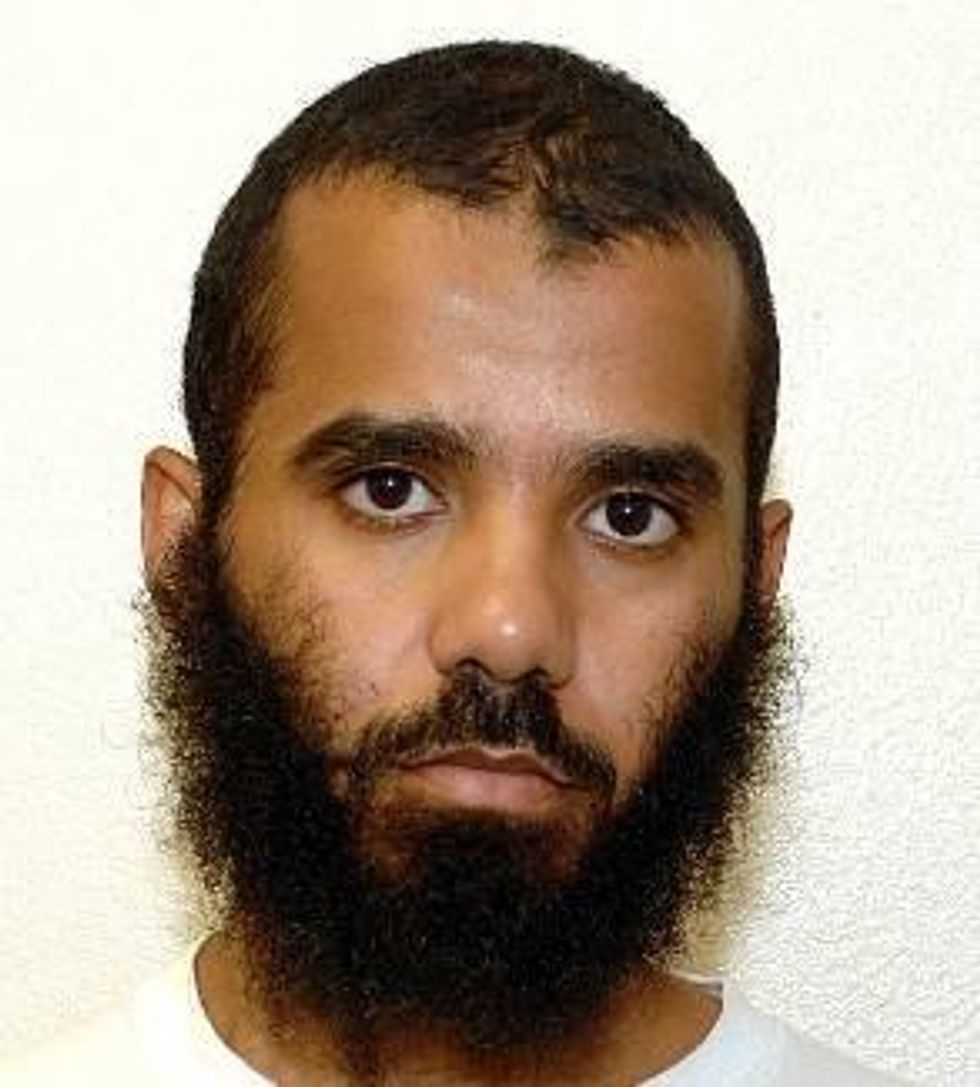
Un-edited and in full, his missive to those who hold him captive follows:
I hear the war in Afghanistan is over.
This war was supposedly the reason I remained trapped, rotting in this endless horror at Guantanamo Bay. I write this letter today to ask, if this war has ended, why am I still here? Why has nothing changed?
Amid falling bombs and mass hysteria, I fled Afghanistan for safety when the US launched its military operations in 2001. I was abducted despite never fighting against the United States, was sold into US military custody, and then imprisoned, tortured, and abused at Guantanamo since 2002 without ever being charged with a single crime.
I protest this injustice by hunger striking, refusing food and sometimes water.One of Guantanamo's long-term hunger strikers, I am a frail man now, weighing only 96 pounds (44kg) at 5'5" (1.68m).
Recently, my latest strike surpassed its second year. My health is deteriorating rapidly, but my intention to continue my strike is steadfast. I do not want to kill myself. My religion prohibits suicide. But despite daily bouts of violent vomiting and sharp pain, I will not eat or drink to peacefully protest against the injustice of this place. My protest is the one form of control I have of my own life and I vow to continue it until I am free.
I remain on lockdown alone in my cell 22 hours a day. Despite my condition, prison authorities unleash an entire riot squad of six giant guards to forcibly extract me from my cell, restrain me onto a chair and brutally force-feed me daily. They push a thick tube down my nose until I bleed, after which I vomit.
This gruesome procedure may not be written about so much any more, but it remains my everyday reality. It is painful. And it is bewildering. How can I possibly resist anyone, let alone these men? Hunger striking is a form of peaceful and civil disobedience. It is not a crime. So why am I being punished? Why not humanely tube-feed me instead?
My time here has been ridden with unanswered questions. Two years ago, as I attempted to pray, a sudden raid was ordered and a guard deliberately shot me without warning or provocation. Once again, I was not resisting. So why did he shoot? My clothes, torn, were soaked in my own blood. I want the government to ask the guard who shot me to account for his actions.
I began to wonder if shooting without any provocation is legal in the US. But now I realise that US police officers get away with ruthlessly killing black people all the time.
I wonder now if the US follows any rule of law at all: the Geneva Conventions or even its own Constitution. Where is the freedom and justice for all that it so proudly boasts to the world?
For us at Guantanamo, this place is not fit for any living, breathing, human being. The US seems to want to smother us, to kill us slowly as we are left in a vacuum of uncertainty wondering if we will ever be free.
I have lived the past 13 years in this despair, at the cost of my dignity, paying the price for the US government's political theatre. Meanwhile, little has changed for the 122 men remaining at Guantanamo.
The world may turn a blind eye and find this number small. But for each of us here, the cost of our indefinite and unfair imprisonment is beyond immeasurable. Our families have lost fathers, brothers, husbands, and sons to this hell on earth. Many of us have unnecessarily lost over a decade of our already short time in this world, yearning to be free again.
First, they tried to shoot the dogs. Next, they tried to poison them with strychnine. When both failed as efficient killing methods, British government agents and U.S. Navy personnel used raw meat to lure the pets into a sealed shed. Locking them inside, they gassed the howling animals with exhaust piped in from U.S. military vehicles. Then, setting coconut husks ablaze, they burned the dogs' carcasses as their owners were left to watch and ponder their own fate.
The truth about the U.S. military base on the British-controlled Indian Ocean island of Diego Garcia is often hard to believe. It would be easy enough to confuse the real story with fictional accounts of the island found in the Transformersmovies, on the television series 24, and in Internet conspiracy theories about the disappearance of Malaysia Airlines flight MH370.
While the grim saga of Diego Garcia frequently reads like fiction, it has proven all too real for the people involved. It's the story of a U.S. military base built on a series of real-life fictions told by U.S. and British officials over more than half a century. The central fiction is that the U.S. built its base on an "uninhabited" island. That was "true" only because the indigenous people were secretly exiled from the Chagos Archipelago when the base was built. Although their ancestors had lived there since the time of the American Revolution, Anglo-American officials decided, as one wrote, to "maintain the fiction that the inhabitants of Chagos [were] not a permanent or semi-permanent population," but just "transient contract workers." The same official summed up the situation bluntly: "We are able to make up the rules as we go along."
And so they did: between 1968 and 1973, American officials conspired with their British colleagues to remove the Chagossians, carefully hiding their expulsion from Congress, Parliament, the U.N., and the media. During the deportations, British agents and members of a U.S. Navy construction battalion rounded up and killed all those pet dogs. Their owners were then deported to the western Indian Ocean islands of Mauritius and the Seychelles, 1,200 miles from their homeland, where they received no resettlement assistance. More than 40 years after their expulsion, Chagossians generally remain the poorest of the poor in their adopted lands, struggling to survive in places that outsiders know as exotic tourist destinations.
During the same period, Diego Garcia became a multi-billion-dollar Navy and Air Force base and a central node in U.S. military efforts to control the Greater Middle East and its oil and natural gas supplies. The base, which few Americans are aware of, is more important strategically and more secretive than the U.S. naval base-cum-prison at Guantanamo Bay, Cuba. Unlike Guantanamo, no journalist has gotten more than a glimpse of Diego Garcia in more than 30 years. And yet, it has played a key role in waging the Gulf War, the 2003 invasion of Iraq, the U.S.-led war in Afghanistan, and the current bombing campaign against the Islamic State in Syria and Iraq.
Following years of reports that the base was a secret CIA "black site" for holding terrorist suspects and years of denials by U.S. and British officials, leaders on both sides of the Atlantic finally fessed up in 2008. "Contrary to earlier explicit assurances," said Secretary of State for Foreign and Commonwealth Affairs David Miliband, Diego Garcia had indeed played at least some role in the CIA's secret "rendition" program.
Last year, British officials claimed that flight log records, which might have shed light on those rendition operations, were "incomplete due to water damage" thanks to "extremely heavy weather in June 2014." A week later, they suddenly reversed themselves, saying that the "previously wet paper records have been dried out." Two months later, they insisted the logs had not dried out at all and were "damaged to the point of no longer being useful." Except that the British government's own weather data indicates that June 2014 was an unusually dry month on Diego Garcia. A legal rights advocate said British officials "could hardly be less credible if they simply said 'the dog ate my homework.'"
And these are just a few of the fictions underlying the base that occupies the Chagossians' former home and that the U.S. military has nicknamed the "Footprint of Freedom." After more than four decades of exile, however, with a Chagossian movement to return to their homeland growing, the fictions of Diego Garcia may finally be crumbling.
No "Tarzans"
The story of Diego Garcia begins in the late eighteenth century. At that time, enslaved peoples from Africa, brought to work on Franco-Mauritian coconut plantations, became the first settlers in the Chagos Archipelago. Following emancipation and the arrival of indentured laborers from India, a diverse mixture of peoples created a new society with its own language, Chagos Kreol. They called themselves the Ilois -- the Islanders.
While still a plantation society, the archipelago, by then under British colonial control, provided a secure life featuring universal employment and numerous social benefits on islands described by many as idyllic. "That beautiful atoll of Diego Garcia, right in the middle of the ocean," is how Stuart Barber described it in the late 1950s. A civilian working for the U.S. Navy, Barber would become the architect of one of the most powerful U.S. military bases overseas.
Amid Cold War competition with the Soviet Union, Barber and other officials were concerned that there was almost no U.S. military presence in and around the Indian Ocean. Barber noted that Diego Garcia's isolation -- halfway between Africa and Indonesia and 1,000 miles south of India -- ensured that it would be safe from attack, yet was still within striking distance of territory from southern Africa and the Middle East to South and Southeast Asia.
Guided by Barber's idea, the administrations of John F. Kennedy and Lyndon Johnson convinced the British government to detach the Chagos Archipelago from colonial Mauritius and create a new colony, which they called the British Indian Ocean Territory. Its sole purpose would be to house U.S. military facilities.
During secret negotiations with their British counterparts, Pentagon and State Department officials insisted that Chagos come under their "exclusive control (without local inhabitants)," embedding an expulsion order in a polite-looking parenthetical phrase. U.S. officials wanted the islands "swept" and "sanitized." British officials appeared happy to oblige, removing a people one official called "Tarzans" and, in a racist reference to Robinson Crusoe, "Man Fridays."
"Absolutely Must Go"
This plan was confirmed with an "exchange of notes" signed on December 30, 1966, by U.S. and British officials, as one of the State Department negotiators told me, "under the cover of darkness." The notes effectively constituted a treaty but required no Congressional or Parliamentary approval, meaning that both governments could keep their plans hidden.
According to the agreement, the United States would gain use of the new colony "without charge." This was another fiction. In confidential minutes, the United States agreed to secretly wipe out a $14 million British military debt, circumventing the need to ask Congress for funding. In exchange, the British agreed to take the "administrative measures" necessary for "resettling the inhabitants."
Those measures meant that, after 1967, any Chagossians who left home for medical treatment or a routine vacation in Mauritius were barred from returning. Soon, British officials began restricting the flow of food and medical supplies to Chagos. As conditions deteriorated, more islanders began leaving. By 1970, the U.S. Navy had secured funding for what officials told Congress would be an "austere communications station." They were, however, already planning to ask for additional funds to expand the facility into a much larger base. As the Navy's Office of Communications and Cryptology explained, "The communications requirements cited as justification are fiction." By the 1980s, Diego Garcia would become a billion-dollar garrison.
In briefing papers delivered to Congress, the Navy described Chagos's population as "negligible," with the islands "for all practical purposes... uninhabited." In fact, there were around 1,000 people on Diego Garcia in the 1960s and 500 to 1,000 more on other islands in the archipelago. With Congressional funds secured, the Navy's highest-ranking admiral, Elmo Zumwalt, summed up the Chagossians' fate in a 1971 memo of exactly three words: "Absolutely must go."
The authorities soon ordered the remaining Chagossians -- generally allowed no more than a single box of belongings and a sleeping mat -- onto overcrowded cargo ships destined for Mauritius and the Seychelles. By 1973, the last Chagossians were gone.
"Abject Poverty"
At their destinations, most of the Chagossians were literally left on the docks, homeless, jobless, and with little money. In 1975, two years after the last removals, a Washington Post reporter found them living in "abject poverty."
Aurelie Lisette Talate was one of the last to go. "I came to Mauritius with six children and my mother," she told me. "We got our house... but the house didn't have a door, didn't have running water, didn't have electricity. And then my children and I began to suffer. All my children started getting sick."
Within two months, two of her children were dead. The second was buried in an unmarked grave because she lacked money for a proper burial. Aurelie experienced fainting spells herself and couldn't eat. "We were living like animals. Land? We had none... Work? We had none. Our children weren't going to school."
Today, most Chagossians, who now number more than 5,000, remain impoverished. In their language, their lives are ones of lamizer(impoverished misery) and sagren (profound sorrow and heartbreak over being exiled from their native lands). Many of the islanders attribute sickness and even death to sagren. "I had something that had been affecting me for a long time, since we were uprooted," was the way Aurelie explained it to me. "This sagren, this shock, it was this same problem that killed my child. We weren't living free like we did in our natal land."
Struggling for Justice
From the moment they were deported, the Chagossians demanded to be returned or at least properly resettled. After years of protest, including five hunger strikes led by women like Aurelie Talate, some in Mauritius received the most modest of compensation from the British government: small concrete houses, tiny plots of land, and about $6,000 per adult. Many used the money to pay off large debts they had accrued. For most, conditions improved only marginally. Those living in the Seychelles received nothing.
The Chagossian struggle was reinvigorated in 1997 with the launching of a lawsuit against the British government. In November 2000, the British High Court ruled the removal illegal. In 2001 and 2002, most Chagossians joined new lawsuits in both American and British courts demanding the right to return and proper compensation for their removal and for resettling their islands. The U.S. suit was ultimately dismissed on the grounds that the judiciary can't, in most circumstances, overrule the executive branch on matters of military and foreign policy. In Britain, the Chagossians were more successful. In 2002, they secured the right to full U.K. citizenship. Over 1,000 Chagossians have since moved to Britain in search of better lives. Twice more, British courts ruled in the people's favor, with judges calling the government's behavior "repugnant" and an "abuse of power."
On the government's final appeal, however, Britain's then highest court, the Law Lords in the House of Lords, upheld the exile in a 3-2 decision. The Chagossians appealed to the European Court of Human Rights to overturn the ruling.
A Green Fiction
Before the European Court could rule, the British government announced the creation of the world's largest Marine Protected Area (MPA) in the Chagos Archipelago. The date of the announcement, April Fool's Day 2010, should have been a clue that there was more than environmentalism behind the move. The MPA banned commercial fishing and limited other human activity in the archipelago, endangering the viability of any resettlement efforts.
And then came WikiLeaks. In December 2010, it released a State Department cable from the U.S. Embassy in London quoting a senior Foreign and Commonwealth Office official saying that the "former inhabitants would find it difficult, if not impossible, to pursue their claim for resettlement on the islands if the entire Chagos Archipelago were a marine reserve." U.S. officials agreed. According to the Embassy, Political Counselor Richard Mills wrote, "Establishing a marine reserve might, indeed... be the most effective long-term way to prevent any of the Chagos Islands' former inhabitants or their descendants from resettling."
Not surprisingly, the main State Department concern was whether the MPA would affect base operations. "We are concerned," the London Embassy noted, that some "would come to see the existence of a marine reserve as inherently inconsistent with the military use of Diego Garcia." British officials assured the Americans there would be "no constraints on military operations."
Although the European Court of Human Rights ultimately ruled against the Chagossians in 2013, this March, a U.N. tribunal found that the British government had violated international law in creating the Marine Protected Area. Next week, Chagossians will challenge the MPA and their expulsion before the British Supreme Court (now Britain's highest) armed with the U.N. ruling and revelations that the government won its House of Lords decision with the help of a fiction-filled resettlement study.
Meanwhile, the European Parliament has passed a resolution calling for the Chagossians' return, the African Union has condemned their deportation as unlawful, three Nobel laureates have spoken out on their behalf, and dozens of members of the British Parliament have joined a group supporting their struggle. In January, a British government "feasibility study" found no significant legal barriers to resettling the islands and outlined several possible resettlement plans, beginning with Diego Garcia. (Notably, Chagossians are not calling for the removal of the U.S. military base. Their opinions about it are diverse and complicated. At least some would prefer jobs on the base to lives of poverty and unemployment in exile.)
Of course, no study was needed to know that resettlement on Diego Garcia and in the rest of the archipelago is feasible. The base, which has hosted thousands of military and civilian personnel for more than 40 years, has demonstrated that well enough. In fact, Stuart Barber, its architect, came to the same conclusion in the years before his death. After he learned of the Chagossians' fate, he wrote a series of impassioned letters to Human Rights Watch and the British Embassy in Washington, among others, imploring them to help the Chagossians return home. In a letter to Alaska Senator Ted Stevens, he said bluntly that the expulsion "wasn't necessary militarily."
In a 1991 letter to the Washington Post, Barber suggested that it was time "to redress the inexcusably inhuman wrongs inflicted by the British at our insistence." He added, "Substantial additional compensation for 18-25 past years of misery for all evictees is certainly in order. Even if that were to cost $100,000 per family, we would be talking of a maximum of $40-50 million, modest compared with our base investment there."
Almost a quarter-century later, nothing has yet been done. In 2016, the initial 50-year agreement for Diego Garcia will expire. While it is subject to an automatic 20-year renewal, it provides for a two-year renegotiation period, which commenced in late 2014. With momentum building in support of the Chagossians, they are optimistic that the two governments will finally correct this historic injustice. That U.S. officials allowed the British feasibility study to consider resettlement plans for Diego Garcia is a hopeful sign that Anglo-American policy may finally be shifting to right a great wrong in the Indian Ocean.
Unfortunately, Aurelie Talate will never see the day when her people go home. Like others among the rapidly dwindling number of Chagossians born in the archipelago, Aurelie died in 2012 at age 70, succumbing to the heartbreak that is sagren.