

SUBSCRIBE TO OUR FREE NEWSLETTER
Daily news & progressive opinion—funded by the people, not the corporations—delivered straight to your inbox.
5
#000000
#FFFFFF
To donate by check, phone, or other method, see our More Ways to Give page.
Daily news & progressive opinion—funded by the people, not the corporations—delivered straight to your inbox.
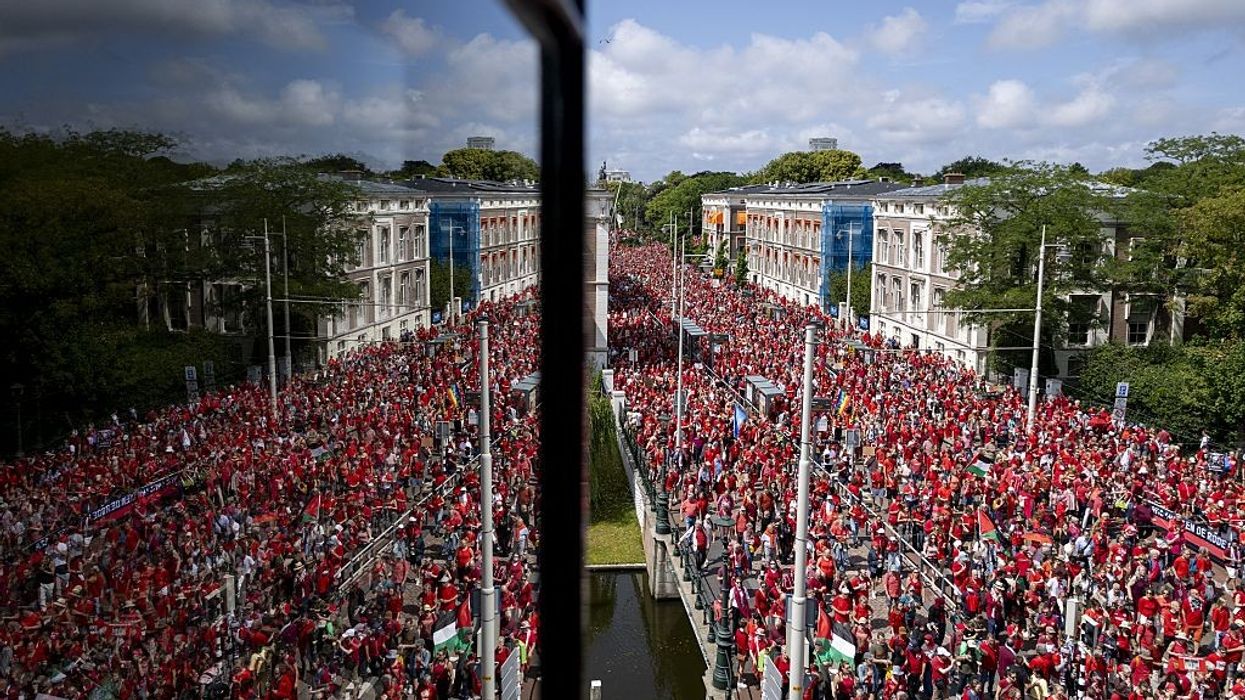
The red line the government has failed to set.
Hundreds of thousands of people dressed in red marched through the streets of The Hague on Sunday to demand more action against the "genocide" in Gaza.
NGOs such as Amnesty International, Save the Children, Médecins Sans Frontières (Doctors Without Borders), and Oxfam organized the demonstration, which ran through the city to the International Court of Justice. The protesters were all dressed in red, creating a "red line".
Organisers described it as the country's largest demonstration in two decades. Many waving Palestinian flags and some chanting "Stop the Genocide", the demonstrators turned a central park in the city into a sea of red on a sunny afternoon.
“The Dutch cabinet still refuses to draw a red line. That is why we do it, for as long as necessary,” Marjon Rozema of Amnesty International Netherlands said in a statement.
Protesters walked a 5-kilometer loop around the city center of The Hague to symbolically create the red line that the government has failed to set.

Campaigners described the company’s appeal as “a desperate attempt at justifying more oil and gas extraction.”
Shell appealed a case on Tuesday at The Hague that ordered the fossil fuel giant to drastically cut its greenhouse gas emissions.
A Dutch court ordered the company in 2021 to reduce its carbon emissions by 45% by 2030. Shell is arguing that customers will turn to other fuel suppliers if it obeys the order.
"This case has no legal basis," Shell's lawyer Daan Lunsingh Scheurleer told the court. "It obstructs the role that Shell can and wants to play in the energy transition."
" Oil and gas will play an important role in both the security of supply and affordability during the energy transition," he claimed.
NEW: Shell is appealing against a landmark order to cut greenhouse gas emissions, after rowing back on its climate targets.
It's a desperate attempt at justifying more oil and gas extraction amidst warnings from experts and increasing climate impacts.
Shell must be stopped. pic.twitter.com/jC0TrDU8VD
— #StopRosebank (@StopCambo) April 2, 2024
Friends of the Earth Netherlands, which brought the case against Shell, said the "scientific basis" for its case has "only solidified" since the initial ruling.
"I am confident that we can once again convince the judges that Shell needs to act in line with international climate agreements," the group's lawyer Roger Cox said.
.@Shell appeal against 2021 historic #climate ruling starts April 2 and @milieudefensie are ready!
“Shell is constantly trying to run away from its responsibility to stop dangerous climate change, but they can't bolt from the courtroom" says @DonaldPols https://t.co/bPlVIXTnI5
— Friends of the Earth International (@FoEint) March 28, 2024
The court order affects the company as a whole, not just its operations in the Netherlands. A verdict on the appeal is expected later this year.
"Shell aims to reduce the carbon intensity of products it sells by 15-20% by 2030 from a 2016 baseline after watering down the target in March," Reuters reports. "Shell has an 'ambition' to reduce customer emissions from the use of its oil products by 15-20% by 2030 compared with 2021. Shell also aims to become a 'net zero' emissions company by 2050."
A report from last year found Shell knew about the impacts of burning fossil fuels much earlier than previously known.

"How is it possible that such a sacred space is being used to normalize genocide today?" asked one Dutch Jewish organizer behind the protest.
Human rights activists in The Netherlands greeted Israeli President Isaac Herzog on Sunday with large protests and directed him towards the International Criminal Court at The Hague over his nation's alleged war crimes against the Palestinian people in the Occupied West Bank and Gaza.
Herzog was in Amsterdam to attend the opening of the new National Holocaust Museum, but demonstrators said Herzog's presence needed to be challenged given the large scale death and destruction that Israel's military has unleashed in Gaza over the last five months.
As Al-Jazeera reports:
Dutch Jewish anti-Zionist organization Erev Rave, which organized the demonstrations at the musuem’s opening with the Dutch Palestinian community and Socialist International, said that while it is important to honor the memory of Holocaust victims, it cannot stand by while the war in Gaza continues.
"For us Jews, these museums are part of our history, of our past," said Joana Cavaco, an activist with Erev Rav, addressing the crowd before the museum's opening ceremony. "How is it possible that such a sacred space is being used to normalize genocide today?"
A pro-Palestinian Dutch organization, The Rights Forum, called Herzog's presence "slap in the face of the Palestinians who can only helplessly watch how Israel murders their loved ones and destroys their land."
Along Herzog's route through the city, members of Amnesty International—which has accused Israel of apartheid and backed the findings of the International Court of Justice (ICJ) which said policies in Gaza may amount to genocide—carried fake detour signs pointing the motorcade towards the nearby ICC.
As the president of Israel, Amnesty International Netherlands said Herzog "is the political symbol of the humanitarian disaster in Gaza. It is unfortunate that Herzog was invited after his controversial statements. That is why we are taking action."
Amnesty and other rights groups have documented numerous incidents in Gaza and the West Bank that they say may amount to "war crimes," including the indiscriminate bombing of civilians areas, the use of prohibited weapons like white phosphorous, attacks on hospitals and emergency medical personnel, the blocking of life-saving food, water, and other supplies, and other acts of "callous disregard for Palestinian lives."
At a square nearby the museum where Herzog gave his speech, reports Reuters, demonstrators crowded the streets and chanted slogans like "Cease-fire Now!" and "Stop Bombing Children!" as they held signs that read "Jews Against Genocide" and "The Grandchild of a Holocaust Survivor Says: Stop Gaza Holocaust."
Israeli President Isaac Herzog attended an opening of Amsterdam’s Holocaust museum, where pro-Palestinian protesters demanding an end to Israel's assault in Gaza booed him https://t.co/L3NceMdAwk pic.twitter.com/ZspcNrl8FF
— Reuters (@Reuters) March 10, 2024
Ahead of Sunday's opening, the Jewish Cultural Quarter that operates the new museum, said in a statement that it was "profoundly concerned by the war and the consequences this conflict has had, first and foremost for the citizens of Israel, Gaza and the West Bank."
The statement said the museum stands "for a just and resolution for all those directly involved" and the impact the ongoing violence and hatred is having beyond the Middle East:
The reduction to black-and-white opposites and apparently incompatible arguments – oppressed against oppressor, good against bad, truth against lie. This polarization has spread hatred toward Jews and Islamophobia. It takes courage to speak out against injustice. It takes courage to recognize that the real world is complex and contradictory, and that our empathy need not be confined to one side.
At the heart of the National Holocaust Museum's mission is the desire to build a just society in the Netherlands by signalling the danger of dehumanizing and excluding those who live among us. That is the message in our presentation, our educational program and our events.
The group said Herzog had been invited to attend the opening prior to the Hamas-led attack on October 7 of last year, but that the fighting since has only further revealed the importance of remembering and learning from the past.
That "the war continues to rage," the statement concluded, "makes our mission all the more urgent."

The world owes South Africa a huge debt. By bringing Israel to the Hague, South Africa has wrenched moral and legal force from the hands of imperial carnage to the possibility of universal justice.
Today, history was made: the International Court of Justice has ruled for South Africa.
Israel's military actions in Gaza fall under the purview of the Genocide Convention. In its order, the court established that the Palestinians are a protected national group and there is a risk of irreparable harm for Palestinians under the Genocide Convention.
The court issued urgent measures directing Israel to "take all measures" to prevent genocide as detailed in South Africa's case. Israel’s denials have, in effect, been rejected.
It directed Israel to ensure the provision of basic services and humanitarian assistance in Gaza, and instructed it to report on compliance. Most of these measures were passed with a 15-2 vote.
By bringing this case, South Africa asserted our common humanity and wrenched moral and legal force from the hands of imperial carnage to the possibility of universal justice.
It is impossible to reckon with not just how much death, but how much cruelty and contempt, it had to take to bring about this moment. In just the first six weeks of the siege of Gaza, Israel dropped 500 “bunker-buster” bombs on the thin strip of land, a rate of destruction with few precedents in human history. When bombs that size touch the ground, they have a lethal fragmentation radius — an area of death nearing 365 meters (about 1,198 feet). They turn “earth to liquid,” said Marc Garlasco, a former Pentagon defence official.
The world owes South Africa a huge debt. By bringing Israel to the Hague, in one fell swoop, South Africa has acted for our common humanity.
In contrast, we have only seen dismissals, falsehoods, and contempt from Western leaders. U.S. President Joe Biden lied to the world to justify the massacre in Gaza. “I never really thought that I would see and have confirmed pictures of terrorists beheading children,” he declared in early October. That statement, it is now well documented, was a lie. The White House admitted that they “have not seen pictures or confirmed such reports independently” and the Israeli government admitted it had no evidence to support the claim. Biden continued to repeat it.
On January 11-12, I travelled to The Hague as a member of the South African delegation. Minutes before the hearing began inside the Peace Palace, the numbers were updated one final time inside the briefing room. Death toll: 22,000. As I write this note today, it has surpassed 26,000—and many thousands more are missing under the rubble, presumed dead.
That is why this fight is far from over. Today’s ICJ verdict, by itself, cannot halt the massacre. Mass movements, governments, and trade unions around the world are determinedly supporting the Palestinians—exposing Israel’s lies, accounting for the complicity of its backers, and rejecting the sacrifice of our humanity. We must go on.
As the case progresses, all eyes will be on the Hague: Will the ICJ uphold the truth plain for us to see? Israel's military actions in Gaza constitute a genocide. Israel is in breach of its obligations under the 1948 Genocide Convention and "genocidal in character because they are intended to bring about the destruction of a substantial part of the Palestinian national, racial and ethnical group.” After all, this case serves as a critical test of Western impunity.
By bringing this case, South Africa asserted our common humanity and wrenched moral and legal force from the hands of imperial carnage to the possibility of universal justice. It has acted for you and me — and our collective conscience.
"When military goods can contribute to human rights violations or international humanitarian law, that export is strictly prohibited," said one campaigner. "It is incomprehensible that, despite clear warnings, the government has knowingly deviated from this."
A Dutch court on Monday heard opening arguments in a case brought by four human rights organizations that have accused the government of the Netherlands of being complicit in Israeli war crimes due to its export of military supplies as Israel kills thousands of civilians in Gaza.
Supplying the Israel Defense Forces (IDF) with parts for F-35 fighter jets, which are stored in a warehouse in the Netherlands, puts the Dutch government at risk for "becoming complicit in violations of international humanitarian law," the director of the Dutch branch of Amnesty International, one of the plaintiffs, said when the lawsuit was announced last month.
Amnesty is joined by Oxfam Novib—the Dutch chapter of Oxfam International—The Rights Forum, and PAX in the case, which is expected to result in a judgement around December 15.
The groups filed the lawsuit after government documents showed the Netherlands had allowed at least one shipment of reserve parts for F-35s since October 7, Al Jazeera reported.
The Dutch Defense Ministry wrote in a letter to Parliament that "it cannot be established that the F-35s are involved in grave violations of the humanitarian laws of war," but with nearly 16,000 people killed in Gaza in less than two months—including more than 6,600 children—the human rights groups aim to test that claim in court.
"The state must immediately stop its deliveries of F-35 parts to Israel," lawyer Liesbeth Zegveld said Monday at the Hague District Court. "That is its obligation under... Article 1 of the Geneva Conventions, it is its obligation under the Genocide Treaty to prevent genocide, and it is its obligation under export law."
Martje van Nes, PAX's director of organization, pointed out last month that "the Netherlands has a very concrete assessment framework for arms exports."
"When military goods can contribute to human rights violations or international humanitarian law, that export is strictly prohibited," said van Nes. "It is incomprehensible that, despite clear warnings, the government has knowingly deviated from this. This makes them responsible for the deployment of the equipment."
PAX noted on Monday that the call for the Netherlands to end shipments of any supplies that Israel could use to continue its massacre of Palestinian civilians—in retaliation for an attack by Hamas in October that killed 1,200 Israelis—"is all the more urgent" considering the end of a temporary cease-fire on Friday. More than 800 people have been killed since the pause in fighting ended last week, and Israel was stepping up its ground attacks on Monday.
"As far as we are concerned, the government must take action now to protect citizens," said PAX on social media. The group has demanded a permanent humanitarian cease-fire.
Dagmar Oudshoorn, director of Amnesty International in the Netherlands, said that as the host country "of both the International Court of Justice and the International Criminal Court," the Dutch government "likes to present itself as a champion of international law."
"Our government is losing all credibility right now," she said. "Evident violations such as food, water, and fuel blockade, the forced displacement of the population, and the bombing of schools and hospitals, are not mentioned. And by supplying armies, the Netherlands runs the risk of becoming complicit in violations of international humanitarian law."
The Netherlands has maintained since October 7 that Israel "has the right to defend itself" and has called for Prime Minister Benjamin Netanyahu's government to adhere to international law, but the groups said the IDF is clearly not doing so and should lose the support of the country.
"This complicity must stop now," said Gerard Jonkman, director of The Rights Forum.

"While the world is going up in flames, the government continues to add fuel to the fire by propping up the biggest source of the climate crisis, fossil fuels, with billions in subsidies."
Climate campaigners calling for an end to fossil fuel subsidies were fired upon with water cannons and physically abused Saturday near The Hague in the Netherlands as the global movement demanding an end to the dominance of the coal, oil, and gas industry continues to call on world leaders to act.
Members of Extinction Rebellion spearheaded the direct action on the A12 Utrechtsebaan highway near the center of the Dutch government. With an estimated 10,000 participants overall, the jovial protesters sat down in the road, bringing traffic to a standstill as they chanted, "The seas are rising and so are we!" even as police vehicles sprayed them with water at high velocity.
The Associated Press reported that the protesters vowed to stay until the Netherlands ends public subsidies for the fossil fuel industry or, if removed by police, to return each day until the financial support is suspended.
"This is much larger than any one of us," one participant, Yolanda de Jager, told the AP. "This concerns the whole world."
Dutch police carted some protesters off in carts while others were beaten with batons or dragged off the roadway:
Earlier this week, a new report detailed how the Dutch government spends nearly $38 billion in taxpayer funds each year to support fossil fuels. The authors of the peer-reviewed report—a joint research effort by SOMO, Oil Change International, and Milieudefensie—argued that such subsidies should be eliminated by 2025 in order to help the nation meet its emission reductions goals and also help fund the necessary transition to renewable energy.
"Phasing out fossil subsidies kills two birds with one stone: it reduces fossil fuel emissions and raises additional revenue needed to accelerate a social and equitable transition," said Audrey Gaughran, director of SOMO, also known as the Centre for Research on Multinational Corporations.
OCI director Elizabeth Bast said, "The Netherlands has taken the international stage to promise an end to fossil fuel subsidies multiple times already, but it is failing to live up to its promise."
"While the world is going up in flames, the government continues to add fuel to the fire by propping up the biggest source of the climate crisis, fossil fuels, with billions in subsidies," she added. "With an urgent and fair phase-out plan the Netherlands can deliver on longstanding promises and take the lead within the EU and internationally to ensure other countries follow through."
THE HAGUE, Netherlands--One hundred years ago, more than 1,000 women gathered here in The Hague during World War I, demanding peace. Britain denied passports to more than 120 women, forbidding them from making the trip to suppress their peaceful dissent. Now, a century later, in these very violent times, nearly 1,000 women have gathered here again, this time from Africa, Asia and Latin America, as well as Europe and North America, saying "No" to wars from Iraq to Afghanistan to Yemen to Syria, not to mention the wars in our streets at home. They were marking the 100th anniversary of the founding of WILPF, the Women's International League for Peace and Freedom. Dr. Aletta Jacobs, a Dutch suffragist who co-founded the group a century ago, said the purpose of the original gathering in 1915 was to empower women "to protest against war and to suggest steps which may lead to warfare being an impossibility."
Among the women here were four Nobel Peace Prize winners. Shirin Ebadi was awarded the prize in 2003 for advocating for human rights for Iranian women, children and political prisoners. She was the first Muslim woman, and the first Iranian, to receive a Nobel. Nevertheless, she has lived in exile since 2009, and has only seen her husband once since then. "Had books been thrown at people, at the Taliban, instead of bombs, and had schools been built in Afghanistan," Ebadi said in her keynote address to the WILPF conference this week, "3,000 schools could have been built in memory of the 3,000 people who died on 9/11--at this time, we wouldn't have had ISIS. Let's not forget that the roots of the ISIS rest in the Taliban." She was joined by her sister laureates Leymah Gbowee, who helped achieve a negotiated peace during the civil wars in Liberia; Mairead Maguire, who won the peace prize in 1976 at the age of 32 for advancing an end to the conflict in her native Northern Ireland; and Jody Williams, a Vermonter who led the global campaign to ban land mines, and who now is organizing to ban "killer robots," weapons that kill automatically, without the active participation of a human controller.
These four world-renowned Nobel laureates were joined by nearly a thousand deeply committed peace activists from around the globe. Madeleine Rees, the secretary-general of WILPF, recalled the history of the first gathering in 1915, and how it was organized: "It wouldn't have happened, but for the suffrage movement," she told me, "because you don't just start a mass movement. You actually have to have an organizational structure to make that happen. That had started with the suffragette movement. ... Every single one of those women who went to The Hague ... were demanding the right to vote. They saw, quite rightly, that the absence of women in making decisions in government meant a greater likelihood of war."
Kozue Akibayashi is WILPF's new president. After World War II, the U.S. required that Japan's Constitution explicitly forbid it from pursuing war to settle disputes with foreign states. "The majority of people in Japan support the peace constitution," Akibayashi explained. President Barack Obama, however, like George W. Bush before him, is pressuring Japan to eliminate the pacifistic Article Nine from the Japanese Constitution. He hosted Japan's prime minister, Shinzo Abe, in Washington this week, celebrating Abe as he works to restore Japan's military to its former offensive capacity. Akibayashi and thousands of others also are protesting the planned expansion of the U.S. military presence on Okinawa.
Africa activist Hakima Abbas was also in The Hague. I interviewed her hours after mass graves were reported in Nigeria, containing victims of the militant group Boko Haram. The story of Boko Haram, she told me, "is an intersection with violent Islamist fundamentalisms, with global capitalism and with militarization ... fundamentalisms, though, don't start and end with Islamic fundamentalisms in Africa. We've seen Christian fundamentalisms in Uganda, and the persecution of LGBTQI people." She then made a connection to the street protests in Baltimore this week: "In your own country," she told me, "the white supremacist and Christian right fundamentalisms are exacerbated by the gun culture and the promotion of an armed police force, which is killing black women, men, trans people and children. ... So fundamentalisms is really something that we have to address globally."
I asked Shirin Ebadi if she had advice for the people of the world. She replied with a simple yet powerful prescription for peace, laying out the work for WILPF as it enters its second century: "Treat the people of Afghanistan the same as you treat your own people. Look at Iraqi children the same as you look at your own children. Then you will see that the solution is there."
Denis Moynihan contributed research to this column.