

SUBSCRIBE TO OUR FREE NEWSLETTER
Daily news & progressive opinion—funded by the people, not the corporations—delivered straight to your inbox.
5
#000000
#FFFFFF
To donate by check, phone, or other method, see our More Ways to Give page.
Daily news & progressive opinion—funded by the people, not the corporations—delivered straight to your inbox.

Journalists from each of the outlets were barred from entering the White House complex just hours after a Trump-appointed federal judge ordered the president to reverse his ban.
Update (1:30 pm ET):
Journalists from Politico, MS NOW, and CNN said their access to the White House has been restored, hours after they were denied access to the complex despite a federal judge's Thursday morning order temporarily reversing President Donald Trump's ban on the outlets.
The director of the White House's press operations attested in a court filing that the administration had restored the outlets' access:
BREAKING: White House attests that access for POLITICO, CNN and MSNOW was restored as of 9:55am.https://t.co/32pQuZ1NmB pic.twitter.com/CZTqpJQeb9
— Kyle Cheney (@kyledcheney) September 24, 2026
Earlier (8:40 am ET):
Trump administration officials denied Politico, MS NOW, and CNN reporters access to the White House complex on Thursday morning, in blatant violation of a federal judge's decision ordering President Donald Trump to immediately reverse his ban on the three outlets.
US District Court Judge Timothy Kelly, a Trump appointee, ordered the White House in an early Thursday ruling to "immediately return, reinstate, and restore" press passes to reporters from the three outlets.
Politico reported that its journalist had "his press credentials confiscated" upon trying to enter the White House complex hours after Kelly's ruling.
Laura Barrón-López, a White House reporter for MS NOW, said she was also denied access to the White House. She said a Secret Service agent confiscated her press badge after it failed to scan properly.
Barrón-López said it is "not clear, based on the interaction that I had, whether or not this is a defiance... of the court order, or it's some kind of incompetence or lag in the system where they have not updated our press badges."
Watch her account:
MS NOW reports that their White House reproter was denied access to the White House this morning despite a court order demanding she have access pic.twitter.com/wqUiB413jV
— Aaron Rupar (@atrupar) September 24, 2026
According to CNN, one of its reporters and a photojournalist were "denied access to the White House grounds" early Thursday.
"There was no reason provided for the refusal and CNN will continue to try to gain access as regular business hours start," the outlet added.
Earlier:
A federal judge on Thursday ordered President Donald Trump to immediately restore White House access to CNN, MS NOW, and Politico, prominent media outlets that the president banned last week.
Timothy Kelly, a Trump-appointed judge for the US District Court in Washington, DC, granted the media outlets' request for a temporary restraining order as the legal fight continues. Kelly ruled that the outlets showed "a likelihood of success" on their claim that the president's ban and revocation of reporters' press credentials violated the Fifth Amendment's due process protections.
The judge rejected the Trump administration's claim that the president's ban on the three outlets was necessary to protect national security.
"The court is skeptical—at least on this record—that defendants’ interest in safeguarding national security is the actual motivation for, or is even advanced by, the revocation of plaintiffs’ hard passes," Kelly wrote. "The record lacks factual support for defendants’ contention that the revocation of plaintiffs’ hard passes will in fact protect national security or that national security will be endangered if the court orders their passes reinstated while this litigation proceeds."
Trump's initial announcement of the ban, on September 18, said nothing about national security. The president vaguely accused the outlets he has long attacked of publishing "FICTION and LIES."
In letters submitted to the court as part of the ongoing legal fight over the ban, the White House press office cited examples of reporting from the three outlets that it claimed damaged US national security.
In its letter to CNN, the White House points to the outlet's reporting on "construction details related to the East Wing bunker" and a story on the US military's bombing of an Iranian elementary school.
Ted Boutrous, the lawyer representing the news outlets, welcomed Kelly's decision to grant the temporary restraining order, which will be in effect for 14 days.
"This is a strong ruling vindicating freedom of the press, due process, and the rule of law," Boutrous said. "We greatly appreciate the court’s swift action."
Kelly ordered the Trump administration to "immediately return, reinstate, and restore" White House press passes to reporters from CNN, MS NOW, and Politico.
It's unclear how swiftly the news outlets will resume their typical coverage of the White House following the judge's order. Earlier this week, a White House event was broadcast with no audio after the administration dropped CNN from its TV press pool duties, prompting other major networks to ditch pool coverage in solidarity with CNN.
On Wednesday, when Trump greeted Chinese President Xi Jinping upon his arrival in the US, no major TV network captured the moment.
"Other television outlets whose crews were present, according to signs on their tripods and cameras, were NewsNation, Newsmax, Right Side Broadcasting Network, One America News, and LindellTV," The Associated Press reported.
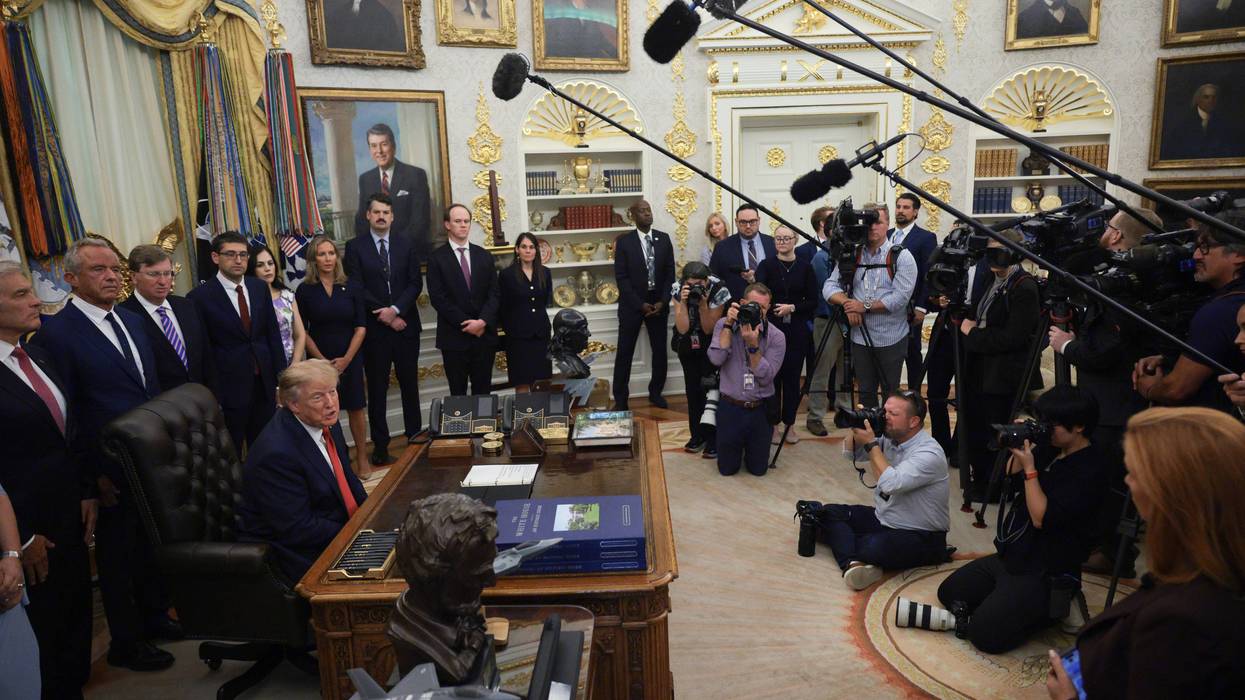
One press freedom advocate said it was "difficult to imagine a more blatant violation of the First Amendment."
In one of his most direct assaults on the First Amendment, President Donald Trump announced in a Friday afternoon tirade that he would ban CNN, MSNOW (formerly MSNBC), and Politico from the White House.
"I am proud to announce that, effective immediately, I am banning Fake News CNN, MSNOW... and Politico from the White House as a result of their constant 'reporting' FAKE NEWS!" the president wrote in a rambling Truth Social post.
"Media Outlets shouldn’t be able to constantly write or report FICTION and LIES when they’re covering the President of the United States, the Trump Administration, or the United States of America," he added, though he did not specify any particular reports he objected to. He added that bans on "Other Fake News Media Outlets" would soon follow.
Trump, who has long portrayed himself as a defender of free speech, has taken unprecedented actions to censor news outlets during his second term, including threatening networks' broadcast licenses through the Federal Communications Commission over unfavorable programming.
As of Friday afternoon, it's unclear whether Trump actually plans to follow through on his White House ban.
Reacting to the news on the air, CNN anchor Brian Stelter said that the network's reporting team "remains at the White House working just like a usual normal Friday afternoon." He added that "right now, there is no indication that the administration is taking any steps to actually follow through on his threat."
"Certainly, if there is an attempt to remove journalists from the White House, well, our cameras are rolling. I think viewers will see it happen," he said.
"CNN stands fully behind our White House team and their fair and accurate reporting," the network said in a statement following news of the ban. "We have a right under the US Constitution to do that reporting without hindrance or interference from the government."
Bruce D. Brown, the president of the Reporters Committee for Freedom of the Press, told Common Dreams in an email Friday that simply banning news organizations from the White House over the content of their reporting "would be flatly unconstitutional."
"The First Amendment is clear that once the White House invites in some journalists, it can't ban others because it doesn't like their reporting," he said. "This is textbook viewpoint discrimination and will be quickly struck down by the courts if challenged."
Federal courts have previously struck down attempts by Trump to bar certain press outlets on First Amendment grounds. Last year, a judge ruled that Trump's removal of the Associated Press from the White House press pool for its refusal to adopt the name "Gulf of America" for the Gulf of Mexico was an unconstitutional form of viewpoint discrimination.
Defense Secretary Pete Hegseth's rule banning reporters from obtaining information not authorized by the Pentagon, which led dozens of journalists to turn over their press badges and walk out of the building in protest, was also struck down as a violation of press freedom.
In light of these previous failures, Jameel Jaffer, the executive director of the Knight First Amendment Institute at Columbia University, expressed bewilderment that Trump was once again trying to ban news outlets from the White House.
"With so many courts having ruled against him on exactly this point, you’d think President Trump would have learned this lesson by now," he said in a statement.
Seth Stern, chief of advocacy at the Freedom of the Press Foundation, agreed it was "difficult to imagine a more blatant violation of the First Amendment than Trump banning news outlets from the People’s House for criticizing the government."
"It’s also hard to imagine a dumber move," he said. "The historically unpopular president has been retaliating against the press for years, but it hasn’t helped him. The press keeps exposing his corruption and his failures. These outrageous attacks only demonstrate how scared he is of an informed public."
He added that the press must "fight back to protect their rights, not only to access the White House but to access the public records and whistleblowers this administration so desperately wants to keep from them."
Trump's announcement was met with outrage from Democrats in Congress, who described it as an assault on a basic constitutional freedom.
Sen. Mark Warner (D-Va.) responded to the news simply by posting the full text of the First Amendment on X.
"Fascist and communist governments limit press access to only favorable outlets, persecute journalists, and suppress truthful reporting," said Rep. Jim McGovern (D-Mass.) in a post to social media. "Trump’s administration is doing all of that."
Sen. Ruben Gallego (D-Ariz.) agreed the move was "straight out of the authoritarian playbook."

A Maine woman accused the Democratic US Senate candidate of drunkenly assaulting her at her home in 2021, which he denied.
US Senate candidate Graham Platner on Monday denied allegations of sexual assault, but the Maine Democrat also said his campaign is considering the "best path forward" in the wake of Politico's reporting.
Jenny Racicot told The New York Times in an article published last month that Platner's behavior was "reckless" and "unsettling" during their on-and-off relationship in 2019-21, and she cut off contact after he arrived at her Maine home drunk, despite her telling him not to come over. Politico reported Monday that the 41-year-old had told the newspaper off the record that he assaulted her.
Racicot told Politico that Platner came into her home uninvited that night and forced himself on her while she repeatedly told him to stop. She said that she was conflicted about publicly accusing him in part because she agrees with the candidate politically, but decided to speak out after much of the reaction to the Times focused on another ex with ties to the Republican Party. The outlet reviewed documents, including emails with her therapist, and spoke with sources Racicot had previously told about her experience.
In a two-minute video shared on social media Monday, Platner called Racicot's allegations "troubling, serious, and false," and said that "any accusation of nonconsensual behavior is categorically false." He also said that, "mindful of the political reality" that the reporting will inflict, "we are taking the time to reflect on the best path forward."
Platner decisively won his primary last month, after his opponent, Democratic Gov. Janet Mills, suspended her campaign in late April. The oyster farmer and combat veteran is a political newcomer who has championed progressive policies and called out the ultrarich, as well as the politicians who serve them—including longtime Republican Sen. Susan Collins, whom he's running to unseat in November.
While Platner has traveled Maine, speaking and rallying with working-class voters, he's also faced a series of controversies, including concerns over his offensive posts on Reddit, and the skull and crossbones tattoo he got with fellow Marines in Croatia, which he claimed he did not know closely resembled a Nazi symbol and got covered up during the campaign.
There was also the allegation from the GOP-affiliated ex interviewed by the Times, Lyndsey Fifield, that Platner was physically aggressive during their relationship, which he denied, and reporting that Platner's wife, Amy Gertner, told a senior campaign staffer that he had exchanged sexual messages with other women during their marriage, which Gertner responded to with a video.
In a statement to Politico on Monday, Platner's campaign pointed to previous controversies, saying:
These allegations are very serious and Graham vigorously denies them. They are also coached and coordinated by out-of-state establishment operatives. For a year, opponents of this campaign have thrown everything they can at Graham—calling him a Nazi, a war criminal, and a communist. None of it has been true, and this is no different. It is not a coincidence that this story comes a week before the ballot deadline, just as the previous false allegations came a week before the primary. Graham began this campaign to fight for a Maine where everyone is treated with dignity and where Mainers are put first, and no amount of desperate smears will stop this movement from seeing that vision through.
Following Politico's reporting, Platner has lost some key support. At least two members of Congress who backed him—Rep. Ro Khanna (D-Calif.) and Sen. Ruben Gallego (D-Ariz.)—withdrew their endorsements, and the Maine Democratic Party's chair, vice chair, and executive director issued a joint statement urging him to withdraw as the party nominee.
The US National Domestic Violence Hotline can be reached at 1-800-799-SAFE (7233), by texting "START" to 88788, or through chat at thehotline.org. It offers 24/7, free, and confidential support. DomesticShelters.org has a list of global and national resources.
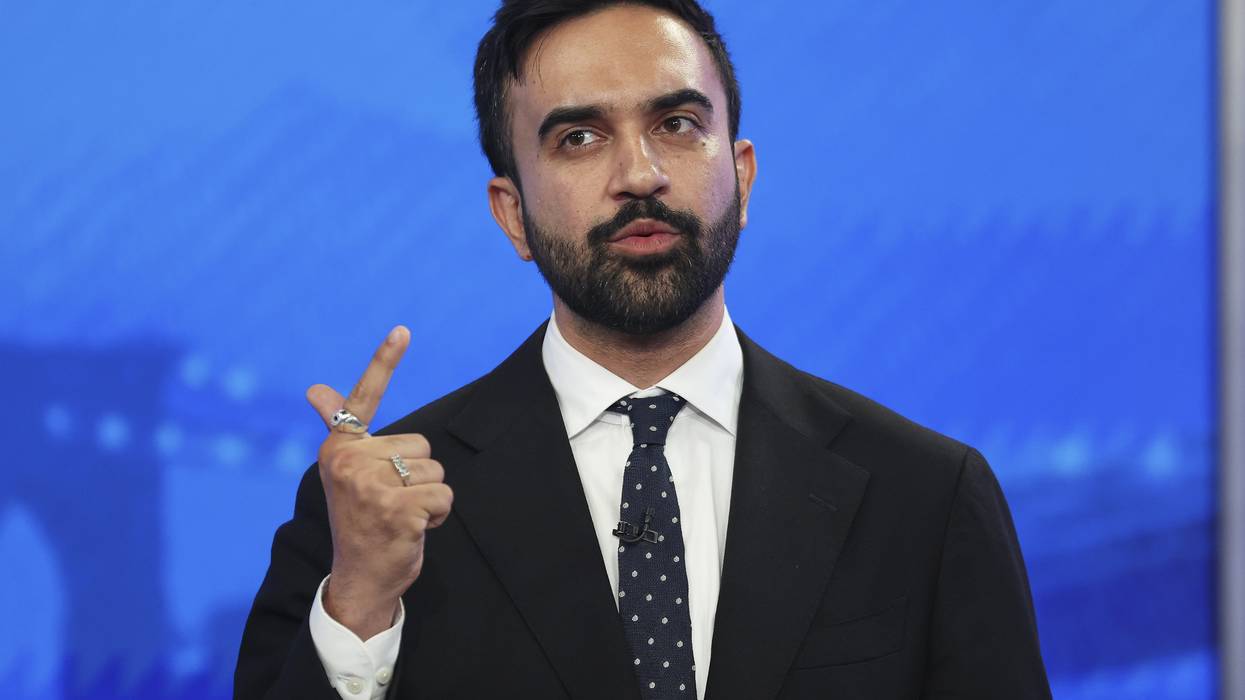
"Everyone who is serious about defeating Andrew Cuomo needs to endorse Zohran Mamdani immediately," wrote one Democratic state senator.
A June survey from Public Policy Polling shows New York City mayoral candidate and democratic socialist Zohran Mamdani ahead of opponent and former Democratic New York Gov. Andrew Cuomo as the city's Democratic primary draws near. Primary day is June 24 and early voting begins June 14.
Cuomo has been the consistent front-runner in the race, though Mamdani, a state assemblymember who is running on an affordability platform, has risen from long-shot candidate to serious contender.
"All gas, no breaks," wrote Mamdani on X on Wednesday of the poll results.
"When you run a disciplined, grassroots campaign relentlessly focused on an agenda to address the crises in working people's lives, these are the results," Andrew Epstein, spokesperson for Mamdani, told Politico, which was first to report on the results of the poll on Wednesday.
Mehdi Hasan, editor-in-chief and CEO of the outlet Zeteo, wrote on X: "Wow. Just wow."
New York Democratic state Sen. Jabari Brisport reacted to reporting on the poll by writing that "everyone who is serious about defeating Andrew Cuomo needs to endorse Zohran Mamdani immediately."
The poll was conducted for the campaign of candidate for city comptroller Justin Brannan, a Democrat, and surveyed 573 likely Democratic primary voters between June 6-7. On June 9, Mamdani posted a video asking New Yorkers to donate to Brannan's campaign.
The relevant question in the poll lists eight Democratic candidates running in the race and asks respondents who they would vote for among them.
Thirty-five percent of respondents said Mamdani, while 31% said they would support Cuomo. The other candidate options listed did not break above 10%, and 11% of respondents said they were not sure.
The poll, however, does not include how the candidates would fare in a ranked-choice voting simulation. New York City uses ranked-choice voting for certain elections, including primary and special elections for mayor. The system allows voters to rank multiple candidates on their ballots.
"As you know, we have had a poll in the field at the same time and our poll showed a race with us maintaining what has now been a consistent double digit lead for more than three months—which is rare for any NYC mayoral race in recent memory," Cuomo spokesperson Rich Azzopardi told Politico. The poll Azzopardi was speaking of is from Expedition Strategies and showed Cuomo leading Mamdani by 12 points after eight rounds of voting.
In response to reporting on the latest survey that shows Mamdani ahead, some observers cast doubt on the quality of Public Policy Polling's polls.

Sending more undocumented people there, one lawyer said, would be a "natural extension of the crimes committed at Gitmo for two decades, and also wildly, wildly illegal."
Citing government documents and unnamed officials, Politico and The Washington Post reported Tuesday that President Donald Trump's administration is preparing to potentially transfer up to thousands of undocumented immigrants to the U.S. naval station in Guantánamo Bay, Cuba—though the White House denies it.
"This story is Fake News. Not happening," White House press secretary Karoline Leavitt said on social media Wednesday, sharing a link to the Post. Far-right Congresswoman Marjorie Taylor Greene (R-S.C.) suggested Trump should sue the newspaper.
Rights advocates last week filed a federal lawsuit against the Trump administration for sending migrants to the "notorious" military base where the U.S. government held and tortured foreigners as part of the so-called War on Terror.
Now, at least 9,000 people are "being vetted for transfer," which "would be an exponential increase from the roughly 500 migrants who have been held for short periods at the base since February," according to Politico.
As the Post detailed:
The foreign nationals under consideration hail from a range of countries. They include hundreds from friendly European nations, including Britain, Italy, France, Germany, Ireland, Belgium, the Netherlands, Lithuania, Poland, Turkey, and Ukraine, but also other parts of the world, including many from Haiti. Officials shared the plans with The Washington Post, including some documents, on the condition of anonymity because the matter is considered highly sensitive.
The administration is unlikely to inform the foreigners' home governments about the impending transfers to the infamous military facility, including close U.S. allies such as Britain, Germany, and France, the officials said.
Politico noted that U.S. State Department officials who deal with Europe are trying to persuade the Department of Homeland Security to ditch the plan. One of them said: "The message is to shock and horrify people, to upset people... But we're allies."
Responding to the Post's reporting on social media, former U.S. diplomat William Gill said that "this is a clear violation of international law. A foreign detainee's government must immediately be notified via its local consulate and has right of access to the detainee to provide assistance/arrange legal representation. Failure to respect this jeopardizes Americans abroad."
Alka Pradhan, an attorney who has represented Guantánamo detainees, said: "Please understand both that this is [a] natural extension of the crimes committed at Gitmo for two decades, and also wildly, wildly illegal. This is not 'complex' or 'difficult' or related to security or defensible in any way."
In the case filed in Washington, D.C. last week on behalf of two Nicaraguan men and other noncitizens now at Guantánamo, rights groups are asking U.S. District Judge Carl Nichols, a Trump appointee, to rule that detaining these migrants there violates the Immigration and Nationality Act, Administrative Procedure Act, and Fifth Amendment to the U.S. Constitution.
"The government's real reason for holding immigration detainees at Guantánamo is to instill fear in the immigrant population," the complaint declares. "That is not conjecture; it is government policy."
"This is an absolutely devastating development on the precipice of the next administration," said one journalist.
Journalists and other critics of how money influences U.S. politics expressed alarm and disappointment in response to Friday reporting that shortly after the nation's latest election, the research nonprofit OpenSecrets had to lay off a third of its staff.
Citing a current staffer, Politico's Daniel Lippman revealed that OpenSecrets "laid off 10 employees yesterday due to financial difficulties" and "much of the research team were among the casualties, which constituted around a third of the group's total headcount."
According to the Politico Playbook newsletter:
Executive director Hilary Braseth wrote in an email to supporters that "OpenSecrets remains committed to its mission—serving as the trusted authority on money in American politics—but our task has become more difficult as groups have opted to fund a partisan outcome rather than nonpartisan democratic infrastructure."
She said in a subsequent email to Playbook that the layoffs were "a necessary first step to make our organization sustainable," and that she had "no doubt that our team will continue to produce the high-quality data that the public has come to rely on."
With a mission "to serve as the trusted authority on money in American politics," OpenSecrets envisions a country in which citizens "use data on money in politics to create a more vibrant, representative, and responsive democracy."
In response to the layoffs, numerous reporters took to social media on Friday to share how they—like Common Dreams—have used what National Public Radio media correspondent David Folkenflik called that "an invaluable resource for many a journalist and researcher—utterly nonpartisan but a source for transparency about money in politics now under financial threat."
"Terrible news!" declared NerdWallet data journalist Joe Yerardi. "The folks at OpenSecrets have helped me so many times on stories. The [organization] does such vital work."
Other reactions included:
Republican President-elect Donald Trump—known for "outright scandals and blatant corruption" during his first term—defeated Democratic Vice President Kamala Harris on Election Day earlier this week, . The GOP also seized control of the U.S. Senate and is on track to win a majority in the House of Representatives.
In a Tuesday analysis, OpenSecrets' Albert Serna Jr. and Anna Massoglia detailed how about $16 billion "went to influence federal elections and another $4.6 billion was raised by state candidates, party committees, and ballot measure committees for 2023 and 2024 elections."
The pair also highlighted Tuesday that this cycle "has broken the record for outside spending," with about $4.5 billion from independent groups such as super political action committees; dark money accounted for over $1 billion in total contributions to organizations like super PACs; top donors had outsize influence; and donations to support or defeat various ballot measures have also set "several records."
Jimmy Cloutier, a former OpenSecrets reporting fellow now at the Pittsburgh Post-Gazette, said Friday in response to the layoffs that "I'm devastated for my former colleagues—and shocked that this news comes just days after the most expensive election in U.S. history."
Investigative journalist Dave Levinthal, who also previously worked for the organization, said that "this is heartbreaking news, not just for us OpenSecrets alums, but anyone who cares about genuinely nonpartisan research and reporting plus political/governmental transparency."
Healthcare Across Borders executive director Jodi Jacobson said Friday that "this is unacceptable and unconscionable and shows how perverse our funding streams are. We can sink over a billion into a political campaign but not fund one of the most critical tools of accountability at a time when we need it most?"
Some responded to the layoff news with calls for donations to OpenSecrets. Filmmaker Adam McKay declared: "Legacy news media has all but blacked out money's outsized control of [government] so this is one of the few places to find out who is bribing your candidate or [representative]. Donate if you can ASAP."
Issue One research director Michael Beckels said: "Care about being able to follow the money in politics? Today would be a good day to donate—or become a monthly donor—OpenSecretsDC, one of the best groups around for understanding the flow of money in state and federal elections."
Democratic presidential hopeful Hillary Clinton said during a town hall on Thursday evening she will release transcripts of paid, closed-door speeches she gave to Wall Street firms "when everyone else does."
That may be sooner than she thinks.
On Friday morning, rival Bernie Sanders appeared to throw down the gauntlet by posting a video of one of the speeches he was paid to give in 2011—and the amount he was paid for it.
Clinton's speaking fees—which have netted the former secretary of state millions in recent years—have been scrutinized during the campaign. Sanders and others suggest they show she is too closely aligned with big banks.
Politico reported earlier this month that when she addressed Goldman Sachs executives and technology titans at a summit in Arizona in October of 2013, "she spoke glowingly of the work the bank was doing raising capital and helping create jobs, according to people who saw her remarks."
The issue seems to have resonated with voters, like the man who asked Clinton about the speaking fees at Thursday's MSNBC-moderated Democratic presidential town hall in Las Vegas.
"As a realtor here in Nevada, I know how important the economy is to our great nation," he said. "As a Democratic candidate who has delivered speeches to the largest U.S. financial institutions in exchange for hundreds of thousands of dollars in speaking fees, why are you hesitant to release transcript or audio/video recordings of those meetings to be transparent with the American people regarding the promises and assurances that you have made to the big banks?"
"Let me say this," Clinton responded, "I am happy to release anything I have when everybody else does the same because every other candidate in this race has given speeches to private groups, including Senator Sanders."
The New York Times reported in May 2015 that in the year prior, Sanders had collected $1,867.42 for three appearances, "a grand sum that is chump change in presidential politicking but enough for the senator to respectably donate the money to charity."