

SUBSCRIBE TO OUR FREE NEWSLETTER
Daily news & progressive opinion—funded by the people, not the corporations—delivered straight to your inbox.
5
#000000
#FFFFFF
To donate by check, phone, or other method, see our More Ways to Give page.
Daily news & progressive opinion—funded by the people, not the corporations—delivered straight to your inbox.
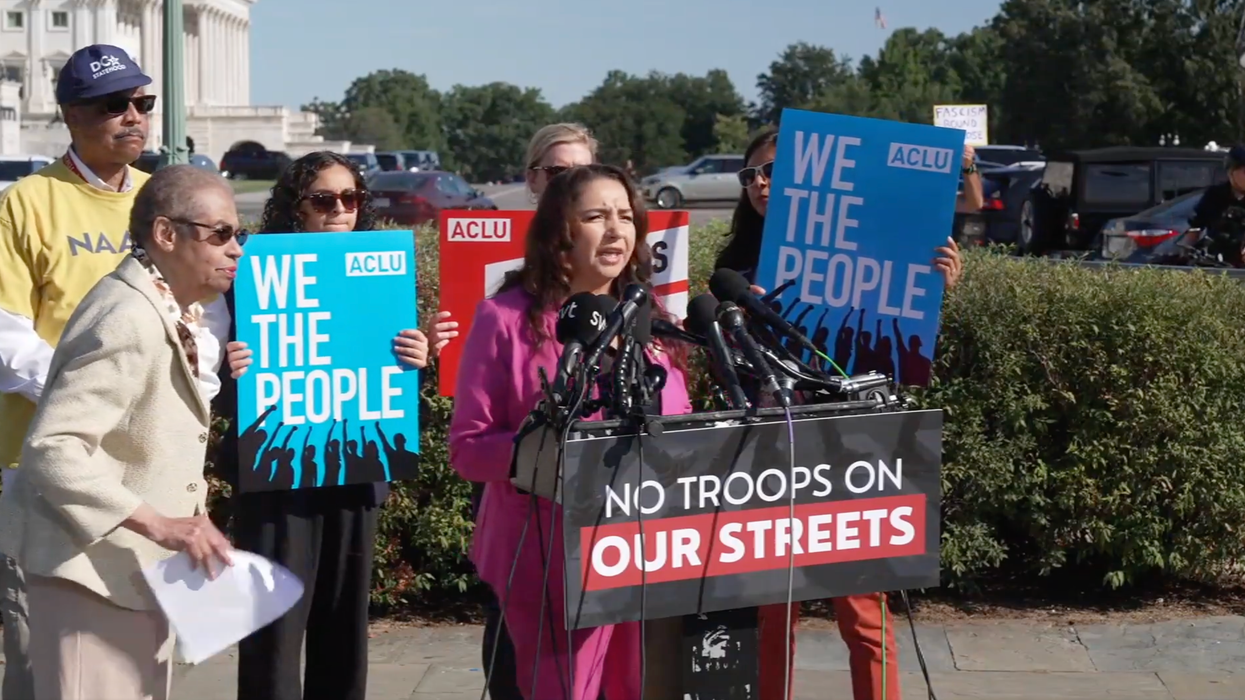
"We don't need Trump's troops on our streets," said Rep. Delia Ramirez. "What we need and what our constituents continue to say is that we need an investment in our neighborhoods."
Following US President Donald Trump's declaration that "we're going on" with a deployment of federal agents to Chicago, the nation's third-largest city and a frequent target of fearmongering by the president, Congresswoman Delia Ramirez led Democratic lawmakers in condemning the White House's threat to militarize federal troops in cities across the country.
Trump's persistent, baseless claims that large cities like Washington, DC; Chicago; and Los Angeles are facing violent crime waves are part of an attempt, suggested Ramirez (D-Ill.), to distract from the fact that his administration and Republicans in Congress are slashing funding that millions of people rely on.
"We have less than 30 days to pass a spending budget," said Ramirez, who represents parts of Chicago. "And yet here we are, the president is attempting to send the National Guard and terrorize cities instead of actually funding the government. See, we don't need Trump's troops on our streets. What we need and what our constituents continue to say is that we need an investment in our neighborhoods. We need an investment in food for our tables, healthcare for our families, and safety that is rooted in justice and opportunity."
Trump's comments about Chicago came Tuesday and followed plans to deploy 200 Homeland Security officials to the city and use a nearby naval base as a staging area, as part of his nationwide anti-immigration crackdown.
The White House has said it's overseen the arrests of more than 65,000 people by Immigration and Customs Enforcement (ICE) since Trump took office in January, but the Cato Institute found in June that 65% of people rounded up by the agency had no criminal conviction, while 93% had no conviction for violence offenses.
Trump's threat against Chicago also came as a federal judge ruled that his use of federal troops in Los Angeles was illegal. The president deployed Marine and National Guard soldiers to the city more than two months ago, and about 300 members of the National Guard remain there to crack down on protests against ICE raids and "ensure that federal immigration law was enforced."
Last month, the president sent the National Guard to Washington, DC and federalized the police force of the nation's capital, claiming he planned to rid the city of "slums" and ordering the destruction of encampments inhabited by homeless people.
Since that deployment, law enforcement agents have subjected local residents to illegal searches and unfairly charged them with serious crime, threatening them with lengthy prison sentences.
On Wednesday, Ramirez noted that as with ICE raids that are targeting people without criminal records despite Trump's claims to the contrary, the president is threatening to send troops to cities including Chicago to crack down on crime waves that aren't happening.
Thanks to investments in communities across Chicago, said Ramirez, "violent crime rates have fallen 22% today. Homicides are down more than 33% in the past year, while shootings are down by 38%."
Trump's actions in Washington, DC and his threats against Chicago, added the congresswoman, "are not just about one city."
"When armed troops are sent into American communities to suppress protests, to target civil society leaders, or to facilitate the disappearance of our neighbors, it is not just a local issue," said Ramirez. "It strikes at the core of our very own democracy... This moment demands courage. It demands that we understand that we must obstruct and do everything we can to oppose any of these authoritarian against our cities."
Rep. Jonathan Jackson (D-Ill.) also spoke at the press conference, warning that Trump's threat against Chicago is a "dangerous sign that the president is signaling to turn American troops on American citizens on American soil."
Ramirez said legislative action, legal challenges, and organizing on the ground are needed to fight back against Trump's attacks on cities.
At the press conference, Del. Eleanor Holmes Norton (D-DC) said she was introducing two bills to give Washington, DC full control over the National Guard and its police department, and renewed her call for the passage of legislation that would grant statehood to the nation's capital.
"Our local police force should not be subject to federalization, an action that wouldn't be possible for any other police department in the country," said Norton. "Although DC's lack of statehood makes it more vulnerable to the president's abuses of power, he has frequently made it known that his authoritarian ambitions do not end with DC."
"The only emergency here is a lawless president experiencing a growing public relations emergency because of his close friendship with Jeffrey Epstein," said Rep. Jamie Raskin.
As part of the ongoing battle against US President Donald Trump's "hostile takeover" of Washington, DC, key congressional Democrats on Friday introduced a resolution to terminate his executive order, "Declaring a Crime Emergency in the District of Columbia."
The resolution explains that Trump "has failed to identify special conditions of an emergency nature that compel the use of the
Metropolitan Police Department for federal purposes," and "even if properly invoked for an actual emergency, Section 740 of the District of Columbia Home Rule Act does not empower the president to federalize" the MPD.
"Violent crime in the District of Columbia has declined for the past two years and currently stands at a 30-year low," the measure notes. Additionally, it points out, the GOP-controlled federal government this year has prevented DC from "spending $1 billion of its own locally raised revenues—money that was budgeted for essential public safety purposes, including law enforcement, fire and emergency response services, and schools."
The bill's lead sponsors tied Trump's federalization of the MPD to his efforts to distract from intense calls—including from his base—to release files related to the federal case against deceased financier and sex offender Jeffrey Epstein.
"The only emergency here is a lawless president experiencing a growing public relations emergency because of his close friendship with Jeffrey Epstein and his stubborn refusal to release the Epstein file despite his promise to do so," said US House Judiciary Committee Ranking Member Jamie Raskin (D-Md.) in a statement.
"Trump has made clear that his efforts in DC, where 700,000 taxpaying American citizens lack the protections of statehood, are part of a broader plan to militarize and federalize the streets of cities around America whose citizens voted against him," he added. Trump this week deployed the National Guard in the nation's capital and threatened to do the same in other US cities—including Baltimore, Chicago, Los Angeles, New York, and Oakland—where crime rates are also falling.
No emergency exists in DC that the president did not create himself, and he is not using MPD for federal purposes, as required by law. I introduced legislation with RM Raskin, RM Garcia, & Senator Van Hollen to end the unlawful and unprecedented federalization of MPD.
[image or embed]
— Congresswoman Eleanor Holmes Norton (D-DC) (@eleanornorton.bsky.social) August 15, 2025 at 1:23 PM
Like Raskin—who led the historic second effort to impeach the president after his supporters stormed the US Capitol on January 6, 2021—House Committee on Oversight and Government Reform Ranking Member Robert Garcia (D-Calif.) framed the DC takeover as Trump "making every effort to distract America from Epstein."
In addition to Raskin and Garcia, the bill is sponsored by DC's sole representative in Congress, Democratic Rep. Eleanor Holmes Norton, who can participate in most House proceedings but not vote on final passage of legislation.
"President Trump's incursions against DC are among the most egregious attacks on DC home rule in decades," she said. "DC residents are Americans, worthy of the same autonomy granted to residents of the states. Our local police force, paid for by DC residents, should not be subject to federalization, an action that wouldn't be possible for any other police department in the country."
"No emergency exists in DC that the president did not create himself, and he is not using the DC Police for federal purposes, as required by law," Norton continued. "I appreciate Ranking Member Raskin's enduring support for DC and for working with me to end this unprecedented, dangerous, and disgraceful violation of DC's right to govern its own local affairs."
Sen. Chris Van Hollen (D-Md.), who will introduce the joint resolution in the upper chamber, noted that "Trump was AWOL when the District of Columbia actually needed support from the National Guard to protect it from an insurrectionist mob on January 6th."
"His current takeover is an abuse of power and nothing more than a raw power grab," Van Hollen added. "The District of Columbia has made important progress on public safety in recent years, and can do more if Trump and House Republicans get the hell out of their way and stop blocking D.C. from accessing $1 billion of its own funds to strengthen policing and provide other public services."
Earlier Friday, DC Attorney General Brian Schwalb filed a lawsuit to block US Attorney General Pam Bondi from taking over the city's police department.
"I applaud DC for taking legal action to end the president's unlawful attempt to seize control of MPD," Norton said on social media, also highlighting the resolution in Congress. "DC is united in our resistance."
"Emergency powers are the lifeblood of authoritarians," said a former Republican congressman.
U.S. President Donald Trump suggested Wednesday he may declare a national emergency to circumvent Congress and continue his military occupation of Washington, D.C. indefinitely.
Under the Home Rule Act, the president is allowed to unilaterally take control of law enforcement in the nation's capital for 30 days. After that, Congress must extend its authorization through a joint resolution.
The authorization would need 60 votes to break the Senate filibuster, meaning some Democrats would need to sign on. Minority Leader Chuck Schumer (D-N.Y.) has said there's "no fucking way" they would, adding that some Republicans would likely vote against it as well.
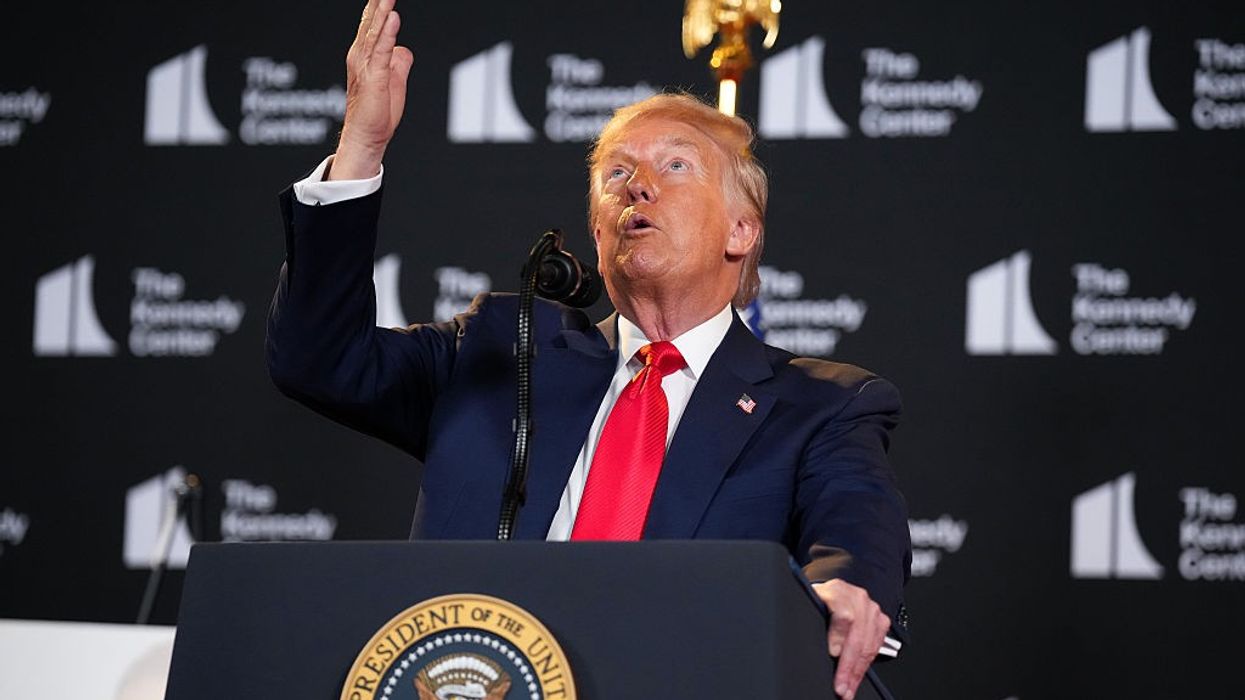
During a speech at the Kennedy Center on Wednesday, Trump said that if Congress won't approve his indefinite deployment of the National Guard, he'll just invoke emergency powers.
"If it's a national emergency, we can do it without Congress, but we expect to be before Congress very quickly," Trump said.
"I don't want to call a national emergency," Trump said, before adding, "If I have to, I will."
Announcing his federal takeover of the D.C. police, Trump said he would authorize the cops to "do whatever the hell they want" when patrolling the city.
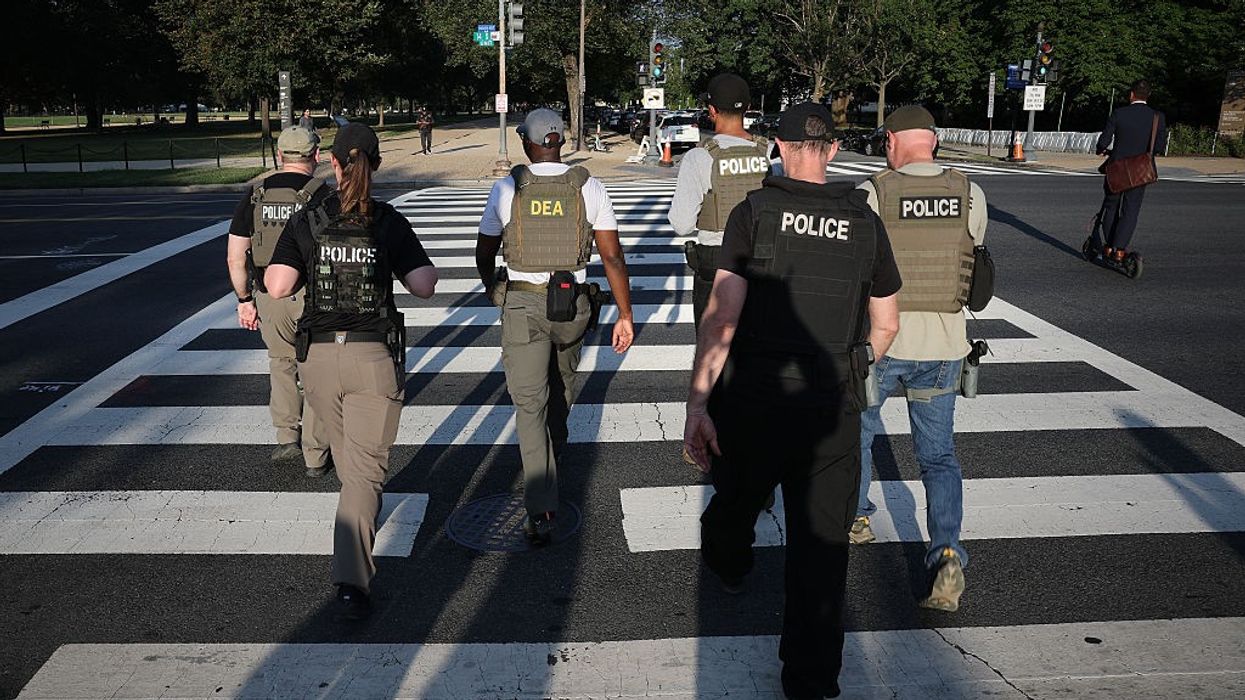
On Wednesday, a day after troops deployed to D.C., federal agents set up a security checkpoint on the busy 14th Street Northwest Corridor, where Newsweek reports that they have been conducting random stops, which have previously been ruled unconstitutional.
One eyewitness described seeing agents "in unmarked cars without badges pulling people out of their cars and taking them away."
Other similar scenes of what appear to be random and arbitrary stops and arrests have been documented around the city.
"President Trump fabricated the 'emergency' that's required to exist for a president to federalize D.C. Police," said Eleanor Holmes Norton, the District of Columbia's nonvoting congressional delegate on X. "He admitted to reporters today that he's willing to fabricate a national emergency in order to try to extend his power."
It would not be the first time Trump called a national emergency in an attempt to suspend the usual checks on his power.
In 2019—despite border crossings being at historic lows—he declared a national emergency to reroute billions of dollars to construct his border wall after Congress refused to approve it. He has also declared a national emergency at the U.S. border.
He has used national emergency declarations even more liberally in his second term, including to send U.S. troops to the Southern border, to expedite oil drilling projects, and to enact extreme tariffs without congressional approval.
According to Joseph Nunn, a legal scholar at the Brennan Center for Justice, Trump is already abusing the language of the Home Rule Act, which only allows D.C. law enforcement to be federalized in "special conditions of an emergency nature."
Though the law does not explicitly define what constitutes a "national emergency," Nunn says, "the word 'emergency' has meaning. An emergency is a sudden crisis, an unexpected change in circumstances." That would be at odds with the facts on the ground in D.C., where crime has fallen dramatically over the past year.
After Trump floated using a national emergency to extend his occupation of D.C., Justin Amash—a former Republican congressman who was ousted in 2021 after breaking with Trump—wrote on X that "emergency powers are the lifeblood of authoritarians."
"Once established in law, they're nearly impossible to revoke because a president can veto any bill curtailing the power," Amash said. "We always live under dozens of active 'national emergencies,' almost none of which are true emergencies."
Trump also said he was working with congressional Republicans on a "crime bill" that will "pertain initially to D.C." but will be expanded to apply to other blue cities like Chicago, New York, and Los Angeles. Despite Trump's portrayal of these cities as crime-ridden hellscapes, crime is falling in every single one of them.
"What Donald Trump is doing is, in some ways, a dress rehearsal for going after others around the country. And I think we need to stop this—certainly by the end of the 30 days," said Sen. Chris Van Hollen (D-Md.). "This should never have started, so I definitely want to make sure it doesn't continue."
One D.C.-based observer accused the GOP of "attempting to casually cut the budget of a major city simply because they hate us and they can."
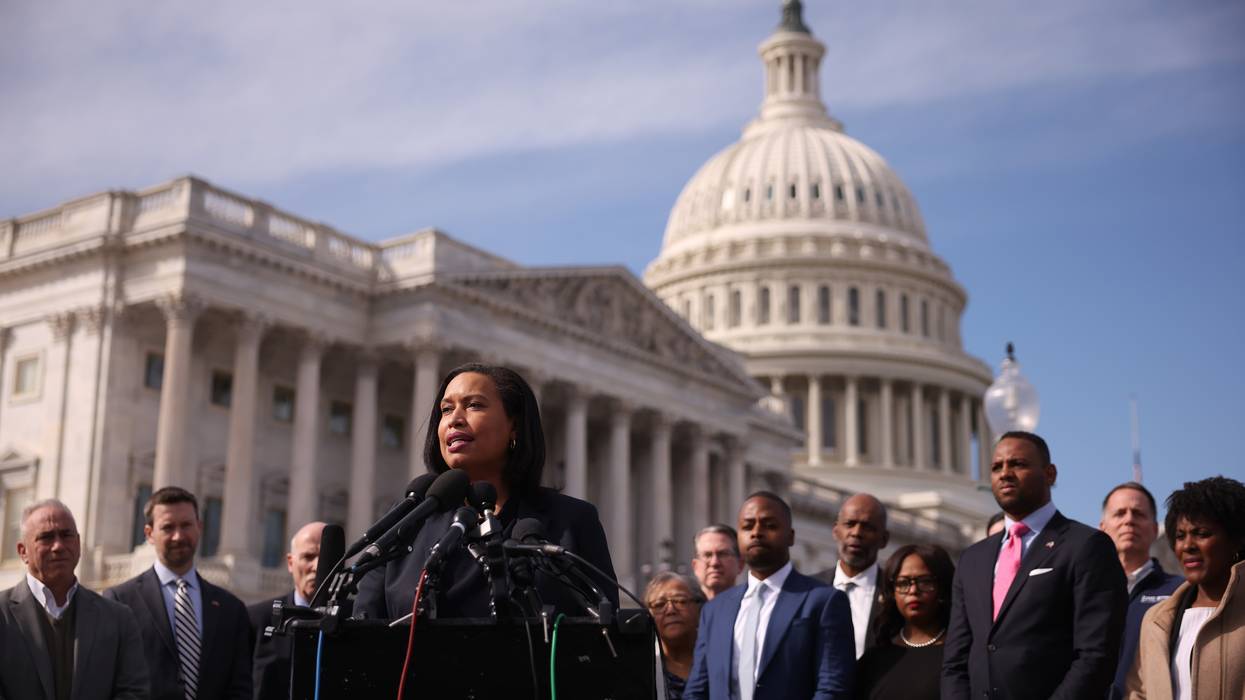
The government spending bill passed by the Republican-controlled House of Representatives on Tuesday that aims to avert a government shutdown would effectively cut Washington, D.C.'s budget by almost $1.1 billion dollars, a move that city leaders warned would be devastating for city services, schools, and more.
"The proposed one billion [dollar] cut to D.C.'s budget is senseless, reckless, and would have devastating consequences for our nation’s capital," a spokeswoman for Democratic D.C. Mayor Muriel Bowser's office said in a statement that was sent to multiple outlets.
The dilemma stems from the fact that Congress has the final word over D.C.'s budget.
The Republican spending bill is a continuing resolution and largely freezes federal spending at levels approved in the prior fiscal year, with $13 billion in cuts to non-military spending. Generally, Congress includes language in the continuing resolution that allows D.C. to spend its locally generated revenue at spending levels it has separately approved, but did not include that provision this time. In 2024, D.C. passed a 2025 budget of $21 billion, funded largely with local tax revenues.
" Republicans opted instead to treat D.C. the same as a federal agency, freezing funds and thus forcing the city to revert to its fiscal year 2024 budget—even as the city has been operating under its larger fiscal year 2025 budget since last October," explained the local D.C. outlet The 51st.
Delegate Eleanor Holmes Norton (D-D.C.) released a statement Monday blasting the text of the bill.
"With this bill, House Republicans have intentionally committed nothing short of fiscal sabotage against D.C.," said Norton. "D.C. has not been treated as a federal agency for funding purposes in more than 20 years precisely because doing so can force dramatic overnight cuts to essential services, including police, sanitation, and schools. Cuts to these services would work against Republicans' stated goal of improving public safety and order in D.C."
A memo from D.C. officials explains that reducing local spending by over $1 billion would force a 16% cut to all remaining funds that are not expended. A cut that large would result in layoffs of direct services workers and a reduction or elimination of direct services, per the memo.
The Washington Post reported that it's hard to predict exactly how the cuts will play out, but budget officials believe the reduction could cause $200 million in cuts to D.C. Public Schools and $166 million in cuts to charter schools.
D.C. Water, which distributes drinking water and provides regional wastewater treatment services, could see $51 million in cuts.
"The federal government saves no money from reducing D.C.'s locally funded expenditures," according to the memo from the District, which also noted that the cuts could cause D.C.'s bond rating to be downgraded.
"This is all completely pointless," wrote one observer on X. "There should not be a single vote in Congress in favor of these catastrophic cuts."
Another D.C. resident shared the Post's story and wrote the GOP is "attempting to casually cut the budget of a major city simply because they hate us and they can."
The spending bill now heads to the Senate. Democrats can try to block the measure, though that carries the risk of being blamed for a government shutdown, which would go into effect if no spending bill is passed by Friday.
"Big vote upcoming for Senate Democrats," wrote Post reporter Jeff Stein on Wednesday. "The Trump administration is asserting massive new powers to control federal spending unilaterally, and many Dems view the shutdown bill as their only possible point of leverage. We'll see what they do soon."

"The time is long overdue for us to start investing in our young people and help them get the jobs and education they need to be part of our economy and our society," Sen. Bernie Sanders (I-Vt.) wrote in a Mic op-ed published on Tuesday.
"Youth unemployment is one of the great crises facing our country...but it is one we rarely discuss in Washington."
--Sen. Bernie Sanders
"Youth unemployment is one of the great crises facing our country, impacting millions of young people and their families, but it is one we rarely discuss in Washington," he added. Sen. Sanders used the article to explain a youth job bill (pdf) he is co-sponsoring with Rep. John Conyers (D-Mich.) and Rep. Eleanor Holmes Norton (D-D.C.).
"It is time for our country to honor our duty to those young people who are struggling to find work," said Rep. Conyers, when the legislation was announced. "Tackling youth unemployment isn't just good ethics. It's good economics. Putting our youth to work will not only avoid anxiety, poverty, and broken dreams for young people, but will also provide needed tax revenue and reduce the need for social services."
The proposed law would provide states and localities with $5.5 billion in immediate funding to employ a million American workers who are 16 to 24 years old, and support job training for hundreds of thousands more.
"These outrageously high rates of youth unemployment are not only unacceptable: They are having a tragic impact on our society."
--Sen. Sanders
A large portion of the funding--$4 billion--would be issued as grants to state and local governments, to provide low-income youth with summer and year-round employment opportunities, as well as necessary services such as child care and transporation. The remaining $1.5 billion in grants would be issued to employers, community colleges, and local organizations, to provide young workers with apprenticeship programs and on-the-job training.
Sen. Sanders's Mic op-ed pointed to data analyis from the Economic Policy Institute (EPI), which recently found that even as the economy improves, young workers still struggle with unemployment and underemployment. As EPI senior economist Elise Gould wrote in July:
Young workers, ages 16-24 years old, had an unemployment rate more than twice as high as prime-age (25-54 year old) workers (9.8 percent versus 4.0 percent) and nearly three times as high as older (55-64 year old) workers (3.3 percent).... More than 1-in-6 young workers are underemployed, more than twice the rate of prime-age workers (17.8 versus 8.0 percent). More than 1-in-4 young black workers (27.4 percent) and nearly 1-in-5 young Hispanic workers (19.0 percent) are underemployed.
"These outrageously high rates of youth unemployment are not only unacceptable: They are having a tragic impact on our society," Sen. Sanders wrote for Mic, emphasizing the importance of his proposed legislation. "The alternative is to allow the status quo to continue--to ignore the needs of these young people and others like them. When our young people cannot find jobs, housing or income within mainstream society, it is no secret as to what happens.... Today, we spend some $80 billion a year to lock up our fellow Americans instead of investing in our young people, and in jobs and education for them."
The troubling correlation between young Americans' employment struggles and mass incarceration is not a new issue for Sen. Sanders. While campaigning for president in October 2015, he outlined for a large crowd full of cheering young people how the two issues are connected.
"It makes a lot more sense to me that we invest in jobs and education, not in jails and incarceration," Sen. Sanders said in part of the 2015 speech captured by the New York Times.