SUBSCRIBE TO OUR FREE NEWSLETTER
Daily news & progressive opinion—funded by the people, not the corporations—delivered straight to your inbox.
5
#000000
#FFFFFF
To donate by check, phone, or other method, see our More Ways to Give page.

Daily news & progressive opinion—funded by the people, not the corporations—delivered straight to your inbox.
The actions of these DAFs directly undermine democracy by excluding a group the administration has targeted and potentially denying funding to other targeted groups.
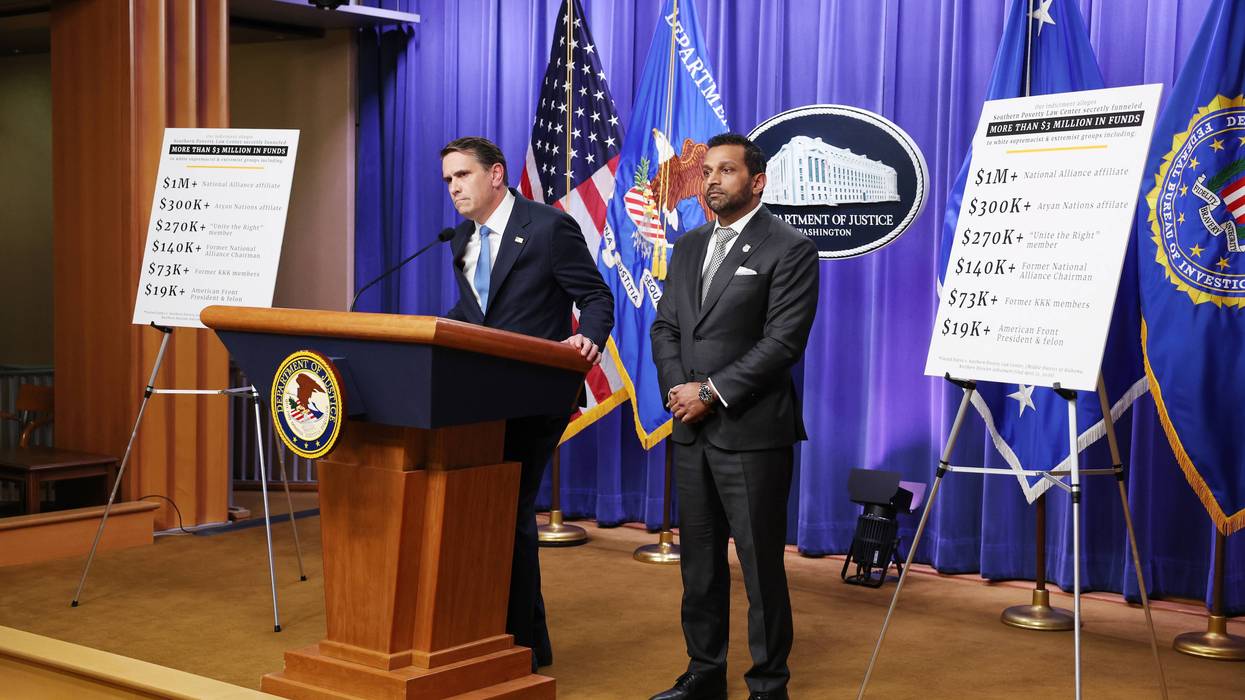
We know the Trump Department of Justice has threatened individuals they consider political opponents. Echoing authoritarian regimes worldwide, they’re now indicted Southern Poverty Law Center, or SPLC.
In response, major Donor-Advised Funds (DAFs), including Vanguard, Fidelity, and Schwab, have prevented clients from donating to SPLC, cutting the organization off from funding without even a shred of due process. If the DAFs follow this precedent, it could eliminate a key source of funding for any nonprofits this—or any future—administration chooses to attack.
The funds claim their action is necessary because, according to the administration, it constituted fraud for SPLC to have paid hate group informants. But federal and state law enforcement agencies have known about the infiltrations for years, using information they provided to help secure indictments and convictions. So the charges are spurious.
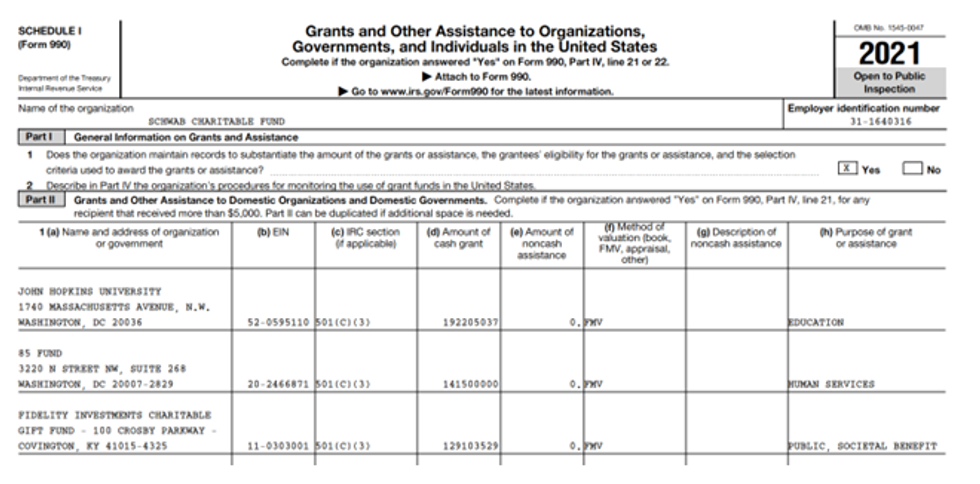
Fidelity justified its actions by citing a policy of pausing DAF giving if an organization “is being investigated for alleged illegal activities… such as terrorism, money laundering, hate crimes or fraud,” or if “state and federal agencies” are investigating a charitable organization. Schwab’s fund quietly removed SPLC from its list of eligible nonprofits, and a representative read me similar boilerplate, saying the fund was deciding on next steps.
If the Trump administration and its enablers can do this to SPLC, they can do it to far smaller and more vulnerable nonprofits.
The danger is far larger than the SPLC case. The listed criteria would let federal or state authorities cripple any nonprofit they choose, simply by launching an investigation. The organization doesn’t have to be convicted, or even indicted. They just have to be investigated, which makes this a perfect way to target political opponents. The administration has already issued a memorandum promising investigations of groups that promote “anti-fascism,” “anti-Christianity,” or “hostility” toward “traditional American views on family, religion, and morality.” It’s threatened Wikipedia, the Vera Institute for Justice, and the governmental watchdog Citizens for Responsibility and Ethics in Washington, not to mention major universities. All the federal government, or even a state government, would need to do to launch a DAF freeze is to open an official public investigation. And these major DAFs would then block the targeted organization from receiving funding.
The implications aren’t confined to the Trump administration. Under this precedent, Democrats holding power could do the same to disfavored nonprofits. Just launching an investigation would cut off a significant part of a targeted organization’s money flow. The defunding or banning of targeted NGOs is exactly what Vladimir Putin did in Russia, Viktor Orbán in Hungary, Recep Tayyip Erdoğan in Turkey, and Nicolás Maduro in Venezuela. It’s a classic way to eliminate opposition and consolidate power. And the anticipatory compliance of Vanguard, Fidelity, and Schwab is the exact kind of response that empowers would-be dictatorships, whatever their politics.
If a nonprofit is convicted of fraud or money laundering, it’s of course legitimate to remove or suspend their 501(c)(3) nonprofit status. But SPLC has neither been tried nor convicted, so the DAFs are letting a hostile administration’s mere accusation of wrongdoing become an excuse to block funding. The $326 billion of money that DAFs hold is part of the lifeblood of nonprofits. The actions of these DAFs directly undermine democracy by excluding a group the administration has targeted and potentially denying funding to other targeted groups. That’s true whatever you think of SPLC.
If there’s a nonprofit that could weather this, it’s SPLC, with its $786 million endowment. I don’t give to them because I think other groups are more impactful for the money they spend. But if the Trump administration and its enablers can do this to SPLC, they can do it to far smaller and more vulnerable nonprofits. For instance, they could target nonpartisan voter engagement groups, drying up funding (including pledged contributions) at the point when these groups need it the most to engage citizens in democracy. Damaging attacks on nonprofit funding also don’t have to come from the federal Department of Justice. Under Fidelity’s criteria, attacks could come from state governments as well, with potential targets including either conservative or liberal groups depending on which party runs a particular state.
But ordinary citizens have the power to change this. The campaigns that got ABC to reinstate Jimmy Kimmel offer a model. This issue has less visibility, but for the nonprofits it could affect is equally critical. If we have money in a DAF, our calls or emails could well make the difference. Schwab told me that they’d been getting lots of critical responses. But even if we don’t have a DAF, nearly 60% of us have retirement or other investment accounts, with most housed at the major affiliated brokerages. So we can reach out as well, threatening to switch our investments to brokerages that don’t empower authoritarian initiatives, like TIAA-CREF (at least for now Merrill Lynch-Bank of America is still putting through grants as well), and, if we have DAF’s, transfer them to ones that haven’t banned SPLC contributions, like Amalgamated Bank, Impact Assets, or Daffy. A group of socially responsible investment advisers have created a sign-on letter. New York’s historic Riverside Church just divested $12 million from Vanguard. A long-time activist friend created a leavefidelity.com site with cut and paste templates to send to the companies involved.
The goal is to echo what people did in the Kimmel situation when they boycotted the channels, advertisers, and theme park properties of national ABC-Disney and local Sinclair and Nextstar stations. People also protested in front of affiliated ABC stations—something they could do at the headquarters of the relevant brokerage houses. While DAFs are technically separate entities, they share investment management, administration, and the parent brand, which offers them as an incentive for clients. So we’re far from powerless.
The job of the brokerage houses is not to police client giving. Their affiliated DAFs need to allow donations to all legitimate nonprofits, whether or not the Trump administration—or any administration—agrees with what they do.
Current rules enable wealthy donors to bank their tax break immediately, but the donated funds may remain sidelined for decades.
For as long as we can remember, the end of the calendar year has marked the start of America’s giving season.
The holidays that light up our darkest months also invite us to celebrate (and practice!) generosity. Food banks, youth groups, arts and civic organizations, and community service programs heavily depend on the support they receive in November and December.
Year-end giving is big for tax purposes, but many people donate without regard to whether they’ll get a deduction. In fact, fewer than 10% of donors claim a tax deduction for charitable giving.
So, big donors: You want a tax break? Make sure the money gets to a working charity—and fast.
The super-wealthy, who do take advantage of itemizing their tax returns, give differently. They give more to large hospitals and universities, where you can get your name on a building. That kind of giving can be valuable too.
But a less visible difference is crucial to recognize.
Increasingly, wealthy donors are parking money in entities they control, like private foundations and donor advised funds (DAFs). These intermediaries then, in theory, donate money to working charities.
But private foundations are only required to “payout” 5% of their assets a year to these other charities. And DAFs have no requirement to payout at all. So wealthy donors bank their tax break immediately, but the donated funds may remain sidelined for decades.
According to a new report we co-authored, Gilded Giving 2024: Saving Philanthropy from Wall Street, over 35% of all charitable donations now go to one of these two intermediaries.
There’s now $1.7 trillion parked in private foundations and DAFs—money that could be flowing to working charities in a timely way to solve problems. We estimate that by 2028, half of all donations will go to private foundations and DAFs.
As wealth has concentrated in fewer hands over the last four decades, so has this kind of dubiously “charitable” giving—a trend we call “top-heavy philanthropy.” And it’s increasingly profitable for financial advisers to the ultra rich.
Wall Street financiers promote DAFs as a way for donors to receive immediate tax reductions in the year they give, but then they sit on those funds and collect wealth management fees. The financiers have no financial incentive to ever see the money go to a mental health center, food bank, community theater, or other working charity. It’s more profitable for them to keep assets under management.
The rest of us subsidize this system. For every dollar a billionaire donates to charity, including to their own foundation or DAF, the rest of us chip in up to 74 cents in the form of lost tax revenue.
So how did we get a charity system that works for multi-millionaire donors and wealth managers but not for nonprofit charities, small donors, and the taxpaying public? In part, it’s because lobbyists for the financial industry and DAF sponsors fight vigorously against any change.
But a growing coalition of donors, nonprofit charities, and people who care about tax fairness are pushing back. They point out that lawmakers could easily fix the rules to increase the flow of charitable funding, increase transparency, and shut down the tax avoidance and self-dealing practices currently corrupting philanthropy.
The message is getting across. A 2024 Ipsos poll found that 71% of respondents believe Congress should raise the annual payout rate for private foundations and require the same for DAFs. Across the political spectrum, a clear majority of Americans believe if a donor gets a tax break, they should move the money in a timely way to a working charity.
So, big donors: You want a tax break? Make sure the money gets to a working charity—and fast. You want other taxpayers to subsidize your giving preferences? Tell us where the money’s going.
Don’t like these rules? Then don’t ask the rest of us to subsidize it. Let’s make sure the season of giving actually centers on giving, not hoarding.
"The financial industry aggressively markets DAFs for uncharitable reasons: advantages as tax avoidance vehicles, especially for complex assets; no payout requirements—and secrecy to donors and grantees alike," said one of the report's authors.
A new report released on this year's philanthropic holiday known as Giving Tuesday details how the "profit motives of the financial services sector have increasingly and disastrously warped how charitable giving functions."
The analysis by the Institute for Policy Studies—titled "Gilded Giving 2024: Saving Philanthropy from Wall Street"—shows how donor-advised funds (DAFs) increasingly serve the economic interests of donors and the Wall Street firms that manage the funds, rather than the interests of nonprofit charities.
Rather than donate to a cause directly, wealthy people have the option to donate to foundations or DAFs, which can be sponsored by for-profit wealth management firms like Fidelity Investments or Charles Schwab. Firms like Fidelity Investments, in turn, benefit from being able to offer this type of service to wealthy clients.
"At last count," according to the report's authors, "DAFs and foundations together take in 35 percent of all individual giving in the U.S." If they continue to grow at the rate they have for the past five years, they're expected to take in half of all individual giving in the country by 2028.
Why is this a problem? For one thing, according to the report, some of the money that's intended for donation is scraped up by the DAFs and foundations, meaning that dollars meant for a cause are diverted elsewhere.
"With each passing year, an additional 2 cents of each dollar donated by individuals is funneled into intermediaries and away from working charities. Assuming that their assets will grow at the same rate they have over the past five years, the assets held in DAFs and foundations will eclipse $2 trillion by 2026," according to the report's authors.
What's more, there is no requirement that DAFs disburse their assets, according to the report's authors—meaning there's no guarantee the money is given to charity, and in practice the money in these accounts tends to move slowly, often generating gains instead of being dispersed.
DAFs also facilitate anonymous giving, because donations from them need only be credited to their sponsors, not the original person directing the contribution, according to Inequality.org, a project of IPS.
The report's authors argue that DAFs are part of a wider “wealth defense industry” — tax lawyers, accountants, and wealth managers whose interests are more geared towards helping their clients increase assets, minimize taxes, maximize wealth transfer to descendants, and net some of those assets for themselves in the form of fees, as opposed to supporting charitable causes.
DAFS are used strategically in this way, for example, by giving donors the ability to dispose of noncash assets, according to the report. In practice, this means that DAF donors can give stocks, real estate and other noncash assets directly to DAFS when markets are doing well, meaning they are able to get income tax deductions from their contribution while side stepping paying capital gains tax on appreciation of those assets.
"The financial industry aggressively markets DAFs for uncharitable reasons: advantages as tax avoidance vehicles, especially for complex assets; no payout requirements—and secrecy to donors and grantees alike," said Chuck Collins, co-author of the report and director of the Charity Reform Initiative at IPS.
Other key insights from the study include: