SUBSCRIBE TO OUR FREE NEWSLETTER
Daily news & progressive opinion—funded by the people, not the corporations—delivered straight to your inbox.
5
#000000
#FFFFFF
To donate by check, phone, or other method, see our More Ways to Give page.
Daily news & progressive opinion—funded by the people, not the corporations—delivered straight to your inbox.
The case of Celeste Burgess illustrates "the real, human cost of mass surveillance of everyone's private digital communications," said one digital rights advocate.
Advocates for digital privacy rights and reproductive rights alike were outraged Thursday over the jail sentence of a 19-year-old in Nebraska who self-managed her abortion last year—a case which one campaigner said highlights how prosecutors will "stretch laws far beyond their intended scope" to penalize people who end or attempt to end their pregnancies in the post-Roe v. Wade legal landscape.
Self-managed abortion is only banned in two states—Nevada and South Carolina—but prosecutors charged Celeste Burgess with one felony and two misdemeanors last year, several months after she had a stillbirth at 29 weeks of pregnancy. Burgess, who was 17 at the time, had procured pills for a medication abortion shortly before the stillbirth, and had discussed the outcome of the pregnancy on Facebook Messenger with her mother, Jessica Burgess.
Nebraska had a 20-week abortion ban in place in April 2022, when Burgess's stillbirth took place.
Prosecutors ultimately dropped the misdemeanor charges against Burgess in exchange for her plea of guilty to a felony charge of concealing or abandoning a dead body. On the Facebook messaging application, Burgess and her mother had discussed "burning the evidence" of the stillbirth and burying it, which they did with the help of a third person named Tanner Barnhill, who has been sentenced to probation.
According to Jezebel, police received a tip about the disposal of the remains and obtained a warrant to view the mother and daughters' Facebook messages after Celeste Burgess mentioned the correspondence when she was being questioned by law enforcement.
Meta, the company that owns Facebook, complied with the warrant and released the messages, which were not subject to end-to-end encryption.
Digital rights groups have long called on Facebook and other online messaging platforms to make end-to-end encryption the default setting for users' conversations.
Burgess' case illustrates "the real, human cost of mass surveillance of everyone's private digital communications," said Meredith Whittaker, president of the encrypted messaging app Signal.
Emma Roth, a staff attorney at Pregnancy Justice, which advocates for people who face pregnancy-related criminal charges, told Jezebel that police and prosecutors in Nebraska charged Burgess out of desperation to "criminalize what they view as immoral behavior," in the absence of state laws against the 17-year-old's procurement of abortion pills.
"When [prosecutors] are faced with the limitations of state law and the fact that a self-managed abortion or a pregnancy loss is not illegal under state law, it's almost as if they start throwing spaghetti at the wall to see what sticks," Roth said. "Prosecutors are much more likely to try to 'make an example' of someone who seeks an abortion later on in pregnancy because they deem that less morally acceptable, and they may seek charges in the hope that the public will find the facts of the case egregious and will welcome a prosecution."
"But the risk, of course, is that any type of precedent that a prosecutor sets when bringing a case against someone who sought a later abortion can be applied against somebody seeking an earlier abortion," she added.
In the case of Burgess, noted journalist Jessica Valenti, one detail that made it into numerous media reports was a claim that the 17-year-old said in her Facebook messages that she couldn't "wait to get the 'thing' out of her body."
In reality, Valenti wrote, "that sentence is nowhere in the Facebook messages; in fact, the language is actually a police officer's interpretation of the teenager's conversation."
Prosecutors in Madison County, Nebraska "tried to paint a portrait of this mother and daughter in a negative light and to deprive them of their humanity and to erase the fact that we're talking about a teenager who was not ready to have a child," Roth told Jezebel.
While prosecutors have long filed charges against people for pregnancy losses and self-managed abortions, said Jezebel reporter Susan Rikunas, "Celeste Burgess may be the first person charged and sentenced for crimes related to an abortion since the Supreme Court's Dobbs ruling."
Last year's decision in Dobbs v. Jackson Women's Health Organization reversed nearly a half-century of national abortion rights affirmed by Roe.
As progressive advocacy group Indivisible said, Burgess' jail sentence represents Republican lawmakers' "deranged vision for our country."
A small-government intervention will clean up the public market and force Threads—and Meta—to build a better, safer sewing machine.
As a kid, I worked in a men’s store tailor shop on the East Side of Cleveland. It was chaos, watching master tailors cut, sew, and press tiny threads into modern fashion. My job was to clean the shop, oil the machines, and keep the steam presses hydrated. Thread was everywhere and constantly needed to be swept up, as each garment was crafted with care and purpose.
Whether Meta founder Mark Zuckerberg realized it or not, the name of his new text-based social media platform, Threads, is the perfect metaphor for the new platform we’ve all been craving. Will it be sewn into something beautiful or just another tangled mess that needs to be swept up?
Elon Musk’s decisions at the helm of Twitter and the longstanding issues surrounding the lack of controls against bullies and bots have disgusted millions of users. But is jumping ship to a new platform—owned by a flawed company that has not cleaned up its own issues—the way we want to engage?
After my first day on Threads, I already faced issues that have plagued Twitter for years. I had fake profiles and bots already following my account.
Social media fashions have changed from when we first logged on over a decade ago. We are no longer excited by chaos, stunts, or gimmicks, or learning basic HTML to customize our backgrounds on MySpace. Many of us just want an uncluttered, simple social platform that’s bully and bot-free, and isn’t trying to sell us stuff we don’t want or need. Adam Mosseri, the head of Instagram, knows this, and was quoted in The New York Times saying he wants “Threads to be a ‘friendly place’ for public conversation.”
But is that even possible, given that Threads has seemingly already fallen short on protections? After my first day on Threads, I already faced issues that have plagued Twitter—a blatantly similar type of platform—for years. I had fake profiles and bots already following my account.
If Threads wants to succeed, it needs a bobbin to keep it running smoothly. Think of it as adding some simple guardrails to help guide the threads from jamming the machine. Without this basic intervention, we already know the downward spiral that’s coming next.
We have watched social networks, including Meta, fight to keep and expand archaic protections that were granted in 1996’s Communications Decency Act. These protections were created to allow companies like AOL and Prodigy to be treated as blind infrastructure, like a telephone line, and never be held liable for any communications on their railways.
These laws were created before there were modern-day social networks, let alone billions of dollars in advertising revenue being moved through them.
Unfortunately, as each of these platforms competes to become the largest network in the free market, without any intervention or protections, they will create more of the same bot-driven cesspools, spreading misinformation and disinformation and promoting false advertising. There is no real incentive for them to do anything different in the United States. Threads is not yet in the European Union, since the E.U. has stricter privacy laws. It also has yet to implement advertising, but that’s just a matter of time.
Now is the time to evolve the Communications Decency Act so that the next generation of social networks are sewn into a more wearable garment. This is not unAmerican. Think back to that famous Thomas Jefferson quote, “We might as well require a man to wear still the coat which fitted him when a boy as a civilized society to remain ever under the regimen of their barbarous ancestors." Let’s follow this lead and advance our social platforms by evolving Section 230 of the 1996 Communications Decency Act and force these powerful companies to take accountability for their actions.
Historically, Twitter only took performative actions to resolve or remove bots and fake accounts before they testified before Congress or before a major election. The company was well known for putting out self-congratulatory press releases on how it clamped down and removed tons of bots and bad actors—but let’s be honest, they never implemented long-term fixes to these known problems.
A simple change in liability, the bobbin, will ensure social networks run smoother by forcing them to focus on their consumers. This simple change will make these companies spend resources on security measures, monitoring technology, and even hiring staff to review advertising for accuracy, just like every other media outlet in America.
In other words, a small-government intervention will clean up the public market and force Threads—and Meta—to build a better, safer sewing machine. One that does not allow its users to be threatened by hate speech or acts of violence without real consequences.
It’s time for Congress to take out their brooms, evolve the Communications Decency Act, and help clean up these threads.
"The need for privacy has never been more urgent," said one advocate. "Encryption is a shield that protects everyone but most especially the most targeted and vulnerable communities."
A global coalition of more than 40 companies and digital rights groups on Wednesday urged governments around the world to publicly vow to "protect encryption and ensure a free and open internet."
The coalition sent its open letter to policymakers in Australia, Canada, the European Union, India, the United Kingdom, and the United States on World Press Freedom Day because digital privacy safeguards are particularly important to journalists and their sources, though advocates stressed they're essential to preserving democracy and human rights at large.
"Encryption is a critical tool for user privacy, data security, safety online, press freedom, self-determination, and free expression," states the letter. "Without encryption, users' data and communications can be accessed by law enforcement and malicious actors."
"Government attacks on encrypted services threaten privacy and put users at risk," the letter continues. "This might seem like a distant problem primarily faced in authoritarian countries but the threat is just as real and knocking at the doors of democratic nations."
"Policymakers understand the importance of privacy when it comes to opening someone else's physical mail, accessing their banking or other private information, but limit such protections online."
As the coalition, organized by Tutanoa, Fight for the Future, and Tor, explained, the value of end-to-end encryption "in defending privacy cannot be overstated, but is also seen as a threat to law enforcement who argue that the ability to freely access individuals' communications is critical for criminal investigations."
Law enforcement's narrative "has spurred worrying initiatives such as the Online Safety Bill in the U.K., the Lawful Access to Encrypted Data Act and EARN IT Act in the U.S., India's Directions 20(3)/2022 – CERT-In, Bill C26 in Canada, the Surveillance Legislation Amendment Act in Australia as well as the proposed rules to prevent and combat child sexual abuse in the E.U.," the coalition noted. "These laws aim to take away the right to privacy online by forcing encrypted services to weaken the security of their users and give law enforcement access to user information upon request."
In a statement, the coalition condemned the aforementioned proposals as "alarming examples of democratic governments following in the path of authoritarian governments like Russia and Iran, who actively limit their citizens' access to encrypted services thereby weakening their human rights."
Pushing back against such measures, the letter calls on "democratic leaders" to "protect encryption and uphold the human right to privacy."
Specifically, signatories implored all governments to:
"Encrypted services are at the forefront of the battle for online privacy, freedom of the press, freedom of opinion and expression," says the letter. "Many journalists, whistleblowers, and activists depend on secure, encrypted solutions to protect their data as well as their identity. Access to these tools can be literally life or death for those who rely on them."
The open letter echoes United Nations Secretary-General António Guterres' fresh warning that "in every corner of the world, freedom of the press is under attack."
"Freedom of the press is the foundation of democracy and justice," said Guterres. "It gives all of us the facts we need to shape opinions and speak truth to power."
"Meanwhile, journalists and media workers are directly targeted on and offline as they carry out their vital work. They are routinely harassed, intimidated, detained, and imprisoned," he added. "At least 67 media workers were killed in 2022—an unbelievable 50% increase over the previous year."
"Many policymakers believe they can have a 'magical key' to access encrypted communication—completely ignoring technical facts: Encryption is either securing everyone or it is broken for everyone."
While legislative and regulatory attempts to undermine encryption are especially hazardous to reporters and dissidents, experts made clear that weakening digital privacy ultimately endangers everyone.
"Encryption is a necessary tool for safeguarding our digital rights and the principles of a free and open society. By upholding encryption within messaging apps, websites, file sharing, and other online services, we empower journalists to report on important issues while protecting their sources without fear of surveillance and retribution," said Isabela Fernandes, executive director of the Tor Project. "The Tor network is underpinned by encryption, and we have partnered with many news outlets and social media sites to launch Onion Sites that bypass censorship and allow people to safely and anonymously access, share, and publish information."
Fight for the Future campaigner Eseohe Ojo argued that "the need for privacy has never been more urgent."
"Encryption is a shield that protects everyone but most especially the most targeted and vulnerable communities," said Ojo. "This ranges from journalists and activists to LGBTQ+ folks, abortion seekers, [and] ethnic and other minorities. Why take away the tools needed to help protect them at a time they need these tools the most?"
"Policymakers understand the importance of privacy when it comes to opening someone else's physical mail, accessing their banking or other private information, but limit such protections online," she added. "Encrypted services protect and empower individuals. It is about time governments recognize and safeguard access to these tools."
Tutanota co-founder Matthias Pfau lamented that "many policymakers believe they can have a 'magical key' to access encrypted communication—completely ignoring technical facts: Encryption is either securing everyone or it is broken for everyone."
"If policymakers want a 'magical key,' they will ultimately destroy the security of all citizens, including journalists and whistleblowers who depend on encryption to expose abuses of power or other grievances in society," Pfau warned. "That's why we at Tutanota will never weaken our encryption. If governments outlaw encryption, they need to block access to our encrypted email service, just like Russia and Iran are already doing."
The ongoing effort to investigate and ban TikTok is not about our privacy, but about fueling more aggression against China.
Last Thursday, a Congressional hearing took place where the TikTok CEO was grilled for five hours on the grounds of “security concerns.” This was days after the FBI and DOJ launched an investigation on the Chinese-owned American company. Isn’t it ironic that while the US government is putting TikTok under the magnifying glass, it’s turning a blind eye to its own surveillance programs on the American people?
Ten years ago, Edward Snowden told the whole world the truth about the US global surveillance programs. If Congress cares about our digital privacy, it should first begin by investigating the surveillance policies of its own US agencies. The campaign against TikTok is a fear-mongering tactic to wage war on China.
In 2020, the FBI used social media to monitor racial justice protesters who were targeted for arrests. For example, activist Mike Avery was arrested after posting about protests on Facebook, and his charges were dropped without explanation a few weeks later. An FBI official was so frustrated with the extensive social media surveillance that he told The Intercept, “Man, I don’t even know what’s legal anymore.”
The dissonance between accusing TikTok of security concerns and working with other companies to invade people’s privacy rings loudly in our ears.
Social media has long been a tool used by federal agencies to target individuals and communities designated as “threat.” The Department of Homeland Security and the Immigration and Customs Enforcement have monitored the social media activities of immigrant rights activists. The State Department used social media screening to discriminate against the Muslim, Arab, Middle Eastern, and South Asian communities under the Trump administration’s “Muslim ban.”
Only last year that the post-9/11 NSA phone surveillance program was reported to have shut down. Major telecom companies like Verizon gave the government access to hundreds of millions of calls and texts. Dataminr, a startup Twitter partner, provided police with data about BLM protests. One focus on ‘potential gang members’ targeted Black and Latinx people, including school-aged children.
Meta's subsidiary WhatsApp was reportedly used by the Saudi government to hack journalist Jamal Khashoggi's phone. Meanwhile, Meta itself used a VPN to spy on users' smartphones for market research in exchange for bribes. Yet WhatsApp is not banned on government devices.
If our lawmakers are concerned about protecting digital privacy, then Congress should start with investigating American federal agencies. Unlike China as well as other Western countries, such as the EU, the US does not have any digital privacy laws on the federal level. The US could cooperate with China to better ensure people’s privacy is protected, instead of driving fear to target one single social media platform.
The ongoing effort to investigate and ban TikTok is not about our privacy, but about fueling more aggression against China. Fear-mongering about China has also caused the rise of anti-Asian racism in the US. In banning TikTok, the US is projecting its invasive policies onto another government. Warmongers are using the issue to create paranoia and justify even more aggression toward China.
It is not a coincidence that these recent bans have come about shortly after a Chinese weather balloon was shot down over the US. Privacy concerns are being used to wage war on China. The US should focus on passing federal data privacy laws instead of targeting one app. Double standards and warmongering against China need to stop. China is not our enemy.
Currently, there are no significant consequences for political campaigns, their data vendors, or peer-to-peer software providers to prevent them from continuously spamming voters.
Do you have a friend, maybe an ex-girlfriend or an ex-boyfriend, who won’t stop texting you? Then you know how annoying it is, and difficult it is, once they have your number, to block them.
What if that same person turns into a stalker and starts sending you an unstoppable stream of messages from different phone numbers? Creepy! What do you do? Who do you call? Local police, FCC, FBI, your Attorney General?
That is, essentially, what politicians are currently doing when they spam targeted voters without their permission by simply obtaining their number and using peer-to-peer (P2P) text messaging from a random ten-digit phone number (10DLC).
Currently, it is impossible to unsubscribe from political P2P text messages. Even if you block one number, the messages keep coming at you from another – over and over again.
Last week the FCC took significant steps toward blocking text messages from scammers and spammers. In the first ruling of its kind, the government decided to force wireless carriers to block messages from invalid and unused numbers that many of today’s spammers use in these nefarious activities.
Unfortunately, this ruling still allows politicians to blast text messages to your phone as it does not hold political campaigns to the same standard regarding spamming voters.
Wait. What? Why? How Come?
It's all based on how our government evolved its rulemaking around new technologies while playing catch-up to clever developers designing new hacks to create end-run around current rules to scam consumers. So while the Telecommunications Consumer Protection Act states that you can’t blast unwanted messages to consumers using an auto-dialer, some technologists created mobile phone apps to skirt these rules by crowdsourcing their activities through peer-to-peer (P2P) to volunteer proxy sending these messages instead of an autodialer. Unfortunately, in 2020 The P2P tech providers created the P2P Alliance that successfully lobbied the Trump Administration to roll back the specifically added protections against political spam messaging that the Obama Administration put in place in 2015.
Currently, there are no significant consequences for political campaigns, their data vendors, or peer-to-peer software providers to prevent them from continuously spamming voters.
This is not a partisan issue. All 50 states' Attorneys General pushed for this new ruling as they are all receiving consumer complaints too. And it's only getting worse. According to the FCC, text message spam has become a “pervasive consumer threat” as complaints have skyrocketed sixfold (from around 3,300 in 2015 to 18,900 in 2022). Almost certainly, you, too, have noticed the increase in spam messages yourself, or you know someone who has been duped, phished, misled, and scammed by these tactics.
Nonetheless, these companies claim that P2P text should be permissible because it "enables two-way text communication” and requires a person to manually send each text message through this software.
The P2P companies are not worried about the new FCC rules as they are currently advertising their spamming software to any campaign that wants to buy. One ad reads, “One Person can Send 13,000 Texts Hourly Guaranteed. 1.2¢ Per Text Segment, Including Picture MMS. No Blocking! Double the Speed of Anyone Else.”
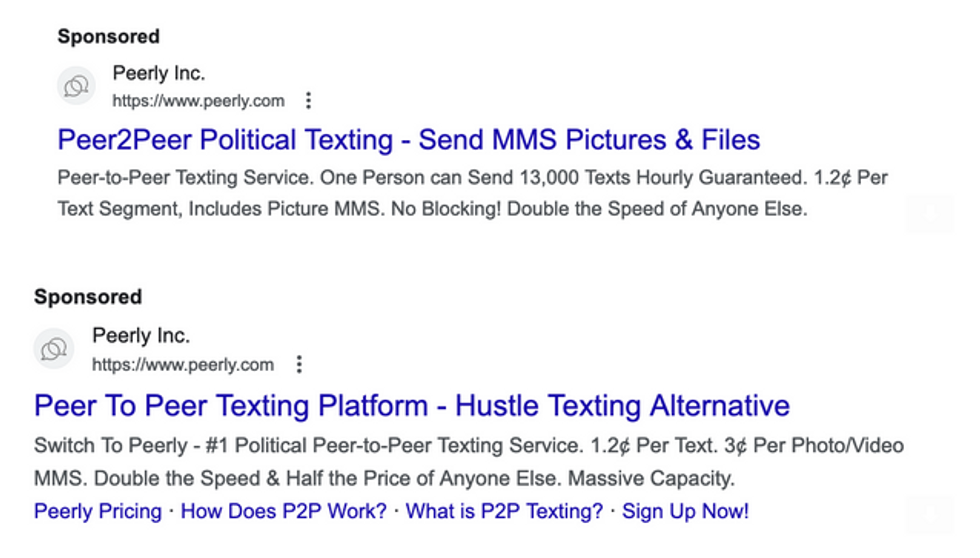
It's time for the FCC to weigh in and rule that these messaging apps are not being used for having personal conversations when users can send 13,000 text messages in an hour from a computer program that uploads voter file lists to an app.
I understand that politicians love this technology. It's fast, extremely accurate, and super easy to target voters on the only device that is with them almost 24 hours a day. It's become easy to match a list of donors' cell phone numbers and blast out urgent messages to help raise critically needed campaign contributions. But this same technology is being used to target and spam voters with misinformation and disinformation. We saw this happen in 2012 and again in 2022’s Kansas statewide abortion-rights ballot initiative, where voters received inaccurate information from an unknown cell number to dissuade a group of targeted voters. We will only see more of this type of misleading spam messages in the upcoming elections if the FCC doesn’t take action by closing these loopholes and protecting American voters from last-minute voter suppression campaigns being run through our mobile phones.
In other words, just because big data technology allows political operatives to match a voter file with cell phone numbers to quickly target and reach millions of registered Democrats, Republicans, or Independents with spam messages on their cell phones doesn’t mean we should allow this type of abuse.
These P2P tech companies are violating your privacy and misusing your personal data by claiming that these messages resemble personal text messages and are not actually auto-dialed robotic spam. So the FCC needs to do more to make sure politicians are not spamming the same voters they claim to represent. It's time the FCC creates a permanent text message do-not-text list that applies to political campaigns and P2P messaging that has real teeth and consequences for those that violate the rules.