SUBSCRIBE TO OUR FREE NEWSLETTER
Daily news & progressive opinion—funded by the people, not the corporations—delivered straight to your inbox.
5
#000000
#FFFFFF
To donate by check, phone, or other method, see our More Ways to Give page.
Daily news & progressive opinion—funded by the people, not the corporations—delivered straight to your inbox.
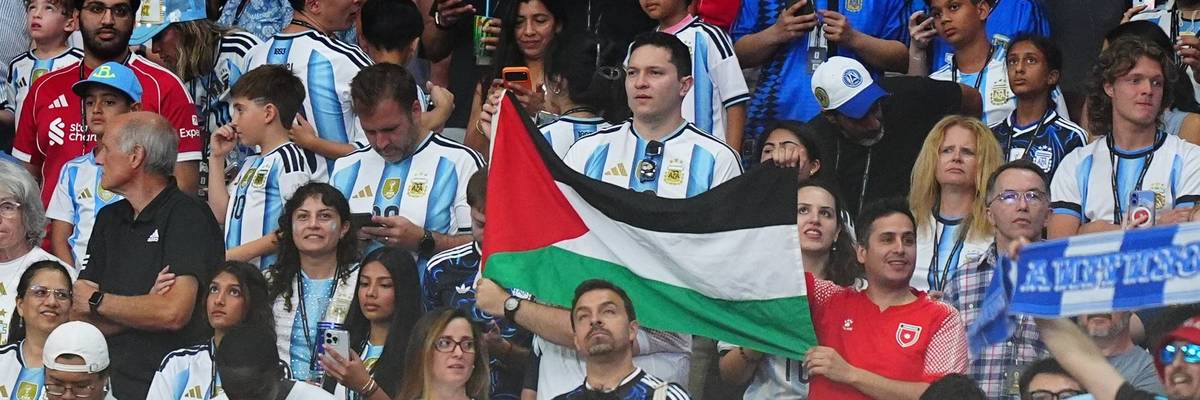
Fans unfurl a Palestinian flag prior the 2026 FIFA World Cup Round of 16 match between Argentina and Egypt at Mercedes-Benz Stadium (Atlanta Stadium) in Atlanta, Georgia, United States on July 7, 2026.
The support shown for Palestinians has been especially inspiring at a World Cup that, like others, has been tainted by more signs of corruption.
The Palestinian national soccer team isn’t playing in this year’s World Cup. But despite a national and global crackdown on pro-Palestinian protest and speech, the games have witnessed an outpouring of support for Palestinians. Fans, players, and coaches from the likes of Egypt, Scotland, Brazil, South Korea, Morocco, Mexico, Turkey, Norway, Senegal, Bosnia and Herzegovina, Algeria, Spain, and perhaps all 48 countries playing have publicly shown support for Palestinian lives and their struggle for freedom and a return to lands taken since 1948.
This comes after nearly three years in which the world has watched the Israeli government respond to October 7, 2023 Hamas attacks on Israel, which killed around 1,200, with a war that has killed more than 73,000, mostly civilians, and is widely considered a genocide by international experts.
Games have featured Palestinian flags held aloft in stadiums and by players and coaches on the fields. Chants of “Free Palestine” have come from the stands and the streets surrounding games. People have attended games wearing the Palestinian national team jersey. Others have flown banners reading, “Kick Israel Out of FIFA” and “Red Card Israel.” (FIFA is the infamously corrupt international organization that runs the tournament; a red card is given to soccer players ejected and banned from games for foul play.)
The support shown for Palestinians has been especially inspiring at a World Cup that, like others, has been tainted by more signs of corruption. Most recently, President Donald Trump called FIFA’s president to overturn a red-card ban for a US player so that he could participate in what turned out to be a lopsided loss for Team America. The FIFA president also awarded Trump a meaningless “peace prize” not long before the United States joined Israel in an illegal and historically unpopular war in Iran.
“Palestinian families don’t get their homes back because people flew a flag in a stadium. But movements build over time and through moments of visibility, through the accumulation of pressure, and through the refusal to let the issue disappear.”
Expressions of solidarity at soccer games don’t change anything on their own. During the days of the tournament alone, the Israeli government, which receives extensive military backing from the US government, has killed dozens of people in Gaza. Before a match between Argentina and Egypt, Israel killed Mohammed al-Wahidi, a representative of an Egyptian humanitarian organization in Gaza, along with two children and another person, on the day al-Wahidi was organizing a Gaza City viewing party to watch the game. (Al-Wahidi is one of more than 1,000 Palestinians, including hundreds of women and children, reported killed by the Israeli military in Gaza since the officially declared “ceasefire” last year.)
A soccer tournament, alone, doesn’t solve anything, Palestinian journalist Dina El-Kurd has said: “Palestinian families don’t get their homes back because people flew a flag in a stadium. But movements build over time and through moments of visibility, through the accumulation of pressure, and through the refusal to let the issue disappear.”
Egypt’s coach Hossam Hassan has been one of the most bravely and consistently outspoken. “Before being Arab, Muslim, Christian, or anything else, I am a human being,” he said in a press conference when he might have only spoken about playing against probably history’s greatest-ever player in Lionel Messi and Argentina. “Through football—the world’s soft power—I want to send a message,” he said. “Please let the Palestinian people live. I ask athletes and journalists everywhere to help deliver that message.”
Along with coaches, journalists, and players—including, one hopes, the likes of Messi—isn’t that a message to share at viewing parties, bars, and family gatherings during the World Cup’s final matches—and beyond?
The red, green, and black colors of the Palestinian flag are easy enough to apply as face paint. I’ll be taking some small steps by wearing a Palestine jersey and using the games to raise funds for humanitarian relief in Gaza. Discussing the morality of continuing US military support for the Israeli government is a start.
Journalist El Kurd says she’s felt a kind of hope seeing the flag waived in stadiums: “It’s not the hope that this will be resolved soon or easily, but the hope that says Palestinians are not alone and the cause is not forgotten.”
Dear Common Dreams reader, It’s been nearly 30 years since I co-founded Common Dreams with my late wife, Lina Newhouser. We had the radical notion that journalism should serve the public good, not corporate profits. It was clear to us from the outset what it would take to build such a project. No paid advertisements. No corporate sponsors. No millionaire publisher telling us what to think or do. Many people said we wouldn't last a year, but we proved those doubters wrong. Together with a tremendous team of journalists and dedicated staff, we built an independent media outlet free from the constraints of profits and corporate control. Our mission has always been simple: To inform. To inspire. To ignite change for the common good. Building Common Dreams was not easy. Our survival was never guaranteed. When you take on the most powerful forces—Wall Street greed, fossil fuel industry destruction, Big Tech lobbyists, and uber-rich oligarchs who have spent billions upon billions rigging the economy and democracy in their favor—the only bulwark you have is supporters who believe in your work. But here’s the urgent message from me today. It's never been this bad out there. And it's never been this hard to keep us going. At the very moment Common Dreams is most needed, the threats we face are intensifying. We need your support now more than ever. We don't accept corporate advertising and never will. We don't have a paywall because we don't think people should be blocked from critical news based on their ability to pay. Everything we do is funded by the donations of readers like you. When everyone does the little they can afford, we are strong. But if that support retreats or dries up, so do we. Will you donate now to make sure Common Dreams not only survives but thrives? —Craig Brown, Co-founder |
The Palestinian national soccer team isn’t playing in this year’s World Cup. But despite a national and global crackdown on pro-Palestinian protest and speech, the games have witnessed an outpouring of support for Palestinians. Fans, players, and coaches from the likes of Egypt, Scotland, Brazil, South Korea, Morocco, Mexico, Turkey, Norway, Senegal, Bosnia and Herzegovina, Algeria, Spain, and perhaps all 48 countries playing have publicly shown support for Palestinian lives and their struggle for freedom and a return to lands taken since 1948.
This comes after nearly three years in which the world has watched the Israeli government respond to October 7, 2023 Hamas attacks on Israel, which killed around 1,200, with a war that has killed more than 73,000, mostly civilians, and is widely considered a genocide by international experts.
Games have featured Palestinian flags held aloft in stadiums and by players and coaches on the fields. Chants of “Free Palestine” have come from the stands and the streets surrounding games. People have attended games wearing the Palestinian national team jersey. Others have flown banners reading, “Kick Israel Out of FIFA” and “Red Card Israel.” (FIFA is the infamously corrupt international organization that runs the tournament; a red card is given to soccer players ejected and banned from games for foul play.)
The support shown for Palestinians has been especially inspiring at a World Cup that, like others, has been tainted by more signs of corruption. Most recently, President Donald Trump called FIFA’s president to overturn a red-card ban for a US player so that he could participate in what turned out to be a lopsided loss for Team America. The FIFA president also awarded Trump a meaningless “peace prize” not long before the United States joined Israel in an illegal and historically unpopular war in Iran.
“Palestinian families don’t get their homes back because people flew a flag in a stadium. But movements build over time and through moments of visibility, through the accumulation of pressure, and through the refusal to let the issue disappear.”
Expressions of solidarity at soccer games don’t change anything on their own. During the days of the tournament alone, the Israeli government, which receives extensive military backing from the US government, has killed dozens of people in Gaza. Before a match between Argentina and Egypt, Israel killed Mohammed al-Wahidi, a representative of an Egyptian humanitarian organization in Gaza, along with two children and another person, on the day al-Wahidi was organizing a Gaza City viewing party to watch the game. (Al-Wahidi is one of more than 1,000 Palestinians, including hundreds of women and children, reported killed by the Israeli military in Gaza since the officially declared “ceasefire” last year.)
A soccer tournament, alone, doesn’t solve anything, Palestinian journalist Dina El-Kurd has said: “Palestinian families don’t get their homes back because people flew a flag in a stadium. But movements build over time and through moments of visibility, through the accumulation of pressure, and through the refusal to let the issue disappear.”
Egypt’s coach Hossam Hassan has been one of the most bravely and consistently outspoken. “Before being Arab, Muslim, Christian, or anything else, I am a human being,” he said in a press conference when he might have only spoken about playing against probably history’s greatest-ever player in Lionel Messi and Argentina. “Through football—the world’s soft power—I want to send a message,” he said. “Please let the Palestinian people live. I ask athletes and journalists everywhere to help deliver that message.”
Along with coaches, journalists, and players—including, one hopes, the likes of Messi—isn’t that a message to share at viewing parties, bars, and family gatherings during the World Cup’s final matches—and beyond?
The red, green, and black colors of the Palestinian flag are easy enough to apply as face paint. I’ll be taking some small steps by wearing a Palestine jersey and using the games to raise funds for humanitarian relief in Gaza. Discussing the morality of continuing US military support for the Israeli government is a start.
Journalist El Kurd says she’s felt a kind of hope seeing the flag waived in stadiums: “It’s not the hope that this will be resolved soon or easily, but the hope that says Palestinians are not alone and the cause is not forgotten.”
The Palestinian national soccer team isn’t playing in this year’s World Cup. But despite a national and global crackdown on pro-Palestinian protest and speech, the games have witnessed an outpouring of support for Palestinians. Fans, players, and coaches from the likes of Egypt, Scotland, Brazil, South Korea, Morocco, Mexico, Turkey, Norway, Senegal, Bosnia and Herzegovina, Algeria, Spain, and perhaps all 48 countries playing have publicly shown support for Palestinian lives and their struggle for freedom and a return to lands taken since 1948.
This comes after nearly three years in which the world has watched the Israeli government respond to October 7, 2023 Hamas attacks on Israel, which killed around 1,200, with a war that has killed more than 73,000, mostly civilians, and is widely considered a genocide by international experts.
Games have featured Palestinian flags held aloft in stadiums and by players and coaches on the fields. Chants of “Free Palestine” have come from the stands and the streets surrounding games. People have attended games wearing the Palestinian national team jersey. Others have flown banners reading, “Kick Israel Out of FIFA” and “Red Card Israel.” (FIFA is the infamously corrupt international organization that runs the tournament; a red card is given to soccer players ejected and banned from games for foul play.)
The support shown for Palestinians has been especially inspiring at a World Cup that, like others, has been tainted by more signs of corruption. Most recently, President Donald Trump called FIFA’s president to overturn a red-card ban for a US player so that he could participate in what turned out to be a lopsided loss for Team America. The FIFA president also awarded Trump a meaningless “peace prize” not long before the United States joined Israel in an illegal and historically unpopular war in Iran.
“Palestinian families don’t get their homes back because people flew a flag in a stadium. But movements build over time and through moments of visibility, through the accumulation of pressure, and through the refusal to let the issue disappear.”
Expressions of solidarity at soccer games don’t change anything on their own. During the days of the tournament alone, the Israeli government, which receives extensive military backing from the US government, has killed dozens of people in Gaza. Before a match between Argentina and Egypt, Israel killed Mohammed al-Wahidi, a representative of an Egyptian humanitarian organization in Gaza, along with two children and another person, on the day al-Wahidi was organizing a Gaza City viewing party to watch the game. (Al-Wahidi is one of more than 1,000 Palestinians, including hundreds of women and children, reported killed by the Israeli military in Gaza since the officially declared “ceasefire” last year.)
A soccer tournament, alone, doesn’t solve anything, Palestinian journalist Dina El-Kurd has said: “Palestinian families don’t get their homes back because people flew a flag in a stadium. But movements build over time and through moments of visibility, through the accumulation of pressure, and through the refusal to let the issue disappear.”
Egypt’s coach Hossam Hassan has been one of the most bravely and consistently outspoken. “Before being Arab, Muslim, Christian, or anything else, I am a human being,” he said in a press conference when he might have only spoken about playing against probably history’s greatest-ever player in Lionel Messi and Argentina. “Through football—the world’s soft power—I want to send a message,” he said. “Please let the Palestinian people live. I ask athletes and journalists everywhere to help deliver that message.”
Along with coaches, journalists, and players—including, one hopes, the likes of Messi—isn’t that a message to share at viewing parties, bars, and family gatherings during the World Cup’s final matches—and beyond?
The red, green, and black colors of the Palestinian flag are easy enough to apply as face paint. I’ll be taking some small steps by wearing a Palestine jersey and using the games to raise funds for humanitarian relief in Gaza. Discussing the morality of continuing US military support for the Israeli government is a start.
Journalist El Kurd says she’s felt a kind of hope seeing the flag waived in stadiums: “It’s not the hope that this will be resolved soon or easily, but the hope that says Palestinians are not alone and the cause is not forgotten.”