SUBSCRIBE TO OUR FREE NEWSLETTER
Daily news & progressive opinion—funded by the people, not the corporations—delivered straight to your inbox.
5
#000000
#FFFFFF
To donate by check, phone, or other method, see our More Ways to Give page.
Daily news & progressive opinion—funded by the people, not the corporations—delivered straight to your inbox.
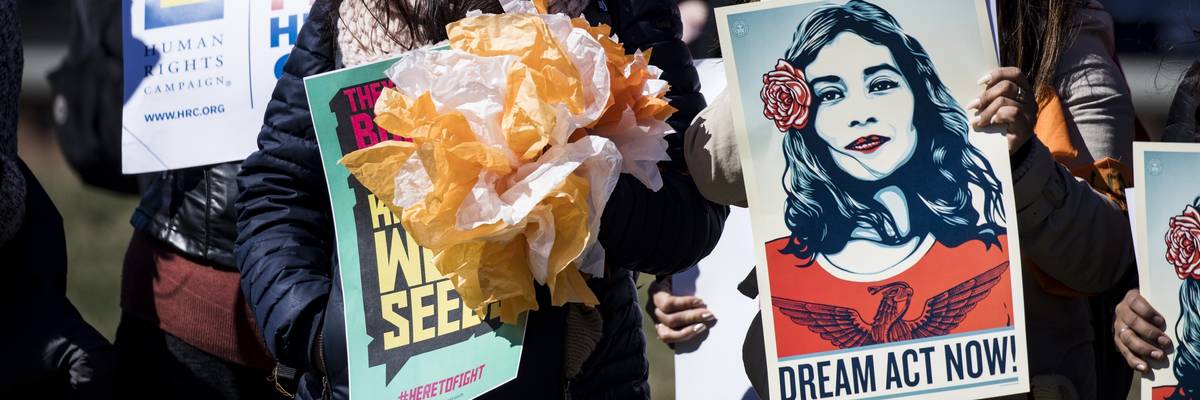
Demonstrators protest President Donald Trump's attempts to end the Deferred Action for Childhood Arrivals (DACA), an executive action made by President Barack Obama that protected minors known as Dreamers who entered the country illegally from deportation, outside of the US Capitol in Washington, USA on March 5, 2018.
You could have been born here, gone to school here, worked here, served in this country’s military, followed the laws, learned the language and history, and yet still not be American enough to belong.
On December 4, Senators Dick Durbin and Lisa Murkowski reintroduced the bipartisan Dream Act to Congress—24 years after it was first introduced. If passed, it would create a pathway for citizenship for people who were brought to the US as children and meet certain requirements.
The Dream Act, whether now or in 2001, is a commonsense measure. Even if one believes that undocumented immigrants have committed a crime, their children are innocent. To meet the eligibility requirements, they must have proficiency in English; be knowledgeable of US history; not have committed any serious crimes; and have either served in the military, worked, or gained an education. These are not the “illegal alien gang members” that President Donald Trump insists must be deported.
Trump himself acknowledges this. In a 2024 interview with Kristen Welker, he said, “In many cases, they become successful. They have great jobs. In some cases, they have small businesses, some cases they might have large businesses. And we’re going to have to do something with them.” When Welker asked him to clarify whether he wants “them to be able to stay,” he replied, “I do.”
Unfortunately, that doesn't matter. The Dream Act will fail again. Trump’s Department of Homeland Security has already tried to strip 525,000 DACA recipients of their benefits this year. DHS Assistant Press Secretary Tricia McLaughlin has even urged recipients to self-deport, noting that they “are not automatically protected from deportations.”
What it means to be an American is not something Trump gets to decide.
In fact, Trump is one Supreme Court decision away from creating a new class of Dreamer.
On December 5, the Supreme Court agreed to hear Trump’s challenge to birthright citizenship. His executive order would deny citizenship to children born in the US of undocumented immigrants or those on temporary visas.
Those children, despite being born here, will effectively become neo-Dreamers. Another group of people whom the US government would be failing to recognize and protect. The major difference between Dreamers and these neo-Dreamers would be the basis of their belonging—the reason why, despite everything, they are Americans.
The Dreamers are American by virtue of having lived and built a life here. Their identity, values, and communities are tied to the US. As Marie Gonzalez-Deel explains, “No matter what, I will always consider the United States of America my home. I love this country. Only in America would a person like me have the opportunity to tell my story to people like you. Many may argue that because I have a Costa Rican birth certificate, I am Costa Rican and should be sent back to that country. If I am sent back there, sure I'd be with my Mom and Dad, but I'd be torn away from loved ones that are my family here, and from everything I have known since I was a child.” The Dreamers are American by action and deed.
For the neo-Dreamers, the justification would rest largely on the legality and constitutionality of their birthright claim. The neo-Dreamers would be American by right.
The Dreamers and neo-Dreamers represent two different ways of conceptualizing what it means to be an American. Yet, for the Trump administration, neither is sufficient. You could have been born here, gone to school here, worked here, served in this country’s military, followed the laws, learned the language and history, and yet still not be an American. But then, who is?
Trump claims that he’s “America First.” But who exactly is he putting first? Whether it's defunding the Supplemental Nutrition Assistance Program, letting Obamacare subsidies expire, limiting states’ ability to regulate artificial intelligence, conducting military-style raids in American cities, rolling back Environmental Protection Agency air quality protections, recommending controversial vaccine schedules, imposing tariffs that raise prices for everyone, eliminating the SAVE student loan repayment plan, or dismantling the Consumer Financial Protection Bureau, his policies overwhelmingly harm US citizens and immigrants alike.
In Trump’s America, only the Trump family and the ultra wealthy benefit. So perhaps instead of focusing on him, we should start thinking about what we, as Americans, think about who we are and what we represent. I’ll start: To me, Americans have contributed to the US and allowed the US to shape their lives and sense of self. By contributing, I don’t simply mean in the economic sense. Cultural and interpersonal contributions are just as if not more significant. We are more than laborers. The value we add to our communities cannot be reduced to GDP or market value.
By shaping their lives and sense of self, I don’t simply mean assimilation or acculturation. Being with others is always a two-way street. Each of us enriches the lives of others, and our lives are enriched in turn. We grow together.
A community, at its core, is a collective achievement. Citizens and immigrants, in many diverse ways, work together to maintain and nourish that achievement. We build together. Whatever problems we face, we solve them together. And yes, sometimes, we stumble and lose our way together. Progress is not a straight line. But we must never lose sight of who we are and what we represent.
What it means to be an American is not something Trump gets to decide. It’s our country, we decide.
Dear Common Dreams reader, It’s been nearly 30 years since I co-founded Common Dreams with my late wife, Lina Newhouser. We had the radical notion that journalism should serve the public good, not corporate profits. It was clear to us from the outset what it would take to build such a project. No paid advertisements. No corporate sponsors. No millionaire publisher telling us what to think or do. Many people said we wouldn't last a year, but we proved those doubters wrong. Together with a tremendous team of journalists and dedicated staff, we built an independent media outlet free from the constraints of profits and corporate control. Our mission has always been simple: To inform. To inspire. To ignite change for the common good. Building Common Dreams was not easy. Our survival was never guaranteed. When you take on the most powerful forces—Wall Street greed, fossil fuel industry destruction, Big Tech lobbyists, and uber-rich oligarchs who have spent billions upon billions rigging the economy and democracy in their favor—the only bulwark you have is supporters who believe in your work. But here’s the urgent message from me today. It's never been this bad out there. And it's never been this hard to keep us going. At the very moment Common Dreams is most needed, the threats we face are intensifying. We need your support now more than ever. We don't accept corporate advertising and never will. We don't have a paywall because we don't think people should be blocked from critical news based on their ability to pay. Everything we do is funded by the donations of readers like you. When everyone does the little they can afford, we are strong. But if that support retreats or dries up, so do we. Will you donate now to make sure Common Dreams not only survives but thrives? —Craig Brown, Co-founder |
On December 4, Senators Dick Durbin and Lisa Murkowski reintroduced the bipartisan Dream Act to Congress—24 years after it was first introduced. If passed, it would create a pathway for citizenship for people who were brought to the US as children and meet certain requirements.
The Dream Act, whether now or in 2001, is a commonsense measure. Even if one believes that undocumented immigrants have committed a crime, their children are innocent. To meet the eligibility requirements, they must have proficiency in English; be knowledgeable of US history; not have committed any serious crimes; and have either served in the military, worked, or gained an education. These are not the “illegal alien gang members” that President Donald Trump insists must be deported.
Trump himself acknowledges this. In a 2024 interview with Kristen Welker, he said, “In many cases, they become successful. They have great jobs. In some cases, they have small businesses, some cases they might have large businesses. And we’re going to have to do something with them.” When Welker asked him to clarify whether he wants “them to be able to stay,” he replied, “I do.”
Unfortunately, that doesn't matter. The Dream Act will fail again. Trump’s Department of Homeland Security has already tried to strip 525,000 DACA recipients of their benefits this year. DHS Assistant Press Secretary Tricia McLaughlin has even urged recipients to self-deport, noting that they “are not automatically protected from deportations.”
What it means to be an American is not something Trump gets to decide.
In fact, Trump is one Supreme Court decision away from creating a new class of Dreamer.
On December 5, the Supreme Court agreed to hear Trump’s challenge to birthright citizenship. His executive order would deny citizenship to children born in the US of undocumented immigrants or those on temporary visas.
Those children, despite being born here, will effectively become neo-Dreamers. Another group of people whom the US government would be failing to recognize and protect. The major difference between Dreamers and these neo-Dreamers would be the basis of their belonging—the reason why, despite everything, they are Americans.
The Dreamers are American by virtue of having lived and built a life here. Their identity, values, and communities are tied to the US. As Marie Gonzalez-Deel explains, “No matter what, I will always consider the United States of America my home. I love this country. Only in America would a person like me have the opportunity to tell my story to people like you. Many may argue that because I have a Costa Rican birth certificate, I am Costa Rican and should be sent back to that country. If I am sent back there, sure I'd be with my Mom and Dad, but I'd be torn away from loved ones that are my family here, and from everything I have known since I was a child.” The Dreamers are American by action and deed.
For the neo-Dreamers, the justification would rest largely on the legality and constitutionality of their birthright claim. The neo-Dreamers would be American by right.
The Dreamers and neo-Dreamers represent two different ways of conceptualizing what it means to be an American. Yet, for the Trump administration, neither is sufficient. You could have been born here, gone to school here, worked here, served in this country’s military, followed the laws, learned the language and history, and yet still not be an American. But then, who is?
Trump claims that he’s “America First.” But who exactly is he putting first? Whether it's defunding the Supplemental Nutrition Assistance Program, letting Obamacare subsidies expire, limiting states’ ability to regulate artificial intelligence, conducting military-style raids in American cities, rolling back Environmental Protection Agency air quality protections, recommending controversial vaccine schedules, imposing tariffs that raise prices for everyone, eliminating the SAVE student loan repayment plan, or dismantling the Consumer Financial Protection Bureau, his policies overwhelmingly harm US citizens and immigrants alike.
In Trump’s America, only the Trump family and the ultra wealthy benefit. So perhaps instead of focusing on him, we should start thinking about what we, as Americans, think about who we are and what we represent. I’ll start: To me, Americans have contributed to the US and allowed the US to shape their lives and sense of self. By contributing, I don’t simply mean in the economic sense. Cultural and interpersonal contributions are just as if not more significant. We are more than laborers. The value we add to our communities cannot be reduced to GDP or market value.
By shaping their lives and sense of self, I don’t simply mean assimilation or acculturation. Being with others is always a two-way street. Each of us enriches the lives of others, and our lives are enriched in turn. We grow together.
A community, at its core, is a collective achievement. Citizens and immigrants, in many diverse ways, work together to maintain and nourish that achievement. We build together. Whatever problems we face, we solve them together. And yes, sometimes, we stumble and lose our way together. Progress is not a straight line. But we must never lose sight of who we are and what we represent.
What it means to be an American is not something Trump gets to decide. It’s our country, we decide.
On December 4, Senators Dick Durbin and Lisa Murkowski reintroduced the bipartisan Dream Act to Congress—24 years after it was first introduced. If passed, it would create a pathway for citizenship for people who were brought to the US as children and meet certain requirements.
The Dream Act, whether now or in 2001, is a commonsense measure. Even if one believes that undocumented immigrants have committed a crime, their children are innocent. To meet the eligibility requirements, they must have proficiency in English; be knowledgeable of US history; not have committed any serious crimes; and have either served in the military, worked, or gained an education. These are not the “illegal alien gang members” that President Donald Trump insists must be deported.
Trump himself acknowledges this. In a 2024 interview with Kristen Welker, he said, “In many cases, they become successful. They have great jobs. In some cases, they have small businesses, some cases they might have large businesses. And we’re going to have to do something with them.” When Welker asked him to clarify whether he wants “them to be able to stay,” he replied, “I do.”
Unfortunately, that doesn't matter. The Dream Act will fail again. Trump’s Department of Homeland Security has already tried to strip 525,000 DACA recipients of their benefits this year. DHS Assistant Press Secretary Tricia McLaughlin has even urged recipients to self-deport, noting that they “are not automatically protected from deportations.”
What it means to be an American is not something Trump gets to decide.
In fact, Trump is one Supreme Court decision away from creating a new class of Dreamer.
On December 5, the Supreme Court agreed to hear Trump’s challenge to birthright citizenship. His executive order would deny citizenship to children born in the US of undocumented immigrants or those on temporary visas.
Those children, despite being born here, will effectively become neo-Dreamers. Another group of people whom the US government would be failing to recognize and protect. The major difference between Dreamers and these neo-Dreamers would be the basis of their belonging—the reason why, despite everything, they are Americans.
The Dreamers are American by virtue of having lived and built a life here. Their identity, values, and communities are tied to the US. As Marie Gonzalez-Deel explains, “No matter what, I will always consider the United States of America my home. I love this country. Only in America would a person like me have the opportunity to tell my story to people like you. Many may argue that because I have a Costa Rican birth certificate, I am Costa Rican and should be sent back to that country. If I am sent back there, sure I'd be with my Mom and Dad, but I'd be torn away from loved ones that are my family here, and from everything I have known since I was a child.” The Dreamers are American by action and deed.
For the neo-Dreamers, the justification would rest largely on the legality and constitutionality of their birthright claim. The neo-Dreamers would be American by right.
The Dreamers and neo-Dreamers represent two different ways of conceptualizing what it means to be an American. Yet, for the Trump administration, neither is sufficient. You could have been born here, gone to school here, worked here, served in this country’s military, followed the laws, learned the language and history, and yet still not be an American. But then, who is?
Trump claims that he’s “America First.” But who exactly is he putting first? Whether it's defunding the Supplemental Nutrition Assistance Program, letting Obamacare subsidies expire, limiting states’ ability to regulate artificial intelligence, conducting military-style raids in American cities, rolling back Environmental Protection Agency air quality protections, recommending controversial vaccine schedules, imposing tariffs that raise prices for everyone, eliminating the SAVE student loan repayment plan, or dismantling the Consumer Financial Protection Bureau, his policies overwhelmingly harm US citizens and immigrants alike.
In Trump’s America, only the Trump family and the ultra wealthy benefit. So perhaps instead of focusing on him, we should start thinking about what we, as Americans, think about who we are and what we represent. I’ll start: To me, Americans have contributed to the US and allowed the US to shape their lives and sense of self. By contributing, I don’t simply mean in the economic sense. Cultural and interpersonal contributions are just as if not more significant. We are more than laborers. The value we add to our communities cannot be reduced to GDP or market value.
By shaping their lives and sense of self, I don’t simply mean assimilation or acculturation. Being with others is always a two-way street. Each of us enriches the lives of others, and our lives are enriched in turn. We grow together.
A community, at its core, is a collective achievement. Citizens and immigrants, in many diverse ways, work together to maintain and nourish that achievement. We build together. Whatever problems we face, we solve them together. And yes, sometimes, we stumble and lose our way together. Progress is not a straight line. But we must never lose sight of who we are and what we represent.
What it means to be an American is not something Trump gets to decide. It’s our country, we decide.