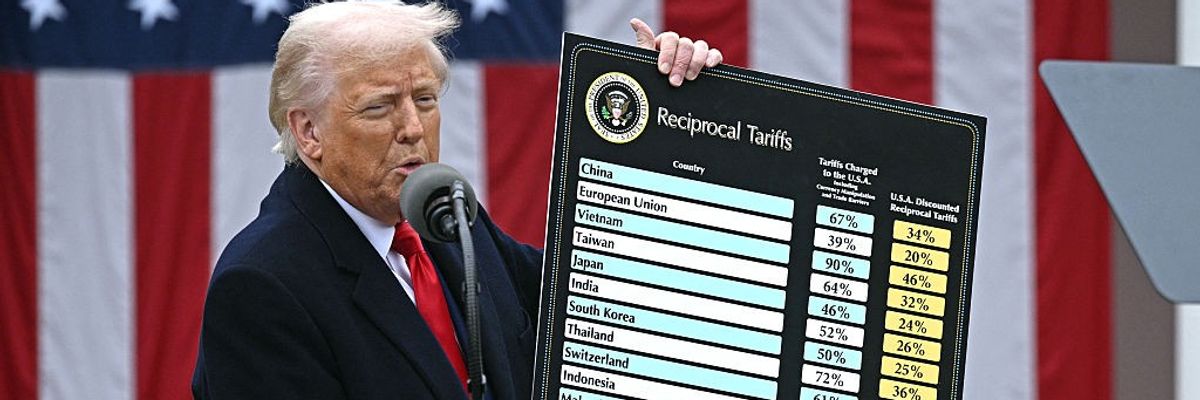
U.S. President Donald Trump delivers remarks on reciprocal tariffs as U.S. Secretary of Commerce Howard Lutnick holds a chart during an event in the Rose Garden entitled "Make America Wealthy Again" at the White House in Washington, D.C., on April 2, 2025.
The US Leads the Global Race to the Bottom—and Still Pretends to Be the Victim
Trump’s tariffs are not a departure from business as usual; they are an extension of it and will overwhelmingly benefit the world’s financial elite.
Global trade systems are not free, nor are they neutral. They were built to facilitate capital transfer and to transfer wealth upward—benefiting the rich while harming workers worldwide. This arrangement can feel too big, too abstract, and too disconnected from our experience. For these reasons, and as a sociologist across decades and schools, I have facilitated this race to the bottom activity to help students understand the problems inherent to our complex global reality.
In the Transnational Capital Auction: A Game of Survival simulation, students role play as leaders of countries with less wealth than GDP leading nation states. They are instructed that they rely on trade and economic development from wealthier countries such as the United States and powerful transnational corporations.
Capital flight occurs when transnational corporations move their factory or industry from one geographical area to another in order to seek better conditions for their bottom line, profits, or for shareholders. These moves highlight the antagonism between the working class and the owning class. For example, in the activity, teams gain points when they satisfy corporate demands: being lax on child labor laws and environmental regulations, maintaining a low minimum wage and corporate tax rate, and suppressing unionization of workers. This is not just a game with hypothetical conditions, it is a microcosm which echoes real-world socioeconomic and political dynamics.
Rather than denying our power and privilege in order to justify more bad behavior, we need to do our part to realign around policies that are internationally, socially, and environmentally sustainable.
We have seen this play out domestically and internationally. Sociologists have documented how corporations leave the United States to go to places more favorable to capital. For example, when an area develops unions, industry can flee to what it considers a safer space for business. In this way, capital for transnational corporations can accumulate faster when workers’ rights and environmental policy is lax. These conditions have led to countless deaths, especially among women and people of color, and have fueled global climate destabilization. These corporations are helped by policies and loopholes such as international tax havens like Nauru.
The human cost of this system is staggering. Body-catching nets were installed around Foxconn buildings because workers were unaliving themselves by jumping off their job site. Women, including mothers, leave their families and countries in order to work in other locations where the wages are higher.
The unjust arrangements are often complex by design. There are free trade zones or “special economic zones” in places like Jamaica, which allow companies to operate under a different set of laws than the rest of their country—sometimes with fewer worker protections. Meanwhile, local markets neglect or dispose of their natural resources because of the flux of imported goods dictated by trade agreements.
To be sure, the global working class harmed by these lopsided systems includes American workers who have lost their jobs, houses, and communities through capital flight. And yet, American consumers love the low prices these systems enable. The products we rely on—the food, the technology, the entertainment—these things are not created in a vacuum, and they are also not free. We have access to fast fashion and too soon obsolete technologies because people spend their lives working in conditions and receiving wages that we would consider un-American. Yet they are so very American.
The United States is no one’s victim. It helped create the race to the bottom and continues to benefit from its downward spiral. Trump’s narrative, justification, and chaotic enactment of tariffs are more than problematic. They are not a departure from business as usual, they are an extension of it and will overwhelmingly benefit the world’s financial elite.
Change is needed. The United States needs to reevaluate its relationship with itself and as part of a global community. We need reciprocal, resilient, and renewable structures in place. We will not get there by the same policies of violence, domination, and extraction that got us to the asymmetrical and disproportionate power that we have now. Rather than denying our power and privilege in order to justify more bad behavior, we need to do our part to realign around policies that are internationally, socially, and environmentally sustainable. We can all start by reflecting on our personal commodity chains, which tether us to global enterprise and its bottom rungs.
We are at a crossroads
This country and this world are at a monumental crossroads. In a few short weeks, US voters will have an opportunity to beat back the forces of fascism and confront the billionaires who are rigging the economy, our media system, and our democracy, making it increasingly impossible for ordinary people to get by. We’re not just talking about the election. We’re talking about what must be done once these fascist elements are vanquished from power. We need a bolder set of solutions than what either major party has so far been willing to offer and a working-class movement ready to fight like hell for it. Trump didn't emerge from nowhere. The conditions that fueled MAGA authoritarianism were created by decades of radical neoliberal economic policies and a corrupt political system dominated by corporate interests. They slashed taxes on the super-rich, promising that the benefits would trickle down. They said giveaways to the corporate titans would make life more affordable for the rest of us. It was all bullshit. And when a bitter, betrayed populace searches for someone to blame, right-wing demagogues have little trouble finding scapegoats. People know when they're being lied to, but you won't hear any of this from the corporate media. Only independent journalism—powered and funded by people who believe in building a better world—can deliver truly trustworthy daily news. Our Fall Campaign is underway, and we need your help. To power our newsroom through the rest of the year, we need to raise $125,000 by midnight on October 31. So if you share our vision, please contribute whatever you can to sustain our work. |
Global trade systems are not free, nor are they neutral. They were built to facilitate capital transfer and to transfer wealth upward—benefiting the rich while harming workers worldwide. This arrangement can feel too big, too abstract, and too disconnected from our experience. For these reasons, and as a sociologist across decades and schools, I have facilitated this race to the bottom activity to help students understand the problems inherent to our complex global reality.
In the Transnational Capital Auction: A Game of Survival simulation, students role play as leaders of countries with less wealth than GDP leading nation states. They are instructed that they rely on trade and economic development from wealthier countries such as the United States and powerful transnational corporations.
Capital flight occurs when transnational corporations move their factory or industry from one geographical area to another in order to seek better conditions for their bottom line, profits, or for shareholders. These moves highlight the antagonism between the working class and the owning class. For example, in the activity, teams gain points when they satisfy corporate demands: being lax on child labor laws and environmental regulations, maintaining a low minimum wage and corporate tax rate, and suppressing unionization of workers. This is not just a game with hypothetical conditions, it is a microcosm which echoes real-world socioeconomic and political dynamics.
Rather than denying our power and privilege in order to justify more bad behavior, we need to do our part to realign around policies that are internationally, socially, and environmentally sustainable.
We have seen this play out domestically and internationally. Sociologists have documented how corporations leave the United States to go to places more favorable to capital. For example, when an area develops unions, industry can flee to what it considers a safer space for business. In this way, capital for transnational corporations can accumulate faster when workers’ rights and environmental policy is lax. These conditions have led to countless deaths, especially among women and people of color, and have fueled global climate destabilization. These corporations are helped by policies and loopholes such as international tax havens like Nauru.
The human cost of this system is staggering. Body-catching nets were installed around Foxconn buildings because workers were unaliving themselves by jumping off their job site. Women, including mothers, leave their families and countries in order to work in other locations where the wages are higher.
The unjust arrangements are often complex by design. There are free trade zones or “special economic zones” in places like Jamaica, which allow companies to operate under a different set of laws than the rest of their country—sometimes with fewer worker protections. Meanwhile, local markets neglect or dispose of their natural resources because of the flux of imported goods dictated by trade agreements.
To be sure, the global working class harmed by these lopsided systems includes American workers who have lost their jobs, houses, and communities through capital flight. And yet, American consumers love the low prices these systems enable. The products we rely on—the food, the technology, the entertainment—these things are not created in a vacuum, and they are also not free. We have access to fast fashion and too soon obsolete technologies because people spend their lives working in conditions and receiving wages that we would consider un-American. Yet they are so very American.
The United States is no one’s victim. It helped create the race to the bottom and continues to benefit from its downward spiral. Trump’s narrative, justification, and chaotic enactment of tariffs are more than problematic. They are not a departure from business as usual, they are an extension of it and will overwhelmingly benefit the world’s financial elite.
Change is needed. The United States needs to reevaluate its relationship with itself and as part of a global community. We need reciprocal, resilient, and renewable structures in place. We will not get there by the same policies of violence, domination, and extraction that got us to the asymmetrical and disproportionate power that we have now. Rather than denying our power and privilege in order to justify more bad behavior, we need to do our part to realign around policies that are internationally, socially, and environmentally sustainable. We can all start by reflecting on our personal commodity chains, which tether us to global enterprise and its bottom rungs.
- Condemning NAFTA 2.0 as 'Giveaway to Fossil Fuel Industry,' Sanders Vows to Immediately Renegotiate Trump Deal If Elected ›
- New NAFTA Must Put People and Planet First ›
- Trump's Tariffs Are Extremely Dumb, Just Not For The Reasons You Might Think ›
- Census Data Show Poverty Is a Policy Choice ›
- "Psychopath's Trade War": Critics Denounce Trump's Reckless Tariffs on Mexico, EU, and Canada ›
- Top Economist Has Winning Idea for Trump's Trade War: Tariffs for US Oligarchs ›
Global trade systems are not free, nor are they neutral. They were built to facilitate capital transfer and to transfer wealth upward—benefiting the rich while harming workers worldwide. This arrangement can feel too big, too abstract, and too disconnected from our experience. For these reasons, and as a sociologist across decades and schools, I have facilitated this race to the bottom activity to help students understand the problems inherent to our complex global reality.
In the Transnational Capital Auction: A Game of Survival simulation, students role play as leaders of countries with less wealth than GDP leading nation states. They are instructed that they rely on trade and economic development from wealthier countries such as the United States and powerful transnational corporations.
Capital flight occurs when transnational corporations move their factory or industry from one geographical area to another in order to seek better conditions for their bottom line, profits, or for shareholders. These moves highlight the antagonism between the working class and the owning class. For example, in the activity, teams gain points when they satisfy corporate demands: being lax on child labor laws and environmental regulations, maintaining a low minimum wage and corporate tax rate, and suppressing unionization of workers. This is not just a game with hypothetical conditions, it is a microcosm which echoes real-world socioeconomic and political dynamics.
Rather than denying our power and privilege in order to justify more bad behavior, we need to do our part to realign around policies that are internationally, socially, and environmentally sustainable.
We have seen this play out domestically and internationally. Sociologists have documented how corporations leave the United States to go to places more favorable to capital. For example, when an area develops unions, industry can flee to what it considers a safer space for business. In this way, capital for transnational corporations can accumulate faster when workers’ rights and environmental policy is lax. These conditions have led to countless deaths, especially among women and people of color, and have fueled global climate destabilization. These corporations are helped by policies and loopholes such as international tax havens like Nauru.
The human cost of this system is staggering. Body-catching nets were installed around Foxconn buildings because workers were unaliving themselves by jumping off their job site. Women, including mothers, leave their families and countries in order to work in other locations where the wages are higher.
The unjust arrangements are often complex by design. There are free trade zones or “special economic zones” in places like Jamaica, which allow companies to operate under a different set of laws than the rest of their country—sometimes with fewer worker protections. Meanwhile, local markets neglect or dispose of their natural resources because of the flux of imported goods dictated by trade agreements.
To be sure, the global working class harmed by these lopsided systems includes American workers who have lost their jobs, houses, and communities through capital flight. And yet, American consumers love the low prices these systems enable. The products we rely on—the food, the technology, the entertainment—these things are not created in a vacuum, and they are also not free. We have access to fast fashion and too soon obsolete technologies because people spend their lives working in conditions and receiving wages that we would consider un-American. Yet they are so very American.
The United States is no one’s victim. It helped create the race to the bottom and continues to benefit from its downward spiral. Trump’s narrative, justification, and chaotic enactment of tariffs are more than problematic. They are not a departure from business as usual, they are an extension of it and will overwhelmingly benefit the world’s financial elite.
Change is needed. The United States needs to reevaluate its relationship with itself and as part of a global community. We need reciprocal, resilient, and renewable structures in place. We will not get there by the same policies of violence, domination, and extraction that got us to the asymmetrical and disproportionate power that we have now. Rather than denying our power and privilege in order to justify more bad behavior, we need to do our part to realign around policies that are internationally, socially, and environmentally sustainable. We can all start by reflecting on our personal commodity chains, which tether us to global enterprise and its bottom rungs.
- Condemning NAFTA 2.0 as 'Giveaway to Fossil Fuel Industry,' Sanders Vows to Immediately Renegotiate Trump Deal If Elected ›
- New NAFTA Must Put People and Planet First ›
- Trump's Tariffs Are Extremely Dumb, Just Not For The Reasons You Might Think ›
- Census Data Show Poverty Is a Policy Choice ›
- "Psychopath's Trade War": Critics Denounce Trump's Reckless Tariffs on Mexico, EU, and Canada ›
- Top Economist Has Winning Idea for Trump's Trade War: Tariffs for US Oligarchs ›