SUBSCRIBE TO OUR FREE NEWSLETTER
Daily news & progressive opinion—funded by the people, not the corporations—delivered straight to your inbox.
5
#000000
#FFFFFF
To donate by check, phone, or other method, see our More Ways to Give page.
Daily news & progressive opinion—funded by the people, not the corporations—delivered straight to your inbox.
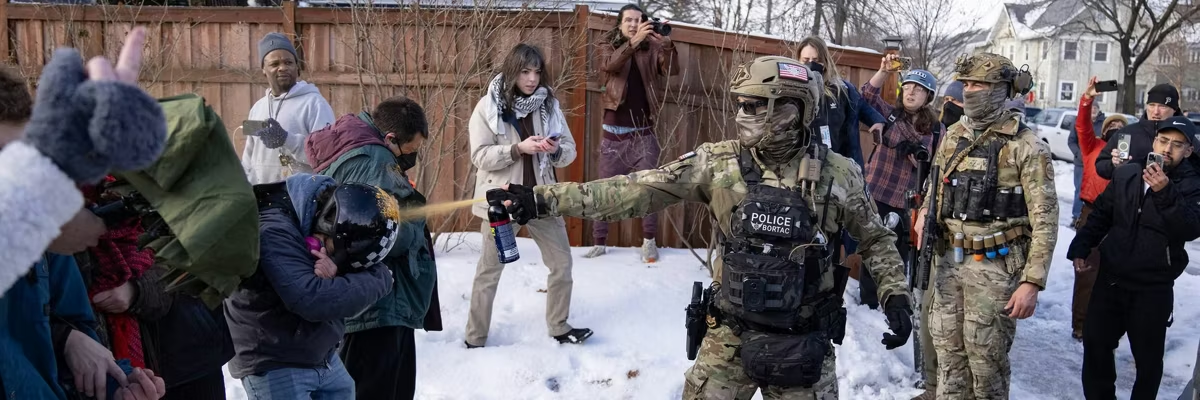
A Border Patrol Tactical Unit agent sprays pepper spray into the face of a protester attempting to block an immigration officer vehicle from leaving the scene where a woman was shot and killed by a federal agent earlier, in Minneapolis, Minnesota on Wednesday, January 7, 2026.
There is cause for serious concern about the future of US democracy, as exclusionary rhetoric and practices contribute to political instability.
It takes decades to build institutions and the norms and values that keep them working, but far less time to destroy them.
Less than two years into the second Trump administration, the United States finds itself in an undeclared war with Iran, while at home, efforts to undermine institutions like the Justice Department and the legitimacy of elections continue to grow, alongside the threat of Christian nationalism, an ideology that weakens democracy by narrowing the definition of who belongs. At the same time, immigration enforcement has been at the forefront of normalizing the repressive use of state power, with two US citizens killed by Immigration and Customs Enforcement officers and deaths in ICE custody reaching their highest levels in two decades. There is cause for serious concern about the future of US democracy, as exclusionary rhetoric and practices contribute to political instability.
I grew up in a politically unstable system. In just a few years at the end of the 1990s, Ecuador went through five presidents, a civilian-military uprising, a banking collapse, rising inflation, and widespread social unrest. When I first came to the United States as an exchange student, I didn’t understand the importance of “institutional legitimacy,” the idea that an institution is rightful, appropriate, and deserving of trust or respect. In my home country, no such legitimacy existed—and the consequences were dire.
Now, I see Americans’ confidence in institutions—particularly those meant to protect the public and uphold justice, such as the Justice Department and the police—being weakened in real time. At the same time, President Donald Trump continues to delegitimize the entire US electoral system by promoting his (baseless) claim that the 2020 election was stolen. Because of this misinformation, the majority of Republicans believe this to be the case (62%), compared with 31% of all Americans, according to a survey by the Public Religion Research Institute (PRRI), where I am the director of research.
As we move through this election season and approach the nation’s 250th anniversary, it is worth reflecting on how diversity, trust, tolerance, respect, honesty, and empathy are hallmarks of the American democratic ideal.
It is deeply troubling to see continued messaging from the president that risks undermining confidence in the integrity of midterm elections, instilling widespread fear around voting, and advancing immigration rhetoric and policies that demonize vulnerable minorities and limit their rights. Freedom House, an organization that monitors democracy levels worldwide, reports that over the past decade, US democracy has declined from 92 (out of 100) to 81 in 2025, reflecting a gradual erosion in key democratic indicators, particularly in the protection of minority rights.
Despite recent changes in the Department of Homeland Security’s leadership, the Trump administration has continued to pursue its aggressive immigration agenda, conflating undocumented immigrants with violent criminal convictions, and, most recently, with Trump’s push for the Supreme Court to uphold his executive order ending birthright citizenship.
Diversity strengthens democracies by bringing different perspectives to decision-making. It also cultivates empathy by exposing individuals to experiences beyond their own and encouraging tolerance and mutual respect. By contrast, autocracies favor conformity, distrust, the concentration of power, intimidation of critics, and targeting of minorities, like immigrants.
Most, but not all, Americans disagree with the Trump administration’s divisive, dehumanizing policies. PRRI’s recent survey shows solid majorities of Republicans (61%) and Christian nationalism adherents (57%) favor “allowing ICE officers to arrest and relocate undocumented immigrants to detention centers in states far from their home without allowing them to challenge their detainment in court.” They also favor “allowing ICE officers to regularly conduct surveillance and arrests at sensitive locations like schools, hospitals, places of worship, and social service locations” (54% and 53%), suggesting a willingness among these groups to expand state power at the expense of due process and civil liberties.
In addition, a growing movement is challenging traditional understandings of empathy. Data from PRRI finds that while most Americans agree more with the idea that “empathy is a moral value that is the foundation of a healthy society” (80%) than that it is “a dangerous emotion that undermines our ability to set up a society that is guided by God’s truth (16%),” a quarter of Republicans (25%) and nearly 4 in 10 Christian nationalism adherents (37%) agree that empathy is dangerous.
I find myself asking: At what point did we lose sight of the democratic principles we used to uphold? What happened to our commitment to human rights, the fight against corruption, limits on the unchecked use of power, and, simply put, the truth? When did we stop caring about other human beings?
As we move through this election season and approach the nation’s 250th anniversary, it is worth reflecting on how diversity, trust, tolerance, respect, honesty, and empathy are hallmarks of the American democratic ideal. What is happening across the country and abroad should serve as a wake-up call about our commitment to democratic institutions and values, compelling us to come together to repair the damage.
Dear Common Dreams reader, It’s been nearly 30 years since I co-founded Common Dreams with my late wife, Lina Newhouser. We had the radical notion that journalism should serve the public good, not corporate profits. It was clear to us from the outset what it would take to build such a project. No paid advertisements. No corporate sponsors. No millionaire publisher telling us what to think or do. Many people said we wouldn't last a year, but we proved those doubters wrong. Together with a tremendous team of journalists and dedicated staff, we built an independent media outlet free from the constraints of profits and corporate control. Our mission has always been simple: To inform. To inspire. To ignite change for the common good. Building Common Dreams was not easy. Our survival was never guaranteed. When you take on the most powerful forces—Wall Street greed, fossil fuel industry destruction, Big Tech lobbyists, and uber-rich oligarchs who have spent billions upon billions rigging the economy and democracy in their favor—the only bulwark you have is supporters who believe in your work. But here’s the urgent message from me today. It's never been this bad out there. And it's never been this hard to keep us going. At the very moment Common Dreams is most needed, the threats we face are intensifying. We need your support now more than ever. We don't accept corporate advertising and never will. We don't have a paywall because we don't think people should be blocked from critical news based on their ability to pay. Everything we do is funded by the donations of readers like you. When everyone does the little they can afford, we are strong. But if that support retreats or dries up, so do we. Will you donate now to make sure Common Dreams not only survives but thrives? —Craig Brown, Co-founder |
It takes decades to build institutions and the norms and values that keep them working, but far less time to destroy them.
Less than two years into the second Trump administration, the United States finds itself in an undeclared war with Iran, while at home, efforts to undermine institutions like the Justice Department and the legitimacy of elections continue to grow, alongside the threat of Christian nationalism, an ideology that weakens democracy by narrowing the definition of who belongs. At the same time, immigration enforcement has been at the forefront of normalizing the repressive use of state power, with two US citizens killed by Immigration and Customs Enforcement officers and deaths in ICE custody reaching their highest levels in two decades. There is cause for serious concern about the future of US democracy, as exclusionary rhetoric and practices contribute to political instability.
I grew up in a politically unstable system. In just a few years at the end of the 1990s, Ecuador went through five presidents, a civilian-military uprising, a banking collapse, rising inflation, and widespread social unrest. When I first came to the United States as an exchange student, I didn’t understand the importance of “institutional legitimacy,” the idea that an institution is rightful, appropriate, and deserving of trust or respect. In my home country, no such legitimacy existed—and the consequences were dire.
Now, I see Americans’ confidence in institutions—particularly those meant to protect the public and uphold justice, such as the Justice Department and the police—being weakened in real time. At the same time, President Donald Trump continues to delegitimize the entire US electoral system by promoting his (baseless) claim that the 2020 election was stolen. Because of this misinformation, the majority of Republicans believe this to be the case (62%), compared with 31% of all Americans, according to a survey by the Public Religion Research Institute (PRRI), where I am the director of research.
As we move through this election season and approach the nation’s 250th anniversary, it is worth reflecting on how diversity, trust, tolerance, respect, honesty, and empathy are hallmarks of the American democratic ideal.
It is deeply troubling to see continued messaging from the president that risks undermining confidence in the integrity of midterm elections, instilling widespread fear around voting, and advancing immigration rhetoric and policies that demonize vulnerable minorities and limit their rights. Freedom House, an organization that monitors democracy levels worldwide, reports that over the past decade, US democracy has declined from 92 (out of 100) to 81 in 2025, reflecting a gradual erosion in key democratic indicators, particularly in the protection of minority rights.
Despite recent changes in the Department of Homeland Security’s leadership, the Trump administration has continued to pursue its aggressive immigration agenda, conflating undocumented immigrants with violent criminal convictions, and, most recently, with Trump’s push for the Supreme Court to uphold his executive order ending birthright citizenship.
Diversity strengthens democracies by bringing different perspectives to decision-making. It also cultivates empathy by exposing individuals to experiences beyond their own and encouraging tolerance and mutual respect. By contrast, autocracies favor conformity, distrust, the concentration of power, intimidation of critics, and targeting of minorities, like immigrants.
Most, but not all, Americans disagree with the Trump administration’s divisive, dehumanizing policies. PRRI’s recent survey shows solid majorities of Republicans (61%) and Christian nationalism adherents (57%) favor “allowing ICE officers to arrest and relocate undocumented immigrants to detention centers in states far from their home without allowing them to challenge their detainment in court.” They also favor “allowing ICE officers to regularly conduct surveillance and arrests at sensitive locations like schools, hospitals, places of worship, and social service locations” (54% and 53%), suggesting a willingness among these groups to expand state power at the expense of due process and civil liberties.
In addition, a growing movement is challenging traditional understandings of empathy. Data from PRRI finds that while most Americans agree more with the idea that “empathy is a moral value that is the foundation of a healthy society” (80%) than that it is “a dangerous emotion that undermines our ability to set up a society that is guided by God’s truth (16%),” a quarter of Republicans (25%) and nearly 4 in 10 Christian nationalism adherents (37%) agree that empathy is dangerous.
I find myself asking: At what point did we lose sight of the democratic principles we used to uphold? What happened to our commitment to human rights, the fight against corruption, limits on the unchecked use of power, and, simply put, the truth? When did we stop caring about other human beings?
As we move through this election season and approach the nation’s 250th anniversary, it is worth reflecting on how diversity, trust, tolerance, respect, honesty, and empathy are hallmarks of the American democratic ideal. What is happening across the country and abroad should serve as a wake-up call about our commitment to democratic institutions and values, compelling us to come together to repair the damage.
It takes decades to build institutions and the norms and values that keep them working, but far less time to destroy them.
Less than two years into the second Trump administration, the United States finds itself in an undeclared war with Iran, while at home, efforts to undermine institutions like the Justice Department and the legitimacy of elections continue to grow, alongside the threat of Christian nationalism, an ideology that weakens democracy by narrowing the definition of who belongs. At the same time, immigration enforcement has been at the forefront of normalizing the repressive use of state power, with two US citizens killed by Immigration and Customs Enforcement officers and deaths in ICE custody reaching their highest levels in two decades. There is cause for serious concern about the future of US democracy, as exclusionary rhetoric and practices contribute to political instability.
I grew up in a politically unstable system. In just a few years at the end of the 1990s, Ecuador went through five presidents, a civilian-military uprising, a banking collapse, rising inflation, and widespread social unrest. When I first came to the United States as an exchange student, I didn’t understand the importance of “institutional legitimacy,” the idea that an institution is rightful, appropriate, and deserving of trust or respect. In my home country, no such legitimacy existed—and the consequences were dire.
Now, I see Americans’ confidence in institutions—particularly those meant to protect the public and uphold justice, such as the Justice Department and the police—being weakened in real time. At the same time, President Donald Trump continues to delegitimize the entire US electoral system by promoting his (baseless) claim that the 2020 election was stolen. Because of this misinformation, the majority of Republicans believe this to be the case (62%), compared with 31% of all Americans, according to a survey by the Public Religion Research Institute (PRRI), where I am the director of research.
As we move through this election season and approach the nation’s 250th anniversary, it is worth reflecting on how diversity, trust, tolerance, respect, honesty, and empathy are hallmarks of the American democratic ideal.
It is deeply troubling to see continued messaging from the president that risks undermining confidence in the integrity of midterm elections, instilling widespread fear around voting, and advancing immigration rhetoric and policies that demonize vulnerable minorities and limit their rights. Freedom House, an organization that monitors democracy levels worldwide, reports that over the past decade, US democracy has declined from 92 (out of 100) to 81 in 2025, reflecting a gradual erosion in key democratic indicators, particularly in the protection of minority rights.
Despite recent changes in the Department of Homeland Security’s leadership, the Trump administration has continued to pursue its aggressive immigration agenda, conflating undocumented immigrants with violent criminal convictions, and, most recently, with Trump’s push for the Supreme Court to uphold his executive order ending birthright citizenship.
Diversity strengthens democracies by bringing different perspectives to decision-making. It also cultivates empathy by exposing individuals to experiences beyond their own and encouraging tolerance and mutual respect. By contrast, autocracies favor conformity, distrust, the concentration of power, intimidation of critics, and targeting of minorities, like immigrants.
Most, but not all, Americans disagree with the Trump administration’s divisive, dehumanizing policies. PRRI’s recent survey shows solid majorities of Republicans (61%) and Christian nationalism adherents (57%) favor “allowing ICE officers to arrest and relocate undocumented immigrants to detention centers in states far from their home without allowing them to challenge their detainment in court.” They also favor “allowing ICE officers to regularly conduct surveillance and arrests at sensitive locations like schools, hospitals, places of worship, and social service locations” (54% and 53%), suggesting a willingness among these groups to expand state power at the expense of due process and civil liberties.
In addition, a growing movement is challenging traditional understandings of empathy. Data from PRRI finds that while most Americans agree more with the idea that “empathy is a moral value that is the foundation of a healthy society” (80%) than that it is “a dangerous emotion that undermines our ability to set up a society that is guided by God’s truth (16%),” a quarter of Republicans (25%) and nearly 4 in 10 Christian nationalism adherents (37%) agree that empathy is dangerous.
I find myself asking: At what point did we lose sight of the democratic principles we used to uphold? What happened to our commitment to human rights, the fight against corruption, limits on the unchecked use of power, and, simply put, the truth? When did we stop caring about other human beings?
As we move through this election season and approach the nation’s 250th anniversary, it is worth reflecting on how diversity, trust, tolerance, respect, honesty, and empathy are hallmarks of the American democratic ideal. What is happening across the country and abroad should serve as a wake-up call about our commitment to democratic institutions and values, compelling us to come together to repair the damage.