SUBSCRIBE TO OUR FREE NEWSLETTER
Daily news & progressive opinion—funded by the people, not the corporations—delivered straight to your inbox.
5
#000000
#FFFFFF
To donate by check, phone, or other method, see our More Ways to Give page.
Daily news & progressive opinion—funded by the people, not the corporations—delivered straight to your inbox.
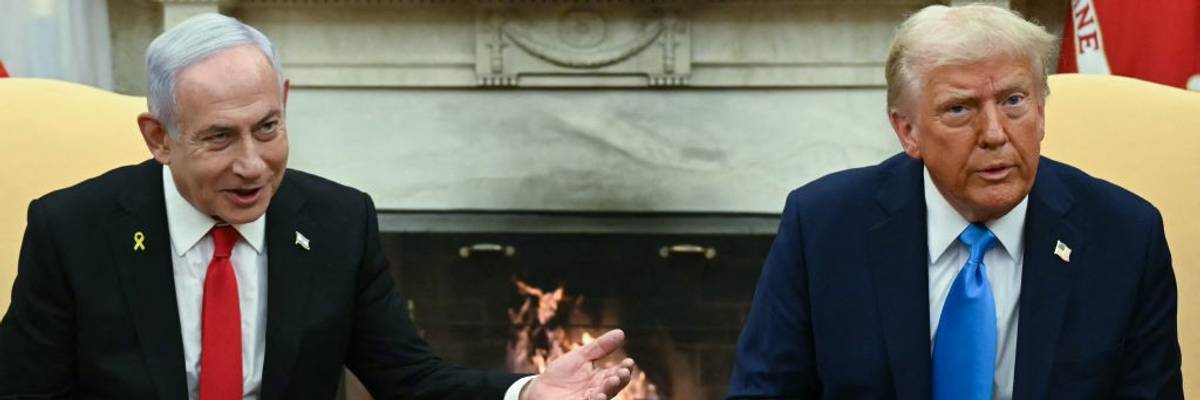
U.S. President Donald Trump and Israel's Prime Minister Benjamin Netanyahu speak to the press ahead of a meeting in the Oval Office of the White House in Washington, D.C., on February 4, 2025.
His proposal was not about rebuilding Gaza for the sake of its people but about finishing the job Israel was unable to finish.
A friend texted if I had watched the press conference between U.S President Donald Trump and Israeli Prime Minister Benjamin Netanyahu.
“Fortunately, I did not watch it live,” I wrote back. It took me nearly 24 hours to be in the right state of mind to endure watching two narcissistic figures standing on stage, lavishing praise upon each other.
As I listened carefully to Trump’s opening remarks, I also caught Netanyahu’s sneaky eye movements at key points. With a smug expression on his face, he repeatedly cast stealthy glances at Ron Dermer, Israel’s strategic affairs minister, as if silently acknowledging him for crafting Trump’s words. It was evident that Trump’s speech bore the unmistakable imprint of the Israeli minister.
Trump wants the world to believe that the genocide of Gaza should be celebrated as a chance to “build back better”—just without the very people whose homeland it is.
I watched Netanyahu, an indicted war criminal, skillfully exploit Trump’s narcissism through calculated flattery. Their interactions were not just awkward; they were profoundly revealing. Netanyahu’s effusive praise was a calculated move, designed to keep Trump firmly in his corner and ensure continued support for Israel’s policies.
Trump, for his part, appeared more focused on basking in the admiration than grappling with the complex realities of Israeli destruction of Gaza and the lives of more than 2 million human beings. When he answered questions, his sentences were often disjointed, filled with rambling, and devoid of substantive insight, highlighting his preoccupation with self-praise.
From the moment Trump had entered the political arena, Netanyahu recognized an opportunity to cultivate a relationship that would serve Israel’s interests. Trump’s personality—marked by a craving for admiration, a fragile ego, and an insatiable desire for validation—made him uniquely susceptible to flattery. Netanyahu, a seasoned con artist, adeptly tailored his approach to appeal to Trump’s vanity.
Netanyahu’s comments at the press conference were particularly telling. While he spoke at length about the importance of U.S. support for Israel, he made no mention of the Palestinian people or their rights. This erasure was not accidental; it was a deliberate attempt to sidestep Israeli occupation, displacement, and genocide.
Trump, for his part, offered vague platitudes about peace and prosperity without addressing any recognition of Palestinians as a distinct people with legitimate rights. While he expressed vague sympathy for the suffering, he never mentioned the Palestinian right to self-determination, freedom, or equality. The omission is not accidental; it is a calculated move to delegitimize Palestinian aspirations and reinforce the narrative that their plight is merely a humanitarian issue rather than a political one rooted in decades of occupation and systemic injustice.
What was most striking about the news conference was its lack of substance. While the dire situation in Gaza and the West Bank grows increasingly grim, neither leader offered any a coherent response. Instead, they spent the majority of their time recounting past “achievements” and reiterating their commitment to a relationship that has increasingly come to symbolize one-sided support for Israeli policies.
One of Trump’s most grotesque proposals was his so-called vision for Gaza’s future. He spoke of creating jobs from the very destruction Israel has inflicted upon the besieged territory, as if the complete obliteration of an entire society were merely a business opportunity.
Would anyone have dared to suggest that the destruction of European cities at the hands of the “old Nazis” as a job creation opportunity? How about the opportunity for redeveloping the concentration camps in Poland? Would the survivors have accepted that narrative? Yet Trump wants the world to believe that the genocide of Gaza should be celebrated as a chance to“build back better”—just without the very people whose homeland it is.
Rather than holding Israel accountable for its destruction, Trump wants to reward it. His proposal was not about rebuilding Gaza for the sake of its people but about finishing the job Israel was unable to finish. After all, what better way to disguise forced displacement than by dressing it up as “urban renewal”?
Trump views Gaza not as a humanitarian catastrophe but as a gentrification project—like a rundown building in New York City awaiting developers to swoop in and transform it for their own benefit. The difference, of course, is that this is not about real estate—this is about the systematic destruction of a people, their history, and their right to exist.
The Netanyahu-Trump news conference was more than just an embarrassing spectacle; it was a lesson in what happens when leadership is self-interest and performative politics. Both individuals have long been known for their narcissism and their willingness to prioritize personal gain over the public good, and Tuesday’s event was a perfect encapsulation of those flaws.
Trump proposal is not rebuilding. Gaza is not an economic development project. This is the final phase of a slow-motion genocide—wrapped in the language of business and diplomacy.
Trump’s suggestion for new opportunities following a war of destruction would be like scavenging for crumbs in a landfill and calling it a feast. The idea that the Gaza genocide should be reframed as an economic opportunity is not just obscene—it is the final project of dispossession.
Dear Common Dreams reader, It’s been nearly 30 years since I co-founded Common Dreams with my late wife, Lina Newhouser. We had the radical notion that journalism should serve the public good, not corporate profits. It was clear to us from the outset what it would take to build such a project. No paid advertisements. No corporate sponsors. No millionaire publisher telling us what to think or do. Many people said we wouldn't last a year, but we proved those doubters wrong. Together with a tremendous team of journalists and dedicated staff, we built an independent media outlet free from the constraints of profits and corporate control. Our mission has always been simple: To inform. To inspire. To ignite change for the common good. Building Common Dreams was not easy. Our survival was never guaranteed. When you take on the most powerful forces—Wall Street greed, fossil fuel industry destruction, Big Tech lobbyists, and uber-rich oligarchs who have spent billions upon billions rigging the economy and democracy in their favor—the only bulwark you have is supporters who believe in your work. But here’s the urgent message from me today. It's never been this bad out there. And it's never been this hard to keep us going. At the very moment Common Dreams is most needed, the threats we face are intensifying. We need your support now more than ever. We don't accept corporate advertising and never will. We don't have a paywall because we don't think people should be blocked from critical news based on their ability to pay. Everything we do is funded by the donations of readers like you. When everyone does the little they can afford, we are strong. But if that support retreats or dries up, so do we. Will you donate now to make sure Common Dreams not only survives but thrives? —Craig Brown, Co-founder |
A friend texted if I had watched the press conference between U.S President Donald Trump and Israeli Prime Minister Benjamin Netanyahu.
“Fortunately, I did not watch it live,” I wrote back. It took me nearly 24 hours to be in the right state of mind to endure watching two narcissistic figures standing on stage, lavishing praise upon each other.
As I listened carefully to Trump’s opening remarks, I also caught Netanyahu’s sneaky eye movements at key points. With a smug expression on his face, he repeatedly cast stealthy glances at Ron Dermer, Israel’s strategic affairs minister, as if silently acknowledging him for crafting Trump’s words. It was evident that Trump’s speech bore the unmistakable imprint of the Israeli minister.
Trump wants the world to believe that the genocide of Gaza should be celebrated as a chance to “build back better”—just without the very people whose homeland it is.
I watched Netanyahu, an indicted war criminal, skillfully exploit Trump’s narcissism through calculated flattery. Their interactions were not just awkward; they were profoundly revealing. Netanyahu’s effusive praise was a calculated move, designed to keep Trump firmly in his corner and ensure continued support for Israel’s policies.
Trump, for his part, appeared more focused on basking in the admiration than grappling with the complex realities of Israeli destruction of Gaza and the lives of more than 2 million human beings. When he answered questions, his sentences were often disjointed, filled with rambling, and devoid of substantive insight, highlighting his preoccupation with self-praise.
From the moment Trump had entered the political arena, Netanyahu recognized an opportunity to cultivate a relationship that would serve Israel’s interests. Trump’s personality—marked by a craving for admiration, a fragile ego, and an insatiable desire for validation—made him uniquely susceptible to flattery. Netanyahu, a seasoned con artist, adeptly tailored his approach to appeal to Trump’s vanity.
Netanyahu’s comments at the press conference were particularly telling. While he spoke at length about the importance of U.S. support for Israel, he made no mention of the Palestinian people or their rights. This erasure was not accidental; it was a deliberate attempt to sidestep Israeli occupation, displacement, and genocide.
Trump, for his part, offered vague platitudes about peace and prosperity without addressing any recognition of Palestinians as a distinct people with legitimate rights. While he expressed vague sympathy for the suffering, he never mentioned the Palestinian right to self-determination, freedom, or equality. The omission is not accidental; it is a calculated move to delegitimize Palestinian aspirations and reinforce the narrative that their plight is merely a humanitarian issue rather than a political one rooted in decades of occupation and systemic injustice.
What was most striking about the news conference was its lack of substance. While the dire situation in Gaza and the West Bank grows increasingly grim, neither leader offered any a coherent response. Instead, they spent the majority of their time recounting past “achievements” and reiterating their commitment to a relationship that has increasingly come to symbolize one-sided support for Israeli policies.
One of Trump’s most grotesque proposals was his so-called vision for Gaza’s future. He spoke of creating jobs from the very destruction Israel has inflicted upon the besieged territory, as if the complete obliteration of an entire society were merely a business opportunity.
Would anyone have dared to suggest that the destruction of European cities at the hands of the “old Nazis” as a job creation opportunity? How about the opportunity for redeveloping the concentration camps in Poland? Would the survivors have accepted that narrative? Yet Trump wants the world to believe that the genocide of Gaza should be celebrated as a chance to“build back better”—just without the very people whose homeland it is.
Rather than holding Israel accountable for its destruction, Trump wants to reward it. His proposal was not about rebuilding Gaza for the sake of its people but about finishing the job Israel was unable to finish. After all, what better way to disguise forced displacement than by dressing it up as “urban renewal”?
Trump views Gaza not as a humanitarian catastrophe but as a gentrification project—like a rundown building in New York City awaiting developers to swoop in and transform it for their own benefit. The difference, of course, is that this is not about real estate—this is about the systematic destruction of a people, their history, and their right to exist.
The Netanyahu-Trump news conference was more than just an embarrassing spectacle; it was a lesson in what happens when leadership is self-interest and performative politics. Both individuals have long been known for their narcissism and their willingness to prioritize personal gain over the public good, and Tuesday’s event was a perfect encapsulation of those flaws.
Trump proposal is not rebuilding. Gaza is not an economic development project. This is the final phase of a slow-motion genocide—wrapped in the language of business and diplomacy.
Trump’s suggestion for new opportunities following a war of destruction would be like scavenging for crumbs in a landfill and calling it a feast. The idea that the Gaza genocide should be reframed as an economic opportunity is not just obscene—it is the final project of dispossession.
A friend texted if I had watched the press conference between U.S President Donald Trump and Israeli Prime Minister Benjamin Netanyahu.
“Fortunately, I did not watch it live,” I wrote back. It took me nearly 24 hours to be in the right state of mind to endure watching two narcissistic figures standing on stage, lavishing praise upon each other.
As I listened carefully to Trump’s opening remarks, I also caught Netanyahu’s sneaky eye movements at key points. With a smug expression on his face, he repeatedly cast stealthy glances at Ron Dermer, Israel’s strategic affairs minister, as if silently acknowledging him for crafting Trump’s words. It was evident that Trump’s speech bore the unmistakable imprint of the Israeli minister.
Trump wants the world to believe that the genocide of Gaza should be celebrated as a chance to “build back better”—just without the very people whose homeland it is.
I watched Netanyahu, an indicted war criminal, skillfully exploit Trump’s narcissism through calculated flattery. Their interactions were not just awkward; they were profoundly revealing. Netanyahu’s effusive praise was a calculated move, designed to keep Trump firmly in his corner and ensure continued support for Israel’s policies.
Trump, for his part, appeared more focused on basking in the admiration than grappling with the complex realities of Israeli destruction of Gaza and the lives of more than 2 million human beings. When he answered questions, his sentences were often disjointed, filled with rambling, and devoid of substantive insight, highlighting his preoccupation with self-praise.
From the moment Trump had entered the political arena, Netanyahu recognized an opportunity to cultivate a relationship that would serve Israel’s interests. Trump’s personality—marked by a craving for admiration, a fragile ego, and an insatiable desire for validation—made him uniquely susceptible to flattery. Netanyahu, a seasoned con artist, adeptly tailored his approach to appeal to Trump’s vanity.
Netanyahu’s comments at the press conference were particularly telling. While he spoke at length about the importance of U.S. support for Israel, he made no mention of the Palestinian people or their rights. This erasure was not accidental; it was a deliberate attempt to sidestep Israeli occupation, displacement, and genocide.
Trump, for his part, offered vague platitudes about peace and prosperity without addressing any recognition of Palestinians as a distinct people with legitimate rights. While he expressed vague sympathy for the suffering, he never mentioned the Palestinian right to self-determination, freedom, or equality. The omission is not accidental; it is a calculated move to delegitimize Palestinian aspirations and reinforce the narrative that their plight is merely a humanitarian issue rather than a political one rooted in decades of occupation and systemic injustice.
What was most striking about the news conference was its lack of substance. While the dire situation in Gaza and the West Bank grows increasingly grim, neither leader offered any a coherent response. Instead, they spent the majority of their time recounting past “achievements” and reiterating their commitment to a relationship that has increasingly come to symbolize one-sided support for Israeli policies.
One of Trump’s most grotesque proposals was his so-called vision for Gaza’s future. He spoke of creating jobs from the very destruction Israel has inflicted upon the besieged territory, as if the complete obliteration of an entire society were merely a business opportunity.
Would anyone have dared to suggest that the destruction of European cities at the hands of the “old Nazis” as a job creation opportunity? How about the opportunity for redeveloping the concentration camps in Poland? Would the survivors have accepted that narrative? Yet Trump wants the world to believe that the genocide of Gaza should be celebrated as a chance to“build back better”—just without the very people whose homeland it is.
Rather than holding Israel accountable for its destruction, Trump wants to reward it. His proposal was not about rebuilding Gaza for the sake of its people but about finishing the job Israel was unable to finish. After all, what better way to disguise forced displacement than by dressing it up as “urban renewal”?
Trump views Gaza not as a humanitarian catastrophe but as a gentrification project—like a rundown building in New York City awaiting developers to swoop in and transform it for their own benefit. The difference, of course, is that this is not about real estate—this is about the systematic destruction of a people, their history, and their right to exist.
The Netanyahu-Trump news conference was more than just an embarrassing spectacle; it was a lesson in what happens when leadership is self-interest and performative politics. Both individuals have long been known for their narcissism and their willingness to prioritize personal gain over the public good, and Tuesday’s event was a perfect encapsulation of those flaws.
Trump proposal is not rebuilding. Gaza is not an economic development project. This is the final phase of a slow-motion genocide—wrapped in the language of business and diplomacy.
Trump’s suggestion for new opportunities following a war of destruction would be like scavenging for crumbs in a landfill and calling it a feast. The idea that the Gaza genocide should be reframed as an economic opportunity is not just obscene—it is the final project of dispossession.