SUBSCRIBE TO OUR FREE NEWSLETTER
Daily news & progressive opinion—funded by the people, not the corporations—delivered straight to your inbox.
5
#000000
#FFFFFF
To donate by check, phone, or other method, see our More Ways to Give page.
Daily news & progressive opinion—funded by the people, not the corporations—delivered straight to your inbox.
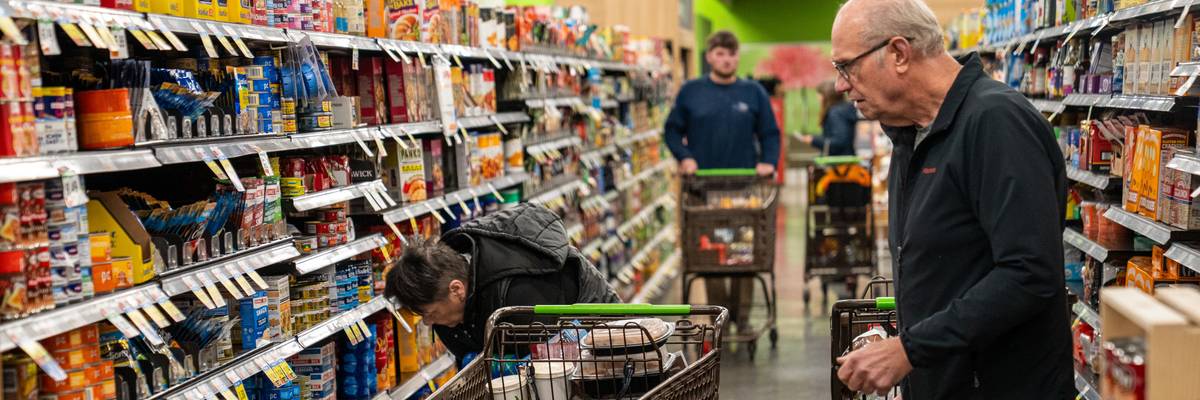
Shoppers look at a canned fish display November 4, 2025 at the Market 32 Supermarket in South Burlington, Vermont. Food prices have increased nearly 30% since 2020 according to the Bureau of Labor Statistics.
When Americans hurt by the rising cost of living believed Donald Trump, they made a big mistake.
In 2024, candidate Donald Trump promised that “a vote for Trump means your groceries will be cheaper.”
“Prices will come down,” he vowed, “and they’ll come down fast, with everything.”
“When I win,” he pledged, “I will immediately bring prices down, starting on Day One.”
Trump never said how he would accomplish this wonder because, in fact, he had no idea. And he didn’t care.
Trump did not campaign on the promise, “I will raise prices, but it will all be for the best.” For Trump, the “art of the deal” was bait and switch: promise lower prices, deliver higher prices.
Surprise! Surprise! Prices did not come down “fast,” “immediately,” “starting on Day One,” or at all. They’re moving in the other direction.
In the nine months since Trump took office, here’s what’s happened to prices:
In fairness, chicken prices are the same, eggs are down, and bread is 2% cheaper. If all you eat are egg salad sandwiches, you’ll do fine under President Trump. (But hold the mayo–the mayonnaise producer price index is up 4% over the year).
Inflation is surging–and soon will get much worse. Trump’s mass deportation crusade and his tariff mania are destined to sharply increase the cost of living.
Deporting millions of law-abiding, hard-working undocumented immigrants is economic lunacy and can only drive up prices.
Undocumented immigrants are half of the agricultural workforce. In a recent Federal Register filing, Trump’s Labor Department admits that his immigration policies have brought on “acute labor shortages” that pose “immediate dangers to the American food supply.” There is now a “risk of supply shock-induced food shortages” leading to “higher prices” for food.
In a back-handed compliment to undocumented immigrants, the Labor Department acknowledges that “agricultural work requires a distinct set of skills and is among the most physically demanding and hazardous occupations in the US labor market.”
“Despite rising wages," the department noted, "such jobs are still not viewed as viable alternatives for many [U.S.-born] workers.”
A California grower explains what a labor shortage looks like: “If 70% of your workforce doesn’t show up, 70% of your crop doesn’t get picked and can go bad in one day. Most Americans don’t want to do this work.” The outcome: “price hikes for consumers.”
Not just food prices. Undocumented immigrants are a major part of the workforce in construction, meat-packing, food processing, hospitality, and transportation. Eliminating immigrant labor means more shortages and higher prices.
Trump’s “beautiful tariffs” make things still worse. A tariff is a sales tax on the cost of everything purchased from overseas–shoes made in Vietnam, shirts and pants from Bangladesh, smartphones and toys from China, aluminum and lumber from Canada, auto parts from Mexico, coffee from Brazil, and bananas from Guatemala.
Eliminating immigrant labor means more shortages and higher prices.
The business that buys these goods pays the tariff and adds the tax to its price. If it is Canadian lumber that bears a 25% tariff, the 25%–as the National Association of Home Builders has pointed out–is a cost for builders and makes houses less affordable. If it is tomatoes from Mexico with a 17% tariff, Safeway will charge you more.
“Overall, Americans now face an average tariff rate of 17.4%... an increase estimated to cost households an extra $2,300 in 2025,” reports CNBC.
What’s the point? Trump believes increasing the cost of imports will make US manufactures cheaper by comparison. But under a tariff economy, everything actually becomes more expensive, not less.
The cost of American cars will go up under Trump’s tariffs because cars include tariff-burdened imported steel, aluminum, and part made abroad.
In theory, clothing manufacture could be returned to the U.S.A. from poor countries like Bangladesh, Vietnam and Ethiopia, where workers earn pennies an hour. But with US wages, apparel would become unaffordable: $126 to $207 for a woman’s shirt and $234 to $324 for a pair of jeans, Marketplace calculates.
Many tariffs are simply pointless. The US doesn’t have the right climate for growing coffee, so making coffee 20% more expensive will not create US coffee plantations and jobs.
Trump did not campaign on the promise, “I will raise prices, but it will all be for the best.” For Trump, the “art of the deal” was bait and switch: promise lower prices, deliver higher prices. American consumers will remain Trump’s victims unless we resist his tariff lunacy and immigration brutality.
Dear Common Dreams reader, It’s been nearly 30 years since I co-founded Common Dreams with my late wife, Lina Newhouser. We had the radical notion that journalism should serve the public good, not corporate profits. It was clear to us from the outset what it would take to build such a project. No paid advertisements. No corporate sponsors. No millionaire publisher telling us what to think or do. Many people said we wouldn't last a year, but we proved those doubters wrong. Together with a tremendous team of journalists and dedicated staff, we built an independent media outlet free from the constraints of profits and corporate control. Our mission has always been simple: To inform. To inspire. To ignite change for the common good. Building Common Dreams was not easy. Our survival was never guaranteed. When you take on the most powerful forces—Wall Street greed, fossil fuel industry destruction, Big Tech lobbyists, and uber-rich oligarchs who have spent billions upon billions rigging the economy and democracy in their favor—the only bulwark you have is supporters who believe in your work. But here’s the urgent message from me today. It's never been this bad out there. And it's never been this hard to keep us going. At the very moment Common Dreams is most needed, the threats we face are intensifying. We need your support now more than ever. We don't accept corporate advertising and never will. We don't have a paywall because we don't think people should be blocked from critical news based on their ability to pay. Everything we do is funded by the donations of readers like you. When everyone does the little they can afford, we are strong. But if that support retreats or dries up, so do we. Will you donate now to make sure Common Dreams not only survives but thrives? —Craig Brown, Co-founder |
In 2024, candidate Donald Trump promised that “a vote for Trump means your groceries will be cheaper.”
“Prices will come down,” he vowed, “and they’ll come down fast, with everything.”
“When I win,” he pledged, “I will immediately bring prices down, starting on Day One.”
Trump never said how he would accomplish this wonder because, in fact, he had no idea. And he didn’t care.
Trump did not campaign on the promise, “I will raise prices, but it will all be for the best.” For Trump, the “art of the deal” was bait and switch: promise lower prices, deliver higher prices.
Surprise! Surprise! Prices did not come down “fast,” “immediately,” “starting on Day One,” or at all. They’re moving in the other direction.
In the nine months since Trump took office, here’s what’s happened to prices:
In fairness, chicken prices are the same, eggs are down, and bread is 2% cheaper. If all you eat are egg salad sandwiches, you’ll do fine under President Trump. (But hold the mayo–the mayonnaise producer price index is up 4% over the year).
Inflation is surging–and soon will get much worse. Trump’s mass deportation crusade and his tariff mania are destined to sharply increase the cost of living.
Deporting millions of law-abiding, hard-working undocumented immigrants is economic lunacy and can only drive up prices.
Undocumented immigrants are half of the agricultural workforce. In a recent Federal Register filing, Trump’s Labor Department admits that his immigration policies have brought on “acute labor shortages” that pose “immediate dangers to the American food supply.” There is now a “risk of supply shock-induced food shortages” leading to “higher prices” for food.
In a back-handed compliment to undocumented immigrants, the Labor Department acknowledges that “agricultural work requires a distinct set of skills and is among the most physically demanding and hazardous occupations in the US labor market.”
“Despite rising wages," the department noted, "such jobs are still not viewed as viable alternatives for many [U.S.-born] workers.”
A California grower explains what a labor shortage looks like: “If 70% of your workforce doesn’t show up, 70% of your crop doesn’t get picked and can go bad in one day. Most Americans don’t want to do this work.” The outcome: “price hikes for consumers.”
Not just food prices. Undocumented immigrants are a major part of the workforce in construction, meat-packing, food processing, hospitality, and transportation. Eliminating immigrant labor means more shortages and higher prices.
Trump’s “beautiful tariffs” make things still worse. A tariff is a sales tax on the cost of everything purchased from overseas–shoes made in Vietnam, shirts and pants from Bangladesh, smartphones and toys from China, aluminum and lumber from Canada, auto parts from Mexico, coffee from Brazil, and bananas from Guatemala.
Eliminating immigrant labor means more shortages and higher prices.
The business that buys these goods pays the tariff and adds the tax to its price. If it is Canadian lumber that bears a 25% tariff, the 25%–as the National Association of Home Builders has pointed out–is a cost for builders and makes houses less affordable. If it is tomatoes from Mexico with a 17% tariff, Safeway will charge you more.
“Overall, Americans now face an average tariff rate of 17.4%... an increase estimated to cost households an extra $2,300 in 2025,” reports CNBC.
What’s the point? Trump believes increasing the cost of imports will make US manufactures cheaper by comparison. But under a tariff economy, everything actually becomes more expensive, not less.
The cost of American cars will go up under Trump’s tariffs because cars include tariff-burdened imported steel, aluminum, and part made abroad.
In theory, clothing manufacture could be returned to the U.S.A. from poor countries like Bangladesh, Vietnam and Ethiopia, where workers earn pennies an hour. But with US wages, apparel would become unaffordable: $126 to $207 for a woman’s shirt and $234 to $324 for a pair of jeans, Marketplace calculates.
Many tariffs are simply pointless. The US doesn’t have the right climate for growing coffee, so making coffee 20% more expensive will not create US coffee plantations and jobs.
Trump did not campaign on the promise, “I will raise prices, but it will all be for the best.” For Trump, the “art of the deal” was bait and switch: promise lower prices, deliver higher prices. American consumers will remain Trump’s victims unless we resist his tariff lunacy and immigration brutality.
In 2024, candidate Donald Trump promised that “a vote for Trump means your groceries will be cheaper.”
“Prices will come down,” he vowed, “and they’ll come down fast, with everything.”
“When I win,” he pledged, “I will immediately bring prices down, starting on Day One.”
Trump never said how he would accomplish this wonder because, in fact, he had no idea. And he didn’t care.
Trump did not campaign on the promise, “I will raise prices, but it will all be for the best.” For Trump, the “art of the deal” was bait and switch: promise lower prices, deliver higher prices.
Surprise! Surprise! Prices did not come down “fast,” “immediately,” “starting on Day One,” or at all. They’re moving in the other direction.
In the nine months since Trump took office, here’s what’s happened to prices:
In fairness, chicken prices are the same, eggs are down, and bread is 2% cheaper. If all you eat are egg salad sandwiches, you’ll do fine under President Trump. (But hold the mayo–the mayonnaise producer price index is up 4% over the year).
Inflation is surging–and soon will get much worse. Trump’s mass deportation crusade and his tariff mania are destined to sharply increase the cost of living.
Deporting millions of law-abiding, hard-working undocumented immigrants is economic lunacy and can only drive up prices.
Undocumented immigrants are half of the agricultural workforce. In a recent Federal Register filing, Trump’s Labor Department admits that his immigration policies have brought on “acute labor shortages” that pose “immediate dangers to the American food supply.” There is now a “risk of supply shock-induced food shortages” leading to “higher prices” for food.
In a back-handed compliment to undocumented immigrants, the Labor Department acknowledges that “agricultural work requires a distinct set of skills and is among the most physically demanding and hazardous occupations in the US labor market.”
“Despite rising wages," the department noted, "such jobs are still not viewed as viable alternatives for many [U.S.-born] workers.”
A California grower explains what a labor shortage looks like: “If 70% of your workforce doesn’t show up, 70% of your crop doesn’t get picked and can go bad in one day. Most Americans don’t want to do this work.” The outcome: “price hikes for consumers.”
Not just food prices. Undocumented immigrants are a major part of the workforce in construction, meat-packing, food processing, hospitality, and transportation. Eliminating immigrant labor means more shortages and higher prices.
Trump’s “beautiful tariffs” make things still worse. A tariff is a sales tax on the cost of everything purchased from overseas–shoes made in Vietnam, shirts and pants from Bangladesh, smartphones and toys from China, aluminum and lumber from Canada, auto parts from Mexico, coffee from Brazil, and bananas from Guatemala.
Eliminating immigrant labor means more shortages and higher prices.
The business that buys these goods pays the tariff and adds the tax to its price. If it is Canadian lumber that bears a 25% tariff, the 25%–as the National Association of Home Builders has pointed out–is a cost for builders and makes houses less affordable. If it is tomatoes from Mexico with a 17% tariff, Safeway will charge you more.
“Overall, Americans now face an average tariff rate of 17.4%... an increase estimated to cost households an extra $2,300 in 2025,” reports CNBC.
What’s the point? Trump believes increasing the cost of imports will make US manufactures cheaper by comparison. But under a tariff economy, everything actually becomes more expensive, not less.
The cost of American cars will go up under Trump’s tariffs because cars include tariff-burdened imported steel, aluminum, and part made abroad.
In theory, clothing manufacture could be returned to the U.S.A. from poor countries like Bangladesh, Vietnam and Ethiopia, where workers earn pennies an hour. But with US wages, apparel would become unaffordable: $126 to $207 for a woman’s shirt and $234 to $324 for a pair of jeans, Marketplace calculates.
Many tariffs are simply pointless. The US doesn’t have the right climate for growing coffee, so making coffee 20% more expensive will not create US coffee plantations and jobs.
Trump did not campaign on the promise, “I will raise prices, but it will all be for the best.” For Trump, the “art of the deal” was bait and switch: promise lower prices, deliver higher prices. American consumers will remain Trump’s victims unless we resist his tariff lunacy and immigration brutality.