SUBSCRIBE TO OUR FREE NEWSLETTER
Daily news & progressive opinion—funded by the people, not the corporations—delivered straight to your inbox.
5
#000000
#FFFFFF
To donate by check, phone, or other method, see our More Ways to Give page.
Daily news & progressive opinion—funded by the people, not the corporations—delivered straight to your inbox.
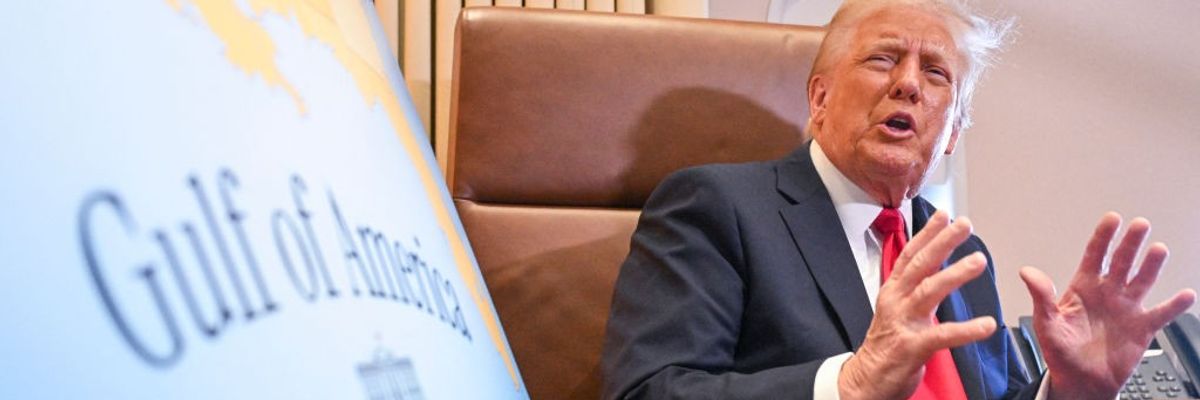
U.S. President Donald Trump speaks to reporters aboard Air Force One after signing a proclamation renaming the Gulf of Mexico as the Gulf of America on February 9, 2025.
"It's at times like these that journalists need to put down their pens and advocate for accountable leadership," asserted one campaigner.
First Amendment defenders are calling on media organizations and journalists to stand up to bullying and intimidation by U.S. President Donald Trump, whose administration on Friday confirmed the indefinite exclusion of one of the world's largest news agencies from White House press briefings and Air Force One flights over its refusal to adopt the Republican leader's new name for the Gulf of Mexico.
White House Deputy Chief of Staff Taylor Budowich said that because The Associated Press "continues to ignore the lawful geographic name change" of the Gulf of Mexico to the Gulf of America, it will be indefinitely banned from White House news conferences and the president's official airplane.
"The level of pettiness displayed by the White House is so incredible that it almost hides the gravity of the situation."
The New York-based AP, which provides news content to roughly 15,000 media outlets in over 100 countries, has explained that, because the gulf is an international body of water, it will continue to call it the Gulf of Mexico because Mexico—whose president on Thursday threatened to sue Google for adopting Trump's name change—and other countries do not recognize the new name.
In contrast, the AP said it will call Denali, the highest peak in North America, Mt. McKinley following a name change by Trump because the Alaska mountain is located entirely inside the United States.
Budowich said the AP's decision on the Gulf of Mexico exposes the agency's "commitment to misinformation."
"While their right to irresponsible and dishonest reporting is protected by the First Amendment, it does not ensure their privilege of unfettered access to limited spaces," he argued.
But critics said the Trump administration's behavior is about a lot more than just a spat over a name change.
"Of course, this is just more petty behavior by a president seeking to punish any news organization that doesn't follow his dictates, regardless of how ridiculous they may be," Timothy Karr, the senior director of strategy and communications at Free Press, told Common Dreams on Friday.
"It's at times like these that journalists need to put down their pens and advocate for accountable leadership," Karr stressed. "They need to advocate for themselves, their colleagues, and for journalism writ large."
"The good news is that more than a dozen of the mass market news outlets have refused to adopt Trump's name change for the Gulf of Mexico," he added. "That's a start. They now need to speak out against his First Amendment threats, despite the consequences. There is much more at stake now than just having access to the White House."
"By defying Trump, the AP has created a rallying point for other organizations and individuals to find their spines and defy him as well."
Writing for Public Notice Friday, Noah Berlatsky commended the AP for "not changing their style to suit the whims of a would-be tin-pot dictator."
"And by defying Trump, the AP has created a rallying point for other organizations and individuals to find their spines and defy him as well," Berlatsky added.
Those include the heads of the White House Correspondents' Association (WHCA) and Reporters Without Borders (RSF), as well as groups like the Committee to Protect Journalists, National Press Club, PEN America, and Society of Professional Journalists.
"The White House cannot dictate how news organizations report the news, nor should it penalize working journalists because it is unhappy with their editors' decisions," WHCA president Eugene Daniels said earlier this week.
RSF USA executive director Clayton Weimers said in a statement that "the level of pettiness displayed by the White House is so incredible that it almost hides the gravity of the situation."
"A sitting president is punishing a major news outlet for its constitutionally protected choice of words," Weimers added. "Donald Trump has been trampling over press freedom since his first day in office."
President Trump banning the Associated Press from an event over their usage of "Gulf of Mexico" instead of "Gulf of America" may seem more absurd than alarming, but Trump's attacks on the free press are no joke.
[image or embed]
— ACLU (@aclu.org) February 11, 2025 at 5:35 PM
Numerous experts highlighted what they called the unconstitutionality of banning a media outlet from press briefings for political reasons.
"The AP—a major news agency that produces and distributes reports to thousands of newspapers, radio stations, and TV broadcasters around the world—has had long-standing access to the White House," Aaron Terr, director of public advocacy at the Foundation for Individual Rights and Expression, wrote on Friday.
"It is now losing that access because its exercise of editorial discretion doesn't align with the administration’s preferred messaging," Terr added. "That's viewpoint discrimination, and it's unconstitutional."
Berlatsky wrote: "As ABC, Meta, the LA Times, The Washington Post, and Google demonstrate, you lose 100% of the fights you preemptively and despicably surrender. The AP has already won an important victory by refusing to change the Gulf of Mexico to some random other name at the whim of a power-mad orange gasbag."
"If any portion of Trump's agenda is to be stopped, we need people and organizations who are willing to defy him and speak truths he doesn't want to hear," he added. "Despite Trump, the
AP still calls the Gulf of Mexico the Gulf of Mexico. In doing so, it's reminding us what freedom looks like. It's also demonstrating us that if you don't want to lose your freedoms, you have to use them."
Dear Common Dreams reader, It’s been nearly 30 years since I co-founded Common Dreams with my late wife, Lina Newhouser. We had the radical notion that journalism should serve the public good, not corporate profits. It was clear to us from the outset what it would take to build such a project. No paid advertisements. No corporate sponsors. No millionaire publisher telling us what to think or do. Many people said we wouldn't last a year, but we proved those doubters wrong. Together with a tremendous team of journalists and dedicated staff, we built an independent media outlet free from the constraints of profits and corporate control. Our mission has always been simple: To inform. To inspire. To ignite change for the common good. Building Common Dreams was not easy. Our survival was never guaranteed. When you take on the most powerful forces—Wall Street greed, fossil fuel industry destruction, Big Tech lobbyists, and uber-rich oligarchs who have spent billions upon billions rigging the economy and democracy in their favor—the only bulwark you have is supporters who believe in your work. But here’s the urgent message from me today. It's never been this bad out there. And it's never been this hard to keep us going. At the very moment Common Dreams is most needed, the threats we face are intensifying. We need your support now more than ever. We don't accept corporate advertising and never will. We don't have a paywall because we don't think people should be blocked from critical news based on their ability to pay. Everything we do is funded by the donations of readers like you. When everyone does the little they can afford, we are strong. But if that support retreats or dries up, so do we. Will you donate now to make sure Common Dreams not only survives but thrives? —Craig Brown, Co-founder |
First Amendment defenders are calling on media organizations and journalists to stand up to bullying and intimidation by U.S. President Donald Trump, whose administration on Friday confirmed the indefinite exclusion of one of the world's largest news agencies from White House press briefings and Air Force One flights over its refusal to adopt the Republican leader's new name for the Gulf of Mexico.
White House Deputy Chief of Staff Taylor Budowich said that because The Associated Press "continues to ignore the lawful geographic name change" of the Gulf of Mexico to the Gulf of America, it will be indefinitely banned from White House news conferences and the president's official airplane.
"The level of pettiness displayed by the White House is so incredible that it almost hides the gravity of the situation."
The New York-based AP, which provides news content to roughly 15,000 media outlets in over 100 countries, has explained that, because the gulf is an international body of water, it will continue to call it the Gulf of Mexico because Mexico—whose president on Thursday threatened to sue Google for adopting Trump's name change—and other countries do not recognize the new name.
In contrast, the AP said it will call Denali, the highest peak in North America, Mt. McKinley following a name change by Trump because the Alaska mountain is located entirely inside the United States.
Budowich said the AP's decision on the Gulf of Mexico exposes the agency's "commitment to misinformation."
"While their right to irresponsible and dishonest reporting is protected by the First Amendment, it does not ensure their privilege of unfettered access to limited spaces," he argued.
But critics said the Trump administration's behavior is about a lot more than just a spat over a name change.
"Of course, this is just more petty behavior by a president seeking to punish any news organization that doesn't follow his dictates, regardless of how ridiculous they may be," Timothy Karr, the senior director of strategy and communications at Free Press, told Common Dreams on Friday.
"It's at times like these that journalists need to put down their pens and advocate for accountable leadership," Karr stressed. "They need to advocate for themselves, their colleagues, and for journalism writ large."
"The good news is that more than a dozen of the mass market news outlets have refused to adopt Trump's name change for the Gulf of Mexico," he added. "That's a start. They now need to speak out against his First Amendment threats, despite the consequences. There is much more at stake now than just having access to the White House."
"By defying Trump, the AP has created a rallying point for other organizations and individuals to find their spines and defy him as well."
Writing for Public Notice Friday, Noah Berlatsky commended the AP for "not changing their style to suit the whims of a would-be tin-pot dictator."
"And by defying Trump, the AP has created a rallying point for other organizations and individuals to find their spines and defy him as well," Berlatsky added.
Those include the heads of the White House Correspondents' Association (WHCA) and Reporters Without Borders (RSF), as well as groups like the Committee to Protect Journalists, National Press Club, PEN America, and Society of Professional Journalists.
"The White House cannot dictate how news organizations report the news, nor should it penalize working journalists because it is unhappy with their editors' decisions," WHCA president Eugene Daniels said earlier this week.
RSF USA executive director Clayton Weimers said in a statement that "the level of pettiness displayed by the White House is so incredible that it almost hides the gravity of the situation."
"A sitting president is punishing a major news outlet for its constitutionally protected choice of words," Weimers added. "Donald Trump has been trampling over press freedom since his first day in office."
President Trump banning the Associated Press from an event over their usage of "Gulf of Mexico" instead of "Gulf of America" may seem more absurd than alarming, but Trump's attacks on the free press are no joke.
[image or embed]
— ACLU (@aclu.org) February 11, 2025 at 5:35 PM
Numerous experts highlighted what they called the unconstitutionality of banning a media outlet from press briefings for political reasons.
"The AP—a major news agency that produces and distributes reports to thousands of newspapers, radio stations, and TV broadcasters around the world—has had long-standing access to the White House," Aaron Terr, director of public advocacy at the Foundation for Individual Rights and Expression, wrote on Friday.
"It is now losing that access because its exercise of editorial discretion doesn't align with the administration’s preferred messaging," Terr added. "That's viewpoint discrimination, and it's unconstitutional."
Berlatsky wrote: "As ABC, Meta, the LA Times, The Washington Post, and Google demonstrate, you lose 100% of the fights you preemptively and despicably surrender. The AP has already won an important victory by refusing to change the Gulf of Mexico to some random other name at the whim of a power-mad orange gasbag."
"If any portion of Trump's agenda is to be stopped, we need people and organizations who are willing to defy him and speak truths he doesn't want to hear," he added. "Despite Trump, the
AP still calls the Gulf of Mexico the Gulf of Mexico. In doing so, it's reminding us what freedom looks like. It's also demonstrating us that if you don't want to lose your freedoms, you have to use them."
First Amendment defenders are calling on media organizations and journalists to stand up to bullying and intimidation by U.S. President Donald Trump, whose administration on Friday confirmed the indefinite exclusion of one of the world's largest news agencies from White House press briefings and Air Force One flights over its refusal to adopt the Republican leader's new name for the Gulf of Mexico.
White House Deputy Chief of Staff Taylor Budowich said that because The Associated Press "continues to ignore the lawful geographic name change" of the Gulf of Mexico to the Gulf of America, it will be indefinitely banned from White House news conferences and the president's official airplane.
"The level of pettiness displayed by the White House is so incredible that it almost hides the gravity of the situation."
The New York-based AP, which provides news content to roughly 15,000 media outlets in over 100 countries, has explained that, because the gulf is an international body of water, it will continue to call it the Gulf of Mexico because Mexico—whose president on Thursday threatened to sue Google for adopting Trump's name change—and other countries do not recognize the new name.
In contrast, the AP said it will call Denali, the highest peak in North America, Mt. McKinley following a name change by Trump because the Alaska mountain is located entirely inside the United States.
Budowich said the AP's decision on the Gulf of Mexico exposes the agency's "commitment to misinformation."
"While their right to irresponsible and dishonest reporting is protected by the First Amendment, it does not ensure their privilege of unfettered access to limited spaces," he argued.
But critics said the Trump administration's behavior is about a lot more than just a spat over a name change.
"Of course, this is just more petty behavior by a president seeking to punish any news organization that doesn't follow his dictates, regardless of how ridiculous they may be," Timothy Karr, the senior director of strategy and communications at Free Press, told Common Dreams on Friday.
"It's at times like these that journalists need to put down their pens and advocate for accountable leadership," Karr stressed. "They need to advocate for themselves, their colleagues, and for journalism writ large."
"The good news is that more than a dozen of the mass market news outlets have refused to adopt Trump's name change for the Gulf of Mexico," he added. "That's a start. They now need to speak out against his First Amendment threats, despite the consequences. There is much more at stake now than just having access to the White House."
"By defying Trump, the AP has created a rallying point for other organizations and individuals to find their spines and defy him as well."
Writing for Public Notice Friday, Noah Berlatsky commended the AP for "not changing their style to suit the whims of a would-be tin-pot dictator."
"And by defying Trump, the AP has created a rallying point for other organizations and individuals to find their spines and defy him as well," Berlatsky added.
Those include the heads of the White House Correspondents' Association (WHCA) and Reporters Without Borders (RSF), as well as groups like the Committee to Protect Journalists, National Press Club, PEN America, and Society of Professional Journalists.
"The White House cannot dictate how news organizations report the news, nor should it penalize working journalists because it is unhappy with their editors' decisions," WHCA president Eugene Daniels said earlier this week.
RSF USA executive director Clayton Weimers said in a statement that "the level of pettiness displayed by the White House is so incredible that it almost hides the gravity of the situation."
"A sitting president is punishing a major news outlet for its constitutionally protected choice of words," Weimers added. "Donald Trump has been trampling over press freedom since his first day in office."
President Trump banning the Associated Press from an event over their usage of "Gulf of Mexico" instead of "Gulf of America" may seem more absurd than alarming, but Trump's attacks on the free press are no joke.
[image or embed]
— ACLU (@aclu.org) February 11, 2025 at 5:35 PM
Numerous experts highlighted what they called the unconstitutionality of banning a media outlet from press briefings for political reasons.
"The AP—a major news agency that produces and distributes reports to thousands of newspapers, radio stations, and TV broadcasters around the world—has had long-standing access to the White House," Aaron Terr, director of public advocacy at the Foundation for Individual Rights and Expression, wrote on Friday.
"It is now losing that access because its exercise of editorial discretion doesn't align with the administration’s preferred messaging," Terr added. "That's viewpoint discrimination, and it's unconstitutional."
Berlatsky wrote: "As ABC, Meta, the LA Times, The Washington Post, and Google demonstrate, you lose 100% of the fights you preemptively and despicably surrender. The AP has already won an important victory by refusing to change the Gulf of Mexico to some random other name at the whim of a power-mad orange gasbag."
"If any portion of Trump's agenda is to be stopped, we need people and organizations who are willing to defy him and speak truths he doesn't want to hear," he added. "Despite Trump, the
AP still calls the Gulf of Mexico the Gulf of Mexico. In doing so, it's reminding us what freedom looks like. It's also demonstrating us that if you don't want to lose your freedoms, you have to use them."