5
#000000
#FFFFFF
To donate by check, phone, or other method, see our More Ways to Give page.
Daily news & progressive opinion—funded by the people, not the corporations—delivered straight to your inbox.
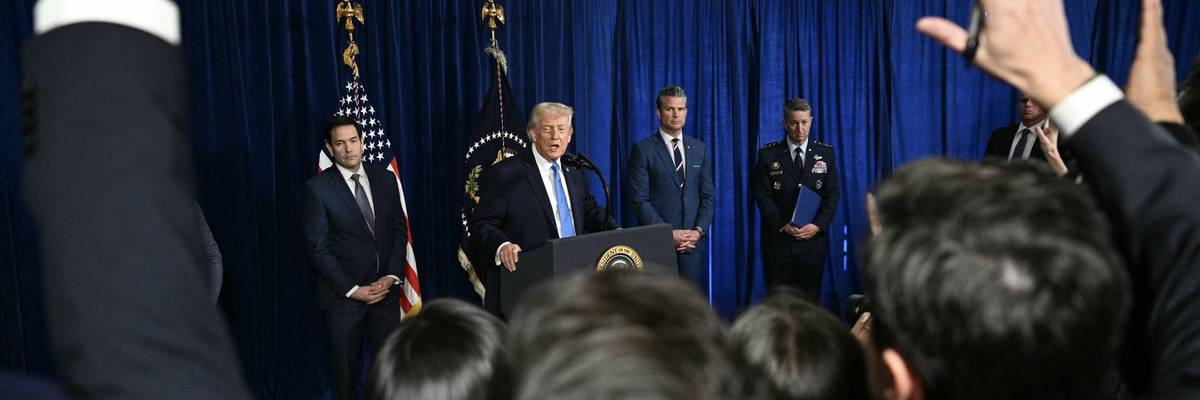
US President Donald Trump takes questions as he speaks to the press following US military actions in Venezuela, at his Mar-a-Lago residence in Palm Beach, Florida, on January 3, 2026.
His latest spending proposals build on his history of overseeing significant reductions in taxes and dramatic increases in defense spending, in line with core conservative goals.
Since Donald Trump first broke onto the national political scene, there has been a serious debate among Republicans regarding his commitment to conservative principles. His style was, in a word, flamboyant. His morality was questionable. And his behavior and language were outrageous. None of these behaviors could be identified with the staid “buttoned down” behaviors on display in conservative circles.
In recent decades, Republicans have latched onto a range of social issues like gay marriage, transgender rights, and abortion, or cultural matters like xenophobia and opposition to affirmative action. None of these issues, however, were central to textbook conservatism, which historically has been encapsulated in the mantra “lower taxes, smaller government” and the insistence that the principal role of government ought to be “securing the national defense.” Despite not being cut from the same mold as Barry Goldwater or Ronald Reagan, President Trump has proven his bona fides on advancing these core conservative goals. Mimicking the Reagan and George W. Bush administrations, President Trump in his first and second terms has coupled significant reductions in taxes with dramatic increases in defense spending either to expand the Pentagon’s already bloated budget or to underwrite foreign wars fought by us or allies.
This week’s rollout of Trump’s proposed budget for fiscal year 2027 looks like a conservative’s dream come true. He is asking for a $500 billion increase in the defense department’s budget, amounting to the largest increase (44%) and the largest overall military budget since World War II. This 2027 increase is on top of the $350 billion supplement requested for 2026, presumably to offset the increased costs resulting from the US-Israel war on Iran.
The 2027 budget request also includes increases for Veterans Affairs and the Justice Department (to cover the costs of immigration prosecutions). But the 2027 budget also makes cuts in 10 other government agencies, with sharp reductions for the State Department and international programs; renewable energy projects; research grants in healthcare; and a number of social, educational, and medical programs. When asked by reporters about the impact of these reductions specifically on Medicare, Medicaid, and daycare programs, the president replied: “We’re fighting wars. It’s not possible for us to take care of daycare, Medicaid, Medicare, all these things.”
Because mainstream Democrats have shied away from criticizing past and present wars and excessive defense spending, they’ve allowed Republicans to use the issue of budget deficits to play innocent and instead attack Democrats as “big spenders” who are recklessly spending the US into a hole.
What makes this problematic is that these dramatic increases in defense spending have been coupled with a sharp reduction in revenues resulting from Trump’s signature legislation—the “One Big Beautiful Bill”—that passed last year. That bill included reductions in taxes totaling $4.5 trillion over the next 10 years. In other words, “lower taxes, smaller government” and a singular focus on defense spending—the conservatives’ dream budget.
Two additional benefits to Republicans result from this pairing of decreases in revenues and increases in defense spending. On the one hand, it sharply increases budget deficits, which Republicans have effectively used to call for more spending cuts to social welfare spending. Because mainstream Democrats have shied away from criticizing past and present wars and excessive defense spending, they’ve allowed Republicans to use the issue of budget deficits to play innocent and instead attack Democrats as “big spenders” who are recklessly spending the US into a hole. In reality, however, it was Ronald Reagan’s irresponsible massive tax cuts and huge increases in military spending that caused the budget deficits of the 1980s. And while during the 2012 election Republicans made an issue of the growing national debt, no one pointed out that it was George W. Bush’s tax cuts and the war in Iraq that rang up a bill of trillions of dollars with no new revenues raised to offset the outlays for the war and its aftermath. To date, that war has cost over $7 trillion. Now Trump is following in the footsteps of Reagan and George W. Bush.
There is still another way, that Trump, like Reagan, will try to exploit the crisis created by a skewed budget to his advantage. This week, when reporters asked the president about his budget proposal’s impact on daycare programs, Medicaid, and Medicaid (which will experience cuts or strains), he replied:
(We can’t) send any money for daycare because theUnited States can’t take care of daycare. We’re a big country. We have 50 states. We have all these other people. We’re fighting wars. It’s not possible for us to take care of daycare, Medicaid, Medicare, all these individual things. They can do that on a state basis.
By recklessly reducing the federal government’s revenues and then forcing cuts in needed social programs to make way for increased defense spending, Trump, like Reagan, is forcing the financial cost of daycare, Medicaid, education, etc., down to the state level. Then when Democratic governors are forced to raise taxes to cover these increased costs, Republicans will pounce, criticizing them for raising taxes.
If this president’s policies over the last decade haven’t convinced the conservative elite that he's really one of them or voters that he’s not the radical populist his rhetoric made him out to be, then his 2027 budget should be all the convincing they need.
Dear Common Dreams reader, The U.S. is on a fast track to authoritarianism like nothing I've ever seen. Meanwhile, corporate news outlets are utterly capitulating to Trump, twisting their coverage to avoid drawing his ire while lining up to stuff cash in his pockets. That's why I believe that Common Dreams is doing the best and most consequential reporting that we've ever done. Our small but mighty team is a progressive reporting powerhouse, covering the news every day that the corporate media never will. Our mission has always been simple: To inform. To inspire. And to ignite change for the common good. Now here's the key piece that I want all our readers to understand: None of this would be possible without your financial support. That's not just some fundraising cliche. It's the absolute and literal truth. We don't accept corporate advertising and never will. We don't have a paywall because we don't think people should be blocked from critical news based on their ability to pay. Everything we do is funded by the donations of readers like you. Will you donate now to help power the nonprofit, independent reporting of Common Dreams? Thank you for being a vital member of our community. Together, we can keep independent journalism alive when it’s needed most. - Craig Brown, Co-founder |
Since Donald Trump first broke onto the national political scene, there has been a serious debate among Republicans regarding his commitment to conservative principles. His style was, in a word, flamboyant. His morality was questionable. And his behavior and language were outrageous. None of these behaviors could be identified with the staid “buttoned down” behaviors on display in conservative circles.
In recent decades, Republicans have latched onto a range of social issues like gay marriage, transgender rights, and abortion, or cultural matters like xenophobia and opposition to affirmative action. None of these issues, however, were central to textbook conservatism, which historically has been encapsulated in the mantra “lower taxes, smaller government” and the insistence that the principal role of government ought to be “securing the national defense.” Despite not being cut from the same mold as Barry Goldwater or Ronald Reagan, President Trump has proven his bona fides on advancing these core conservative goals. Mimicking the Reagan and George W. Bush administrations, President Trump in his first and second terms has coupled significant reductions in taxes with dramatic increases in defense spending either to expand the Pentagon’s already bloated budget or to underwrite foreign wars fought by us or allies.
This week’s rollout of Trump’s proposed budget for fiscal year 2027 looks like a conservative’s dream come true. He is asking for a $500 billion increase in the defense department’s budget, amounting to the largest increase (44%) and the largest overall military budget since World War II. This 2027 increase is on top of the $350 billion supplement requested for 2026, presumably to offset the increased costs resulting from the US-Israel war on Iran.
The 2027 budget request also includes increases for Veterans Affairs and the Justice Department (to cover the costs of immigration prosecutions). But the 2027 budget also makes cuts in 10 other government agencies, with sharp reductions for the State Department and international programs; renewable energy projects; research grants in healthcare; and a number of social, educational, and medical programs. When asked by reporters about the impact of these reductions specifically on Medicare, Medicaid, and daycare programs, the president replied: “We’re fighting wars. It’s not possible for us to take care of daycare, Medicaid, Medicare, all these things.”
Because mainstream Democrats have shied away from criticizing past and present wars and excessive defense spending, they’ve allowed Republicans to use the issue of budget deficits to play innocent and instead attack Democrats as “big spenders” who are recklessly spending the US into a hole.
What makes this problematic is that these dramatic increases in defense spending have been coupled with a sharp reduction in revenues resulting from Trump’s signature legislation—the “One Big Beautiful Bill”—that passed last year. That bill included reductions in taxes totaling $4.5 trillion over the next 10 years. In other words, “lower taxes, smaller government” and a singular focus on defense spending—the conservatives’ dream budget.
Two additional benefits to Republicans result from this pairing of decreases in revenues and increases in defense spending. On the one hand, it sharply increases budget deficits, which Republicans have effectively used to call for more spending cuts to social welfare spending. Because mainstream Democrats have shied away from criticizing past and present wars and excessive defense spending, they’ve allowed Republicans to use the issue of budget deficits to play innocent and instead attack Democrats as “big spenders” who are recklessly spending the US into a hole. In reality, however, it was Ronald Reagan’s irresponsible massive tax cuts and huge increases in military spending that caused the budget deficits of the 1980s. And while during the 2012 election Republicans made an issue of the growing national debt, no one pointed out that it was George W. Bush’s tax cuts and the war in Iraq that rang up a bill of trillions of dollars with no new revenues raised to offset the outlays for the war and its aftermath. To date, that war has cost over $7 trillion. Now Trump is following in the footsteps of Reagan and George W. Bush.
There is still another way, that Trump, like Reagan, will try to exploit the crisis created by a skewed budget to his advantage. This week, when reporters asked the president about his budget proposal’s impact on daycare programs, Medicaid, and Medicaid (which will experience cuts or strains), he replied:
(We can’t) send any money for daycare because theUnited States can’t take care of daycare. We’re a big country. We have 50 states. We have all these other people. We’re fighting wars. It’s not possible for us to take care of daycare, Medicaid, Medicare, all these individual things. They can do that on a state basis.
By recklessly reducing the federal government’s revenues and then forcing cuts in needed social programs to make way for increased defense spending, Trump, like Reagan, is forcing the financial cost of daycare, Medicaid, education, etc., down to the state level. Then when Democratic governors are forced to raise taxes to cover these increased costs, Republicans will pounce, criticizing them for raising taxes.
If this president’s policies over the last decade haven’t convinced the conservative elite that he's really one of them or voters that he’s not the radical populist his rhetoric made him out to be, then his 2027 budget should be all the convincing they need.
Since Donald Trump first broke onto the national political scene, there has been a serious debate among Republicans regarding his commitment to conservative principles. His style was, in a word, flamboyant. His morality was questionable. And his behavior and language were outrageous. None of these behaviors could be identified with the staid “buttoned down” behaviors on display in conservative circles.
In recent decades, Republicans have latched onto a range of social issues like gay marriage, transgender rights, and abortion, or cultural matters like xenophobia and opposition to affirmative action. None of these issues, however, were central to textbook conservatism, which historically has been encapsulated in the mantra “lower taxes, smaller government” and the insistence that the principal role of government ought to be “securing the national defense.” Despite not being cut from the same mold as Barry Goldwater or Ronald Reagan, President Trump has proven his bona fides on advancing these core conservative goals. Mimicking the Reagan and George W. Bush administrations, President Trump in his first and second terms has coupled significant reductions in taxes with dramatic increases in defense spending either to expand the Pentagon’s already bloated budget or to underwrite foreign wars fought by us or allies.
This week’s rollout of Trump’s proposed budget for fiscal year 2027 looks like a conservative’s dream come true. He is asking for a $500 billion increase in the defense department’s budget, amounting to the largest increase (44%) and the largest overall military budget since World War II. This 2027 increase is on top of the $350 billion supplement requested for 2026, presumably to offset the increased costs resulting from the US-Israel war on Iran.
The 2027 budget request also includes increases for Veterans Affairs and the Justice Department (to cover the costs of immigration prosecutions). But the 2027 budget also makes cuts in 10 other government agencies, with sharp reductions for the State Department and international programs; renewable energy projects; research grants in healthcare; and a number of social, educational, and medical programs. When asked by reporters about the impact of these reductions specifically on Medicare, Medicaid, and daycare programs, the president replied: “We’re fighting wars. It’s not possible for us to take care of daycare, Medicaid, Medicare, all these things.”
Because mainstream Democrats have shied away from criticizing past and present wars and excessive defense spending, they’ve allowed Republicans to use the issue of budget deficits to play innocent and instead attack Democrats as “big spenders” who are recklessly spending the US into a hole.
What makes this problematic is that these dramatic increases in defense spending have been coupled with a sharp reduction in revenues resulting from Trump’s signature legislation—the “One Big Beautiful Bill”—that passed last year. That bill included reductions in taxes totaling $4.5 trillion over the next 10 years. In other words, “lower taxes, smaller government” and a singular focus on defense spending—the conservatives’ dream budget.
Two additional benefits to Republicans result from this pairing of decreases in revenues and increases in defense spending. On the one hand, it sharply increases budget deficits, which Republicans have effectively used to call for more spending cuts to social welfare spending. Because mainstream Democrats have shied away from criticizing past and present wars and excessive defense spending, they’ve allowed Republicans to use the issue of budget deficits to play innocent and instead attack Democrats as “big spenders” who are recklessly spending the US into a hole. In reality, however, it was Ronald Reagan’s irresponsible massive tax cuts and huge increases in military spending that caused the budget deficits of the 1980s. And while during the 2012 election Republicans made an issue of the growing national debt, no one pointed out that it was George W. Bush’s tax cuts and the war in Iraq that rang up a bill of trillions of dollars with no new revenues raised to offset the outlays for the war and its aftermath. To date, that war has cost over $7 trillion. Now Trump is following in the footsteps of Reagan and George W. Bush.
There is still another way, that Trump, like Reagan, will try to exploit the crisis created by a skewed budget to his advantage. This week, when reporters asked the president about his budget proposal’s impact on daycare programs, Medicaid, and Medicaid (which will experience cuts or strains), he replied:
(We can’t) send any money for daycare because theUnited States can’t take care of daycare. We’re a big country. We have 50 states. We have all these other people. We’re fighting wars. It’s not possible for us to take care of daycare, Medicaid, Medicare, all these individual things. They can do that on a state basis.
By recklessly reducing the federal government’s revenues and then forcing cuts in needed social programs to make way for increased defense spending, Trump, like Reagan, is forcing the financial cost of daycare, Medicaid, education, etc., down to the state level. Then when Democratic governors are forced to raise taxes to cover these increased costs, Republicans will pounce, criticizing them for raising taxes.
If this president’s policies over the last decade haven’t convinced the conservative elite that he's really one of them or voters that he’s not the radical populist his rhetoric made him out to be, then his 2027 budget should be all the convincing they need.