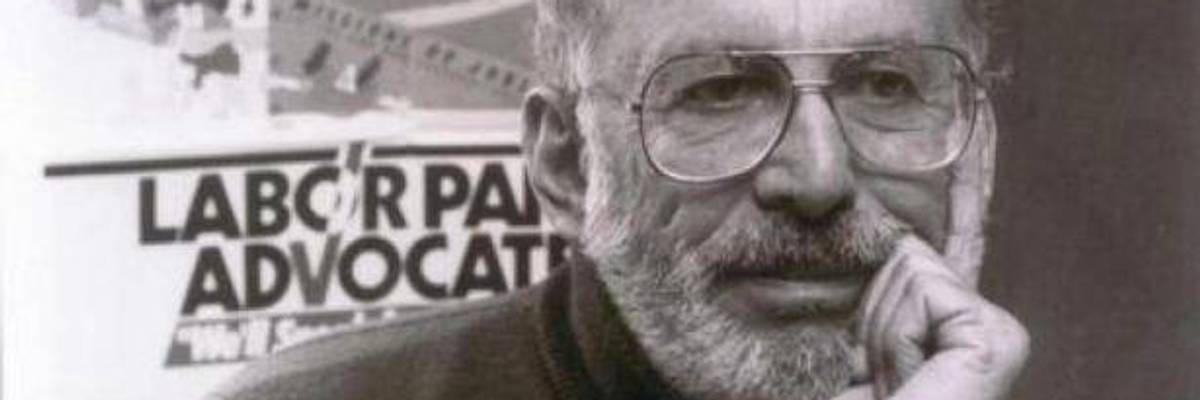
Labor leader Tony Mazzocchi (1926-2002), one of the nation's greatest labor leaders, was born 100 years ago.
Come Celebrate the Life and Work of Tony Mazzocchi
Given the mess we’re in today, now is the perfect time to celebrate his life and, perhaps, get our batteries recharged with the optimism Mazzocchi exuded from every pore.
The year 1926 gave birth to a slew of creative people including Miles Davis, John Coltrane, Mel Brooks, and Marilyn Monroe. Tony Mazzocchi, (1926-2002) was also born in that year and he too was creative virtuoso—a master of radical imagination who transformed our country, even though few have ever heard of him.
On June 4-5, The Rutgers University Labor Education Center will hold a centennial conference in Mazzocchi’s honor to celebrate his work and to promote his radical vision for America. All are invited.
Tony Mazzocchi, born and raised in Bensonhurst, Brooklyn, was a ninth-grade drop-out who lied about his age and enlisted in WWII at age 16. After the war he used the GI Bill of Rights to go to dental school to learn to make teeth. He soon gave that up to work as a labor activist, quickly becoming a local union president in New York and Long Island. He eventually ended up a national leader of the Oil, Chemical and Atomic Workers and spearheaded a new occupational safety and health movement that led to the creation of the Occupational Safety and Health Administration (OSHA).
Mazzocchi’s goal was to build a radical labor movement that would transform capitalism so that every person had a right to a job at a living wage, access to free higher education, and cradle to the grave health coverage.
Here’s a sample of the passion he brought to that fight:
I wanted the whole country to know in detail what had happened at that factory, and to understand that what had gone on there—the fruitless Bureau of Occupational Safety and Health Inspections, the lack of enforcement by the Department of Labor, the whole long, lousy history of neglect, deceit, and stupidity—was happening in dozens of other ways, in hundreds of other factories, to thousands of other men across the land. I wanted people to know that thousands upon thousands of their fellow citizens were being assaulted daily, and that the police—in this case, the federal government—had done nothing to remedy the situation. In short I wanted them to know that murder was being committed in the workplace, and that no one was bothering about it.
Mazzocchi, the drop-out, had a gift for science. That combined with his radicalness attracted hundreds of young scientific and medical professionals to work with unions to improve occupational safety and health. He also built labor alliances with environmental groups, anticipating that a safer and healthier planet would lead to a loss of fossil fuel and toxic-related jobs. That’s why he invented “just transition,” a policy designed to protect the livelihoods of those displaced workers. He was also active in opposing nuclear testing and the Vietnam War.
Mazzocchi’s goal was to build a radical labor movement that would transform capitalism so that every person had a right to a job at a living wage, access to free higher education, and cradle to the grave health coverage. He created a multitude of educational programs and cultural events, including new plays and a labor film series, so that working people would have access to the humanities and the arts.
But none of this could be sustained, he believed, unless working people had their own political party. He saw as early as the 1980s that working people were abandoning the Democrats, which they saw as just another party of their bosses. They wanted something new and Mazzocchi was determined to build it.
Mazzocchi saw a Trump coming, and he tried to warn us that something new for disaffected working people had to be built.
By the mid-1990s this turned into the Labor Party, which for a few years looked like it might catch on. But that didn’t work out for many reasons that will be discussed at the Rutgers conference.
Back then, Tony warned anyone who would listen that unless a new party was formed, and soon, working people were likely to gravitate to the first demagogue who promised them more secure livelihoods. They were sick and tired of the massive job destruction that was ripping through their communities, and they were looking for someone who was willing to challenge the system that was screwing them. In short, Mazzocchi saw a Trump coming, and he tried to warn us that something new for disaffected working people had to be built.
Mazzocchi was a live wire who didn’t just think outside the box. He lived there. With a self-deprecating sense of humor, and a gift for cooking meals for his friends and colleagues, he fought for working people until he could fight no more.
Given the mess we’re in today, now is the perfect time to celebrate his life and, perhaps, get our batteries recharged with the optimism Mazzocchi exuded from every pore. He never gave up. He never gave in. He didn’t know the meaning of pessimism and didn’t tolerate squabbling and in-fighting. He worked each day to transform our unjust and unequal world into something far more humane.
Please join us in this celebration of hope to help find a path out of the morass we are slogging through. And if you can’t make it, know that the best way to celebrate the life of Mazzocchi is to keep on fighting for a fairer and more just world.
Rutgers is also setting up the Tony Mazzocchi archive. Please consider a donation to fund the archive.
For more information on Mazzocchi see The Man Who Hated Work and Loved Labor: The Life and Times of Tony Mazzocchi. All conference registrants will get a free copy of the book.We are at a crossroads
This country and this world are at a monumental crossroads. In a few short weeks, US voters will have an opportunity to beat back the forces of fascism and confront the billionaires who are rigging the economy, our media system, and our democracy, making it increasingly impossible for ordinary people to get by. We’re not just talking about the election. We’re talking about what must be done once these fascist elements are vanquished from power. We need a bolder set of solutions than what either major party has so far been willing to offer and a working-class movement ready to fight like hell for it. Trump didn't emerge from nowhere. The conditions that fueled MAGA authoritarianism were created by decades of radical neoliberal economic policies and a corrupt political system dominated by corporate interests. They slashed taxes on the super-rich, promising that the benefits would trickle down. They said giveaways to the corporate titans would make life more affordable for the rest of us. It was all bullshit. And when a bitter, betrayed populace searches for someone to blame, right-wing demagogues have little trouble finding scapegoats. People know when they're being lied to, but you won't hear any of this from the corporate media. Only independent journalism—powered and funded by people who believe in building a better world—can deliver truly trustworthy daily news. Our Fall Campaign is underway, and we need your help. To power our newsroom through the rest of the year, we need to raise $125,000 by midnight on October 31. So if you share our vision, please contribute whatever you can to sustain our work. |
Les Leopold is the executive director of the Labor Institute and author of the new book, “The Billionaires Have Two Parties, We Need a Party of Our Own” (2026). His previous books include: “Wall Street’s War on Workers: How Mass Layoffs and Greed Are Destroying the Working Class and What to Do About It" (2024); "Runaway Inequality: An Activist's Guide to Economic Justice" (2015); and “The Man Who Hated Work and Loved Labor: The Life and Times of Tony Mazzocchi” (2007). Read more of his work on his substack here.
The year 1926 gave birth to a slew of creative people including Miles Davis, John Coltrane, Mel Brooks, and Marilyn Monroe. Tony Mazzocchi, (1926-2002) was also born in that year and he too was creative virtuoso—a master of radical imagination who transformed our country, even though few have ever heard of him.
On June 4-5, The Rutgers University Labor Education Center will hold a centennial conference in Mazzocchi’s honor to celebrate his work and to promote his radical vision for America. All are invited.
Tony Mazzocchi, born and raised in Bensonhurst, Brooklyn, was a ninth-grade drop-out who lied about his age and enlisted in WWII at age 16. After the war he used the GI Bill of Rights to go to dental school to learn to make teeth. He soon gave that up to work as a labor activist, quickly becoming a local union president in New York and Long Island. He eventually ended up a national leader of the Oil, Chemical and Atomic Workers and spearheaded a new occupational safety and health movement that led to the creation of the Occupational Safety and Health Administration (OSHA).
Mazzocchi’s goal was to build a radical labor movement that would transform capitalism so that every person had a right to a job at a living wage, access to free higher education, and cradle to the grave health coverage.
Here’s a sample of the passion he brought to that fight:
I wanted the whole country to know in detail what had happened at that factory, and to understand that what had gone on there—the fruitless Bureau of Occupational Safety and Health Inspections, the lack of enforcement by the Department of Labor, the whole long, lousy history of neglect, deceit, and stupidity—was happening in dozens of other ways, in hundreds of other factories, to thousands of other men across the land. I wanted people to know that thousands upon thousands of their fellow citizens were being assaulted daily, and that the police—in this case, the federal government—had done nothing to remedy the situation. In short I wanted them to know that murder was being committed in the workplace, and that no one was bothering about it.
Mazzocchi, the drop-out, had a gift for science. That combined with his radicalness attracted hundreds of young scientific and medical professionals to work with unions to improve occupational safety and health. He also built labor alliances with environmental groups, anticipating that a safer and healthier planet would lead to a loss of fossil fuel and toxic-related jobs. That’s why he invented “just transition,” a policy designed to protect the livelihoods of those displaced workers. He was also active in opposing nuclear testing and the Vietnam War.
Mazzocchi’s goal was to build a radical labor movement that would transform capitalism so that every person had a right to a job at a living wage, access to free higher education, and cradle to the grave health coverage. He created a multitude of educational programs and cultural events, including new plays and a labor film series, so that working people would have access to the humanities and the arts.
But none of this could be sustained, he believed, unless working people had their own political party. He saw as early as the 1980s that working people were abandoning the Democrats, which they saw as just another party of their bosses. They wanted something new and Mazzocchi was determined to build it.
Mazzocchi saw a Trump coming, and he tried to warn us that something new for disaffected working people had to be built.
By the mid-1990s this turned into the Labor Party, which for a few years looked like it might catch on. But that didn’t work out for many reasons that will be discussed at the Rutgers conference.
Back then, Tony warned anyone who would listen that unless a new party was formed, and soon, working people were likely to gravitate to the first demagogue who promised them more secure livelihoods. They were sick and tired of the massive job destruction that was ripping through their communities, and they were looking for someone who was willing to challenge the system that was screwing them. In short, Mazzocchi saw a Trump coming, and he tried to warn us that something new for disaffected working people had to be built.
Mazzocchi was a live wire who didn’t just think outside the box. He lived there. With a self-deprecating sense of humor, and a gift for cooking meals for his friends and colleagues, he fought for working people until he could fight no more.
Given the mess we’re in today, now is the perfect time to celebrate his life and, perhaps, get our batteries recharged with the optimism Mazzocchi exuded from every pore. He never gave up. He never gave in. He didn’t know the meaning of pessimism and didn’t tolerate squabbling and in-fighting. He worked each day to transform our unjust and unequal world into something far more humane.
Please join us in this celebration of hope to help find a path out of the morass we are slogging through. And if you can’t make it, know that the best way to celebrate the life of Mazzocchi is to keep on fighting for a fairer and more just world.
Rutgers is also setting up the Tony Mazzocchi archive. Please consider a donation to fund the archive.
For more information on Mazzocchi see The Man Who Hated Work and Loved Labor: The Life and Times of Tony Mazzocchi. All conference registrants will get a free copy of the book.Les Leopold is the executive director of the Labor Institute and author of the new book, “The Billionaires Have Two Parties, We Need a Party of Our Own” (2026). His previous books include: “Wall Street’s War on Workers: How Mass Layoffs and Greed Are Destroying the Working Class and What to Do About It" (2024); "Runaway Inequality: An Activist's Guide to Economic Justice" (2015); and “The Man Who Hated Work and Loved Labor: The Life and Times of Tony Mazzocchi” (2007). Read more of his work on his substack here.
The year 1926 gave birth to a slew of creative people including Miles Davis, John Coltrane, Mel Brooks, and Marilyn Monroe. Tony Mazzocchi, (1926-2002) was also born in that year and he too was creative virtuoso—a master of radical imagination who transformed our country, even though few have ever heard of him.
On June 4-5, The Rutgers University Labor Education Center will hold a centennial conference in Mazzocchi’s honor to celebrate his work and to promote his radical vision for America. All are invited.
Tony Mazzocchi, born and raised in Bensonhurst, Brooklyn, was a ninth-grade drop-out who lied about his age and enlisted in WWII at age 16. After the war he used the GI Bill of Rights to go to dental school to learn to make teeth. He soon gave that up to work as a labor activist, quickly becoming a local union president in New York and Long Island. He eventually ended up a national leader of the Oil, Chemical and Atomic Workers and spearheaded a new occupational safety and health movement that led to the creation of the Occupational Safety and Health Administration (OSHA).
Mazzocchi’s goal was to build a radical labor movement that would transform capitalism so that every person had a right to a job at a living wage, access to free higher education, and cradle to the grave health coverage.
Here’s a sample of the passion he brought to that fight:
I wanted the whole country to know in detail what had happened at that factory, and to understand that what had gone on there—the fruitless Bureau of Occupational Safety and Health Inspections, the lack of enforcement by the Department of Labor, the whole long, lousy history of neglect, deceit, and stupidity—was happening in dozens of other ways, in hundreds of other factories, to thousands of other men across the land. I wanted people to know that thousands upon thousands of their fellow citizens were being assaulted daily, and that the police—in this case, the federal government—had done nothing to remedy the situation. In short I wanted them to know that murder was being committed in the workplace, and that no one was bothering about it.
Mazzocchi, the drop-out, had a gift for science. That combined with his radicalness attracted hundreds of young scientific and medical professionals to work with unions to improve occupational safety and health. He also built labor alliances with environmental groups, anticipating that a safer and healthier planet would lead to a loss of fossil fuel and toxic-related jobs. That’s why he invented “just transition,” a policy designed to protect the livelihoods of those displaced workers. He was also active in opposing nuclear testing and the Vietnam War.
Mazzocchi’s goal was to build a radical labor movement that would transform capitalism so that every person had a right to a job at a living wage, access to free higher education, and cradle to the grave health coverage. He created a multitude of educational programs and cultural events, including new plays and a labor film series, so that working people would have access to the humanities and the arts.
But none of this could be sustained, he believed, unless working people had their own political party. He saw as early as the 1980s that working people were abandoning the Democrats, which they saw as just another party of their bosses. They wanted something new and Mazzocchi was determined to build it.
Mazzocchi saw a Trump coming, and he tried to warn us that something new for disaffected working people had to be built.
By the mid-1990s this turned into the Labor Party, which for a few years looked like it might catch on. But that didn’t work out for many reasons that will be discussed at the Rutgers conference.
Back then, Tony warned anyone who would listen that unless a new party was formed, and soon, working people were likely to gravitate to the first demagogue who promised them more secure livelihoods. They were sick and tired of the massive job destruction that was ripping through their communities, and they were looking for someone who was willing to challenge the system that was screwing them. In short, Mazzocchi saw a Trump coming, and he tried to warn us that something new for disaffected working people had to be built.
Mazzocchi was a live wire who didn’t just think outside the box. He lived there. With a self-deprecating sense of humor, and a gift for cooking meals for his friends and colleagues, he fought for working people until he could fight no more.
Given the mess we’re in today, now is the perfect time to celebrate his life and, perhaps, get our batteries recharged with the optimism Mazzocchi exuded from every pore. He never gave up. He never gave in. He didn’t know the meaning of pessimism and didn’t tolerate squabbling and in-fighting. He worked each day to transform our unjust and unequal world into something far more humane.
Please join us in this celebration of hope to help find a path out of the morass we are slogging through. And if you can’t make it, know that the best way to celebrate the life of Mazzocchi is to keep on fighting for a fairer and more just world.
Rutgers is also setting up the Tony Mazzocchi archive. Please consider a donation to fund the archive.
For more information on Mazzocchi see The Man Who Hated Work and Loved Labor: The Life and Times of Tony Mazzocchi. All conference registrants will get a free copy of the book.