SUBSCRIBE TO OUR FREE NEWSLETTER
Daily news & progressive opinion—funded by the people, not the corporations—delivered straight to your inbox.
5
#000000
#FFFFFF
To donate by check, phone, or other method, see our More Ways to Give page.
Daily news & progressive opinion—funded by the people, not the corporations—delivered straight to your inbox.
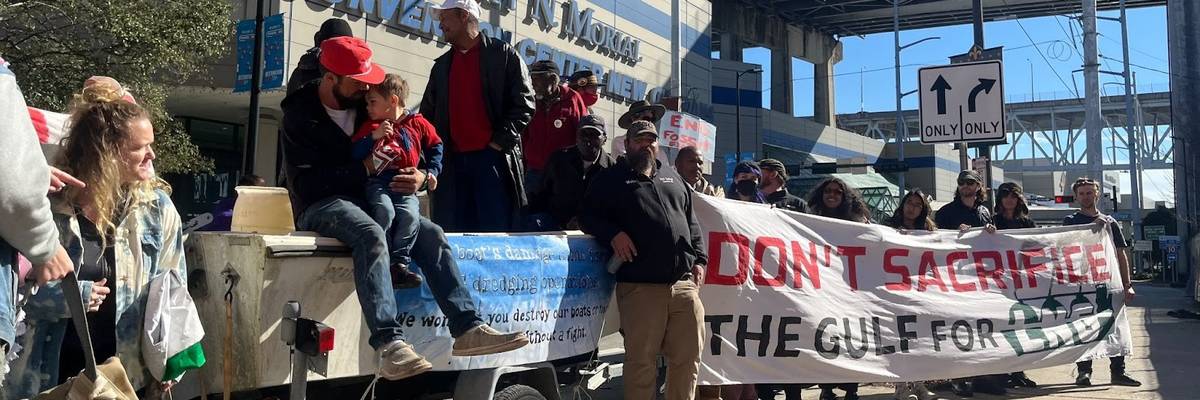
Frontline fishers and environmental activists protest the buildout of liquefied natural gas export infrastructure in Louisiana outside a meeting of Americas Energy Summit in New Orleans on January 19, 2023.
Now is the time to make our voices heard before the haze, smog, and soot choke the sky for good and while there is still time remaining for the Biden administration to reject the many LNG export applications in the queue.
No one likes bad air days. Days when the air smells wrong; the sky is choked with haze, smog, soot; and the weather report has to invent new shades of purple to warn us to stay inside. But what people might not know is that bad air is literally killing us and making us less healthy.
And the build out of liquefied “natural” gas (LNG) export terminals along the Texas and Louisiana coast is making it worse.
A large percentage of U.S. “natural” gas production, which is just fracked methane gas, isn’t used here at home, but now gets shipped directly overseas. The terminals where this gas is turned into a liquid and loaded onto massive tankers emit all sorts of harmful air pollution. These facilities have a permit to pollute, but a recent report shows that just because the government signs off on something doesn’t mean it won’t kill you.
Maybe the most frustrating part of this whole story is that Texas and Louisiana taxpayers are footing the bill for all this suffering.
Seven of the currently operating LNG export terminals are estimated to cause 60 premature deaths every year due to flaring and other emissions. And there are many, many more such terminals in the planning stages looking to become operational within the decade, potentially upping that number to almost 150 premature deaths per year. The “soot” and “smog” that form from the resulting particulate matter and ozone also cause a range of other health problems, including asthma, and lead to people having to miss school and work, and cost us health impacts worth billions of dollars.
These LNG terminals plan to operate for decades to come, and if you add up the health impacts over time it amounts to over 4,000 deaths by 2050. The coastal communities that live in the shadow of these massive facilities face the highest per capita health impacts, but particulate matter and ozone don’t stay confined near their source. They are regional pollutants that can travel hundreds of miles and still cause harm.
As we speak, Harris County, Texas, home to Houston; and Calcasieu Parish, Louisiana are estimated to suffer the most deaths due to LNG terminal air pollution. Dallas County is No. 3, even though it is 250 miles from the nearest LNG terminal.
This report only looks at LNG terminals, but the dirty secret is that many places in Texas and Louisiana are already over-polluted. Oil refineries, petrochemical plants, coal plants, and more are already contributing to air pollution and health harms in the region. This frenzy to export methane gas is only pouring new pollution on top of old.
In Southwest Louisiana, decades of toxic emissions from refineries and petrochemical plants have polluted the air and contaminated the upper Calcasieu River, leading to a seafood advisory, limiting the amount of fish locals can eat. LNG export facilities have expanded this industrial air pollution to communities that had never faced these issues before. Now, residents frequently hear warning alarms and witness massive flares spewing black smoke into the sky. Many in the community report symptoms such as frequent headaches and worsening respiratory problems, clear signs of the harmful impact this pollution is having on their health.
For generations, fishermen in Cameron Parish, Louisiana have depended on the bounty of the estuaries and wetlands, providing for their families and communities. These waters were once an integral part of the local culture and economy, passed down from father to son. After rebuilding through storm after storm, these same families now face a new challenge—being displaced by a multi-billion-dollar industry that not only pollutes their environment but jeopardizes their ability to sustain themselves from it. The risks that coastal communities face like coastal erosion and extreme weather are worsened by the climate crisis, which the LNG industry ironically helps fuel.
Maybe the most frustrating part of this whole story is that Texas and Louisiana taxpayers are footing the bill for all this suffering. Another report from late last year showed how several of these LNG companies have received tax handouts in the billions of dollars, taking money away from needed resources like health and safety services. All this on the promise of good paying jobs to local folks that never materialize. And what’s more, every tanker of LNG that gets shipped overseas raises energy prices here at home.
Talk about a raw deal.
But after nearly a decade of rubber stamping these terminals, the federal government just took a closer look.The U.S. Department of Energy, who authorizes LNG for export, just updated its studies used to determine whether LNG exports actually serve the public interest. The studies conclude that LNG exports raise energy prices, inflame climate change, sabotage the clean energy transition, and cause harm to our local communities.
The incoming presidential administration may try to ignore the evidence. To expect them to choose what’s right for Texas and Louisiana—let’s just say, unfortunately, we won’t be holding our breath.
Now is the time to make our voices heard before the haze, smog, and soot choke the sky for good and while there are still a few days remaining that the Biden administration can reject the many LNG export applications in the queue. We all need to act now to protect the air in Louisiana and Texas, and everyone from the worst of the climate crisis.
Dear Common Dreams reader, It’s been nearly 30 years since I co-founded Common Dreams with my late wife, Lina Newhouser. We had the radical notion that journalism should serve the public good, not corporate profits. It was clear to us from the outset what it would take to build such a project. No paid advertisements. No corporate sponsors. No millionaire publisher telling us what to think or do. Many people said we wouldn't last a year, but we proved those doubters wrong. Together with a tremendous team of journalists and dedicated staff, we built an independent media outlet free from the constraints of profits and corporate control. Our mission has always been simple: To inform. To inspire. To ignite change for the common good. Building Common Dreams was not easy. Our survival was never guaranteed. When you take on the most powerful forces—Wall Street greed, fossil fuel industry destruction, Big Tech lobbyists, and uber-rich oligarchs who have spent billions upon billions rigging the economy and democracy in their favor—the only bulwark you have is supporters who believe in your work. But here’s the urgent message from me today. It's never been this bad out there. And it's never been this hard to keep us going. At the very moment Common Dreams is most needed, the threats we face are intensifying. We need your support now more than ever. We don't accept corporate advertising and never will. We don't have a paywall because we don't think people should be blocked from critical news based on their ability to pay. Everything we do is funded by the donations of readers like you. When everyone does the little they can afford, we are strong. But if that support retreats or dries up, so do we. Will you donate now to make sure Common Dreams not only survives but thrives? —Craig Brown, Co-founder |
No one likes bad air days. Days when the air smells wrong; the sky is choked with haze, smog, soot; and the weather report has to invent new shades of purple to warn us to stay inside. But what people might not know is that bad air is literally killing us and making us less healthy.
And the build out of liquefied “natural” gas (LNG) export terminals along the Texas and Louisiana coast is making it worse.
A large percentage of U.S. “natural” gas production, which is just fracked methane gas, isn’t used here at home, but now gets shipped directly overseas. The terminals where this gas is turned into a liquid and loaded onto massive tankers emit all sorts of harmful air pollution. These facilities have a permit to pollute, but a recent report shows that just because the government signs off on something doesn’t mean it won’t kill you.
Maybe the most frustrating part of this whole story is that Texas and Louisiana taxpayers are footing the bill for all this suffering.
Seven of the currently operating LNG export terminals are estimated to cause 60 premature deaths every year due to flaring and other emissions. And there are many, many more such terminals in the planning stages looking to become operational within the decade, potentially upping that number to almost 150 premature deaths per year. The “soot” and “smog” that form from the resulting particulate matter and ozone also cause a range of other health problems, including asthma, and lead to people having to miss school and work, and cost us health impacts worth billions of dollars.
These LNG terminals plan to operate for decades to come, and if you add up the health impacts over time it amounts to over 4,000 deaths by 2050. The coastal communities that live in the shadow of these massive facilities face the highest per capita health impacts, but particulate matter and ozone don’t stay confined near their source. They are regional pollutants that can travel hundreds of miles and still cause harm.
As we speak, Harris County, Texas, home to Houston; and Calcasieu Parish, Louisiana are estimated to suffer the most deaths due to LNG terminal air pollution. Dallas County is No. 3, even though it is 250 miles from the nearest LNG terminal.
This report only looks at LNG terminals, but the dirty secret is that many places in Texas and Louisiana are already over-polluted. Oil refineries, petrochemical plants, coal plants, and more are already contributing to air pollution and health harms in the region. This frenzy to export methane gas is only pouring new pollution on top of old.
In Southwest Louisiana, decades of toxic emissions from refineries and petrochemical plants have polluted the air and contaminated the upper Calcasieu River, leading to a seafood advisory, limiting the amount of fish locals can eat. LNG export facilities have expanded this industrial air pollution to communities that had never faced these issues before. Now, residents frequently hear warning alarms and witness massive flares spewing black smoke into the sky. Many in the community report symptoms such as frequent headaches and worsening respiratory problems, clear signs of the harmful impact this pollution is having on their health.
For generations, fishermen in Cameron Parish, Louisiana have depended on the bounty of the estuaries and wetlands, providing for their families and communities. These waters were once an integral part of the local culture and economy, passed down from father to son. After rebuilding through storm after storm, these same families now face a new challenge—being displaced by a multi-billion-dollar industry that not only pollutes their environment but jeopardizes their ability to sustain themselves from it. The risks that coastal communities face like coastal erosion and extreme weather are worsened by the climate crisis, which the LNG industry ironically helps fuel.
Maybe the most frustrating part of this whole story is that Texas and Louisiana taxpayers are footing the bill for all this suffering. Another report from late last year showed how several of these LNG companies have received tax handouts in the billions of dollars, taking money away from needed resources like health and safety services. All this on the promise of good paying jobs to local folks that never materialize. And what’s more, every tanker of LNG that gets shipped overseas raises energy prices here at home.
Talk about a raw deal.
But after nearly a decade of rubber stamping these terminals, the federal government just took a closer look.The U.S. Department of Energy, who authorizes LNG for export, just updated its studies used to determine whether LNG exports actually serve the public interest. The studies conclude that LNG exports raise energy prices, inflame climate change, sabotage the clean energy transition, and cause harm to our local communities.
The incoming presidential administration may try to ignore the evidence. To expect them to choose what’s right for Texas and Louisiana—let’s just say, unfortunately, we won’t be holding our breath.
Now is the time to make our voices heard before the haze, smog, and soot choke the sky for good and while there are still a few days remaining that the Biden administration can reject the many LNG export applications in the queue. We all need to act now to protect the air in Louisiana and Texas, and everyone from the worst of the climate crisis.
No one likes bad air days. Days when the air smells wrong; the sky is choked with haze, smog, soot; and the weather report has to invent new shades of purple to warn us to stay inside. But what people might not know is that bad air is literally killing us and making us less healthy.
And the build out of liquefied “natural” gas (LNG) export terminals along the Texas and Louisiana coast is making it worse.
A large percentage of U.S. “natural” gas production, which is just fracked methane gas, isn’t used here at home, but now gets shipped directly overseas. The terminals where this gas is turned into a liquid and loaded onto massive tankers emit all sorts of harmful air pollution. These facilities have a permit to pollute, but a recent report shows that just because the government signs off on something doesn’t mean it won’t kill you.
Maybe the most frustrating part of this whole story is that Texas and Louisiana taxpayers are footing the bill for all this suffering.
Seven of the currently operating LNG export terminals are estimated to cause 60 premature deaths every year due to flaring and other emissions. And there are many, many more such terminals in the planning stages looking to become operational within the decade, potentially upping that number to almost 150 premature deaths per year. The “soot” and “smog” that form from the resulting particulate matter and ozone also cause a range of other health problems, including asthma, and lead to people having to miss school and work, and cost us health impacts worth billions of dollars.
These LNG terminals plan to operate for decades to come, and if you add up the health impacts over time it amounts to over 4,000 deaths by 2050. The coastal communities that live in the shadow of these massive facilities face the highest per capita health impacts, but particulate matter and ozone don’t stay confined near their source. They are regional pollutants that can travel hundreds of miles and still cause harm.
As we speak, Harris County, Texas, home to Houston; and Calcasieu Parish, Louisiana are estimated to suffer the most deaths due to LNG terminal air pollution. Dallas County is No. 3, even though it is 250 miles from the nearest LNG terminal.
This report only looks at LNG terminals, but the dirty secret is that many places in Texas and Louisiana are already over-polluted. Oil refineries, petrochemical plants, coal plants, and more are already contributing to air pollution and health harms in the region. This frenzy to export methane gas is only pouring new pollution on top of old.
In Southwest Louisiana, decades of toxic emissions from refineries and petrochemical plants have polluted the air and contaminated the upper Calcasieu River, leading to a seafood advisory, limiting the amount of fish locals can eat. LNG export facilities have expanded this industrial air pollution to communities that had never faced these issues before. Now, residents frequently hear warning alarms and witness massive flares spewing black smoke into the sky. Many in the community report symptoms such as frequent headaches and worsening respiratory problems, clear signs of the harmful impact this pollution is having on their health.
For generations, fishermen in Cameron Parish, Louisiana have depended on the bounty of the estuaries and wetlands, providing for their families and communities. These waters were once an integral part of the local culture and economy, passed down from father to son. After rebuilding through storm after storm, these same families now face a new challenge—being displaced by a multi-billion-dollar industry that not only pollutes their environment but jeopardizes their ability to sustain themselves from it. The risks that coastal communities face like coastal erosion and extreme weather are worsened by the climate crisis, which the LNG industry ironically helps fuel.
Maybe the most frustrating part of this whole story is that Texas and Louisiana taxpayers are footing the bill for all this suffering. Another report from late last year showed how several of these LNG companies have received tax handouts in the billions of dollars, taking money away from needed resources like health and safety services. All this on the promise of good paying jobs to local folks that never materialize. And what’s more, every tanker of LNG that gets shipped overseas raises energy prices here at home.
Talk about a raw deal.
But after nearly a decade of rubber stamping these terminals, the federal government just took a closer look.The U.S. Department of Energy, who authorizes LNG for export, just updated its studies used to determine whether LNG exports actually serve the public interest. The studies conclude that LNG exports raise energy prices, inflame climate change, sabotage the clean energy transition, and cause harm to our local communities.
The incoming presidential administration may try to ignore the evidence. To expect them to choose what’s right for Texas and Louisiana—let’s just say, unfortunately, we won’t be holding our breath.
Now is the time to make our voices heard before the haze, smog, and soot choke the sky for good and while there are still a few days remaining that the Biden administration can reject the many LNG export applications in the queue. We all need to act now to protect the air in Louisiana and Texas, and everyone from the worst of the climate crisis.