SUBSCRIBE TO OUR FREE NEWSLETTER
Daily news & progressive opinion—funded by the people, not the corporations—delivered straight to your inbox.
5
#000000
#FFFFFF
To donate by check, phone, or other method, see our More Ways to Give page.
Daily news & progressive opinion—funded by the people, not the corporations—delivered straight to your inbox.
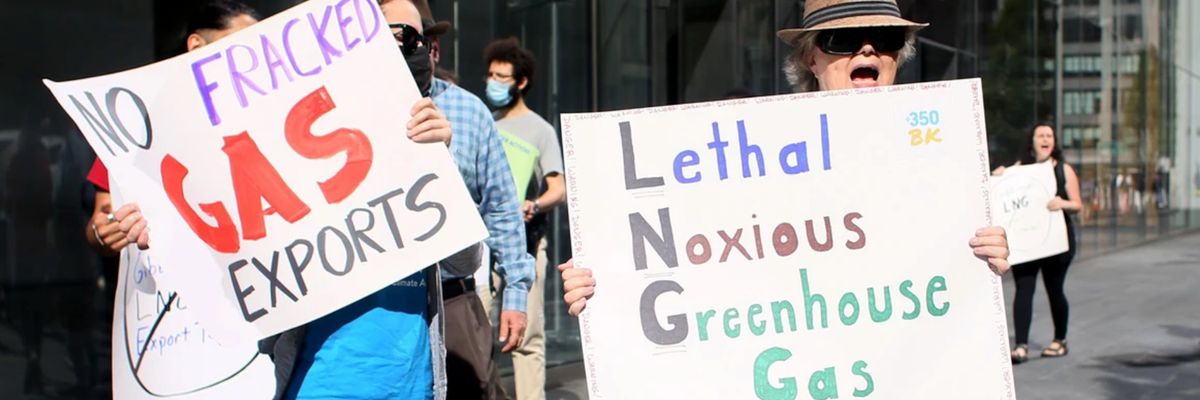
Two demonstrators hold up signs protesting the export of liquefied natural gas in this undated photo.
"The bizarre rush to overbuild methane gas export capacity is not only a climate and an economic mistake—it is also a public health disaster," said the report's co-author.
Permitted emissions from both currently operating and planned liquefied natural gas terminals in the United States "have a major price tag for communities' public health," with existing facilities already estimated to cause scores of premature deaths and nearly a billion dollars in damage each year, according to an analysis published Wednesday.
The report— Permit to Kill—was published by Greenpeace USA and the Sierra Club, which said the analysis "adds to the mounting body of evidence showing that LNG exports are not in the public interest."
Greenpeace USA senior research specialist and report co-author Andres Chang said in a statement that "this study shows that any discussion of LNG exports that ignores the deadly air pollution from LNG terminals is missing the boat."
"The bizarre rush to overbuild methane gas export capacity is not only a climate and an economic mistake—it is also a public health disaster," Chang added. "Our research shows that air pollution from continuing the LNG buildout would hit fenceline communities the hardest, but would also be carried downwind to further away cities like Dallas and New Orleans, causing childhood asthma onset, lost work and school days, and premature death."
Among the report's key findings:
"This briefing provides a new compelling and distressing data point in the long list of reasons to stop approving LNG export applications," said Sierra Club energy campaigns analyst and report co-author Johanna Heureaux-Torres. "It is shocking that regulators do not already consider deadly pollution impacts in their environmental analyses of gas export projects and related infrastructure."
"DOE and other federal agencies should listen to the science and frontline communities, and develop more robust controls on the cumulative impacts of air pollution from these high-polluting projects," Heureaux-Torres added. "The health of communities and the climate depends on the folks in charge to stand up and do the right thing based on the facts of the situation on the ground."
Climate defenders applauded U.S. President Joe Biden's January pause on LNG export permit applications pending a review of their environmental and economic impacts.
However, the Biden administration has also presided over what climate campaigners have called a "staggering" LNG expansion, including Venture Global's Calcasieu Pass 2 export terminal in Cameron Parish, Louisiana and more than a dozen other projects that, if all completed, would make U.S. exported LNG emissions higher than all of Europe's combined greenhouse gas footprint, according to climate campaigner Bill McKibben.
"It's time for DOE to stop using permitted emissions from operating and planned LNG export terminals as a license to pollute our most vulnerable people and places."
Numerous other studies have highlighted the public health harms of LNG, including a 2023 study by the University of Pittsburgh and the Pennsylvania Department of Health that found children who live near fracking operations are roughly five to seven times more likely to develop lymphoma than those whose homes are at least five miles away from drilling sites.
"The Permit to Kill report underscores what residents in frontline communities have been saying for decades—it's time for DOE to stop using permitted emissions from operating and planned LNG export terminals as a license to pollute our most vulnerable people and places," said Robert D. Bullard, director of the Bullard Center for Environmental and Climate Justice and distinguished professor of urban planning and environmental policy at Texas Southern University.
"DOE now has the opportunity and moral responsibility to correct its flawed approach, methodology, thinking, and assumptions that follow the dominant pattern and allow Black, Hispanic, and low-income residents to be overburdened with health-threatening air pollution," he added. "Our communities matter."
Dear Common Dreams reader, It’s been nearly 30 years since I co-founded Common Dreams with my late wife, Lina Newhouser. We had the radical notion that journalism should serve the public good, not corporate profits. It was clear to us from the outset what it would take to build such a project. No paid advertisements. No corporate sponsors. No millionaire publisher telling us what to think or do. Many people said we wouldn't last a year, but we proved those doubters wrong. Together with a tremendous team of journalists and dedicated staff, we built an independent media outlet free from the constraints of profits and corporate control. Our mission has always been simple: To inform. To inspire. To ignite change for the common good. Building Common Dreams was not easy. Our survival was never guaranteed. When you take on the most powerful forces—Wall Street greed, fossil fuel industry destruction, Big Tech lobbyists, and uber-rich oligarchs who have spent billions upon billions rigging the economy and democracy in their favor—the only bulwark you have is supporters who believe in your work. But here’s the urgent message from me today. It's never been this bad out there. And it's never been this hard to keep us going. At the very moment Common Dreams is most needed, the threats we face are intensifying. We need your support now more than ever. We don't accept corporate advertising and never will. We don't have a paywall because we don't think people should be blocked from critical news based on their ability to pay. Everything we do is funded by the donations of readers like you. When everyone does the little they can afford, we are strong. But if that support retreats or dries up, so do we. Will you donate now to make sure Common Dreams not only survives but thrives? —Craig Brown, Co-founder |
Permitted emissions from both currently operating and planned liquefied natural gas terminals in the United States "have a major price tag for communities' public health," with existing facilities already estimated to cause scores of premature deaths and nearly a billion dollars in damage each year, according to an analysis published Wednesday.
The report— Permit to Kill—was published by Greenpeace USA and the Sierra Club, which said the analysis "adds to the mounting body of evidence showing that LNG exports are not in the public interest."
Greenpeace USA senior research specialist and report co-author Andres Chang said in a statement that "this study shows that any discussion of LNG exports that ignores the deadly air pollution from LNG terminals is missing the boat."
"The bizarre rush to overbuild methane gas export capacity is not only a climate and an economic mistake—it is also a public health disaster," Chang added. "Our research shows that air pollution from continuing the LNG buildout would hit fenceline communities the hardest, but would also be carried downwind to further away cities like Dallas and New Orleans, causing childhood asthma onset, lost work and school days, and premature death."
Among the report's key findings:
"This briefing provides a new compelling and distressing data point in the long list of reasons to stop approving LNG export applications," said Sierra Club energy campaigns analyst and report co-author Johanna Heureaux-Torres. "It is shocking that regulators do not already consider deadly pollution impacts in their environmental analyses of gas export projects and related infrastructure."
"DOE and other federal agencies should listen to the science and frontline communities, and develop more robust controls on the cumulative impacts of air pollution from these high-polluting projects," Heureaux-Torres added. "The health of communities and the climate depends on the folks in charge to stand up and do the right thing based on the facts of the situation on the ground."
Climate defenders applauded U.S. President Joe Biden's January pause on LNG export permit applications pending a review of their environmental and economic impacts.
However, the Biden administration has also presided over what climate campaigners have called a "staggering" LNG expansion, including Venture Global's Calcasieu Pass 2 export terminal in Cameron Parish, Louisiana and more than a dozen other projects that, if all completed, would make U.S. exported LNG emissions higher than all of Europe's combined greenhouse gas footprint, according to climate campaigner Bill McKibben.
"It's time for DOE to stop using permitted emissions from operating and planned LNG export terminals as a license to pollute our most vulnerable people and places."
Numerous other studies have highlighted the public health harms of LNG, including a 2023 study by the University of Pittsburgh and the Pennsylvania Department of Health that found children who live near fracking operations are roughly five to seven times more likely to develop lymphoma than those whose homes are at least five miles away from drilling sites.
"The Permit to Kill report underscores what residents in frontline communities have been saying for decades—it's time for DOE to stop using permitted emissions from operating and planned LNG export terminals as a license to pollute our most vulnerable people and places," said Robert D. Bullard, director of the Bullard Center for Environmental and Climate Justice and distinguished professor of urban planning and environmental policy at Texas Southern University.
"DOE now has the opportunity and moral responsibility to correct its flawed approach, methodology, thinking, and assumptions that follow the dominant pattern and allow Black, Hispanic, and low-income residents to be overburdened with health-threatening air pollution," he added. "Our communities matter."
Permitted emissions from both currently operating and planned liquefied natural gas terminals in the United States "have a major price tag for communities' public health," with existing facilities already estimated to cause scores of premature deaths and nearly a billion dollars in damage each year, according to an analysis published Wednesday.
The report— Permit to Kill—was published by Greenpeace USA and the Sierra Club, which said the analysis "adds to the mounting body of evidence showing that LNG exports are not in the public interest."
Greenpeace USA senior research specialist and report co-author Andres Chang said in a statement that "this study shows that any discussion of LNG exports that ignores the deadly air pollution from LNG terminals is missing the boat."
"The bizarre rush to overbuild methane gas export capacity is not only a climate and an economic mistake—it is also a public health disaster," Chang added. "Our research shows that air pollution from continuing the LNG buildout would hit fenceline communities the hardest, but would also be carried downwind to further away cities like Dallas and New Orleans, causing childhood asthma onset, lost work and school days, and premature death."
Among the report's key findings:
"This briefing provides a new compelling and distressing data point in the long list of reasons to stop approving LNG export applications," said Sierra Club energy campaigns analyst and report co-author Johanna Heureaux-Torres. "It is shocking that regulators do not already consider deadly pollution impacts in their environmental analyses of gas export projects and related infrastructure."
"DOE and other federal agencies should listen to the science and frontline communities, and develop more robust controls on the cumulative impacts of air pollution from these high-polluting projects," Heureaux-Torres added. "The health of communities and the climate depends on the folks in charge to stand up and do the right thing based on the facts of the situation on the ground."
Climate defenders applauded U.S. President Joe Biden's January pause on LNG export permit applications pending a review of their environmental and economic impacts.
However, the Biden administration has also presided over what climate campaigners have called a "staggering" LNG expansion, including Venture Global's Calcasieu Pass 2 export terminal in Cameron Parish, Louisiana and more than a dozen other projects that, if all completed, would make U.S. exported LNG emissions higher than all of Europe's combined greenhouse gas footprint, according to climate campaigner Bill McKibben.
"It's time for DOE to stop using permitted emissions from operating and planned LNG export terminals as a license to pollute our most vulnerable people and places."
Numerous other studies have highlighted the public health harms of LNG, including a 2023 study by the University of Pittsburgh and the Pennsylvania Department of Health that found children who live near fracking operations are roughly five to seven times more likely to develop lymphoma than those whose homes are at least five miles away from drilling sites.
"The Permit to Kill report underscores what residents in frontline communities have been saying for decades—it's time for DOE to stop using permitted emissions from operating and planned LNG export terminals as a license to pollute our most vulnerable people and places," said Robert D. Bullard, director of the Bullard Center for Environmental and Climate Justice and distinguished professor of urban planning and environmental policy at Texas Southern University.
"DOE now has the opportunity and moral responsibility to correct its flawed approach, methodology, thinking, and assumptions that follow the dominant pattern and allow Black, Hispanic, and low-income residents to be overburdened with health-threatening air pollution," he added. "Our communities matter."