SUBSCRIBE TO OUR FREE NEWSLETTER
Daily news & progressive opinion—funded by the people, not the corporations—delivered straight to your inbox.
5
#000000
#FFFFFF
To donate by check, phone, or other method, see our More Ways to Give page.
Daily news & progressive opinion—funded by the people, not the corporations—delivered straight to your inbox.
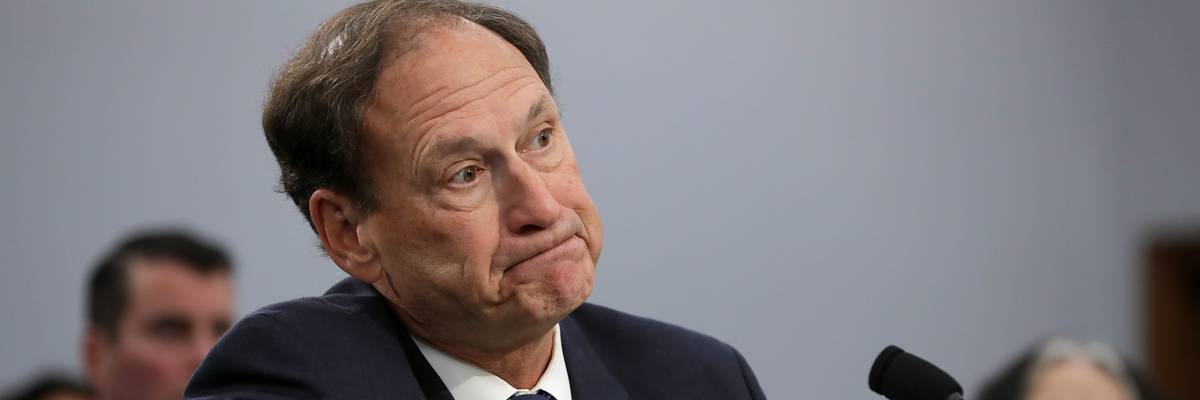
US Supreme Court Associate Justice Samuel Alito testifies about the court's budget during a hearing of the House Appropriations Committee's Financial Services and General Government Subcommittee on March 7, 2019 in Washington, DC.
In majority opinions gutting abortion rights and voting rights, Supreme Court Justice Samuel Alito made crucial errors.
Justice Samuel Alito wrote the conservative majority’s opinions in two of the most consequential Supreme Court decisions in recent years: 1) Dobbs v. Jackson Women’s Health Organization—overruling Roe v. Wade; and 2) Louisiana v. Callais—neutering the Voting Rights Act of 1965. In both cases, Alito recited and relied on asserted “facts” that did not exist.
Ohio State University Prof. Treva Lindsey observed, ”From the nation’s founding through the early 1800s, pre-quickening abortions—that is, abortions before a pregnant person feels fetal movement—were fairly common and even advertised.“
But Alito claimed incorrectly in Dobbs that “no common-law case or authority... remotely suggests a positive right to procure an abortion at any stage of pregnancy” and, in the United States specifically, “an unbroken tradition of prohibiting abortion on pain of criminal punishment persisted from the earliest days of the common law until 1973.”
Writing for the three dissenters, Justice Elena Kagan called Alito “embarrassingly” wrong. There was no such “unbroken tradition,” and historical evidence undermined his claim. But the conservative majority got its desired outcome.
In 2013, Chief Justice John Roberts and the conservative majority began undermining the Voting Rights Act in the Shelby County case. Prior to that decision, states and localities with a history of racial discrimination in voting had to obtain federal approval before making changes to election rules—a process known as preclearance. The state or locality had to prove that any changes would not disadvantage racial and ethnic minorities.
Rewrite history; distort reality; make up facts; overturn longstanding precedent. For Justice Alito—with an occasional assist from Chief Justice Roberts—it’s all in a day’s work.
Roberts argued that the elections of 2008 and 2012—when there was no difference in voter participation rates between Black and white voters (i.e., no “turnout gap”)—meant that the Voting Rights Act had done its job and preclearance could be suspended.
Even at the time, Roberts’ reasoning was suspect. The elections of 2008 and 2012 were anomalies—not the end of the turnout gap—because Barack Obama’s candidacy had driven up Black turnout.
In her dissent, Justice Ruth Bader Ginsburg noted another flaw in Roberts’ logic: “Throwing out preclearance when it has worked and is continuing to work to stop discriminatory changes is like throwing away your umbrella in a rainstorm because you are not getting wet.”
Justice Ginsburg was correct, and now democracy is getting wet. A 2024 study concluded:
The formerly covered states [subject to preclearance] have large nonwhite populations and large turnout gaps, leading to some of the largest statewide turnout distortions in the nation. Put differently, a decade after Shelby County, the turnout gap continues to have a disproportionate impact in precisely the parts of the country that were once covered due to their histories of racially discriminatory voting practices.
Stated simply, “[S]ince 2013, the racial turnout gap around the nation has exploded.”
Justice Alito ignored the exploding turnout gap in striking the fatal blow to the Voting Rights Act on April 29, 2026. For decades previously, the court had ruled repeatedly that a state could not undermine minority voters’ power to choose their desired candidates by drawing legislative districts that dispersed such voters across majority-white districts. Instead, states had to create “majority-minority” districts, thereby assuring minority representation in statehouses and Congress.
In its amicus brief to the court in the Callais case, the Department of Justice (DOJ) ignored the trend after 2013 and argued that majority-minority districts were no longer necessary because “the racial gap in voter registration and turnout had largely disappeared, with minorities registering and voting at levels that sometimes surpassed the majority. Shelby County, 570 U.S. at 547-548.” To emphasize the point, the DOJ observed, “Since 2004, black voters have turned out at higher rates than white voters in two of five presidential elections nationwide and in Louisiana.”
Armed with the Callais decision, Republicans are now racing to eliminate majority-Black districts throughout the country.
Alito parroted the DOJ’s sophistry: “Black voters now participate in elections at similar rates as the rest of the electorate, even turning out at higher rates than white voters in two of the five most recent Presidential elections nationwide and in Louisiana.”
As election experts have observed, Alito’s claim that Black and white turnout reached parity in 2 of the 5 most recent presidential elections “represents egregious cherry-picking. [H]e was not referring to recent elections, but to those in 2008 and 2012—the years that Barack Obama ran for president. In the three most recent presidential elections, the trend shows exactly the opposite. The indisputable fact is the racial turnout gap is widening, and the Roberts Court is partially responsible [because of its Shelby County decision].”
Armed with the Callais decision, Republicans are now racing to eliminate majority-Black districts throughout the country.
Rewrite history; distort reality; make up facts; overturn longstanding precedent. For Justice Alito—with an occasional assist from Chief Justice Roberts—it’s all in a day’s work.
Dear Common Dreams reader, It’s been nearly 30 years since I co-founded Common Dreams with my late wife, Lina Newhouser. We had the radical notion that journalism should serve the public good, not corporate profits. It was clear to us from the outset what it would take to build such a project. No paid advertisements. No corporate sponsors. No millionaire publisher telling us what to think or do. Many people said we wouldn't last a year, but we proved those doubters wrong. Together with a tremendous team of journalists and dedicated staff, we built an independent media outlet free from the constraints of profits and corporate control. Our mission has always been simple: To inform. To inspire. To ignite change for the common good. Building Common Dreams was not easy. Our survival was never guaranteed. When you take on the most powerful forces—Wall Street greed, fossil fuel industry destruction, Big Tech lobbyists, and uber-rich oligarchs who have spent billions upon billions rigging the economy and democracy in their favor—the only bulwark you have is supporters who believe in your work. But here’s the urgent message from me today. It's never been this bad out there. And it's never been this hard to keep us going. At the very moment Common Dreams is most needed, the threats we face are intensifying. We need your support now more than ever. We don't accept corporate advertising and never will. We don't have a paywall because we don't think people should be blocked from critical news based on their ability to pay. Everything we do is funded by the donations of readers like you. When everyone does the little they can afford, we are strong. But if that support retreats or dries up, so do we. Will you donate now to make sure Common Dreams not only survives but thrives? —Craig Brown, Co-founder |
Justice Samuel Alito wrote the conservative majority’s opinions in two of the most consequential Supreme Court decisions in recent years: 1) Dobbs v. Jackson Women’s Health Organization—overruling Roe v. Wade; and 2) Louisiana v. Callais—neutering the Voting Rights Act of 1965. In both cases, Alito recited and relied on asserted “facts” that did not exist.
Ohio State University Prof. Treva Lindsey observed, ”From the nation’s founding through the early 1800s, pre-quickening abortions—that is, abortions before a pregnant person feels fetal movement—were fairly common and even advertised.“
But Alito claimed incorrectly in Dobbs that “no common-law case or authority... remotely suggests a positive right to procure an abortion at any stage of pregnancy” and, in the United States specifically, “an unbroken tradition of prohibiting abortion on pain of criminal punishment persisted from the earliest days of the common law until 1973.”
Writing for the three dissenters, Justice Elena Kagan called Alito “embarrassingly” wrong. There was no such “unbroken tradition,” and historical evidence undermined his claim. But the conservative majority got its desired outcome.
In 2013, Chief Justice John Roberts and the conservative majority began undermining the Voting Rights Act in the Shelby County case. Prior to that decision, states and localities with a history of racial discrimination in voting had to obtain federal approval before making changes to election rules—a process known as preclearance. The state or locality had to prove that any changes would not disadvantage racial and ethnic minorities.
Rewrite history; distort reality; make up facts; overturn longstanding precedent. For Justice Alito—with an occasional assist from Chief Justice Roberts—it’s all in a day’s work.
Roberts argued that the elections of 2008 and 2012—when there was no difference in voter participation rates between Black and white voters (i.e., no “turnout gap”)—meant that the Voting Rights Act had done its job and preclearance could be suspended.
Even at the time, Roberts’ reasoning was suspect. The elections of 2008 and 2012 were anomalies—not the end of the turnout gap—because Barack Obama’s candidacy had driven up Black turnout.
In her dissent, Justice Ruth Bader Ginsburg noted another flaw in Roberts’ logic: “Throwing out preclearance when it has worked and is continuing to work to stop discriminatory changes is like throwing away your umbrella in a rainstorm because you are not getting wet.”
Justice Ginsburg was correct, and now democracy is getting wet. A 2024 study concluded:
The formerly covered states [subject to preclearance] have large nonwhite populations and large turnout gaps, leading to some of the largest statewide turnout distortions in the nation. Put differently, a decade after Shelby County, the turnout gap continues to have a disproportionate impact in precisely the parts of the country that were once covered due to their histories of racially discriminatory voting practices.
Stated simply, “[S]ince 2013, the racial turnout gap around the nation has exploded.”
Justice Alito ignored the exploding turnout gap in striking the fatal blow to the Voting Rights Act on April 29, 2026. For decades previously, the court had ruled repeatedly that a state could not undermine minority voters’ power to choose their desired candidates by drawing legislative districts that dispersed such voters across majority-white districts. Instead, states had to create “majority-minority” districts, thereby assuring minority representation in statehouses and Congress.
In its amicus brief to the court in the Callais case, the Department of Justice (DOJ) ignored the trend after 2013 and argued that majority-minority districts were no longer necessary because “the racial gap in voter registration and turnout had largely disappeared, with minorities registering and voting at levels that sometimes surpassed the majority. Shelby County, 570 U.S. at 547-548.” To emphasize the point, the DOJ observed, “Since 2004, black voters have turned out at higher rates than white voters in two of five presidential elections nationwide and in Louisiana.”
Armed with the Callais decision, Republicans are now racing to eliminate majority-Black districts throughout the country.
Alito parroted the DOJ’s sophistry: “Black voters now participate in elections at similar rates as the rest of the electorate, even turning out at higher rates than white voters in two of the five most recent Presidential elections nationwide and in Louisiana.”
As election experts have observed, Alito’s claim that Black and white turnout reached parity in 2 of the 5 most recent presidential elections “represents egregious cherry-picking. [H]e was not referring to recent elections, but to those in 2008 and 2012—the years that Barack Obama ran for president. In the three most recent presidential elections, the trend shows exactly the opposite. The indisputable fact is the racial turnout gap is widening, and the Roberts Court is partially responsible [because of its Shelby County decision].”
Armed with the Callais decision, Republicans are now racing to eliminate majority-Black districts throughout the country.
Rewrite history; distort reality; make up facts; overturn longstanding precedent. For Justice Alito—with an occasional assist from Chief Justice Roberts—it’s all in a day’s work.
Justice Samuel Alito wrote the conservative majority’s opinions in two of the most consequential Supreme Court decisions in recent years: 1) Dobbs v. Jackson Women’s Health Organization—overruling Roe v. Wade; and 2) Louisiana v. Callais—neutering the Voting Rights Act of 1965. In both cases, Alito recited and relied on asserted “facts” that did not exist.
Ohio State University Prof. Treva Lindsey observed, ”From the nation’s founding through the early 1800s, pre-quickening abortions—that is, abortions before a pregnant person feels fetal movement—were fairly common and even advertised.“
But Alito claimed incorrectly in Dobbs that “no common-law case or authority... remotely suggests a positive right to procure an abortion at any stage of pregnancy” and, in the United States specifically, “an unbroken tradition of prohibiting abortion on pain of criminal punishment persisted from the earliest days of the common law until 1973.”
Writing for the three dissenters, Justice Elena Kagan called Alito “embarrassingly” wrong. There was no such “unbroken tradition,” and historical evidence undermined his claim. But the conservative majority got its desired outcome.
In 2013, Chief Justice John Roberts and the conservative majority began undermining the Voting Rights Act in the Shelby County case. Prior to that decision, states and localities with a history of racial discrimination in voting had to obtain federal approval before making changes to election rules—a process known as preclearance. The state or locality had to prove that any changes would not disadvantage racial and ethnic minorities.
Rewrite history; distort reality; make up facts; overturn longstanding precedent. For Justice Alito—with an occasional assist from Chief Justice Roberts—it’s all in a day’s work.
Roberts argued that the elections of 2008 and 2012—when there was no difference in voter participation rates between Black and white voters (i.e., no “turnout gap”)—meant that the Voting Rights Act had done its job and preclearance could be suspended.
Even at the time, Roberts’ reasoning was suspect. The elections of 2008 and 2012 were anomalies—not the end of the turnout gap—because Barack Obama’s candidacy had driven up Black turnout.
In her dissent, Justice Ruth Bader Ginsburg noted another flaw in Roberts’ logic: “Throwing out preclearance when it has worked and is continuing to work to stop discriminatory changes is like throwing away your umbrella in a rainstorm because you are not getting wet.”
Justice Ginsburg was correct, and now democracy is getting wet. A 2024 study concluded:
The formerly covered states [subject to preclearance] have large nonwhite populations and large turnout gaps, leading to some of the largest statewide turnout distortions in the nation. Put differently, a decade after Shelby County, the turnout gap continues to have a disproportionate impact in precisely the parts of the country that were once covered due to their histories of racially discriminatory voting practices.
Stated simply, “[S]ince 2013, the racial turnout gap around the nation has exploded.”
Justice Alito ignored the exploding turnout gap in striking the fatal blow to the Voting Rights Act on April 29, 2026. For decades previously, the court had ruled repeatedly that a state could not undermine minority voters’ power to choose their desired candidates by drawing legislative districts that dispersed such voters across majority-white districts. Instead, states had to create “majority-minority” districts, thereby assuring minority representation in statehouses and Congress.
In its amicus brief to the court in the Callais case, the Department of Justice (DOJ) ignored the trend after 2013 and argued that majority-minority districts were no longer necessary because “the racial gap in voter registration and turnout had largely disappeared, with minorities registering and voting at levels that sometimes surpassed the majority. Shelby County, 570 U.S. at 547-548.” To emphasize the point, the DOJ observed, “Since 2004, black voters have turned out at higher rates than white voters in two of five presidential elections nationwide and in Louisiana.”
Armed with the Callais decision, Republicans are now racing to eliminate majority-Black districts throughout the country.
Alito parroted the DOJ’s sophistry: “Black voters now participate in elections at similar rates as the rest of the electorate, even turning out at higher rates than white voters in two of the five most recent Presidential elections nationwide and in Louisiana.”
As election experts have observed, Alito’s claim that Black and white turnout reached parity in 2 of the 5 most recent presidential elections “represents egregious cherry-picking. [H]e was not referring to recent elections, but to those in 2008 and 2012—the years that Barack Obama ran for president. In the three most recent presidential elections, the trend shows exactly the opposite. The indisputable fact is the racial turnout gap is widening, and the Roberts Court is partially responsible [because of its Shelby County decision].”
Armed with the Callais decision, Republicans are now racing to eliminate majority-Black districts throughout the country.
Rewrite history; distort reality; make up facts; overturn longstanding precedent. For Justice Alito—with an occasional assist from Chief Justice Roberts—it’s all in a day’s work.