SUBSCRIBE TO OUR FREE NEWSLETTER
Daily news & progressive opinion—funded by the people, not the corporations—delivered straight to your inbox.
5
#000000
#FFFFFF
To donate by check, phone, or other method, see our More Ways to Give page.
Daily news & progressive opinion—funded by the people, not the corporations—delivered straight to your inbox.
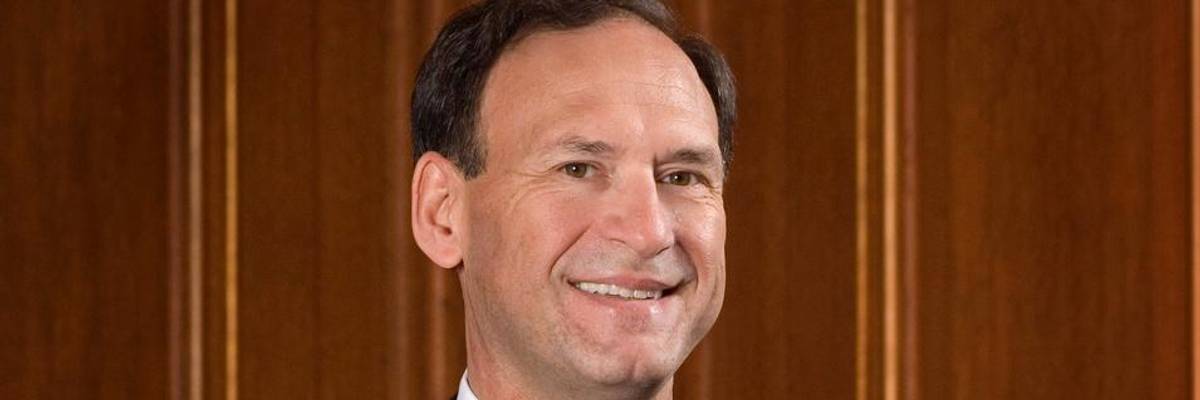
U.S. Supreme Court Justice Samuel Alito delivered a speech to the Federalist Society National Lawyers Convention on November 12, 2020 that critics said flouted the norms of judicial ethics. (Photo: Steve Petteway/U.S. Supreme Court/WikiMedia Commons)
Critics accused U.S. Supreme Court Justice Samuel Alito of departing from ethical rules requiring judges to be impartial and to refrain from appearing biased after he delivered an extraordinarily politicized public speech Thursday night.
In an unusually inflammatory virtual address to this year's Federalist Society National Lawyers Convention, Alito railed against Democrats--including five sitting U.S. senators--LGBTQ civil rights, the progressive movement, the nation's response to the Covid-19 pandemic, and more.
Perhaps the most alarming of Alito's remarks concerned Obergefell v. Hodges, the 2015 ruling that legalized same-sex marriage equality nationwide. While civil rights advocates hailed the 5-4 decision as an historic milestone and the most important civil rights case of the century, Alito--who voted against equality--sees things a bit differently. Citing his dissent in the case, he told the convention:
I wrote the following: "I assume that those who cling to old beliefs will be able to whisper their thoughts in the recesses of their homes. But if they repeat those views in public, they will risk being labeled as bigots, and treated as such by governments, employers, and schools." That is just what is coming to pass. One of the great challenges for the Supreme Court going forward will be to protect freedom of speech. Although that freedom is falling out of favor in some circles, we need to do whatever we can to prevent it from becoming a second-tier constitutional right.
Alito lamented that "religious liberty is fast becoming a disfavored right," citing as one example a Washington state law requiring pharmacies to offer emergency contraception pills. In attacking the requirement, Alito falsely claimed the pill--sold under the brand name Plan B--"destroys an embryo after fertilization."
Regarding public health measures to combat the coronavirus pandemic, Alito decried "previously unimaginable restrictions on individual liberty," a hyperbolic and historically mendacious comment that ignores the SCOTUS-sanctioned practices of slavery and Jim Crow segregation, the genocidal conquest and confinement of Native Americans, the internment of Japanese Americans in concentration camps, and other more recent events including President Donald Trump's Muslim travel ban--which Alito voted to uphold.
Jurists and journalists specializing in the law reacted with shock and disgust to Alito's speech. Writing in Slate, Mark Joseph Stern, a graduate of Georgetown University Law Center, said the justice is behaving like "a bitter partisan out to settle scores" with the nation's political left.
"Flouting his ethical obligations, Alito waded into fierce political debates over public health during a pandemic, reproductive rights, LGBTQ equality, and other issues that routinely come before his court," wrote Stern. "It is wildly inappropriate for a justice to assume the role of Fox News commentators, and unwise in light of progressives' mounting doubt about the Supreme Court's legitimacy."
Referring to the Supreme Court's new conservative supermajority, Chris Geidner, director of strategy at the legal advocacy group Justice Collaborative, called Alito's remarks a "hyper-political, partisan speech."
"[Alito's] message in sum was: I'm free to say this now. We have the votes," Geidner tweeted.
Dear Common Dreams reader, It’s been nearly 30 years since I co-founded Common Dreams with my late wife, Lina Newhouser. We had the radical notion that journalism should serve the public good, not corporate profits. It was clear to us from the outset what it would take to build such a project. No paid advertisements. No corporate sponsors. No millionaire publisher telling us what to think or do. Many people said we wouldn't last a year, but we proved those doubters wrong. Together with a tremendous team of journalists and dedicated staff, we built an independent media outlet free from the constraints of profits and corporate control. Our mission has always been simple: To inform. To inspire. To ignite change for the common good. Building Common Dreams was not easy. Our survival was never guaranteed. When you take on the most powerful forces—Wall Street greed, fossil fuel industry destruction, Big Tech lobbyists, and uber-rich oligarchs who have spent billions upon billions rigging the economy and democracy in their favor—the only bulwark you have is supporters who believe in your work. But here’s the urgent message from me today. It's never been this bad out there. And it's never been this hard to keep us going. At the very moment Common Dreams is most needed, the threats we face are intensifying. We need your support now more than ever. We don't accept corporate advertising and never will. We don't have a paywall because we don't think people should be blocked from critical news based on their ability to pay. Everything we do is funded by the donations of readers like you. When everyone does the little they can afford, we are strong. But if that support retreats or dries up, so do we. Will you donate now to make sure Common Dreams not only survives but thrives? —Craig Brown, Co-founder |
Critics accused U.S. Supreme Court Justice Samuel Alito of departing from ethical rules requiring judges to be impartial and to refrain from appearing biased after he delivered an extraordinarily politicized public speech Thursday night.
In an unusually inflammatory virtual address to this year's Federalist Society National Lawyers Convention, Alito railed against Democrats--including five sitting U.S. senators--LGBTQ civil rights, the progressive movement, the nation's response to the Covid-19 pandemic, and more.
Perhaps the most alarming of Alito's remarks concerned Obergefell v. Hodges, the 2015 ruling that legalized same-sex marriage equality nationwide. While civil rights advocates hailed the 5-4 decision as an historic milestone and the most important civil rights case of the century, Alito--who voted against equality--sees things a bit differently. Citing his dissent in the case, he told the convention:
I wrote the following: "I assume that those who cling to old beliefs will be able to whisper their thoughts in the recesses of their homes. But if they repeat those views in public, they will risk being labeled as bigots, and treated as such by governments, employers, and schools." That is just what is coming to pass. One of the great challenges for the Supreme Court going forward will be to protect freedom of speech. Although that freedom is falling out of favor in some circles, we need to do whatever we can to prevent it from becoming a second-tier constitutional right.
Alito lamented that "religious liberty is fast becoming a disfavored right," citing as one example a Washington state law requiring pharmacies to offer emergency contraception pills. In attacking the requirement, Alito falsely claimed the pill--sold under the brand name Plan B--"destroys an embryo after fertilization."
Regarding public health measures to combat the coronavirus pandemic, Alito decried "previously unimaginable restrictions on individual liberty," a hyperbolic and historically mendacious comment that ignores the SCOTUS-sanctioned practices of slavery and Jim Crow segregation, the genocidal conquest and confinement of Native Americans, the internment of Japanese Americans in concentration camps, and other more recent events including President Donald Trump's Muslim travel ban--which Alito voted to uphold.
Jurists and journalists specializing in the law reacted with shock and disgust to Alito's speech. Writing in Slate, Mark Joseph Stern, a graduate of Georgetown University Law Center, said the justice is behaving like "a bitter partisan out to settle scores" with the nation's political left.
"Flouting his ethical obligations, Alito waded into fierce political debates over public health during a pandemic, reproductive rights, LGBTQ equality, and other issues that routinely come before his court," wrote Stern. "It is wildly inappropriate for a justice to assume the role of Fox News commentators, and unwise in light of progressives' mounting doubt about the Supreme Court's legitimacy."
Referring to the Supreme Court's new conservative supermajority, Chris Geidner, director of strategy at the legal advocacy group Justice Collaborative, called Alito's remarks a "hyper-political, partisan speech."
"[Alito's] message in sum was: I'm free to say this now. We have the votes," Geidner tweeted.
Critics accused U.S. Supreme Court Justice Samuel Alito of departing from ethical rules requiring judges to be impartial and to refrain from appearing biased after he delivered an extraordinarily politicized public speech Thursday night.
In an unusually inflammatory virtual address to this year's Federalist Society National Lawyers Convention, Alito railed against Democrats--including five sitting U.S. senators--LGBTQ civil rights, the progressive movement, the nation's response to the Covid-19 pandemic, and more.
Perhaps the most alarming of Alito's remarks concerned Obergefell v. Hodges, the 2015 ruling that legalized same-sex marriage equality nationwide. While civil rights advocates hailed the 5-4 decision as an historic milestone and the most important civil rights case of the century, Alito--who voted against equality--sees things a bit differently. Citing his dissent in the case, he told the convention:
I wrote the following: "I assume that those who cling to old beliefs will be able to whisper their thoughts in the recesses of their homes. But if they repeat those views in public, they will risk being labeled as bigots, and treated as such by governments, employers, and schools." That is just what is coming to pass. One of the great challenges for the Supreme Court going forward will be to protect freedom of speech. Although that freedom is falling out of favor in some circles, we need to do whatever we can to prevent it from becoming a second-tier constitutional right.
Alito lamented that "religious liberty is fast becoming a disfavored right," citing as one example a Washington state law requiring pharmacies to offer emergency contraception pills. In attacking the requirement, Alito falsely claimed the pill--sold under the brand name Plan B--"destroys an embryo after fertilization."
Regarding public health measures to combat the coronavirus pandemic, Alito decried "previously unimaginable restrictions on individual liberty," a hyperbolic and historically mendacious comment that ignores the SCOTUS-sanctioned practices of slavery and Jim Crow segregation, the genocidal conquest and confinement of Native Americans, the internment of Japanese Americans in concentration camps, and other more recent events including President Donald Trump's Muslim travel ban--which Alito voted to uphold.
Jurists and journalists specializing in the law reacted with shock and disgust to Alito's speech. Writing in Slate, Mark Joseph Stern, a graduate of Georgetown University Law Center, said the justice is behaving like "a bitter partisan out to settle scores" with the nation's political left.
"Flouting his ethical obligations, Alito waded into fierce political debates over public health during a pandemic, reproductive rights, LGBTQ equality, and other issues that routinely come before his court," wrote Stern. "It is wildly inappropriate for a justice to assume the role of Fox News commentators, and unwise in light of progressives' mounting doubt about the Supreme Court's legitimacy."
Referring to the Supreme Court's new conservative supermajority, Chris Geidner, director of strategy at the legal advocacy group Justice Collaborative, called Alito's remarks a "hyper-political, partisan speech."
"[Alito's] message in sum was: I'm free to say this now. We have the votes," Geidner tweeted.