SUBSCRIBE TO OUR FREE NEWSLETTER
Daily news & progressive opinion—funded by the people, not the corporations—delivered straight to your inbox.
5
#000000
#FFFFFF
To donate by check, phone, or other method, see our More Ways to Give page.
Daily news & progressive opinion—funded by the people, not the corporations—delivered straight to your inbox.
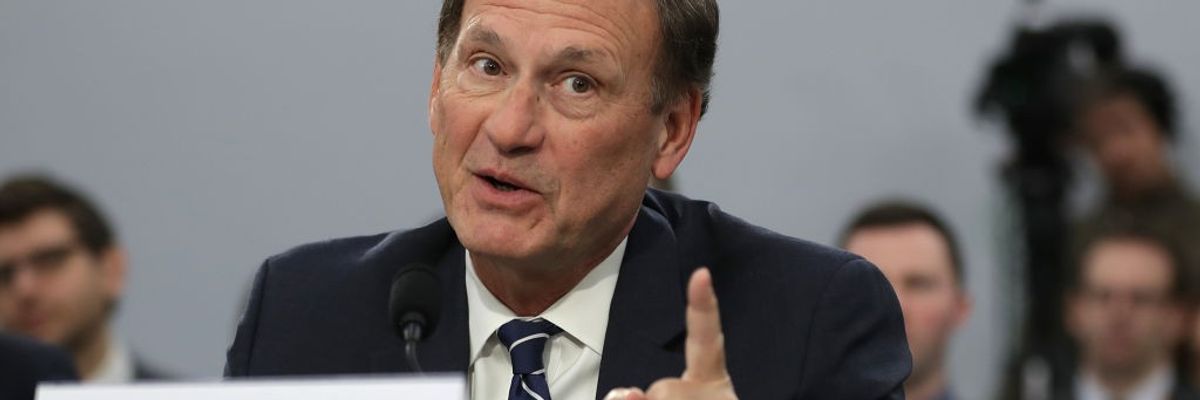
U.S. Supreme Court Associate Justice Samuel Alito testifies during a U.S. House hearing on March 7, 2019 in Washington, D.C.
"What a surprise, guy who is supposed to enforce checks and balances thinks checks shouldn't apply to him," said Rep. Alexandria Ocasio-Cortez.
While conservative Justice Samuel Alito's new Wall Street Journal interview covered various topics, one that provoked intense ire on Friday was his suggestion that federal lawmakers don't have the power to regulate the U.S. Supreme Court.
For a series of Journal opinion pieces—the first was published in April—Alito spent four hours speaking on the record with David B. Rivkin Jr., an attorney who currently has a case before the high court, and James Taranto, the newspaper's editorial features editor.
The latest piece comes after ProPublica revealed in June that Alito took a previously undisclosed 2008 fishing trip to Alaska on a private jet belonging to hedge fund billionaire Paul Singer, an excursion organized by Federalist Society leader Leonard Leo.
ProPublica's reporting prompted Alito to defend himself last month with his own Journal opinion piece and his vacation was among the mounting ethics concerns regarding justices that led Democrats on the U.S. Senate Judiciary Committee last week to advance Sen. Sheldon Whitehouse's (D-R.I.) Supreme Court Ethics, Recusal, and Transparency Act without any GOP support.
Pointing to the panel's vote, Rivkin and Taranto wrote Friday:
Justice Alito says he voluntarily follows disclosure statutes that apply to lower court judges and executive branch officials; so do the other justices. But he notes that "Congress did not create the Supreme Court"—the Constitution did. "I know this is a controversial view, but I'm willing to say it," he says. "No provision in the Constitution gives them the authority to regulate the Supreme Court—period."
Do the other justices agree? "I don't know that any of my colleagues have spoken about it publicly, so I don’t think I should say. But I think it is something we have all thought about."
"This is wrong and frightening," declared Sherrilyn Ifill former president and director-counsel of the Legal Defense Fund. "Justice Alito—and I'm certain not only Justice Alito—believes that the Supreme Court is a branch of our [government] that is unchecked and unaccountable, and unreachable by the power of Congress."
Ifill was among many legal experts and lawmakers who took issue with Alito's remarks, with many citing the U.S. Constitution.
"Article III, Section 2 would like to have a word," tweeted Congressman Sean Casten (D-Ill.). That part of the Constitution states: "In all cases affecting ambassadors, other public ministers and consuls, and those in which a state shall be party, the Supreme Court shall have original jurisdiction. In all the other cases before mentioned, the Supreme Court shall have appellate jurisdiction, both as to law and fact, with such exceptions, and under such regulations as the Congress shall make."
Georgetown University Law Center professor Josh Chafetz highlighted that section of the Constitution and three others about the law-making power of Congress, appropriations for the judicial branch, and the ability of federal lawmakers to impeach judges.
"Alito's unethical grift is matched only by his arrogance," said attorney and former judge Bob Vance. "BTW, he's wrong. The Congress has the power of the purse, controlling funds allocated to the federal judiciary. It can also alter the size of the Supreme Court, which it has done in the past."
U.S. Rep. Ted Lieu (D-Calif.) addressed the justice directly, writing: "Dear Justice Alito: You're on the Supreme Court in part because Congress expanded the court to nine justices. Congress can impeach justices and can in many cases strip the court of jurisdiction. Congress has always regulated you and will continue to do so. You are not above the law."
Indivisible co-executive director Leah Greenberg tweeted that "it's been clear for a while that Alito does not believe that he's accountable to the legislative branch or the American people for his behavior but it's nonetheless shocking that he would say this out loud."
Sen. Brian Schatz (D-Hawaii) suggested Alito's comments could have consequences, saying that "this seems escalatory, and nudges even reluctant court watchers and skeptics of statutory reforms towards doing something. I mean, this is a fancy way of telling everyone to pound sand because he's untouchable."
Vox senior correspondent Ian Millhiser pointed out that "this is hardly the worst thing about Sammy Alito. But, for the record, Article III judges are not supposed to issue advisory opinions on constitutional questions that are not presented to them in case or controversy that their court properly has jurisdiction over."
Rep. Alexandria Ocasio-Cortez (D-N.Y.), who earlier this month sounded the alarm about "a dangerous creep toward authoritarianism and centralization of power in the court," also took aim at Alito on Friday.
"What a surprise, guy who is supposed to enforce checks and balances thinks checks shouldn't apply to him. Too bad!" she said. "Corruption and abuse of power must be stopped, no matter the source. In fact, the court should be *most* subject to scrutiny, [because] it is unelected and life-appointed."
"Alito's next opinion piece in the WSJ is about to be 'I am a little king, actually. The Constitution doesn’t explicitly say I'm not,'" the congresswoman added. "And it'd be boosted by some billionaire who secretly thinks voting rights should only belong to landed gentry."
Other critics called out Rivkin, who not only co-authored the pair of Journal pieces but also represents appellants in the tax case Moore v. United States, which the court has agreed to hear in its upcoming session.
Additionally, as Whitehouse noted, "the lawyer who 'wrote' this is also the lawyer blocking our investigation into Leonard Leo's Supreme Court freebies."
According to the senator, that "shows how small and shallow the pool of operatives is around this captured court—same folks keep popping up wearing new hats."
Dear Common Dreams reader, It’s been nearly 30 years since I co-founded Common Dreams with my late wife, Lina Newhouser. We had the radical notion that journalism should serve the public good, not corporate profits. It was clear to us from the outset what it would take to build such a project. No paid advertisements. No corporate sponsors. No millionaire publisher telling us what to think or do. Many people said we wouldn't last a year, but we proved those doubters wrong. Together with a tremendous team of journalists and dedicated staff, we built an independent media outlet free from the constraints of profits and corporate control. Our mission has always been simple: To inform. To inspire. To ignite change for the common good. Building Common Dreams was not easy. Our survival was never guaranteed. When you take on the most powerful forces—Wall Street greed, fossil fuel industry destruction, Big Tech lobbyists, and uber-rich oligarchs who have spent billions upon billions rigging the economy and democracy in their favor—the only bulwark you have is supporters who believe in your work. But here’s the urgent message from me today. It's never been this bad out there. And it's never been this hard to keep us going. At the very moment Common Dreams is most needed, the threats we face are intensifying. We need your support now more than ever. We don't accept corporate advertising and never will. We don't have a paywall because we don't think people should be blocked from critical news based on their ability to pay. Everything we do is funded by the donations of readers like you. When everyone does the little they can afford, we are strong. But if that support retreats or dries up, so do we. Will you donate now to make sure Common Dreams not only survives but thrives? —Craig Brown, Co-founder |
While conservative Justice Samuel Alito's new Wall Street Journal interview covered various topics, one that provoked intense ire on Friday was his suggestion that federal lawmakers don't have the power to regulate the U.S. Supreme Court.
For a series of Journal opinion pieces—the first was published in April—Alito spent four hours speaking on the record with David B. Rivkin Jr., an attorney who currently has a case before the high court, and James Taranto, the newspaper's editorial features editor.
The latest piece comes after ProPublica revealed in June that Alito took a previously undisclosed 2008 fishing trip to Alaska on a private jet belonging to hedge fund billionaire Paul Singer, an excursion organized by Federalist Society leader Leonard Leo.
ProPublica's reporting prompted Alito to defend himself last month with his own Journal opinion piece and his vacation was among the mounting ethics concerns regarding justices that led Democrats on the U.S. Senate Judiciary Committee last week to advance Sen. Sheldon Whitehouse's (D-R.I.) Supreme Court Ethics, Recusal, and Transparency Act without any GOP support.
Pointing to the panel's vote, Rivkin and Taranto wrote Friday:
Justice Alito says he voluntarily follows disclosure statutes that apply to lower court judges and executive branch officials; so do the other justices. But he notes that "Congress did not create the Supreme Court"—the Constitution did. "I know this is a controversial view, but I'm willing to say it," he says. "No provision in the Constitution gives them the authority to regulate the Supreme Court—period."
Do the other justices agree? "I don't know that any of my colleagues have spoken about it publicly, so I don’t think I should say. But I think it is something we have all thought about."
"This is wrong and frightening," declared Sherrilyn Ifill former president and director-counsel of the Legal Defense Fund. "Justice Alito—and I'm certain not only Justice Alito—believes that the Supreme Court is a branch of our [government] that is unchecked and unaccountable, and unreachable by the power of Congress."
Ifill was among many legal experts and lawmakers who took issue with Alito's remarks, with many citing the U.S. Constitution.
"Article III, Section 2 would like to have a word," tweeted Congressman Sean Casten (D-Ill.). That part of the Constitution states: "In all cases affecting ambassadors, other public ministers and consuls, and those in which a state shall be party, the Supreme Court shall have original jurisdiction. In all the other cases before mentioned, the Supreme Court shall have appellate jurisdiction, both as to law and fact, with such exceptions, and under such regulations as the Congress shall make."
Georgetown University Law Center professor Josh Chafetz highlighted that section of the Constitution and three others about the law-making power of Congress, appropriations for the judicial branch, and the ability of federal lawmakers to impeach judges.
"Alito's unethical grift is matched only by his arrogance," said attorney and former judge Bob Vance. "BTW, he's wrong. The Congress has the power of the purse, controlling funds allocated to the federal judiciary. It can also alter the size of the Supreme Court, which it has done in the past."
U.S. Rep. Ted Lieu (D-Calif.) addressed the justice directly, writing: "Dear Justice Alito: You're on the Supreme Court in part because Congress expanded the court to nine justices. Congress can impeach justices and can in many cases strip the court of jurisdiction. Congress has always regulated you and will continue to do so. You are not above the law."
Indivisible co-executive director Leah Greenberg tweeted that "it's been clear for a while that Alito does not believe that he's accountable to the legislative branch or the American people for his behavior but it's nonetheless shocking that he would say this out loud."
Sen. Brian Schatz (D-Hawaii) suggested Alito's comments could have consequences, saying that "this seems escalatory, and nudges even reluctant court watchers and skeptics of statutory reforms towards doing something. I mean, this is a fancy way of telling everyone to pound sand because he's untouchable."
Vox senior correspondent Ian Millhiser pointed out that "this is hardly the worst thing about Sammy Alito. But, for the record, Article III judges are not supposed to issue advisory opinions on constitutional questions that are not presented to them in case or controversy that their court properly has jurisdiction over."
Rep. Alexandria Ocasio-Cortez (D-N.Y.), who earlier this month sounded the alarm about "a dangerous creep toward authoritarianism and centralization of power in the court," also took aim at Alito on Friday.
"What a surprise, guy who is supposed to enforce checks and balances thinks checks shouldn't apply to him. Too bad!" she said. "Corruption and abuse of power must be stopped, no matter the source. In fact, the court should be *most* subject to scrutiny, [because] it is unelected and life-appointed."
"Alito's next opinion piece in the WSJ is about to be 'I am a little king, actually. The Constitution doesn’t explicitly say I'm not,'" the congresswoman added. "And it'd be boosted by some billionaire who secretly thinks voting rights should only belong to landed gentry."
Other critics called out Rivkin, who not only co-authored the pair of Journal pieces but also represents appellants in the tax case Moore v. United States, which the court has agreed to hear in its upcoming session.
Additionally, as Whitehouse noted, "the lawyer who 'wrote' this is also the lawyer blocking our investigation into Leonard Leo's Supreme Court freebies."
According to the senator, that "shows how small and shallow the pool of operatives is around this captured court—same folks keep popping up wearing new hats."
While conservative Justice Samuel Alito's new Wall Street Journal interview covered various topics, one that provoked intense ire on Friday was his suggestion that federal lawmakers don't have the power to regulate the U.S. Supreme Court.
For a series of Journal opinion pieces—the first was published in April—Alito spent four hours speaking on the record with David B. Rivkin Jr., an attorney who currently has a case before the high court, and James Taranto, the newspaper's editorial features editor.
The latest piece comes after ProPublica revealed in June that Alito took a previously undisclosed 2008 fishing trip to Alaska on a private jet belonging to hedge fund billionaire Paul Singer, an excursion organized by Federalist Society leader Leonard Leo.
ProPublica's reporting prompted Alito to defend himself last month with his own Journal opinion piece and his vacation was among the mounting ethics concerns regarding justices that led Democrats on the U.S. Senate Judiciary Committee last week to advance Sen. Sheldon Whitehouse's (D-R.I.) Supreme Court Ethics, Recusal, and Transparency Act without any GOP support.
Pointing to the panel's vote, Rivkin and Taranto wrote Friday:
Justice Alito says he voluntarily follows disclosure statutes that apply to lower court judges and executive branch officials; so do the other justices. But he notes that "Congress did not create the Supreme Court"—the Constitution did. "I know this is a controversial view, but I'm willing to say it," he says. "No provision in the Constitution gives them the authority to regulate the Supreme Court—period."
Do the other justices agree? "I don't know that any of my colleagues have spoken about it publicly, so I don’t think I should say. But I think it is something we have all thought about."
"This is wrong and frightening," declared Sherrilyn Ifill former president and director-counsel of the Legal Defense Fund. "Justice Alito—and I'm certain not only Justice Alito—believes that the Supreme Court is a branch of our [government] that is unchecked and unaccountable, and unreachable by the power of Congress."
Ifill was among many legal experts and lawmakers who took issue with Alito's remarks, with many citing the U.S. Constitution.
"Article III, Section 2 would like to have a word," tweeted Congressman Sean Casten (D-Ill.). That part of the Constitution states: "In all cases affecting ambassadors, other public ministers and consuls, and those in which a state shall be party, the Supreme Court shall have original jurisdiction. In all the other cases before mentioned, the Supreme Court shall have appellate jurisdiction, both as to law and fact, with such exceptions, and under such regulations as the Congress shall make."
Georgetown University Law Center professor Josh Chafetz highlighted that section of the Constitution and three others about the law-making power of Congress, appropriations for the judicial branch, and the ability of federal lawmakers to impeach judges.
"Alito's unethical grift is matched only by his arrogance," said attorney and former judge Bob Vance. "BTW, he's wrong. The Congress has the power of the purse, controlling funds allocated to the federal judiciary. It can also alter the size of the Supreme Court, which it has done in the past."
U.S. Rep. Ted Lieu (D-Calif.) addressed the justice directly, writing: "Dear Justice Alito: You're on the Supreme Court in part because Congress expanded the court to nine justices. Congress can impeach justices and can in many cases strip the court of jurisdiction. Congress has always regulated you and will continue to do so. You are not above the law."
Indivisible co-executive director Leah Greenberg tweeted that "it's been clear for a while that Alito does not believe that he's accountable to the legislative branch or the American people for his behavior but it's nonetheless shocking that he would say this out loud."
Sen. Brian Schatz (D-Hawaii) suggested Alito's comments could have consequences, saying that "this seems escalatory, and nudges even reluctant court watchers and skeptics of statutory reforms towards doing something. I mean, this is a fancy way of telling everyone to pound sand because he's untouchable."
Vox senior correspondent Ian Millhiser pointed out that "this is hardly the worst thing about Sammy Alito. But, for the record, Article III judges are not supposed to issue advisory opinions on constitutional questions that are not presented to them in case or controversy that their court properly has jurisdiction over."
Rep. Alexandria Ocasio-Cortez (D-N.Y.), who earlier this month sounded the alarm about "a dangerous creep toward authoritarianism and centralization of power in the court," also took aim at Alito on Friday.
"What a surprise, guy who is supposed to enforce checks and balances thinks checks shouldn't apply to him. Too bad!" she said. "Corruption and abuse of power must be stopped, no matter the source. In fact, the court should be *most* subject to scrutiny, [because] it is unelected and life-appointed."
"Alito's next opinion piece in the WSJ is about to be 'I am a little king, actually. The Constitution doesn’t explicitly say I'm not,'" the congresswoman added. "And it'd be boosted by some billionaire who secretly thinks voting rights should only belong to landed gentry."
Other critics called out Rivkin, who not only co-authored the pair of Journal pieces but also represents appellants in the tax case Moore v. United States, which the court has agreed to hear in its upcoming session.
Additionally, as Whitehouse noted, "the lawyer who 'wrote' this is also the lawyer blocking our investigation into Leonard Leo's Supreme Court freebies."
According to the senator, that "shows how small and shallow the pool of operatives is around this captured court—same folks keep popping up wearing new hats."