SUBSCRIBE TO OUR FREE NEWSLETTER
Daily news & progressive opinion—funded by the people, not the corporations—delivered straight to your inbox.
5
#000000
#FFFFFF
To donate by check, phone, or other method, see our More Ways to Give page.
Daily news & progressive opinion—funded by the people, not the corporations—delivered straight to your inbox.
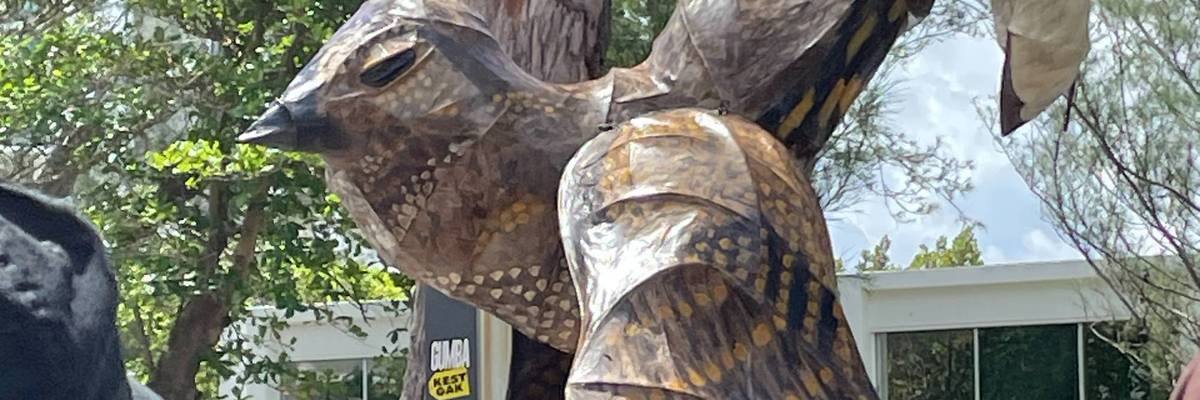
A model of a guabairo, a bird endangered by the Esencia luxury development project in Puerto Rico, is carried at a march opposing the project on March 28, 2026.
A movement is forming to defend the community and island against a project that would turn over a significant piece of Puerto Rico’s land to foreign billionaires, to serve their needs, not the needs of the Puerto Rican people.
On Saturday, March 28—No Kings Day in the US—an estimated 50,000 people marched in the streets of Old San Juan, Puerto Rico to protest plans for “Esencia,” a proposed huge, gated, luxury ocean-side development in Cabo Rojo, Puerto Rico. The protest was spear-headed by Defiende a Cabo Rojo, a coalition of community, scientific, and cultural organizations, and was joined by 66 co-sponsoring groups from all over the island. A retired US professor of (radical) economics, I attended the protest with my friend Dimaris Acosta-Mercado, an activist in the anti-Esencia movement and professor of ecology at the University of Puerto Rico-Mayaguez.
The $2.5 billion Esencia project, first proposed in May 2024, is a quintessential example of neocolonial capitalist development. It would create a tropical enclave for super-rich foreigners on 2,000 acres of land along a 3-mile stretch of beach in the southwest of the island, including 1,200 homes, 500 hotel accommodations, two golf courses, its own school, and an airport. Although it does not yet have building permits, the proposed project has already received generous tax credits and exemptions.
The movement to stop Esencia views this issue in both class and territorial terms. Its goal is to defend the community and island against a project that would turn over a significant piece of Puerto Rico’s land to foreign billionaires, to serve their needs, not the needs of the Puerto Rican people. It builds on a history of successful struggles against previous development projects such as the Northern Corridor, mining in Adjuntas, and beachside construction in Rincon.
One of the movement’s core critiques of Esencia is the loss of public access to the beaches, which has happened with previous developments such as Dorado Beach and Palmas del Mar. Bad Bunny’s song, “What Happened to Hawaii,” has become a theme song for the movement, with its powerful chorus:
Thеy want to take my river and my beach too
They want my neighborhood and grandma to leave
No, don't let go of the flag nor forget the lelolai
'Cause I don't want them to do to you what happened to Hawaii
A second set of criticisms of the project focus on its negative ecological and environmental impact. As part of a team of academic researchers involved in the movement, my friend Dimaris’ critique focuses on the harm Esencia will do to endangered species, including birds, reptiles, snails, and plants that exist only in Puerto Rico, and to the critical habitat system that supports them. Other movement researchers predict that Esencia will cause shortages in the region’s water, already in short supply. A third critique emphasizes the area’s importance as an archaeological site.
The march began at El Escambron, another public beach threatened with privatization. From there we marched along the coast of Old San Juan, stopping to rally at the Capitol Building, where the Puerto Rican Senate and House of Representatives meet, and then marched to the Governor’s mansion, La Fortaleza, for more protesting.
It is hard to capture in words the powerful anti-Esencia presence and statement that the march created. At the front of the protest were huge flags of Puerto Rico and Cabo Rojo. Soon after came a large paper mache model of a guabairo, a rare bird endangered by the project, carried overhead for the length of the protest, wings flapping. Marchers carried and wore a variety of printed and homemade posters denouncing the proposed project. Percussion—including drums, folding fans, kitchen pots, guiros—was omnipresent. The call and response chant of “Esencia No Va… Que No Va, Que No Va” (Esencia is a no-go, it shouldn’t go, it shouldn’t go) echoed throughout the march. Continual rhythmic chanting, drumming, singing, and dancing made the protest come alive as a potent force opposing the project. As a North American, I was touched to join in the familiar “El Pueblo Unido Jamas Sera Vencido” chant and to sing “No Nos Pararon” (“they won’t stop us”) to the tune of “We shall not be moved.”
If we in the US and elsewhere are to use social strikes to retake control of our governments... we have much to learn from the joyful, creative protests of our Puerto Rican comrades.
Puerto Rican peoples are a mixture of African, Indigenous, and European heritage, and, as Dimaris put it, “It’s as if all our ancestry (was) coming alive and making peace in this land to protect it.” Indigenous heritage took center stage when the march stopped in front of the Capitol building, with the blowing of conch shells, chanting, calling in the directions, and leading an areito dance. And Afro-Puerto Rican ancestry was omni-present in the bombas and drumming.
One group wore purple T-shirts announcing “anti-patriarchal, feminista, lesbiana, trans, Caribena, Latinoamericana.” Another T-shirt depicted a plant and the words “sembrando rebeldias” (planting rebellions). Gay protesters snapped fans for percussion (one of their signature acts). The Puerto Rico Sierra Club was there, along with Para la Naturaleza, and AFSCME, and many other groups.
The protest had something I hadn’t experienced in the many many US demonstrations I have participated in since the 1960s: It was fun! It was actually a party, with masses of people dancing, drumming, chanting, singing, and reveling in the streets. It was a celebration of life—not only of Puerto Rico and being Puerto Rican, but also of standing up for Mother Earth, an affirmation of love, cooperation, art, and beauty by a diverse community organizing in self-defense and defense of nature, against the greed, displacement, ecological destruction, and extreme wealth inequality that Esencia embodies. Dimaris later told me that the protest resembled the spirit of Verano 2019, the 15-day protest strike which used creativity, art, and fun to topple Gov. “Ricky” Rosello, including evening dance parties in front of the governor’s mansion. If we in the US and elsewhere are to use social strikes to retake control of our governments, as Jeremy Brecher suggests, we have much to learn from the joyful, creative protests of our Puerto Rican comrades.
A final note. The Solidarity Economy movement uses the motto, “Resist and Build.” Movements such as the one opposing Esencia, which resist the take-over of our lands and lives, are key. Equally important are a growing number of efforts to build non-capitalist, community-based alternatives, which are sprouting up all around the world, such as Casa Pueblo and Plenitud in Puerto Rico, or, in the US, land development projects such as those of the Peoples’ Network for Land and Liberation.
In these dark times, here’s to inspiring one another as we resist and build, and to having fun as we do so! Esencia No Va!!!!!!
Dear Common Dreams reader, It’s been nearly 30 years since I co-founded Common Dreams with my late wife, Lina Newhouser. We had the radical notion that journalism should serve the public good, not corporate profits. It was clear to us from the outset what it would take to build such a project. No paid advertisements. No corporate sponsors. No millionaire publisher telling us what to think or do. Many people said we wouldn't last a year, but we proved those doubters wrong. Together with a tremendous team of journalists and dedicated staff, we built an independent media outlet free from the constraints of profits and corporate control. Our mission has always been simple: To inform. To inspire. To ignite change for the common good. Building Common Dreams was not easy. Our survival was never guaranteed. When you take on the most powerful forces—Wall Street greed, fossil fuel industry destruction, Big Tech lobbyists, and uber-rich oligarchs who have spent billions upon billions rigging the economy and democracy in their favor—the only bulwark you have is supporters who believe in your work. But here’s the urgent message from me today. It's never been this bad out there. And it's never been this hard to keep us going. At the very moment Common Dreams is most needed, the threats we face are intensifying. We need your support now more than ever. We don't accept corporate advertising and never will. We don't have a paywall because we don't think people should be blocked from critical news based on their ability to pay. Everything we do is funded by the donations of readers like you. When everyone does the little they can afford, we are strong. But if that support retreats or dries up, so do we. Will you donate now to make sure Common Dreams not only survives but thrives? —Craig Brown, Co-founder |
On Saturday, March 28—No Kings Day in the US—an estimated 50,000 people marched in the streets of Old San Juan, Puerto Rico to protest plans for “Esencia,” a proposed huge, gated, luxury ocean-side development in Cabo Rojo, Puerto Rico. The protest was spear-headed by Defiende a Cabo Rojo, a coalition of community, scientific, and cultural organizations, and was joined by 66 co-sponsoring groups from all over the island. A retired US professor of (radical) economics, I attended the protest with my friend Dimaris Acosta-Mercado, an activist in the anti-Esencia movement and professor of ecology at the University of Puerto Rico-Mayaguez.
The $2.5 billion Esencia project, first proposed in May 2024, is a quintessential example of neocolonial capitalist development. It would create a tropical enclave for super-rich foreigners on 2,000 acres of land along a 3-mile stretch of beach in the southwest of the island, including 1,200 homes, 500 hotel accommodations, two golf courses, its own school, and an airport. Although it does not yet have building permits, the proposed project has already received generous tax credits and exemptions.
The movement to stop Esencia views this issue in both class and territorial terms. Its goal is to defend the community and island against a project that would turn over a significant piece of Puerto Rico’s land to foreign billionaires, to serve their needs, not the needs of the Puerto Rican people. It builds on a history of successful struggles against previous development projects such as the Northern Corridor, mining in Adjuntas, and beachside construction in Rincon.
One of the movement’s core critiques of Esencia is the loss of public access to the beaches, which has happened with previous developments such as Dorado Beach and Palmas del Mar. Bad Bunny’s song, “What Happened to Hawaii,” has become a theme song for the movement, with its powerful chorus:
Thеy want to take my river and my beach too
They want my neighborhood and grandma to leave
No, don't let go of the flag nor forget the lelolai
'Cause I don't want them to do to you what happened to Hawaii
A second set of criticisms of the project focus on its negative ecological and environmental impact. As part of a team of academic researchers involved in the movement, my friend Dimaris’ critique focuses on the harm Esencia will do to endangered species, including birds, reptiles, snails, and plants that exist only in Puerto Rico, and to the critical habitat system that supports them. Other movement researchers predict that Esencia will cause shortages in the region’s water, already in short supply. A third critique emphasizes the area’s importance as an archaeological site.
The march began at El Escambron, another public beach threatened with privatization. From there we marched along the coast of Old San Juan, stopping to rally at the Capitol Building, where the Puerto Rican Senate and House of Representatives meet, and then marched to the Governor’s mansion, La Fortaleza, for more protesting.
It is hard to capture in words the powerful anti-Esencia presence and statement that the march created. At the front of the protest were huge flags of Puerto Rico and Cabo Rojo. Soon after came a large paper mache model of a guabairo, a rare bird endangered by the project, carried overhead for the length of the protest, wings flapping. Marchers carried and wore a variety of printed and homemade posters denouncing the proposed project. Percussion—including drums, folding fans, kitchen pots, guiros—was omnipresent. The call and response chant of “Esencia No Va… Que No Va, Que No Va” (Esencia is a no-go, it shouldn’t go, it shouldn’t go) echoed throughout the march. Continual rhythmic chanting, drumming, singing, and dancing made the protest come alive as a potent force opposing the project. As a North American, I was touched to join in the familiar “El Pueblo Unido Jamas Sera Vencido” chant and to sing “No Nos Pararon” (“they won’t stop us”) to the tune of “We shall not be moved.”
If we in the US and elsewhere are to use social strikes to retake control of our governments... we have much to learn from the joyful, creative protests of our Puerto Rican comrades.
Puerto Rican peoples are a mixture of African, Indigenous, and European heritage, and, as Dimaris put it, “It’s as if all our ancestry (was) coming alive and making peace in this land to protect it.” Indigenous heritage took center stage when the march stopped in front of the Capitol building, with the blowing of conch shells, chanting, calling in the directions, and leading an areito dance. And Afro-Puerto Rican ancestry was omni-present in the bombas and drumming.
One group wore purple T-shirts announcing “anti-patriarchal, feminista, lesbiana, trans, Caribena, Latinoamericana.” Another T-shirt depicted a plant and the words “sembrando rebeldias” (planting rebellions). Gay protesters snapped fans for percussion (one of their signature acts). The Puerto Rico Sierra Club was there, along with Para la Naturaleza, and AFSCME, and many other groups.
The protest had something I hadn’t experienced in the many many US demonstrations I have participated in since the 1960s: It was fun! It was actually a party, with masses of people dancing, drumming, chanting, singing, and reveling in the streets. It was a celebration of life—not only of Puerto Rico and being Puerto Rican, but also of standing up for Mother Earth, an affirmation of love, cooperation, art, and beauty by a diverse community organizing in self-defense and defense of nature, against the greed, displacement, ecological destruction, and extreme wealth inequality that Esencia embodies. Dimaris later told me that the protest resembled the spirit of Verano 2019, the 15-day protest strike which used creativity, art, and fun to topple Gov. “Ricky” Rosello, including evening dance parties in front of the governor’s mansion. If we in the US and elsewhere are to use social strikes to retake control of our governments, as Jeremy Brecher suggests, we have much to learn from the joyful, creative protests of our Puerto Rican comrades.
A final note. The Solidarity Economy movement uses the motto, “Resist and Build.” Movements such as the one opposing Esencia, which resist the take-over of our lands and lives, are key. Equally important are a growing number of efforts to build non-capitalist, community-based alternatives, which are sprouting up all around the world, such as Casa Pueblo and Plenitud in Puerto Rico, or, in the US, land development projects such as those of the Peoples’ Network for Land and Liberation.
In these dark times, here’s to inspiring one another as we resist and build, and to having fun as we do so! Esencia No Va!!!!!!
On Saturday, March 28—No Kings Day in the US—an estimated 50,000 people marched in the streets of Old San Juan, Puerto Rico to protest plans for “Esencia,” a proposed huge, gated, luxury ocean-side development in Cabo Rojo, Puerto Rico. The protest was spear-headed by Defiende a Cabo Rojo, a coalition of community, scientific, and cultural organizations, and was joined by 66 co-sponsoring groups from all over the island. A retired US professor of (radical) economics, I attended the protest with my friend Dimaris Acosta-Mercado, an activist in the anti-Esencia movement and professor of ecology at the University of Puerto Rico-Mayaguez.
The $2.5 billion Esencia project, first proposed in May 2024, is a quintessential example of neocolonial capitalist development. It would create a tropical enclave for super-rich foreigners on 2,000 acres of land along a 3-mile stretch of beach in the southwest of the island, including 1,200 homes, 500 hotel accommodations, two golf courses, its own school, and an airport. Although it does not yet have building permits, the proposed project has already received generous tax credits and exemptions.
The movement to stop Esencia views this issue in both class and territorial terms. Its goal is to defend the community and island against a project that would turn over a significant piece of Puerto Rico’s land to foreign billionaires, to serve their needs, not the needs of the Puerto Rican people. It builds on a history of successful struggles against previous development projects such as the Northern Corridor, mining in Adjuntas, and beachside construction in Rincon.
One of the movement’s core critiques of Esencia is the loss of public access to the beaches, which has happened with previous developments such as Dorado Beach and Palmas del Mar. Bad Bunny’s song, “What Happened to Hawaii,” has become a theme song for the movement, with its powerful chorus:
Thеy want to take my river and my beach too
They want my neighborhood and grandma to leave
No, don't let go of the flag nor forget the lelolai
'Cause I don't want them to do to you what happened to Hawaii
A second set of criticisms of the project focus on its negative ecological and environmental impact. As part of a team of academic researchers involved in the movement, my friend Dimaris’ critique focuses on the harm Esencia will do to endangered species, including birds, reptiles, snails, and plants that exist only in Puerto Rico, and to the critical habitat system that supports them. Other movement researchers predict that Esencia will cause shortages in the region’s water, already in short supply. A third critique emphasizes the area’s importance as an archaeological site.
The march began at El Escambron, another public beach threatened with privatization. From there we marched along the coast of Old San Juan, stopping to rally at the Capitol Building, where the Puerto Rican Senate and House of Representatives meet, and then marched to the Governor’s mansion, La Fortaleza, for more protesting.
It is hard to capture in words the powerful anti-Esencia presence and statement that the march created. At the front of the protest were huge flags of Puerto Rico and Cabo Rojo. Soon after came a large paper mache model of a guabairo, a rare bird endangered by the project, carried overhead for the length of the protest, wings flapping. Marchers carried and wore a variety of printed and homemade posters denouncing the proposed project. Percussion—including drums, folding fans, kitchen pots, guiros—was omnipresent. The call and response chant of “Esencia No Va… Que No Va, Que No Va” (Esencia is a no-go, it shouldn’t go, it shouldn’t go) echoed throughout the march. Continual rhythmic chanting, drumming, singing, and dancing made the protest come alive as a potent force opposing the project. As a North American, I was touched to join in the familiar “El Pueblo Unido Jamas Sera Vencido” chant and to sing “No Nos Pararon” (“they won’t stop us”) to the tune of “We shall not be moved.”
If we in the US and elsewhere are to use social strikes to retake control of our governments... we have much to learn from the joyful, creative protests of our Puerto Rican comrades.
Puerto Rican peoples are a mixture of African, Indigenous, and European heritage, and, as Dimaris put it, “It’s as if all our ancestry (was) coming alive and making peace in this land to protect it.” Indigenous heritage took center stage when the march stopped in front of the Capitol building, with the blowing of conch shells, chanting, calling in the directions, and leading an areito dance. And Afro-Puerto Rican ancestry was omni-present in the bombas and drumming.
One group wore purple T-shirts announcing “anti-patriarchal, feminista, lesbiana, trans, Caribena, Latinoamericana.” Another T-shirt depicted a plant and the words “sembrando rebeldias” (planting rebellions). Gay protesters snapped fans for percussion (one of their signature acts). The Puerto Rico Sierra Club was there, along with Para la Naturaleza, and AFSCME, and many other groups.
The protest had something I hadn’t experienced in the many many US demonstrations I have participated in since the 1960s: It was fun! It was actually a party, with masses of people dancing, drumming, chanting, singing, and reveling in the streets. It was a celebration of life—not only of Puerto Rico and being Puerto Rican, but also of standing up for Mother Earth, an affirmation of love, cooperation, art, and beauty by a diverse community organizing in self-defense and defense of nature, against the greed, displacement, ecological destruction, and extreme wealth inequality that Esencia embodies. Dimaris later told me that the protest resembled the spirit of Verano 2019, the 15-day protest strike which used creativity, art, and fun to topple Gov. “Ricky” Rosello, including evening dance parties in front of the governor’s mansion. If we in the US and elsewhere are to use social strikes to retake control of our governments, as Jeremy Brecher suggests, we have much to learn from the joyful, creative protests of our Puerto Rican comrades.
A final note. The Solidarity Economy movement uses the motto, “Resist and Build.” Movements such as the one opposing Esencia, which resist the take-over of our lands and lives, are key. Equally important are a growing number of efforts to build non-capitalist, community-based alternatives, which are sprouting up all around the world, such as Casa Pueblo and Plenitud in Puerto Rico, or, in the US, land development projects such as those of the Peoples’ Network for Land and Liberation.
In these dark times, here’s to inspiring one another as we resist and build, and to having fun as we do so! Esencia No Va!!!!!!