SUBSCRIBE TO OUR FREE NEWSLETTER
Daily news & progressive opinion—funded by the people, not the corporations—delivered straight to your inbox.
5
#000000
#FFFFFF
To donate by check, phone, or other method, see our More Ways to Give page.
Daily news & progressive opinion—funded by the people, not the corporations—delivered straight to your inbox.

Time shares its covers naming the “Architects of AI” as 2025 “Person of the Year.”
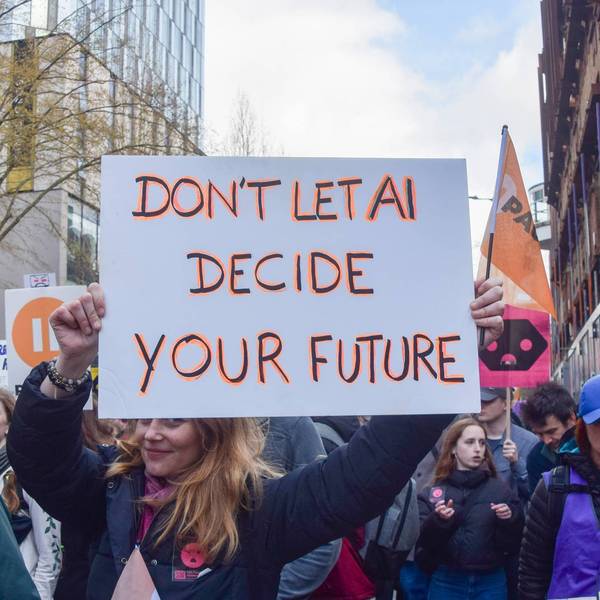
In a functioning democracy, we would have at least one political party that would fly the banner of the 53% of us who are wary of unchecked artificial intelligence.
“This is the West, sir. When the facts become legend, print the legend.” —journalist in the 1962 film, The Man Who Shot Liberty Valance
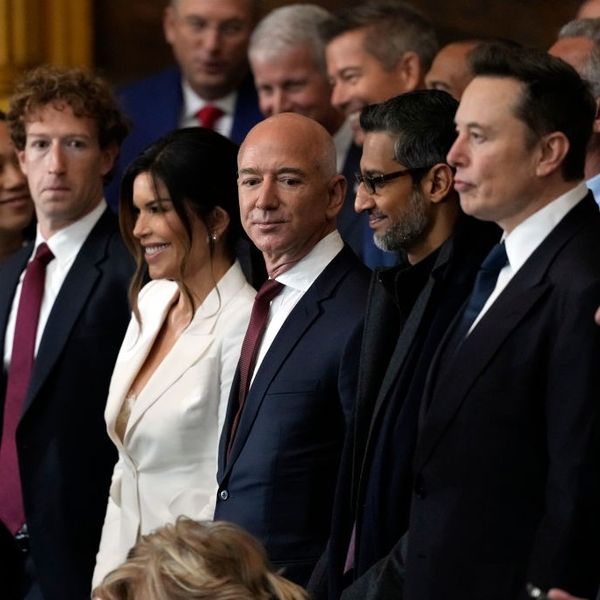
The top editors at Time (yes, it still exists) looked west to Silicon Valley and decided to print the legend last week when picking their Person of the Year for the tumultuous 12 months of 2025. It seemed all too fitting that its cover hailing “The Architects of AI” was the kind of artistic rip-off that’s a hallmark of artificial intelligence: 1932’s iconic newspaper shot, “Lunch Atop a Skyscraper,” “reimagined” with the billionaires—including Elon Musk and OpenAI’s Sam Altman—and lesser-known engineers behind the rapid growth of their technology in everyday life.
Time’s writers strived to outdo the hype of AI itself, writing that these architects of artificial intelligence “reoriented government policy, altered geopolitical rivalries, and brought robots into homes. AI emerged as arguably the most consequential tool in great-power competition since the advent of nuclear weapons.”
OK, but it’s a tool that’s clearly going to need a lot more work, or architecting, or whatever it is those folks out on the beam do. That was apparent on the same day as Time’s celebration when it was reported that Washington Post editors got a little too close to the edge when they decided they were ready to roll out an ambitious scheme for personalized, AI-driven podcasts based on factors like your personal interests or your schedule.
Time magazine got one thing right. Just as its editors understood in 1938 that Adolf Hitler was its Man of the Year because he’d influenced the world more than anyone else, albeit for evil, history will likely look back at 2025 and agree that AI posed an even bigger threat to humanity than Trump’s brand of fascism.
The news site Semafor reported that the many gaffes ranged from minor mistakes in pronunciation to major goofs like inventing quotes—the kind of thing that would get a human journalist fired on the spot. “Never would I have imagined that the Washington Post would deliberately warp its own journalism and then push these errors out to our audience at scale,” a dismayed, unnamed editor reported.
The same-day contrast between the Tomorrowland swooning over the promise of AI and its glitchy, real-world reality felt like a metaphor for an invention that, as Time wasn’t wrong in reporting, is so rapidly reshaping our world. Warts and all.
Like it or not.
And for most people (myself included), it’s mostly “or not.” The vast majority understands that it’s too late to put this 21st-century genie back in the bottle, and like any new technology there are going to be positives from AI, from performing mundane organizing tasks that free up time for actual work, to researching cures for diseases.
But each new wave of technology—atomic power, the internet, and definitely AI—increasingly threatens more risk than reward. And it’s not just the sci-fi notion of sentient robots taking over the planet, although that is a concern. It’s everyday stuff. Schoolkids not learning to think for themselves. Corporations replacing salaried humans with machines. Sky-high electric bills and a worsening climate crisis because AI runs on data centers with an insatiable need for energy and water
The most recent major Pew Research Center survey of Americans found that 50% of us are more concerned than excited about the growing presence of AI, while only 10% are more excited than concerned. Drill down and you’ll see that a majority believes AI will worsen humans’ ability to think creatively, and, by a whopping 50-to-5% margin, also believes it will worsen our ability to form relationships rather than improve it. These, by the way, are two things that weren’t going well before AI.
So naturally our political leaders are racing to see who can place the tightest curbs on artificial intelligence and thus carry out the will of the peop... ha, you did know this time that I was kidding, didn’t you?
It’s no secret that Donald Trump and his regime were in the tank from Day One for those folks out on Time’s steel beam, and not just Musk, who—and this feels like it was seven years ago—donated a whopping $144 million to the Republican’s 2024 campaign. Just last week, the president signed an executive order aiming to press the full weight of the federal government, including Justice Department lawsuits and regulatory actions, against any state that dares to regulate AI. He said that’s necessary to ensure US “global AI dominance.”
This is a problem when his constituents clearly want AI to be regulated. But it’s just as big a problem—perhaps bigger—that the opposition party isn’t offering much opposition. Democrats seem just as awed by the billionaire grand poobahs of AI as Trump. Or the editors of Time.
Also last week, New York Democratic Gov. Kathy Hochul—leader of the second-largest blue state, and seeking reelection in 2026—used her gubernatorial pen to gut the more-stringent AI regulations that were sent to her desk by state lawmakers. Watchdogs said Hochul replaced the hardest-hitting rules with language drafted by lobbyists for Big Tech.
As the American Prospect noted, Hochul’s pro-Silicon Valley maneuvers came after her campaign coffers were boosted by fundraisers held by venture capitalist Ron Conway, who has been seeking a veto, and the industry group Tech:NYC, which wants the bill watered down.
It was a similar story in the biggest blue state, California, where Gov. Gavin Newsom in 2024 vetoed the first effort by state lawmakers to impose tough regulations on AI, and where a second measure did pass but only after substantial input from lobbyists for OpenAI and other tech firms. Silicon Valley billionaires raised $5 million to help Newsom—a 2028 White House front-runner—beat back a 2021 recall.
Like other top Democrats, Pennsylvania Gov. Josh Shapiro favors some light regulation for AI but is generally a booster, insisting the new technology is a “job enhancer, not a job replacer.” He’s all in on the Keystone State building massive data centers, despite their tendency to drive up electric bills and their unpopularity in the communities where they are proposed.
Money talks, democracy walks—an appalling fact of life in 2025 America. In a functioning democracy, we would have at least one political party that would fly the banner of the 53% of us who are wary of unchecked AI, and even take that idea to the next level.
A Harris Poll found that, for the first time, a majority of Americans also see billionaires—many of them fueled by the AI bubble—as a threat to democracy, with 71% supporting a wealth tax. Yet few of the Democrats hoping to retake Congress in 2027 are advocating such a levy. This is a dangerous disconnect.
Time magazine got one thing right. Just as its editors understood in 1938 that Adolf Hitler was its Man of the Year because he’d influenced the world more than anyone else, albeit for evil, history will likely look back at 2025 and agree that AI posed an even bigger threat to humanity than Trump’s brand of fascism. The fight to save the American Experiment must be fought on both fronts.
Dear Common Dreams reader, It’s been nearly 30 years since I co-founded Common Dreams with my late wife, Lina Newhouser. We had the radical notion that journalism should serve the public good, not corporate profits. It was clear to us from the outset what it would take to build such a project. No paid advertisements. No corporate sponsors. No millionaire publisher telling us what to think or do. Many people said we wouldn't last a year, but we proved those doubters wrong. Together with a tremendous team of journalists and dedicated staff, we built an independent media outlet free from the constraints of profits and corporate control. Our mission has always been simple: To inform. To inspire. To ignite change for the common good. Building Common Dreams was not easy. Our survival was never guaranteed. When you take on the most powerful forces—Wall Street greed, fossil fuel industry destruction, Big Tech lobbyists, and uber-rich oligarchs who have spent billions upon billions rigging the economy and democracy in their favor—the only bulwark you have is supporters who believe in your work. But here’s the urgent message from me today. It's never been this bad out there. And it's never been this hard to keep us going. At the very moment Common Dreams is most needed, the threats we face are intensifying. We need your support now more than ever. We don't accept corporate advertising and never will. We don't have a paywall because we don't think people should be blocked from critical news based on their ability to pay. Everything we do is funded by the donations of readers like you. When everyone does the little they can afford, we are strong. But if that support retreats or dries up, so do we. Will you donate now to make sure Common Dreams not only survives but thrives? —Craig Brown, Co-founder |
“This is the West, sir. When the facts become legend, print the legend.” —journalist in the 1962 film, The Man Who Shot Liberty Valance
The top editors at Time (yes, it still exists) looked west to Silicon Valley and decided to print the legend last week when picking their Person of the Year for the tumultuous 12 months of 2025. It seemed all too fitting that its cover hailing “The Architects of AI” was the kind of artistic rip-off that’s a hallmark of artificial intelligence: 1932’s iconic newspaper shot, “Lunch Atop a Skyscraper,” “reimagined” with the billionaires—including Elon Musk and OpenAI’s Sam Altman—and lesser-known engineers behind the rapid growth of their technology in everyday life.
Time’s writers strived to outdo the hype of AI itself, writing that these architects of artificial intelligence “reoriented government policy, altered geopolitical rivalries, and brought robots into homes. AI emerged as arguably the most consequential tool in great-power competition since the advent of nuclear weapons.”
OK, but it’s a tool that’s clearly going to need a lot more work, or architecting, or whatever it is those folks out on the beam do. That was apparent on the same day as Time’s celebration when it was reported that Washington Post editors got a little too close to the edge when they decided they were ready to roll out an ambitious scheme for personalized, AI-driven podcasts based on factors like your personal interests or your schedule.
Time magazine got one thing right. Just as its editors understood in 1938 that Adolf Hitler was its Man of the Year because he’d influenced the world more than anyone else, albeit for evil, history will likely look back at 2025 and agree that AI posed an even bigger threat to humanity than Trump’s brand of fascism.
The news site Semafor reported that the many gaffes ranged from minor mistakes in pronunciation to major goofs like inventing quotes—the kind of thing that would get a human journalist fired on the spot. “Never would I have imagined that the Washington Post would deliberately warp its own journalism and then push these errors out to our audience at scale,” a dismayed, unnamed editor reported.
The same-day contrast between the Tomorrowland swooning over the promise of AI and its glitchy, real-world reality felt like a metaphor for an invention that, as Time wasn’t wrong in reporting, is so rapidly reshaping our world. Warts and all.
Like it or not.
And for most people (myself included), it’s mostly “or not.” The vast majority understands that it’s too late to put this 21st-century genie back in the bottle, and like any new technology there are going to be positives from AI, from performing mundane organizing tasks that free up time for actual work, to researching cures for diseases.
But each new wave of technology—atomic power, the internet, and definitely AI—increasingly threatens more risk than reward. And it’s not just the sci-fi notion of sentient robots taking over the planet, although that is a concern. It’s everyday stuff. Schoolkids not learning to think for themselves. Corporations replacing salaried humans with machines. Sky-high electric bills and a worsening climate crisis because AI runs on data centers with an insatiable need for energy and water
The most recent major Pew Research Center survey of Americans found that 50% of us are more concerned than excited about the growing presence of AI, while only 10% are more excited than concerned. Drill down and you’ll see that a majority believes AI will worsen humans’ ability to think creatively, and, by a whopping 50-to-5% margin, also believes it will worsen our ability to form relationships rather than improve it. These, by the way, are two things that weren’t going well before AI.
So naturally our political leaders are racing to see who can place the tightest curbs on artificial intelligence and thus carry out the will of the peop... ha, you did know this time that I was kidding, didn’t you?
It’s no secret that Donald Trump and his regime were in the tank from Day One for those folks out on Time’s steel beam, and not just Musk, who—and this feels like it was seven years ago—donated a whopping $144 million to the Republican’s 2024 campaign. Just last week, the president signed an executive order aiming to press the full weight of the federal government, including Justice Department lawsuits and regulatory actions, against any state that dares to regulate AI. He said that’s necessary to ensure US “global AI dominance.”
This is a problem when his constituents clearly want AI to be regulated. But it’s just as big a problem—perhaps bigger—that the opposition party isn’t offering much opposition. Democrats seem just as awed by the billionaire grand poobahs of AI as Trump. Or the editors of Time.
Also last week, New York Democratic Gov. Kathy Hochul—leader of the second-largest blue state, and seeking reelection in 2026—used her gubernatorial pen to gut the more-stringent AI regulations that were sent to her desk by state lawmakers. Watchdogs said Hochul replaced the hardest-hitting rules with language drafted by lobbyists for Big Tech.
As the American Prospect noted, Hochul’s pro-Silicon Valley maneuvers came after her campaign coffers were boosted by fundraisers held by venture capitalist Ron Conway, who has been seeking a veto, and the industry group Tech:NYC, which wants the bill watered down.
It was a similar story in the biggest blue state, California, where Gov. Gavin Newsom in 2024 vetoed the first effort by state lawmakers to impose tough regulations on AI, and where a second measure did pass but only after substantial input from lobbyists for OpenAI and other tech firms. Silicon Valley billionaires raised $5 million to help Newsom—a 2028 White House front-runner—beat back a 2021 recall.
Like other top Democrats, Pennsylvania Gov. Josh Shapiro favors some light regulation for AI but is generally a booster, insisting the new technology is a “job enhancer, not a job replacer.” He’s all in on the Keystone State building massive data centers, despite their tendency to drive up electric bills and their unpopularity in the communities where they are proposed.
Money talks, democracy walks—an appalling fact of life in 2025 America. In a functioning democracy, we would have at least one political party that would fly the banner of the 53% of us who are wary of unchecked AI, and even take that idea to the next level.
A Harris Poll found that, for the first time, a majority of Americans also see billionaires—many of them fueled by the AI bubble—as a threat to democracy, with 71% supporting a wealth tax. Yet few of the Democrats hoping to retake Congress in 2027 are advocating such a levy. This is a dangerous disconnect.
Time magazine got one thing right. Just as its editors understood in 1938 that Adolf Hitler was its Man of the Year because he’d influenced the world more than anyone else, albeit for evil, history will likely look back at 2025 and agree that AI posed an even bigger threat to humanity than Trump’s brand of fascism. The fight to save the American Experiment must be fought on both fronts.
“This is the West, sir. When the facts become legend, print the legend.” —journalist in the 1962 film, The Man Who Shot Liberty Valance
The top editors at Time (yes, it still exists) looked west to Silicon Valley and decided to print the legend last week when picking their Person of the Year for the tumultuous 12 months of 2025. It seemed all too fitting that its cover hailing “The Architects of AI” was the kind of artistic rip-off that’s a hallmark of artificial intelligence: 1932’s iconic newspaper shot, “Lunch Atop a Skyscraper,” “reimagined” with the billionaires—including Elon Musk and OpenAI’s Sam Altman—and lesser-known engineers behind the rapid growth of their technology in everyday life.
Time’s writers strived to outdo the hype of AI itself, writing that these architects of artificial intelligence “reoriented government policy, altered geopolitical rivalries, and brought robots into homes. AI emerged as arguably the most consequential tool in great-power competition since the advent of nuclear weapons.”
OK, but it’s a tool that’s clearly going to need a lot more work, or architecting, or whatever it is those folks out on the beam do. That was apparent on the same day as Time’s celebration when it was reported that Washington Post editors got a little too close to the edge when they decided they were ready to roll out an ambitious scheme for personalized, AI-driven podcasts based on factors like your personal interests or your schedule.
Time magazine got one thing right. Just as its editors understood in 1938 that Adolf Hitler was its Man of the Year because he’d influenced the world more than anyone else, albeit for evil, history will likely look back at 2025 and agree that AI posed an even bigger threat to humanity than Trump’s brand of fascism.
The news site Semafor reported that the many gaffes ranged from minor mistakes in pronunciation to major goofs like inventing quotes—the kind of thing that would get a human journalist fired on the spot. “Never would I have imagined that the Washington Post would deliberately warp its own journalism and then push these errors out to our audience at scale,” a dismayed, unnamed editor reported.
The same-day contrast between the Tomorrowland swooning over the promise of AI and its glitchy, real-world reality felt like a metaphor for an invention that, as Time wasn’t wrong in reporting, is so rapidly reshaping our world. Warts and all.
Like it or not.
And for most people (myself included), it’s mostly “or not.” The vast majority understands that it’s too late to put this 21st-century genie back in the bottle, and like any new technology there are going to be positives from AI, from performing mundane organizing tasks that free up time for actual work, to researching cures for diseases.
But each new wave of technology—atomic power, the internet, and definitely AI—increasingly threatens more risk than reward. And it’s not just the sci-fi notion of sentient robots taking over the planet, although that is a concern. It’s everyday stuff. Schoolkids not learning to think for themselves. Corporations replacing salaried humans with machines. Sky-high electric bills and a worsening climate crisis because AI runs on data centers with an insatiable need for energy and water
The most recent major Pew Research Center survey of Americans found that 50% of us are more concerned than excited about the growing presence of AI, while only 10% are more excited than concerned. Drill down and you’ll see that a majority believes AI will worsen humans’ ability to think creatively, and, by a whopping 50-to-5% margin, also believes it will worsen our ability to form relationships rather than improve it. These, by the way, are two things that weren’t going well before AI.
So naturally our political leaders are racing to see who can place the tightest curbs on artificial intelligence and thus carry out the will of the peop... ha, you did know this time that I was kidding, didn’t you?
It’s no secret that Donald Trump and his regime were in the tank from Day One for those folks out on Time’s steel beam, and not just Musk, who—and this feels like it was seven years ago—donated a whopping $144 million to the Republican’s 2024 campaign. Just last week, the president signed an executive order aiming to press the full weight of the federal government, including Justice Department lawsuits and regulatory actions, against any state that dares to regulate AI. He said that’s necessary to ensure US “global AI dominance.”
This is a problem when his constituents clearly want AI to be regulated. But it’s just as big a problem—perhaps bigger—that the opposition party isn’t offering much opposition. Democrats seem just as awed by the billionaire grand poobahs of AI as Trump. Or the editors of Time.
Also last week, New York Democratic Gov. Kathy Hochul—leader of the second-largest blue state, and seeking reelection in 2026—used her gubernatorial pen to gut the more-stringent AI regulations that were sent to her desk by state lawmakers. Watchdogs said Hochul replaced the hardest-hitting rules with language drafted by lobbyists for Big Tech.
As the American Prospect noted, Hochul’s pro-Silicon Valley maneuvers came after her campaign coffers were boosted by fundraisers held by venture capitalist Ron Conway, who has been seeking a veto, and the industry group Tech:NYC, which wants the bill watered down.
It was a similar story in the biggest blue state, California, where Gov. Gavin Newsom in 2024 vetoed the first effort by state lawmakers to impose tough regulations on AI, and where a second measure did pass but only after substantial input from lobbyists for OpenAI and other tech firms. Silicon Valley billionaires raised $5 million to help Newsom—a 2028 White House front-runner—beat back a 2021 recall.
Like other top Democrats, Pennsylvania Gov. Josh Shapiro favors some light regulation for AI but is generally a booster, insisting the new technology is a “job enhancer, not a job replacer.” He’s all in on the Keystone State building massive data centers, despite their tendency to drive up electric bills and their unpopularity in the communities where they are proposed.
Money talks, democracy walks—an appalling fact of life in 2025 America. In a functioning democracy, we would have at least one political party that would fly the banner of the 53% of us who are wary of unchecked AI, and even take that idea to the next level.
A Harris Poll found that, for the first time, a majority of Americans also see billionaires—many of them fueled by the AI bubble—as a threat to democracy, with 71% supporting a wealth tax. Yet few of the Democrats hoping to retake Congress in 2027 are advocating such a levy. This is a dangerous disconnect.
Time magazine got one thing right. Just as its editors understood in 1938 that Adolf Hitler was its Man of the Year because he’d influenced the world more than anyone else, albeit for evil, history will likely look back at 2025 and agree that AI posed an even bigger threat to humanity than Trump’s brand of fascism. The fight to save the American Experiment must be fought on both fronts.