SUBSCRIBE TO OUR FREE NEWSLETTER
Daily news & progressive opinion—funded by the people, not the corporations—delivered straight to your inbox.
5
#000000
#FFFFFF
To donate by check, phone, or other method, see our More Ways to Give page.
Daily news & progressive opinion—funded by the people, not the corporations—delivered straight to your inbox.
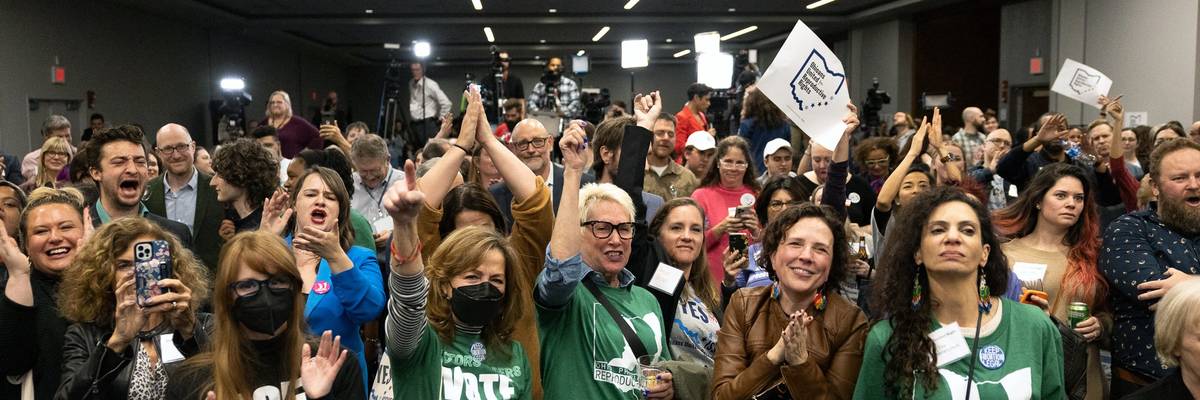
Abortion rights supporters celebrate the passage of Issue One in Ohio.
Tuesday’s vote has broader implications for direct democracy and its ability to reshape state policy across the country.
Ohio voters amended their state constitution Tuesday to protect reproductive rights, including the right to abortion. They also passed a law legalizing marijuana possession and use by adults 21 and older. This watershed election underscores the vital role that direct democracy plays in enabling voters to shape their own laws when their elected representatives ignore their preferences.
To enshrine reproductive rights in the state constitution by passing Issue One, proponents had to overcome multiple hurdles thrown up in the past several months by anti-abortion politicians. They also had to overcome voters’ general reluctance to change the constitution: In the past 15 years, out of more than 60 campaigns in Ohio, only three amendments had passed before this one.
Ohio is one of 16 states that allows voters to put constitutional amendments up for a popular vote if they collect enough signatures. As in most of these states, Ohio voters fought for this form of direct democracy to counteract political cartels that captured the legislature in the late 19th century. As one contemporary account described, when delegates to the 1912 Ohio constitutional convention adopted a new amendment to create the citizen initiative process and referred the measure to voters, “every ruse and trick known to Big Business politicians was employed to frighten the people of Ohio from adopting” it. It passed with 58% of the vote.
In enacting these policies, voters are overcoming various barriers to democracy—not just gerrymandering but also the incumbency advantage and the distorting effects of campaign financing rules that give undue influence to the wealthy and special interests.
This year, true to history, anti-abortion politicians like Gov. Mike DeWine and Secretary of State Frank LaRose used “every ruse and trick” available to block Issue One. First, they cynically engineered an off-season summer election to propose a constitutional amendment that would have made it far harder to amend the constitution in the future. Rather than disclose to voters that the proposed amendment would reduce opportunities for direct democracy, the plan’s proponents described it as “elevating” standards. Voters saw through the dishonesty and overwhelmingly rejected the measure.
Next, these politicians set to work using their state authority to discourage voters from passing the abortion rights amendment. They drafted a confusing and argumentative ballot description for voters to read just before voting. They ran misleading ads, passed a legislative resolution rife with misinformation, and warned that the amendment would bring about “atrocities.” Once again, voters weren’t tricked, approving the amendment 57–43.
It’s no accident that this constitutional amendment passed in Ohio, where one of the most gerrymandered legislatures in the country had enacted a draconian and wildly unpopular abortion ban that—before being temporarily blocked by a court—forced a 10-year-old rape victim to travel to Indiana for care and denied women treatment for dangerous pregnancy complications.
But Tuesday’s vote has broader implications for direct democracy and its ability to reshape state policy across the country, particularly in states where gerrymandered legislatures have for years insulated themselves from the will of the voters. Even now, voting rights advocates are readying an initiative to reform Ohio’s redistricting process. They are not backing down from their vision of a legislature that actually reflects the political balance in the state, even after Republican lawmakers pushed through unfair maps in violation of voter-approved constitutional requirements, then flouted multiple court orders to fix them, and even after the attorney general has repeatedly thwarted current reform efforts.
Citizens in other states have enacted major policies in a number of areas where legislatures had refused to act. They created independent redistricting commissions in Arizona, California—and in Michigan, where they also passed automatic voter registration and other voting rights measures. In Florida, they restored voting rights for individuals with felony convictions who have served their sentences. In Missouri, they banned lobbyist gifts to lawmakers. Voters have made policy in other areas as well, enacting wage increases in states like Arizona, Arkansas, Florida, Maine, and Nebraska; expanding Medicaid in Idaho, Missouri, Nebraska, Oklahoma, and Utah; and securing reproductive rights in Michigan.
In enacting these policies, voters are overcoming various barriers to democracy—not just gerrymandering but also the incumbency advantage and the distorting effects of campaign financing rules that give undue influence to the wealthy and special interests. Looking ahead, citizens are planning paid sick leave initiatives in Missouri, Nebraska, and Alaska, as well as open primaries and ranked choice voting in Nevada.
Perhaps unsurprisingly, politicians in several of these states, as in Ohio, have been trying to make initiatives harder to pass—most egregiously in Missouri, Arizona, North Dakota, Florida, and Wisconsin. Tuesday’s results represent a spectacular failure of that approach. People care about their right to govern themselves. And Ohio voters have shown that direct democracy remains a vital tool for voters to make themselves heard over the noise of moneyed and powerful special interests.
Dear Common Dreams reader, It’s been nearly 30 years since I co-founded Common Dreams with my late wife, Lina Newhouser. We had the radical notion that journalism should serve the public good, not corporate profits. It was clear to us from the outset what it would take to build such a project. No paid advertisements. No corporate sponsors. No millionaire publisher telling us what to think or do. Many people said we wouldn't last a year, but we proved those doubters wrong. Together with a tremendous team of journalists and dedicated staff, we built an independent media outlet free from the constraints of profits and corporate control. Our mission has always been simple: To inform. To inspire. To ignite change for the common good. Building Common Dreams was not easy. Our survival was never guaranteed. When you take on the most powerful forces—Wall Street greed, fossil fuel industry destruction, Big Tech lobbyists, and uber-rich oligarchs who have spent billions upon billions rigging the economy and democracy in their favor—the only bulwark you have is supporters who believe in your work. But here’s the urgent message from me today. It's never been this bad out there. And it's never been this hard to keep us going. At the very moment Common Dreams is most needed, the threats we face are intensifying. We need your support now more than ever. We don't accept corporate advertising and never will. We don't have a paywall because we don't think people should be blocked from critical news based on their ability to pay. Everything we do is funded by the donations of readers like you. When everyone does the little they can afford, we are strong. But if that support retreats or dries up, so do we. Will you donate now to make sure Common Dreams not only survives but thrives? —Craig Brown, Co-founder |
Ohio voters amended their state constitution Tuesday to protect reproductive rights, including the right to abortion. They also passed a law legalizing marijuana possession and use by adults 21 and older. This watershed election underscores the vital role that direct democracy plays in enabling voters to shape their own laws when their elected representatives ignore their preferences.
To enshrine reproductive rights in the state constitution by passing Issue One, proponents had to overcome multiple hurdles thrown up in the past several months by anti-abortion politicians. They also had to overcome voters’ general reluctance to change the constitution: In the past 15 years, out of more than 60 campaigns in Ohio, only three amendments had passed before this one.
Ohio is one of 16 states that allows voters to put constitutional amendments up for a popular vote if they collect enough signatures. As in most of these states, Ohio voters fought for this form of direct democracy to counteract political cartels that captured the legislature in the late 19th century. As one contemporary account described, when delegates to the 1912 Ohio constitutional convention adopted a new amendment to create the citizen initiative process and referred the measure to voters, “every ruse and trick known to Big Business politicians was employed to frighten the people of Ohio from adopting” it. It passed with 58% of the vote.
In enacting these policies, voters are overcoming various barriers to democracy—not just gerrymandering but also the incumbency advantage and the distorting effects of campaign financing rules that give undue influence to the wealthy and special interests.
This year, true to history, anti-abortion politicians like Gov. Mike DeWine and Secretary of State Frank LaRose used “every ruse and trick” available to block Issue One. First, they cynically engineered an off-season summer election to propose a constitutional amendment that would have made it far harder to amend the constitution in the future. Rather than disclose to voters that the proposed amendment would reduce opportunities for direct democracy, the plan’s proponents described it as “elevating” standards. Voters saw through the dishonesty and overwhelmingly rejected the measure.
Next, these politicians set to work using their state authority to discourage voters from passing the abortion rights amendment. They drafted a confusing and argumentative ballot description for voters to read just before voting. They ran misleading ads, passed a legislative resolution rife with misinformation, and warned that the amendment would bring about “atrocities.” Once again, voters weren’t tricked, approving the amendment 57–43.
It’s no accident that this constitutional amendment passed in Ohio, where one of the most gerrymandered legislatures in the country had enacted a draconian and wildly unpopular abortion ban that—before being temporarily blocked by a court—forced a 10-year-old rape victim to travel to Indiana for care and denied women treatment for dangerous pregnancy complications.
But Tuesday’s vote has broader implications for direct democracy and its ability to reshape state policy across the country, particularly in states where gerrymandered legislatures have for years insulated themselves from the will of the voters. Even now, voting rights advocates are readying an initiative to reform Ohio’s redistricting process. They are not backing down from their vision of a legislature that actually reflects the political balance in the state, even after Republican lawmakers pushed through unfair maps in violation of voter-approved constitutional requirements, then flouted multiple court orders to fix them, and even after the attorney general has repeatedly thwarted current reform efforts.
Citizens in other states have enacted major policies in a number of areas where legislatures had refused to act. They created independent redistricting commissions in Arizona, California—and in Michigan, where they also passed automatic voter registration and other voting rights measures. In Florida, they restored voting rights for individuals with felony convictions who have served their sentences. In Missouri, they banned lobbyist gifts to lawmakers. Voters have made policy in other areas as well, enacting wage increases in states like Arizona, Arkansas, Florida, Maine, and Nebraska; expanding Medicaid in Idaho, Missouri, Nebraska, Oklahoma, and Utah; and securing reproductive rights in Michigan.
In enacting these policies, voters are overcoming various barriers to democracy—not just gerrymandering but also the incumbency advantage and the distorting effects of campaign financing rules that give undue influence to the wealthy and special interests. Looking ahead, citizens are planning paid sick leave initiatives in Missouri, Nebraska, and Alaska, as well as open primaries and ranked choice voting in Nevada.
Perhaps unsurprisingly, politicians in several of these states, as in Ohio, have been trying to make initiatives harder to pass—most egregiously in Missouri, Arizona, North Dakota, Florida, and Wisconsin. Tuesday’s results represent a spectacular failure of that approach. People care about their right to govern themselves. And Ohio voters have shown that direct democracy remains a vital tool for voters to make themselves heard over the noise of moneyed and powerful special interests.
Ohio voters amended their state constitution Tuesday to protect reproductive rights, including the right to abortion. They also passed a law legalizing marijuana possession and use by adults 21 and older. This watershed election underscores the vital role that direct democracy plays in enabling voters to shape their own laws when their elected representatives ignore their preferences.
To enshrine reproductive rights in the state constitution by passing Issue One, proponents had to overcome multiple hurdles thrown up in the past several months by anti-abortion politicians. They also had to overcome voters’ general reluctance to change the constitution: In the past 15 years, out of more than 60 campaigns in Ohio, only three amendments had passed before this one.
Ohio is one of 16 states that allows voters to put constitutional amendments up for a popular vote if they collect enough signatures. As in most of these states, Ohio voters fought for this form of direct democracy to counteract political cartels that captured the legislature in the late 19th century. As one contemporary account described, when delegates to the 1912 Ohio constitutional convention adopted a new amendment to create the citizen initiative process and referred the measure to voters, “every ruse and trick known to Big Business politicians was employed to frighten the people of Ohio from adopting” it. It passed with 58% of the vote.
In enacting these policies, voters are overcoming various barriers to democracy—not just gerrymandering but also the incumbency advantage and the distorting effects of campaign financing rules that give undue influence to the wealthy and special interests.
This year, true to history, anti-abortion politicians like Gov. Mike DeWine and Secretary of State Frank LaRose used “every ruse and trick” available to block Issue One. First, they cynically engineered an off-season summer election to propose a constitutional amendment that would have made it far harder to amend the constitution in the future. Rather than disclose to voters that the proposed amendment would reduce opportunities for direct democracy, the plan’s proponents described it as “elevating” standards. Voters saw through the dishonesty and overwhelmingly rejected the measure.
Next, these politicians set to work using their state authority to discourage voters from passing the abortion rights amendment. They drafted a confusing and argumentative ballot description for voters to read just before voting. They ran misleading ads, passed a legislative resolution rife with misinformation, and warned that the amendment would bring about “atrocities.” Once again, voters weren’t tricked, approving the amendment 57–43.
It’s no accident that this constitutional amendment passed in Ohio, where one of the most gerrymandered legislatures in the country had enacted a draconian and wildly unpopular abortion ban that—before being temporarily blocked by a court—forced a 10-year-old rape victim to travel to Indiana for care and denied women treatment for dangerous pregnancy complications.
But Tuesday’s vote has broader implications for direct democracy and its ability to reshape state policy across the country, particularly in states where gerrymandered legislatures have for years insulated themselves from the will of the voters. Even now, voting rights advocates are readying an initiative to reform Ohio’s redistricting process. They are not backing down from their vision of a legislature that actually reflects the political balance in the state, even after Republican lawmakers pushed through unfair maps in violation of voter-approved constitutional requirements, then flouted multiple court orders to fix them, and even after the attorney general has repeatedly thwarted current reform efforts.
Citizens in other states have enacted major policies in a number of areas where legislatures had refused to act. They created independent redistricting commissions in Arizona, California—and in Michigan, where they also passed automatic voter registration and other voting rights measures. In Florida, they restored voting rights for individuals with felony convictions who have served their sentences. In Missouri, they banned lobbyist gifts to lawmakers. Voters have made policy in other areas as well, enacting wage increases in states like Arizona, Arkansas, Florida, Maine, and Nebraska; expanding Medicaid in Idaho, Missouri, Nebraska, Oklahoma, and Utah; and securing reproductive rights in Michigan.
In enacting these policies, voters are overcoming various barriers to democracy—not just gerrymandering but also the incumbency advantage and the distorting effects of campaign financing rules that give undue influence to the wealthy and special interests. Looking ahead, citizens are planning paid sick leave initiatives in Missouri, Nebraska, and Alaska, as well as open primaries and ranked choice voting in Nevada.
Perhaps unsurprisingly, politicians in several of these states, as in Ohio, have been trying to make initiatives harder to pass—most egregiously in Missouri, Arizona, North Dakota, Florida, and Wisconsin. Tuesday’s results represent a spectacular failure of that approach. People care about their right to govern themselves. And Ohio voters have shown that direct democracy remains a vital tool for voters to make themselves heard over the noise of moneyed and powerful special interests.