SUBSCRIBE TO OUR FREE NEWSLETTER
Daily news & progressive opinion—funded by the people, not the corporations—delivered straight to your inbox.
5
#000000
#FFFFFF
To donate by check, phone, or other method, see our More Ways to Give page.
Daily news & progressive opinion—funded by the people, not the corporations—delivered straight to your inbox.
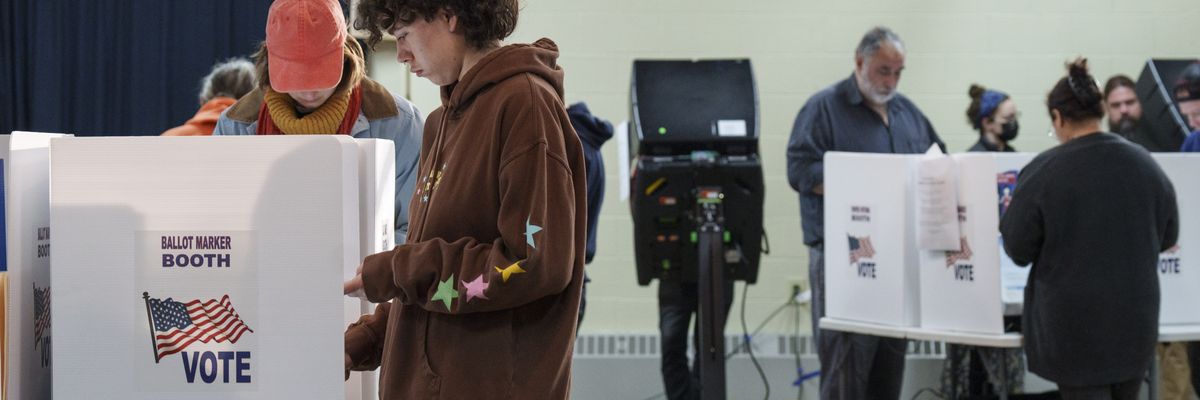
People vote at a polling location at Indianola Church of Christ on November 8, 2022 in Columbus, Ohio.
Republicans' "true motivation, aside from their insatiable desire for power, is to stop women from having the reproductive freedom that we so deserve," said one state lawmaker.
The Ohio Supreme Court's right-wing majority on Friday handed down a ruling that critics said will ultimately make it more difficult for residents to participate in popular democracy by introducing ballot initiatives in future elections—including the one coming up in November, in which reproductive rights advocates aim to hold a referendum on abortion rights.
The court ruled 4-3 in favor of allowing a special election scheduled for August 8 to go forward, even though Republican Gov. Mike DeWine signed a law earlier this year banning August elections in most cases.
The majority said that the state Constitution "authorizes the General Assembly to impose or direct a special election in furtherance of a proposed constitutional amendment."
In the election, Ohioans will vote on a proposal put forward by Republican legislators to increase the threshold needed to amend the state Constitution via referendum from a simple majority to 60%. The proposal would also make it harder for voters to get citizen-led initiatives onto ballots.
"If it passes, the measure would dramatically curtail a tool of direct democracy that has existed in the state for more than a century," wrote Cameron Joseph at Bolts earlier this month.
Mia Lewis, associate director of Common Cause Ohio, told the outlet that the Republican proposal is "an attempt to fool voters into giving away their power."
The special election, which is being held at a time of year that's typically plagued by low voter turnout, will take place as abortion rights advocates are pushing to hold a referendum during the November elections on whether to enshrine the right to abortion care in Ohio's Constitution. States including California and Michigan have affirmed that abortion is a constitutional right since the U.S. Supreme Court overturned Roe v. Wade a year ago.
"Their true motivation" for holding the August election, Ohio House Minority Whip Jessica Miranda (D-28) told Bolts, "aside from their insatiable desire for power, is to stop women from having the reproductive freedom that we so deserve."
Ohio Republicans have joined GOP lawmakers in several other states in attempting to make it harder for ballot measures to be put to a popular vote. Arkansas Republicans passed a law earlier this year making it harder for residents to place proposals on ballots and the Utah GOP passed a similar law in 2021.
Abortion is currently legal in Ohio up to 22 weeks of pregnancy, but Republicans have attempted to ban the procedure at six weeks of pregnancy.
A poll by Baldwin Wallace University last year found that 59% of Ohio residents supported a constitutional amendment that would enshrine abortion access as a right for all Ohioans.
Kelly Hall, executive director of the pro-democracy group Fairness Project, said the question being put to voters in August "is a blatant attempt to undermine direct democracy and diminish voters' rights to make their own decisions on issues that matter to them."
"Despite this unfortunate ruling," Hall said, "we’re confident in the strong, pro-democracy coalition that has formed" to mobilize against the Republican proposal.
This country and this world are at a monumental crossroads. US voters have an opportunity to beat back the forces of fascism and confront the billionaires who are rigging the economy, our media system, and our democracy, making it increasingly impossible for ordinary people to get by. We’re not just talking about the election. We’re talking about what must be done once these fascist elements are vanquished from power. We need a bolder set of solutions than what either major party has so far been willing to offer and a working-class movement ready to fight like hell for it. Trump didn't emerge from nowhere. The conditions that fueled MAGA authoritarianism were created by decades of radical neoliberal economic policies and a corrupt political system dominated by corporate interests. They slashed taxes on the super-rich, promising that the benefits would trickle down. They said giveaways to the corporate titans would make life more affordable for the rest of us. It was all bullshit. And when a bitter, betrayed populace searches for someone to blame, right-wing demagogues have little trouble finding scapegoats. People know when they're being lied to, but you won't hear any of this from the corporate media. Only independent journalism—powered and funded by people who believe in building a better world—can deliver truly trustworthy daily news. If you share our vision, please contribute whatever you can to sustain our work. |
The Ohio Supreme Court's right-wing majority on Friday handed down a ruling that critics said will ultimately make it more difficult for residents to participate in popular democracy by introducing ballot initiatives in future elections—including the one coming up in November, in which reproductive rights advocates aim to hold a referendum on abortion rights.
The court ruled 4-3 in favor of allowing a special election scheduled for August 8 to go forward, even though Republican Gov. Mike DeWine signed a law earlier this year banning August elections in most cases.
The majority said that the state Constitution "authorizes the General Assembly to impose or direct a special election in furtherance of a proposed constitutional amendment."
In the election, Ohioans will vote on a proposal put forward by Republican legislators to increase the threshold needed to amend the state Constitution via referendum from a simple majority to 60%. The proposal would also make it harder for voters to get citizen-led initiatives onto ballots.
"If it passes, the measure would dramatically curtail a tool of direct democracy that has existed in the state for more than a century," wrote Cameron Joseph at Bolts earlier this month.
Mia Lewis, associate director of Common Cause Ohio, told the outlet that the Republican proposal is "an attempt to fool voters into giving away their power."
The special election, which is being held at a time of year that's typically plagued by low voter turnout, will take place as abortion rights advocates are pushing to hold a referendum during the November elections on whether to enshrine the right to abortion care in Ohio's Constitution. States including California and Michigan have affirmed that abortion is a constitutional right since the U.S. Supreme Court overturned Roe v. Wade a year ago.
"Their true motivation" for holding the August election, Ohio House Minority Whip Jessica Miranda (D-28) told Bolts, "aside from their insatiable desire for power, is to stop women from having the reproductive freedom that we so deserve."
Ohio Republicans have joined GOP lawmakers in several other states in attempting to make it harder for ballot measures to be put to a popular vote. Arkansas Republicans passed a law earlier this year making it harder for residents to place proposals on ballots and the Utah GOP passed a similar law in 2021.
Abortion is currently legal in Ohio up to 22 weeks of pregnancy, but Republicans have attempted to ban the procedure at six weeks of pregnancy.
A poll by Baldwin Wallace University last year found that 59% of Ohio residents supported a constitutional amendment that would enshrine abortion access as a right for all Ohioans.
Kelly Hall, executive director of the pro-democracy group Fairness Project, said the question being put to voters in August "is a blatant attempt to undermine direct democracy and diminish voters' rights to make their own decisions on issues that matter to them."
"Despite this unfortunate ruling," Hall said, "we’re confident in the strong, pro-democracy coalition that has formed" to mobilize against the Republican proposal.