

SUBSCRIBE TO OUR FREE NEWSLETTER
Daily news & progressive opinion—funded by the people, not the corporations—delivered straight to your inbox.
5
#000000
#FFFFFF
To donate by check, phone, or other method, see our More Ways to Give page.
Daily news & progressive opinion—funded by the people, not the corporations—delivered straight to your inbox.
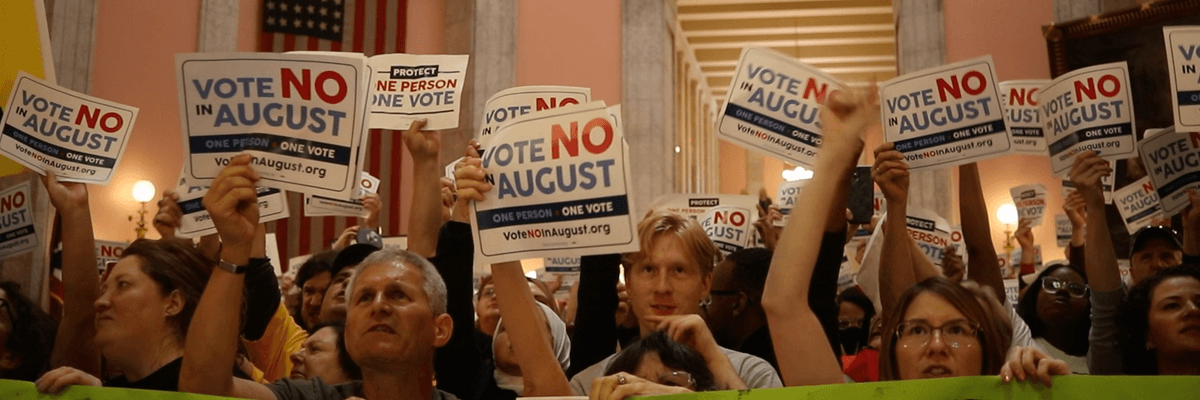
Opponents of Issue 1 hold a demonstration against the GOP's effort to restrict the ballot initiative process.
"Issue 1 was a blatant attempt by its supporters to control both the policy agenda and the process of direct democracy," said one campaigner.
Ohio voters on Tuesday decisively rejected a Republican-authored measure that would have made it more difficult to amend the state constitution through the ballot initiative process, a billionaire-funded effort aimed at preempting a November vote on abortion rights.
If approved by voters, the measure known as Issue 1 would have raised the threshold for passage of a constitutional amendment from a simple majority to 60%. The measure also would have imposed more stringent signature requirements for Ohio ballot initiatives.
The GOP proposal—which was the only item on the ballot in Tuesday's special election—failed by a vote of 43% to 57%, according to the Ohio secretary of state's office.
"Issue 1 was a blatant attempt by its supporters to control both the policy agenda and the process of direct democracy," said Rachael Belz, the CEO of Ohio Citizen Action, one of the groups that mobilized in opposition to the proposal. "When they forced Issue 1 onto the ballot, they awakened a sleeping giant and unleashed a movement. And that movement isn't going away tomorrow. It will continue to build and grow and to carry us through to victories in November and beyond."
The Republican push for Issue 1 drew national attention given the implications for both the democratic process and reproductive rights in Ohio, where abortion is currently legal through 22 weeks of pregnancy—though the state GOP is working to change that.
A proposed constitutional amendment on the ballot in November would codify the right to abortion access in the Ohio constitution, stating that "every individual has a right to make and carry out one's own reproductive decisions, including but not limited to decisions on contraception, fertility treatment, continuing one's own pregnancy, miscarriage care, and abortion."
Frank LaRose, Ohio's Republican secretary of state and a U.S. Senate hopeful, said in June that Issue 1 was " 100% about" preventing passage of the abortion rights amendment.
Recent polling indicates that around 58% of Ohioans back the proposed amendment—a level of support that would have been insufficient had Issue 1 succeeded.
"From defeating Issue 1 tonight to submitting nearly twice the amount of signatures needed to get a measure protecting abortion access on the ballot in November, Ohio voters have made clear that they will settle for nothing less than reproductive freedom for all," Mini Timmaraju, the president of NARAL Pro-Choice America, said in a statement late Tuesday.
"Republicans should be ashamed of their efforts to subvert the will of voters," Timmaraju added. "Seeing this measure defeated is a victory for our fundamental rights and our democracy. We're grateful to our partners on the ground for their tireless efforts to secure abortion rights and access. We look forward to fighting by their side to lock this fundamental freedom into law in November."
"It was the hard work and resilience of Ohioans of all parties that prevented the destruction of a foundational right we've held for 110+ years."
The Republican attack on the ballot initiative process in Ohio is part of a nationwide GOP effort to limit direct democracy as the party—emboldened by the right-wing U.S. Supreme Court—continues its effort to roll back abortion rights and other freedoms.
According to a March tally by election analyst Stephen Wolf, Republicans have recently tried to make it harder to pass citizen-led ballot initiatives in at least 10 states, including Ohio, Florida, Arizona, and Arkansas.
"In the many states where the GOP has refused to take action, activists have used ballot initiatives to expand Medicaid, raise the minimum wage, secure abortion rights, protect the right to vote, curb gerrymandering, legalize marijuana, promote gun safety, and more," Wolf wrote. "How have Republicans reacted to this? By trying to make it harder to pass initiatives in the first place."
Catherine Turcer, executive director of Common Cause Ohio, said Tuesday that "since 1912, Ohioans have had the right to collect signatures and bring proposed constitutional amendments directly to voters."
"This is an important check on the state legislature, hyperpartisan politicians, and special interests who did everything they could to take away that right," Turcer added. "It was the hard work and resilience of Ohioans of all parties that prevented the destruction of a foundational right we've held for 110+ years."
"Tonight's results," Turcer said, "are a resounding victory for Ohio voters who helped stop this power grab by the state legislature and Secretary of State Frank LaRose."
Dear Common Dreams reader, It’s been nearly 30 years since I co-founded Common Dreams with my late wife, Lina Newhouser. We had the radical notion that journalism should serve the public good, not corporate profits. It was clear to us from the outset what it would take to build such a project. No paid advertisements. No corporate sponsors. No millionaire publisher telling us what to think or do. Many people said we wouldn't last a year, but we proved those doubters wrong. Together with a tremendous team of journalists and dedicated staff, we built an independent media outlet free from the constraints of profits and corporate control. Our mission has always been simple: To inform. To inspire. To ignite change for the common good. Building Common Dreams was not easy. Our survival was never guaranteed. When you take on the most powerful forces—Wall Street greed, fossil fuel industry destruction, Big Tech lobbyists, and uber-rich oligarchs who have spent billions upon billions rigging the economy and democracy in their favor—the only bulwark you have is supporters who believe in your work. But here’s the urgent message from me today. It's never been this bad out there. And it's never been this hard to keep us going. At the very moment Common Dreams is most needed, the threats we face are intensifying. We need your support now more than ever. We don't accept corporate advertising and never will. We don't have a paywall because we don't think people should be blocked from critical news based on their ability to pay. Everything we do is funded by the donations of readers like you. When everyone does the little they can afford, we are strong. But if that support retreats or dries up, so do we. Will you donate now to make sure Common Dreams not only survives but thrives? —Craig Brown, Co-founder |
Ohio voters on Tuesday decisively rejected a Republican-authored measure that would have made it more difficult to amend the state constitution through the ballot initiative process, a billionaire-funded effort aimed at preempting a November vote on abortion rights.
If approved by voters, the measure known as Issue 1 would have raised the threshold for passage of a constitutional amendment from a simple majority to 60%. The measure also would have imposed more stringent signature requirements for Ohio ballot initiatives.
The GOP proposal—which was the only item on the ballot in Tuesday's special election—failed by a vote of 43% to 57%, according to the Ohio secretary of state's office.
"Issue 1 was a blatant attempt by its supporters to control both the policy agenda and the process of direct democracy," said Rachael Belz, the CEO of Ohio Citizen Action, one of the groups that mobilized in opposition to the proposal. "When they forced Issue 1 onto the ballot, they awakened a sleeping giant and unleashed a movement. And that movement isn't going away tomorrow. It will continue to build and grow and to carry us through to victories in November and beyond."
The Republican push for Issue 1 drew national attention given the implications for both the democratic process and reproductive rights in Ohio, where abortion is currently legal through 22 weeks of pregnancy—though the state GOP is working to change that.
A proposed constitutional amendment on the ballot in November would codify the right to abortion access in the Ohio constitution, stating that "every individual has a right to make and carry out one's own reproductive decisions, including but not limited to decisions on contraception, fertility treatment, continuing one's own pregnancy, miscarriage care, and abortion."
Frank LaRose, Ohio's Republican secretary of state and a U.S. Senate hopeful, said in June that Issue 1 was " 100% about" preventing passage of the abortion rights amendment.
Recent polling indicates that around 58% of Ohioans back the proposed amendment—a level of support that would have been insufficient had Issue 1 succeeded.
"From defeating Issue 1 tonight to submitting nearly twice the amount of signatures needed to get a measure protecting abortion access on the ballot in November, Ohio voters have made clear that they will settle for nothing less than reproductive freedom for all," Mini Timmaraju, the president of NARAL Pro-Choice America, said in a statement late Tuesday.
"Republicans should be ashamed of their efforts to subvert the will of voters," Timmaraju added. "Seeing this measure defeated is a victory for our fundamental rights and our democracy. We're grateful to our partners on the ground for their tireless efforts to secure abortion rights and access. We look forward to fighting by their side to lock this fundamental freedom into law in November."
"It was the hard work and resilience of Ohioans of all parties that prevented the destruction of a foundational right we've held for 110+ years."
The Republican attack on the ballot initiative process in Ohio is part of a nationwide GOP effort to limit direct democracy as the party—emboldened by the right-wing U.S. Supreme Court—continues its effort to roll back abortion rights and other freedoms.
According to a March tally by election analyst Stephen Wolf, Republicans have recently tried to make it harder to pass citizen-led ballot initiatives in at least 10 states, including Ohio, Florida, Arizona, and Arkansas.
"In the many states where the GOP has refused to take action, activists have used ballot initiatives to expand Medicaid, raise the minimum wage, secure abortion rights, protect the right to vote, curb gerrymandering, legalize marijuana, promote gun safety, and more," Wolf wrote. "How have Republicans reacted to this? By trying to make it harder to pass initiatives in the first place."
Catherine Turcer, executive director of Common Cause Ohio, said Tuesday that "since 1912, Ohioans have had the right to collect signatures and bring proposed constitutional amendments directly to voters."
"This is an important check on the state legislature, hyperpartisan politicians, and special interests who did everything they could to take away that right," Turcer added. "It was the hard work and resilience of Ohioans of all parties that prevented the destruction of a foundational right we've held for 110+ years."
"Tonight's results," Turcer said, "are a resounding victory for Ohio voters who helped stop this power grab by the state legislature and Secretary of State Frank LaRose."
Ohio voters on Tuesday decisively rejected a Republican-authored measure that would have made it more difficult to amend the state constitution through the ballot initiative process, a billionaire-funded effort aimed at preempting a November vote on abortion rights.
If approved by voters, the measure known as Issue 1 would have raised the threshold for passage of a constitutional amendment from a simple majority to 60%. The measure also would have imposed more stringent signature requirements for Ohio ballot initiatives.
The GOP proposal—which was the only item on the ballot in Tuesday's special election—failed by a vote of 43% to 57%, according to the Ohio secretary of state's office.
"Issue 1 was a blatant attempt by its supporters to control both the policy agenda and the process of direct democracy," said Rachael Belz, the CEO of Ohio Citizen Action, one of the groups that mobilized in opposition to the proposal. "When they forced Issue 1 onto the ballot, they awakened a sleeping giant and unleashed a movement. And that movement isn't going away tomorrow. It will continue to build and grow and to carry us through to victories in November and beyond."
The Republican push for Issue 1 drew national attention given the implications for both the democratic process and reproductive rights in Ohio, where abortion is currently legal through 22 weeks of pregnancy—though the state GOP is working to change that.
A proposed constitutional amendment on the ballot in November would codify the right to abortion access in the Ohio constitution, stating that "every individual has a right to make and carry out one's own reproductive decisions, including but not limited to decisions on contraception, fertility treatment, continuing one's own pregnancy, miscarriage care, and abortion."
Frank LaRose, Ohio's Republican secretary of state and a U.S. Senate hopeful, said in June that Issue 1 was " 100% about" preventing passage of the abortion rights amendment.
Recent polling indicates that around 58% of Ohioans back the proposed amendment—a level of support that would have been insufficient had Issue 1 succeeded.
"From defeating Issue 1 tonight to submitting nearly twice the amount of signatures needed to get a measure protecting abortion access on the ballot in November, Ohio voters have made clear that they will settle for nothing less than reproductive freedom for all," Mini Timmaraju, the president of NARAL Pro-Choice America, said in a statement late Tuesday.
"Republicans should be ashamed of their efforts to subvert the will of voters," Timmaraju added. "Seeing this measure defeated is a victory for our fundamental rights and our democracy. We're grateful to our partners on the ground for their tireless efforts to secure abortion rights and access. We look forward to fighting by their side to lock this fundamental freedom into law in November."
"It was the hard work and resilience of Ohioans of all parties that prevented the destruction of a foundational right we've held for 110+ years."
The Republican attack on the ballot initiative process in Ohio is part of a nationwide GOP effort to limit direct democracy as the party—emboldened by the right-wing U.S. Supreme Court—continues its effort to roll back abortion rights and other freedoms.
According to a March tally by election analyst Stephen Wolf, Republicans have recently tried to make it harder to pass citizen-led ballot initiatives in at least 10 states, including Ohio, Florida, Arizona, and Arkansas.
"In the many states where the GOP has refused to take action, activists have used ballot initiatives to expand Medicaid, raise the minimum wage, secure abortion rights, protect the right to vote, curb gerrymandering, legalize marijuana, promote gun safety, and more," Wolf wrote. "How have Republicans reacted to this? By trying to make it harder to pass initiatives in the first place."
Catherine Turcer, executive director of Common Cause Ohio, said Tuesday that "since 1912, Ohioans have had the right to collect signatures and bring proposed constitutional amendments directly to voters."
"This is an important check on the state legislature, hyperpartisan politicians, and special interests who did everything they could to take away that right," Turcer added. "It was the hard work and resilience of Ohioans of all parties that prevented the destruction of a foundational right we've held for 110+ years."
"Tonight's results," Turcer said, "are a resounding victory for Ohio voters who helped stop this power grab by the state legislature and Secretary of State Frank LaRose."

