SUBSCRIBE TO OUR FREE NEWSLETTER
Daily news & progressive opinion—funded by the people, not the corporations—delivered straight to your inbox.
5
#000000
#FFFFFF
To donate by check, phone, or other method, see our More Ways to Give page.
Daily news & progressive opinion—funded by the people, not the corporations—delivered straight to your inbox.
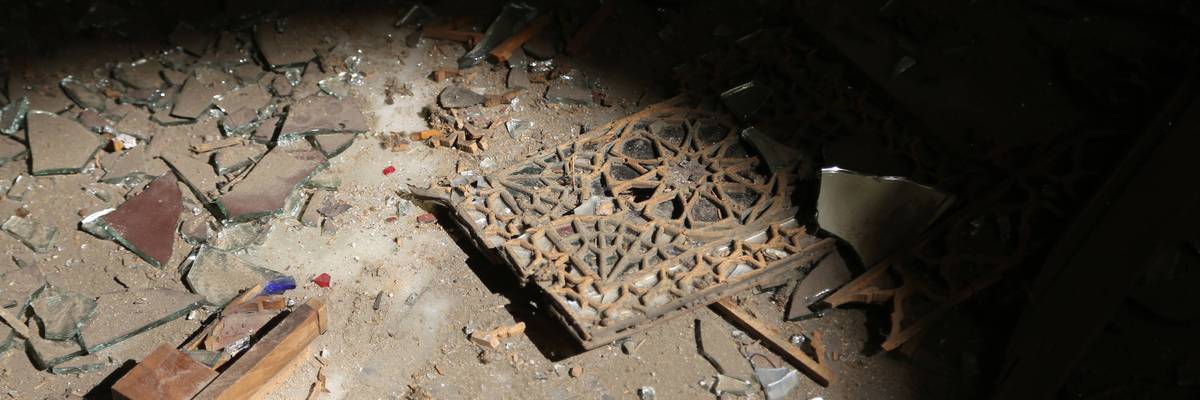
This photo taken on March 3, 2026 shows a view of the damaged Golestan Palace in Tehran, Iran; the Golestan Palace, a UNESCO World Heritage Site, was partially damaged in air raids during US and Israeli strikes on Iran.
The deliberate targeting of sites that have withstood centuries of conquest, colonial incursion, and modern warfare—including World War II and the Iran-Iraq War—constitutes a flagrant violation of international norms.
In modern warfare, destruction is not limited to armed forces or strategic installations. When historic sites are bombed and ancient cities violated, the target becomes civilization itself. The ongoing US-Israeli offensive in Iran exemplifies this brutal calculus with stark clarity: a deliberate campaign not merely to dominate the battlefield, but to erase the memory of a people and the tangible heritage of human history.
According to the Iranian Ministry of Cultural Heritage, nearly 60 museums and historical sites have suffered damage in the first days of the campaign. This staggering figure is more than a statistic; it constitutes a cultural massacre, erasing millennia of accumulated knowledge and artistry. These sites are not inert monuments—they are living archives of human endeavor, ranging from ancient Persian dynasties to Islamic empires, where palaces, mosques, markets, and gardens coalesce into an irreplaceable cultural mosaic.
In Isfahan, long celebrated as “Half the World,” the Ali Qapu Palace has sustained damage to its 17th-century carved wood and frescoes. The iconic Chehel Sotoun Garden, with its elaborate tiled halls and painted pavilions, has seen its delicate ornamentation destroyed. Even the Naqsh-e Jahan Square, one of the world’s largest historic plazas, has witnessed structural damage to surrounding heritage buildings. The Grand Mosque of Isfahan, a millennium-old architectural jewel, has lost portions of its turquoise tiles from domes and minarets.
Tehran has not been spared. The Golestan Palace, dating back to the 14th century and later the Qajar royal residence, has endured shattered stained glass, damaged wooden ornamentation, and debris scattered across its historic gardens after strikes on nearby structures. In western Iran, Falak-ol-Aflak Castle in Khorramabad, an ancient Sassanian fortress hosting local museums, has been partially destroyed following an airstrike on a cultural ministry building.
What moral authority does a nation claim when it devastates the heritage of others while asserting itself as a defender of human values?
The offensive has also struck smaller, yet historically significant, urban areas. In Bushehr province, the old quarter of Siraf—a centuries-old maritime trade hub—has suffered damage to traditional homes and heritage structures. Tehran alone has registered damage to 19 historical sites, highlighting the scale and indiscriminate nature of the strikes.
The deliberate targeting of sites that have withstood centuries of conquest, colonial incursion, and modern warfare—including World War II and the Iran-Iraq War—constitutes a flagrant violation of international norms. Both the Geneva Conventions and UNESCO conventions clearly mandate the protection of cultural property during armed conflict. The United States, in its orchestration of these strikes, has shown contempt for these legal frameworks, weaponizing heritage itself as a means of coercion and terror.
UNESCO has expressed profound concern over the attacks, warning that continued military operations threaten dozens of other cultural landmarks. This is not a local loss—it is a global one. Every destroyed site erases a chapter of shared human history; every shattered mosque, palace, or fortress obliterates a fragment of collective memory. Cultural heritage is not merely aesthetic; it is the anchor of identity and the repository of human civilization. Its deliberate destruction is an attack on the concept of history itself.
What is unfolding in Iran transcends conventional warfare; it is a war against memory, against the very idea of civilization. When historic squares, palaces, mosques, and fortresses are reduced to rubble, the moral bankruptcy of the aggressors is exposed. The US, in coordination with Israel, is not only waging a military campaign—it is perpetrating a calculated assault on cultural identity, turning its technological might against the living archives of humanity.
This is a conflict in which the battlefield is not only territory, but memory; not only cities, but the centuries of human achievement embedded in stone, tile, and timber. The deliberate targeting of Iran’s cultural heritage raises profound questions: What kind of civilization sanctions the obliteration of history? What moral authority does a nation claim when it devastates the heritage of others while asserting itself as a defender of human values?
The answer is stark. The United States has weaponized history itself, converting museums, mosques, and palaces into collateral in a broader agenda of coercion. In doing so, it has shown the world that its power is not measured in justice or civilization, but in the ruthlessness of its ability to erase the past. The human story, in Iran as elsewhere, is under siege—and the consequences reverberate far beyond its borders.
Dear Common Dreams reader, It’s been nearly 30 years since I co-founded Common Dreams with my late wife, Lina Newhouser. We had the radical notion that journalism should serve the public good, not corporate profits. It was clear to us from the outset what it would take to build such a project. No paid advertisements. No corporate sponsors. No millionaire publisher telling us what to think or do. Many people said we wouldn't last a year, but we proved those doubters wrong. Together with a tremendous team of journalists and dedicated staff, we built an independent media outlet free from the constraints of profits and corporate control. Our mission has always been simple: To inform. To inspire. To ignite change for the common good. Building Common Dreams was not easy. Our survival was never guaranteed. When you take on the most powerful forces—Wall Street greed, fossil fuel industry destruction, Big Tech lobbyists, and uber-rich oligarchs who have spent billions upon billions rigging the economy and democracy in their favor—the only bulwark you have is supporters who believe in your work. But here’s the urgent message from me today. It's never been this bad out there. And it's never been this hard to keep us going. At the very moment Common Dreams is most needed, the threats we face are intensifying. We need your support now more than ever. We don't accept corporate advertising and never will. We don't have a paywall because we don't think people should be blocked from critical news based on their ability to pay. Everything we do is funded by the donations of readers like you. When everyone does the little they can afford, we are strong. But if that support retreats or dries up, so do we. Will you donate now to make sure Common Dreams not only survives but thrives? —Craig Brown, Co-founder |
In modern warfare, destruction is not limited to armed forces or strategic installations. When historic sites are bombed and ancient cities violated, the target becomes civilization itself. The ongoing US-Israeli offensive in Iran exemplifies this brutal calculus with stark clarity: a deliberate campaign not merely to dominate the battlefield, but to erase the memory of a people and the tangible heritage of human history.
According to the Iranian Ministry of Cultural Heritage, nearly 60 museums and historical sites have suffered damage in the first days of the campaign. This staggering figure is more than a statistic; it constitutes a cultural massacre, erasing millennia of accumulated knowledge and artistry. These sites are not inert monuments—they are living archives of human endeavor, ranging from ancient Persian dynasties to Islamic empires, where palaces, mosques, markets, and gardens coalesce into an irreplaceable cultural mosaic.
In Isfahan, long celebrated as “Half the World,” the Ali Qapu Palace has sustained damage to its 17th-century carved wood and frescoes. The iconic Chehel Sotoun Garden, with its elaborate tiled halls and painted pavilions, has seen its delicate ornamentation destroyed. Even the Naqsh-e Jahan Square, one of the world’s largest historic plazas, has witnessed structural damage to surrounding heritage buildings. The Grand Mosque of Isfahan, a millennium-old architectural jewel, has lost portions of its turquoise tiles from domes and minarets.
Tehran has not been spared. The Golestan Palace, dating back to the 14th century and later the Qajar royal residence, has endured shattered stained glass, damaged wooden ornamentation, and debris scattered across its historic gardens after strikes on nearby structures. In western Iran, Falak-ol-Aflak Castle in Khorramabad, an ancient Sassanian fortress hosting local museums, has been partially destroyed following an airstrike on a cultural ministry building.
What moral authority does a nation claim when it devastates the heritage of others while asserting itself as a defender of human values?
The offensive has also struck smaller, yet historically significant, urban areas. In Bushehr province, the old quarter of Siraf—a centuries-old maritime trade hub—has suffered damage to traditional homes and heritage structures. Tehran alone has registered damage to 19 historical sites, highlighting the scale and indiscriminate nature of the strikes.
The deliberate targeting of sites that have withstood centuries of conquest, colonial incursion, and modern warfare—including World War II and the Iran-Iraq War—constitutes a flagrant violation of international norms. Both the Geneva Conventions and UNESCO conventions clearly mandate the protection of cultural property during armed conflict. The United States, in its orchestration of these strikes, has shown contempt for these legal frameworks, weaponizing heritage itself as a means of coercion and terror.
UNESCO has expressed profound concern over the attacks, warning that continued military operations threaten dozens of other cultural landmarks. This is not a local loss—it is a global one. Every destroyed site erases a chapter of shared human history; every shattered mosque, palace, or fortress obliterates a fragment of collective memory. Cultural heritage is not merely aesthetic; it is the anchor of identity and the repository of human civilization. Its deliberate destruction is an attack on the concept of history itself.
What is unfolding in Iran transcends conventional warfare; it is a war against memory, against the very idea of civilization. When historic squares, palaces, mosques, and fortresses are reduced to rubble, the moral bankruptcy of the aggressors is exposed. The US, in coordination with Israel, is not only waging a military campaign—it is perpetrating a calculated assault on cultural identity, turning its technological might against the living archives of humanity.
This is a conflict in which the battlefield is not only territory, but memory; not only cities, but the centuries of human achievement embedded in stone, tile, and timber. The deliberate targeting of Iran’s cultural heritage raises profound questions: What kind of civilization sanctions the obliteration of history? What moral authority does a nation claim when it devastates the heritage of others while asserting itself as a defender of human values?
The answer is stark. The United States has weaponized history itself, converting museums, mosques, and palaces into collateral in a broader agenda of coercion. In doing so, it has shown the world that its power is not measured in justice or civilization, but in the ruthlessness of its ability to erase the past. The human story, in Iran as elsewhere, is under siege—and the consequences reverberate far beyond its borders.
In modern warfare, destruction is not limited to armed forces or strategic installations. When historic sites are bombed and ancient cities violated, the target becomes civilization itself. The ongoing US-Israeli offensive in Iran exemplifies this brutal calculus with stark clarity: a deliberate campaign not merely to dominate the battlefield, but to erase the memory of a people and the tangible heritage of human history.
According to the Iranian Ministry of Cultural Heritage, nearly 60 museums and historical sites have suffered damage in the first days of the campaign. This staggering figure is more than a statistic; it constitutes a cultural massacre, erasing millennia of accumulated knowledge and artistry. These sites are not inert monuments—they are living archives of human endeavor, ranging from ancient Persian dynasties to Islamic empires, where palaces, mosques, markets, and gardens coalesce into an irreplaceable cultural mosaic.
In Isfahan, long celebrated as “Half the World,” the Ali Qapu Palace has sustained damage to its 17th-century carved wood and frescoes. The iconic Chehel Sotoun Garden, with its elaborate tiled halls and painted pavilions, has seen its delicate ornamentation destroyed. Even the Naqsh-e Jahan Square, one of the world’s largest historic plazas, has witnessed structural damage to surrounding heritage buildings. The Grand Mosque of Isfahan, a millennium-old architectural jewel, has lost portions of its turquoise tiles from domes and minarets.
Tehran has not been spared. The Golestan Palace, dating back to the 14th century and later the Qajar royal residence, has endured shattered stained glass, damaged wooden ornamentation, and debris scattered across its historic gardens after strikes on nearby structures. In western Iran, Falak-ol-Aflak Castle in Khorramabad, an ancient Sassanian fortress hosting local museums, has been partially destroyed following an airstrike on a cultural ministry building.
What moral authority does a nation claim when it devastates the heritage of others while asserting itself as a defender of human values?
The offensive has also struck smaller, yet historically significant, urban areas. In Bushehr province, the old quarter of Siraf—a centuries-old maritime trade hub—has suffered damage to traditional homes and heritage structures. Tehran alone has registered damage to 19 historical sites, highlighting the scale and indiscriminate nature of the strikes.
The deliberate targeting of sites that have withstood centuries of conquest, colonial incursion, and modern warfare—including World War II and the Iran-Iraq War—constitutes a flagrant violation of international norms. Both the Geneva Conventions and UNESCO conventions clearly mandate the protection of cultural property during armed conflict. The United States, in its orchestration of these strikes, has shown contempt for these legal frameworks, weaponizing heritage itself as a means of coercion and terror.
UNESCO has expressed profound concern over the attacks, warning that continued military operations threaten dozens of other cultural landmarks. This is not a local loss—it is a global one. Every destroyed site erases a chapter of shared human history; every shattered mosque, palace, or fortress obliterates a fragment of collective memory. Cultural heritage is not merely aesthetic; it is the anchor of identity and the repository of human civilization. Its deliberate destruction is an attack on the concept of history itself.
What is unfolding in Iran transcends conventional warfare; it is a war against memory, against the very idea of civilization. When historic squares, palaces, mosques, and fortresses are reduced to rubble, the moral bankruptcy of the aggressors is exposed. The US, in coordination with Israel, is not only waging a military campaign—it is perpetrating a calculated assault on cultural identity, turning its technological might against the living archives of humanity.
This is a conflict in which the battlefield is not only territory, but memory; not only cities, but the centuries of human achievement embedded in stone, tile, and timber. The deliberate targeting of Iran’s cultural heritage raises profound questions: What kind of civilization sanctions the obliteration of history? What moral authority does a nation claim when it devastates the heritage of others while asserting itself as a defender of human values?
The answer is stark. The United States has weaponized history itself, converting museums, mosques, and palaces into collateral in a broader agenda of coercion. In doing so, it has shown the world that its power is not measured in justice or civilization, but in the ruthlessness of its ability to erase the past. The human story, in Iran as elsewhere, is under siege—and the consequences reverberate far beyond its borders.