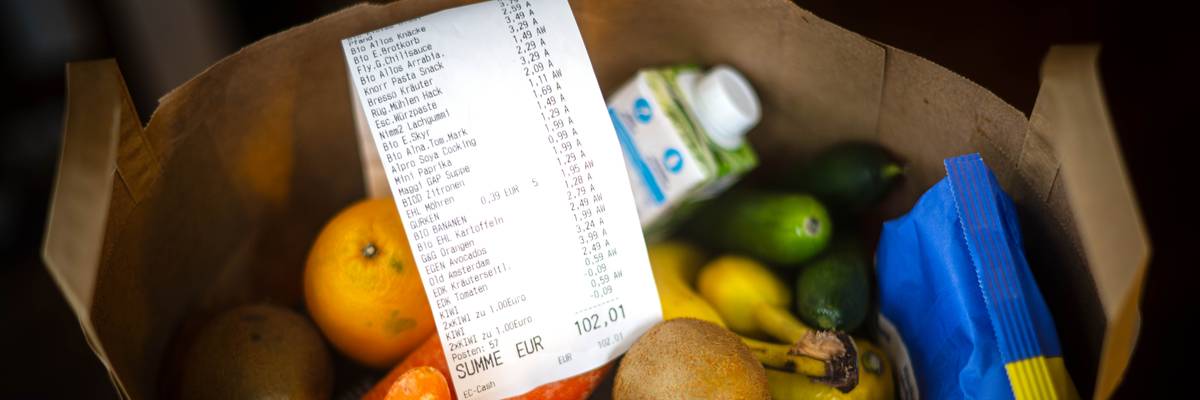
A receipt lies on top of the groceries in a shopping bag.
Trump's Policies Are Making It Harder for the So-Called Middle Class to Make Ends Meet
As life becomes less and less affordable for working people, we need to restore and expand our social safety net so those of us who work for a living can keep our families affordably housed, fed, and healthy.
Affordability is a crisis that keeps millions of us awake at night. It is not, as President Donald Trump claims, a word Democrats “made up.” As more and more families struggle to pay their bills, we need policy solutions, not partisan deflections.
By most accounts, my family is middle class. I have a leadership position at a nonprofit organization, a modest house with a mortgage, student loans, and a car. But like countless other working Americans, I’m struggling to afford the basics.
I’m supposed to be saving for retirement, but instead I’m scouring the internet for “free sites”—mutual aid groups or neighborhood sites where people safely drop off their groceries, clothes, and basic appliances for others to take. In desperation, I even accept open juice cartons and past-date food from my community so I can feed my family as the cost of these items continues to rise.
I’ve lived on the edge of uncertainty all my life. My parents struggled to provide for their three kids when we were growing up. Sufficient medical care was always out of reach. As I grew older, I learned to be super resourceful and did my best to “pull myself up by my bootstraps.”
You simply can’t pay your mortgage with someone else’s stock gains.
But even after I earned a Master’s degree and bought a small townhouse, it wasn’t enough. The cost of babies and childcare is overwhelming when one is struggling to make ends meet. Add health complications from childbirth on top of it, and we were immediately under water.
Getting help from the social safety net has always been harder than it should be. Years ago, before I had kids, I needed help affording food and housing while I searched for new employment after getting laid off. But because I had a car and no kids, I was told I was ineligible.
But that’s nothing compared to what families are facing now.
We’ve recently seen the largest shift away from support for families in modern history. All in favor of massive tax breaks for billionaires. The so-called “One Big Beautiful Bill” mercilessly slashes funding for healthcare and food for the rest of us to subsidize nearly $5 trillion in tax cuts for the already rich.
That doesn’t seem very fair to me.
According to the Urban Institute, more than half of American families can’t afford the true cost of living in their communities, even when both adults work full-time. Costs, especially for essentials like housing, food, childcare, and healthcare, are rising faster than wages.
The label “middle class” hides the real financial stress that millions of us feel. We don’t make enough to cover what our families need, yet we make too much to qualify for help when we need it.
The programs that would help everyday Americans weather the occasional storms have been pillaged to give trillions more to billionaires. Meanwhile, Trump’s tariffs have cost the average US family an extra $1,000 last year and are expected to cost families $1,300 this year.
I’m facing a layoff from my current job in a dismal job market, which will cost my family and me our employer-provided healthcare. And with Congress both slashing Medicaid and allowing extended subsidies for Affordable Care Act plans to expire, I don’t know how I will afford our health coverage.
While many in Washington point to record stock market highs as proof of a booming economy, those gains don’t reflect the reality at my kitchen table. A rising Dow Jones doesn’t pay for a child’s doctor visit or lower the price of eggs. For families like mine, the economy isn’t measured by a ticker, but by our bank balance. You simply can’t pay your mortgage with someone else’s stock gains.
As life becomes less and less affordable for working people, we need to restore and expand our social safety net so those of us who work for a living can keep our families affordably housed, fed, and healthy. Currently, we’re headed in the wrong direction.
We are at a crossroads
This country and this world are at a monumental crossroads. In a few short weeks, US voters will have an opportunity to beat back the forces of fascism and confront the billionaires who are rigging the economy, our media system, and our democracy, making it increasingly impossible for ordinary people to get by. We’re not just talking about the election. We’re talking about what must be done once these fascist elements are vanquished from power. We need a bolder set of solutions than what either major party has so far been willing to offer and a working-class movement ready to fight like hell for it. Trump didn't emerge from nowhere. The conditions that fueled MAGA authoritarianism were created by decades of radical neoliberal economic policies and a corrupt political system dominated by corporate interests. They slashed taxes on the super-rich, promising that the benefits would trickle down. They said giveaways to the corporate titans would make life more affordable for the rest of us. It was all bullshit. And when a bitter, betrayed populace searches for someone to blame, right-wing demagogues have little trouble finding scapegoats. People know when they're being lied to, but you won't hear any of this from the corporate media. Only independent journalism—powered and funded by people who believe in building a better world—can deliver truly trustworthy daily news. Our Fall Campaign is underway, and we need your help. To power our newsroom through the rest of the year, we need to raise $125,000 by midnight on October 31. So if you share our vision, please contribute whatever you can to sustain our work. |
Affordability is a crisis that keeps millions of us awake at night. It is not, as President Donald Trump claims, a word Democrats “made up.” As more and more families struggle to pay their bills, we need policy solutions, not partisan deflections.
By most accounts, my family is middle class. I have a leadership position at a nonprofit organization, a modest house with a mortgage, student loans, and a car. But like countless other working Americans, I’m struggling to afford the basics.
I’m supposed to be saving for retirement, but instead I’m scouring the internet for “free sites”—mutual aid groups or neighborhood sites where people safely drop off their groceries, clothes, and basic appliances for others to take. In desperation, I even accept open juice cartons and past-date food from my community so I can feed my family as the cost of these items continues to rise.
I’ve lived on the edge of uncertainty all my life. My parents struggled to provide for their three kids when we were growing up. Sufficient medical care was always out of reach. As I grew older, I learned to be super resourceful and did my best to “pull myself up by my bootstraps.”
You simply can’t pay your mortgage with someone else’s stock gains.
But even after I earned a Master’s degree and bought a small townhouse, it wasn’t enough. The cost of babies and childcare is overwhelming when one is struggling to make ends meet. Add health complications from childbirth on top of it, and we were immediately under water.
Getting help from the social safety net has always been harder than it should be. Years ago, before I had kids, I needed help affording food and housing while I searched for new employment after getting laid off. But because I had a car and no kids, I was told I was ineligible.
But that’s nothing compared to what families are facing now.
We’ve recently seen the largest shift away from support for families in modern history. All in favor of massive tax breaks for billionaires. The so-called “One Big Beautiful Bill” mercilessly slashes funding for healthcare and food for the rest of us to subsidize nearly $5 trillion in tax cuts for the already rich.
That doesn’t seem very fair to me.
According to the Urban Institute, more than half of American families can’t afford the true cost of living in their communities, even when both adults work full-time. Costs, especially for essentials like housing, food, childcare, and healthcare, are rising faster than wages.
The label “middle class” hides the real financial stress that millions of us feel. We don’t make enough to cover what our families need, yet we make too much to qualify for help when we need it.
The programs that would help everyday Americans weather the occasional storms have been pillaged to give trillions more to billionaires. Meanwhile, Trump’s tariffs have cost the average US family an extra $1,000 last year and are expected to cost families $1,300 this year.
I’m facing a layoff from my current job in a dismal job market, which will cost my family and me our employer-provided healthcare. And with Congress both slashing Medicaid and allowing extended subsidies for Affordable Care Act plans to expire, I don’t know how I will afford our health coverage.
While many in Washington point to record stock market highs as proof of a booming economy, those gains don’t reflect the reality at my kitchen table. A rising Dow Jones doesn’t pay for a child’s doctor visit or lower the price of eggs. For families like mine, the economy isn’t measured by a ticker, but by our bank balance. You simply can’t pay your mortgage with someone else’s stock gains.
As life becomes less and less affordable for working people, we need to restore and expand our social safety net so those of us who work for a living can keep our families affordably housed, fed, and healthy. Currently, we’re headed in the wrong direction.
- Outrage Pours in After House GOP Approves 'One of the Most Catastrophic Bills Passed in Modern History' ›
- Please Note: Zohran Mamdani’s Proposals Are Surprisingly Affordable ›
- Despite Vows on ‘Affordability,’ Trump Proclaims: ‘I Want to Drive Housing Prices Up’ ›
- The Pro-Trump Oligarchs Driving Americans Into Homelessness ›
- Cheap Living, Costly Politics ›
- Affordability Politics Are Class Politics ›
Affordability is a crisis that keeps millions of us awake at night. It is not, as President Donald Trump claims, a word Democrats “made up.” As more and more families struggle to pay their bills, we need policy solutions, not partisan deflections.
By most accounts, my family is middle class. I have a leadership position at a nonprofit organization, a modest house with a mortgage, student loans, and a car. But like countless other working Americans, I’m struggling to afford the basics.
I’m supposed to be saving for retirement, but instead I’m scouring the internet for “free sites”—mutual aid groups or neighborhood sites where people safely drop off their groceries, clothes, and basic appliances for others to take. In desperation, I even accept open juice cartons and past-date food from my community so I can feed my family as the cost of these items continues to rise.
I’ve lived on the edge of uncertainty all my life. My parents struggled to provide for their three kids when we were growing up. Sufficient medical care was always out of reach. As I grew older, I learned to be super resourceful and did my best to “pull myself up by my bootstraps.”
You simply can’t pay your mortgage with someone else’s stock gains.
But even after I earned a Master’s degree and bought a small townhouse, it wasn’t enough. The cost of babies and childcare is overwhelming when one is struggling to make ends meet. Add health complications from childbirth on top of it, and we were immediately under water.
Getting help from the social safety net has always been harder than it should be. Years ago, before I had kids, I needed help affording food and housing while I searched for new employment after getting laid off. But because I had a car and no kids, I was told I was ineligible.
But that’s nothing compared to what families are facing now.
We’ve recently seen the largest shift away from support for families in modern history. All in favor of massive tax breaks for billionaires. The so-called “One Big Beautiful Bill” mercilessly slashes funding for healthcare and food for the rest of us to subsidize nearly $5 trillion in tax cuts for the already rich.
That doesn’t seem very fair to me.
According to the Urban Institute, more than half of American families can’t afford the true cost of living in their communities, even when both adults work full-time. Costs, especially for essentials like housing, food, childcare, and healthcare, are rising faster than wages.
The label “middle class” hides the real financial stress that millions of us feel. We don’t make enough to cover what our families need, yet we make too much to qualify for help when we need it.
The programs that would help everyday Americans weather the occasional storms have been pillaged to give trillions more to billionaires. Meanwhile, Trump’s tariffs have cost the average US family an extra $1,000 last year and are expected to cost families $1,300 this year.
I’m facing a layoff from my current job in a dismal job market, which will cost my family and me our employer-provided healthcare. And with Congress both slashing Medicaid and allowing extended subsidies for Affordable Care Act plans to expire, I don’t know how I will afford our health coverage.
While many in Washington point to record stock market highs as proof of a booming economy, those gains don’t reflect the reality at my kitchen table. A rising Dow Jones doesn’t pay for a child’s doctor visit or lower the price of eggs. For families like mine, the economy isn’t measured by a ticker, but by our bank balance. You simply can’t pay your mortgage with someone else’s stock gains.
As life becomes less and less affordable for working people, we need to restore and expand our social safety net so those of us who work for a living can keep our families affordably housed, fed, and healthy. Currently, we’re headed in the wrong direction.
- Outrage Pours in After House GOP Approves 'One of the Most Catastrophic Bills Passed in Modern History' ›
- Please Note: Zohran Mamdani’s Proposals Are Surprisingly Affordable ›
- Despite Vows on ‘Affordability,’ Trump Proclaims: ‘I Want to Drive Housing Prices Up’ ›
- The Pro-Trump Oligarchs Driving Americans Into Homelessness ›
- Cheap Living, Costly Politics ›
- Affordability Politics Are Class Politics ›