5
#000000
#FFFFFF
To donate by check, phone, or other method, see our More Ways to Give page.
Daily news & progressive opinion—funded by the people, not the corporations—delivered straight to your inbox.

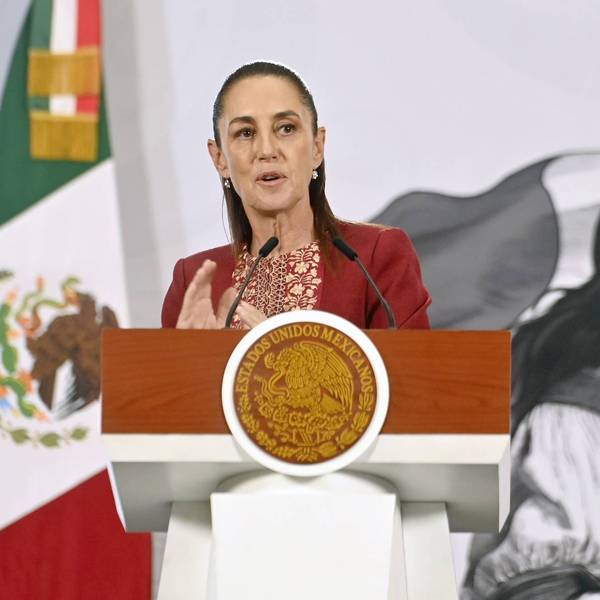
President of Mexico Claudia Sheinbaum speaks during the daily morning briefing at Palacio Nacional on April 07, 2026 in Mexico City, Mexico.
Pretty much every other country in the world has settled on one model for everybody, because it’s cheaper and less convoluted. We could solve a lot of problems in America by following this example.
In 2026, the US health care system is more costly, more unequal and more unstable than at any point in its history.
Last month, a survey released by the West Health-Gallup Center found that an estimated 28 million Americans (roughly 11%) had skipped meals to afford health care expenses in the last year. “Ambulance deserts” – where emergency services take over 25 minutes to arrive – are rapidly forming across the country, affecting millions of people. With the announcement last year of cuts to Medicaid and the federal government’s failure to extend ACA subsidies, the future looks especially bleak.
At the same time, we’ve seen huge increases in profits for insurance companies and hospitals. Greed and short-sighted pursuit of profits have brought American health care to the breaking point. This is a man-made natural disaster.
The US system is an outlier on the world stage in a number of important ways. For one, we’re the only developed country that doesn’t provide universal health care. Every one of our peer nations has some form of basic coverage for all citizens – the U.K., Canada, France, Japan, Italy, Germany, Spain, Australia… We’re the only ones that decided to leave a significant percentage of the population (generally around 8%) without any coverage whatsoever.
American health care is also, by far, the most expensive in the world. According to the Organization for Economic Cooperation and Development (OECD), we have roughly twice the per-capita health care costs of other wealthy nations, yet some of the worst outcomes. We consistently under-perform in areas like life expectancy, infant mortality and deaths from treatable diseases.
According to a study conducted in 2020 by Yale epidemiologists for the medical journal The Lancet, a universal health care system in the US would prevent around 68,000 unnecessary deaths per year. These are people who die from preventable diseases, simply because they don’t have access to health insurance. If they lived in any other country in the developed world, they’d survive.
Mexico, another country where coverage has historically been less-than-total, announced last week that they will be implementing a universal health service designed to guarantee access to health care for the entire population. As Mexico moves forward with its initiative, it may provide a model for how the US can repair our dysfunctional, fragmented system. Mexico’s decree unifies three fragmented public systems (IMSS, ISSSTE, IMSS-Bienestar, taking a patchwork model and consolidating it into one program to prevent unnecessary duplication of costs. Hopefully, we can learn from both their successes and their mistakes.
America also has a patchwork model, combining elements of several different approaches to health care. For working people under 65, we have employer-provided private insurance. For veterans and military personnel, we have the V.A. (Veteran Affairs). For the over-65 population and people with certain disabilities, we have Medicare. For people below the poverty line, we have Medicaid. And for those without any health insurance at all, we have out-of-pocket payments. Pretty much every other country in the world has settled on one model for everybody, because it’s cheaper and less convoluted. A unified system is the best tool for cost control. We could solve a lot of problems in America by following this example.
A majority of Americans favor a universal health care system. This would increase equality of access, bring down costs and help to resolve one of the greatest inequities in American life, something which separates us from the rest of the developed world and which has increasingly become unsustainable in recent years. If the status quo is maintained, health care costs will continue to rise, patients will continue to avoid care because they can’t afford it and for-profit companies will continue to find ways to pass the costs on to patients, even if it bankrupts or kills them.
Dear Common Dreams reader, The U.S. is on a fast track to authoritarianism like nothing I've ever seen. Meanwhile, corporate news outlets are utterly capitulating to Trump, twisting their coverage to avoid drawing his ire while lining up to stuff cash in his pockets. That's why I believe that Common Dreams is doing the best and most consequential reporting that we've ever done. Our small but mighty team is a progressive reporting powerhouse, covering the news every day that the corporate media never will. Our mission has always been simple: To inform. To inspire. And to ignite change for the common good. Now here's the key piece that I want all our readers to understand: None of this would be possible without your financial support. That's not just some fundraising cliche. It's the absolute and literal truth. We don't accept corporate advertising and never will. We don't have a paywall because we don't think people should be blocked from critical news based on their ability to pay. Everything we do is funded by the donations of readers like you. Will you donate now to help power the nonprofit, independent reporting of Common Dreams? Thank you for being a vital member of our community. Together, we can keep independent journalism alive when it’s needed most. - Craig Brown, Co-founder |
In 2026, the US health care system is more costly, more unequal and more unstable than at any point in its history.
Last month, a survey released by the West Health-Gallup Center found that an estimated 28 million Americans (roughly 11%) had skipped meals to afford health care expenses in the last year. “Ambulance deserts” – where emergency services take over 25 minutes to arrive – are rapidly forming across the country, affecting millions of people. With the announcement last year of cuts to Medicaid and the federal government’s failure to extend ACA subsidies, the future looks especially bleak.
At the same time, we’ve seen huge increases in profits for insurance companies and hospitals. Greed and short-sighted pursuit of profits have brought American health care to the breaking point. This is a man-made natural disaster.
The US system is an outlier on the world stage in a number of important ways. For one, we’re the only developed country that doesn’t provide universal health care. Every one of our peer nations has some form of basic coverage for all citizens – the U.K., Canada, France, Japan, Italy, Germany, Spain, Australia… We’re the only ones that decided to leave a significant percentage of the population (generally around 8%) without any coverage whatsoever.
American health care is also, by far, the most expensive in the world. According to the Organization for Economic Cooperation and Development (OECD), we have roughly twice the per-capita health care costs of other wealthy nations, yet some of the worst outcomes. We consistently under-perform in areas like life expectancy, infant mortality and deaths from treatable diseases.
According to a study conducted in 2020 by Yale epidemiologists for the medical journal The Lancet, a universal health care system in the US would prevent around 68,000 unnecessary deaths per year. These are people who die from preventable diseases, simply because they don’t have access to health insurance. If they lived in any other country in the developed world, they’d survive.
Mexico, another country where coverage has historically been less-than-total, announced last week that they will be implementing a universal health service designed to guarantee access to health care for the entire population. As Mexico moves forward with its initiative, it may provide a model for how the US can repair our dysfunctional, fragmented system. Mexico’s decree unifies three fragmented public systems (IMSS, ISSSTE, IMSS-Bienestar, taking a patchwork model and consolidating it into one program to prevent unnecessary duplication of costs. Hopefully, we can learn from both their successes and their mistakes.
America also has a patchwork model, combining elements of several different approaches to health care. For working people under 65, we have employer-provided private insurance. For veterans and military personnel, we have the V.A. (Veteran Affairs). For the over-65 population and people with certain disabilities, we have Medicare. For people below the poverty line, we have Medicaid. And for those without any health insurance at all, we have out-of-pocket payments. Pretty much every other country in the world has settled on one model for everybody, because it’s cheaper and less convoluted. A unified system is the best tool for cost control. We could solve a lot of problems in America by following this example.
A majority of Americans favor a universal health care system. This would increase equality of access, bring down costs and help to resolve one of the greatest inequities in American life, something which separates us from the rest of the developed world and which has increasingly become unsustainable in recent years. If the status quo is maintained, health care costs will continue to rise, patients will continue to avoid care because they can’t afford it and for-profit companies will continue to find ways to pass the costs on to patients, even if it bankrupts or kills them.
In 2026, the US health care system is more costly, more unequal and more unstable than at any point in its history.
Last month, a survey released by the West Health-Gallup Center found that an estimated 28 million Americans (roughly 11%) had skipped meals to afford health care expenses in the last year. “Ambulance deserts” – where emergency services take over 25 minutes to arrive – are rapidly forming across the country, affecting millions of people. With the announcement last year of cuts to Medicaid and the federal government’s failure to extend ACA subsidies, the future looks especially bleak.
At the same time, we’ve seen huge increases in profits for insurance companies and hospitals. Greed and short-sighted pursuit of profits have brought American health care to the breaking point. This is a man-made natural disaster.
The US system is an outlier on the world stage in a number of important ways. For one, we’re the only developed country that doesn’t provide universal health care. Every one of our peer nations has some form of basic coverage for all citizens – the U.K., Canada, France, Japan, Italy, Germany, Spain, Australia… We’re the only ones that decided to leave a significant percentage of the population (generally around 8%) without any coverage whatsoever.
American health care is also, by far, the most expensive in the world. According to the Organization for Economic Cooperation and Development (OECD), we have roughly twice the per-capita health care costs of other wealthy nations, yet some of the worst outcomes. We consistently under-perform in areas like life expectancy, infant mortality and deaths from treatable diseases.
According to a study conducted in 2020 by Yale epidemiologists for the medical journal The Lancet, a universal health care system in the US would prevent around 68,000 unnecessary deaths per year. These are people who die from preventable diseases, simply because they don’t have access to health insurance. If they lived in any other country in the developed world, they’d survive.
Mexico, another country where coverage has historically been less-than-total, announced last week that they will be implementing a universal health service designed to guarantee access to health care for the entire population. As Mexico moves forward with its initiative, it may provide a model for how the US can repair our dysfunctional, fragmented system. Mexico’s decree unifies three fragmented public systems (IMSS, ISSSTE, IMSS-Bienestar, taking a patchwork model and consolidating it into one program to prevent unnecessary duplication of costs. Hopefully, we can learn from both their successes and their mistakes.
America also has a patchwork model, combining elements of several different approaches to health care. For working people under 65, we have employer-provided private insurance. For veterans and military personnel, we have the V.A. (Veteran Affairs). For the over-65 population and people with certain disabilities, we have Medicare. For people below the poverty line, we have Medicaid. And for those without any health insurance at all, we have out-of-pocket payments. Pretty much every other country in the world has settled on one model for everybody, because it’s cheaper and less convoluted. A unified system is the best tool for cost control. We could solve a lot of problems in America by following this example.
A majority of Americans favor a universal health care system. This would increase equality of access, bring down costs and help to resolve one of the greatest inequities in American life, something which separates us from the rest of the developed world and which has increasingly become unsustainable in recent years. If the status quo is maintained, health care costs will continue to rise, patients will continue to avoid care because they can’t afford it and for-profit companies will continue to find ways to pass the costs on to patients, even if it bankrupts or kills them.