SUBSCRIBE TO OUR FREE NEWSLETTER
Daily news & progressive opinion—funded by the people, not the corporations—delivered straight to your inbox.
5
#000000
#FFFFFF
To donate by check, phone, or other method, see our More Ways to Give page.
Daily news & progressive opinion—funded by the people, not the corporations—delivered straight to your inbox.
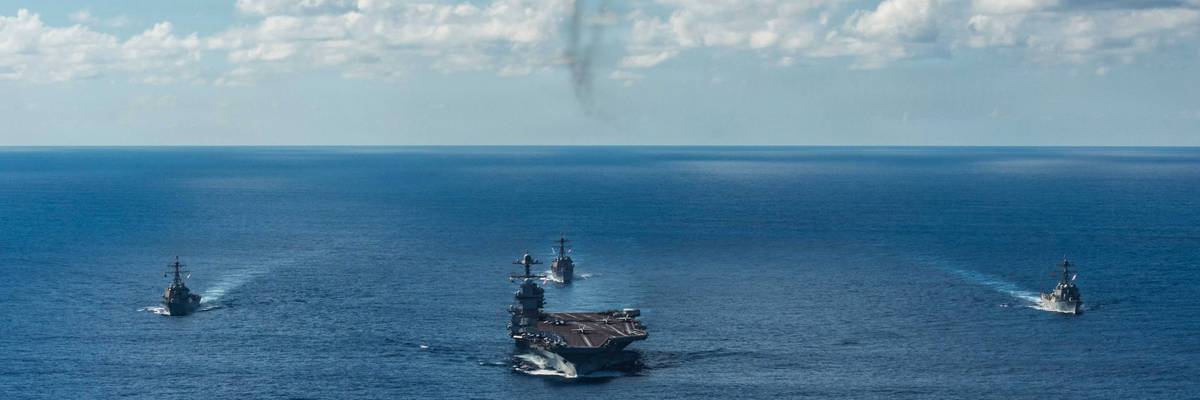
In this handout provided by the US Navy, The US Navy's Gerald R. Ford Carrier Strike Group, including the flagship USS Gerald R. Ford (CVN 78), front; USS Winston S. Churchill (DDG 81), right; USS Mahan (DDG 72), left; USS Bainbridge (DDG 96); and embarked Carrier Air Wing Eight F/A-18E/F Super Hornets assigned to Strike Fighter Squadrons 31, 37, 87, and 213, operates as a joint, multi-domain force with a US Air Force B-52 Stratofortress, November 13, 2025.
There seems to be a lack of imagination at Trump's State Department, where the only way to negotiate is to negotiate with a gun to your interlocutor’s head. But there seems to be no lack of imagination about ways to hold the gun.
The Trump administration has largely abandoned the subtle covert coup of the past in favor of much blunter and more exposed overt overthrows. It turns out, though, that there are many ways to forcefully change a regime.
The first is to not change the regime but to do alterations. That is what was done in Venezuela, where the regime was left in place, but alterations were made to make it pliable to US demands. The US operation in Venezuela was a decapitation that removed the head of the government while leaving the government. The president was replaced by the Vice President, Delcy Rodríguez, who was forced to execute US policy first with a gun, and then with a gunboat, to her head.
There are unconfirmed reports that when the US captured Maduro, they gave the interior minister, the congressional president, and Rodríguez “15 minutes to respond, or they would kill us.” Once she “responded” and was sworn in as acting president, President Donald Trump warned that the US is “ready to stage a second and much larger attack if we need to do so” and that if Rodríguez “doesn’t do what’s right, she is going to pay a very big price, probably bigger than Maduro.” First the gun, then the gunboat. Then Rodriguez was told that all American demands had to be fully implemented before the United States would allow Venezuela to pump another drop of oil.
In Cuba, the Trump administration believes that military intervention of the Venezuela type won’t be necessary because “Cuba looks like it is ready to fall.” Already cut off from its Venezuelan oil supply, Cuba’s fall can be precipitated by cutting its final energy lifeline. “THERE WILL BE NO MORE OIL OR MONEY GOING TO CUBA—ZERO!, Trump announced, “I strongly suggest they make a deal, BEFORE IT IS TOO LATE.” With that, Trump signed an executive order imposing tariffs on any country that sends oil to Cuba. “Now there is going to be a real blockade. Nothing is getting in. No more oil is coming,” the US Charge d’Affairs in the US Embassy in Havana told his staff.
If the protests fail to bring about regime change, perhaps the air and sea power that is massing near Iran will.
The result is a humanitarian disaster. The spokesperson for the secretary-general of the United Nations has said that “the secretary-general is extremely concerned about the humanitarian situation in Cuba, which will worsen, if not collapse, if its oil needs go unmet.” That is not an accident but the plan: That is what Trump meant by “BEFORE IT IS TOO LATE.” On February 16, Trump told reporters that Cuba “should absolutely make a deal, because it’s really a humanitarian threat.”
Starvation is being used as a deliberate tool for regime change in Iran as well where US sanctions have caused an economic crisis that drove Iranians to the streets to demand economic reforms the government was incapable of making without the lifting of sanctions. It was clear, though, that the terms for lifting the sanction posed a threat to the existence of the nation and the regime. US Treasury Secretary Scott Bessent explained that “President Trump ordered… maximum pressure on Iran. And it’s worked, because in December, their economy collapsed… this is why the people took to the street…This is economic statecraft… Things are moving in a very positive direction.” Bessant told the Senate Banking Committee that “what we have done is created a dollar shortage in the country… the Iranian currency went into free fall, inflation exploded, and hence we have seen the Iranian people out on the street.”
But the US did more than cause the protests: They aided them. Calling for regime change, Trump promised, first to protect the protesters, then to help them. And aid them they did. Though the US has denied Iran’s accusations that they aided the protests, it is now known that they did. After the Iranian government shut down the internet in an attempt to disrupt protesters, the US smuggled around 6,000 Starlink satellite-internet kits into Iran to help the protesters stay connected and in touch.
And if the protests fail to bring about regime change, perhaps the air and sea power that is massing near Iran will. The force gathered in the region is already bigger than the one gathered for US Operation Midnight Hammer that bombed Iran’s civilian nuclear cites last June. There are now two aircraft carriers in the region. They are accompanied by guided missile destroyers, cruisers, submarines, hundreds of fighter jets, and ballistic missile defense systems. If using sanctions for starvation and protests fails to bring about regime change, plan C is bombing Iran.
Regime change in Iraq is taking yet another form: economic blackmail to influence the choice of leader. Iraq’s latest election produced a struggle to form a coalition. It looked like former Prime Minister, Nouri al-Maliki, could emerge as the leader. Then Trump took to Truth Social: “I’m hearing that the Great Country of Iraq might make a very bad choice by reinstalling Nouri al-Maliki as Prime Minister... That should not be allowed to happen again. Because of his insane policies and ideologies, if elected, the United States of America will no longer help Iraq…” The US then threatened that, if Iran-allied groups, like Maliki’s party, are included in the government, the US would target the Iraqi state, including blocking Iraq’s access to its own oil revenue.
The same regime influencing plan of using the threat of withholding economic aid if the candidate acceptable to America is not chosen was used in Honduras where Trump told Hondurans that if they vote for the wrong candidate, they will face economic abandonment. “If Tito Asfura wins for President of Honduras, because the United States has so much confidence in him, his Policies, and what he will do for the Great People of Honduras, we will be very supportive,” Trump said, “If he doesn’t win, the United States will not be throwing good money after bad.”
Similar interference has been employed in the choice of leader in Haiti, though the ominous consequences were more ambiguous than the withdrawal of economic support. In Haiti, a majority of the Presidential Transition Council signed a resolution to replace the prime minister. Though the Organization of American States says that decision “rest[s] with Haitian leadership,” the US Embassy in Haiti says it considered the resolution “to be illegal” and warned that “the corrupt politicians” who signed the resolution will “pay the ultimate price.” Accusing the signatories of “support[ing] violent gangs and sow[ing] terror in the country,” Deputy Secretary of State Christopher Landau declared that, “The US would consider anyone supporting such a disruptive step favoring the gangs to be acting contrary to the interests of the United States, the region, and the Haitian people and will act accordingly.”
There seems to be a lack of imagination at the State Department, where the only way to negotiate is to negotiate with a gun to your interlocutor’s head. But there seems to be no lack of imagination about ways to hold the gun to your interlocutor’s head.
Dear Common Dreams reader, It’s been nearly 30 years since I co-founded Common Dreams with my late wife, Lina Newhouser. We had the radical notion that journalism should serve the public good, not corporate profits. It was clear to us from the outset what it would take to build such a project. No paid advertisements. No corporate sponsors. No millionaire publisher telling us what to think or do. Many people said we wouldn't last a year, but we proved those doubters wrong. Together with a tremendous team of journalists and dedicated staff, we built an independent media outlet free from the constraints of profits and corporate control. Our mission has always been simple: To inform. To inspire. To ignite change for the common good. Building Common Dreams was not easy. Our survival was never guaranteed. When you take on the most powerful forces—Wall Street greed, fossil fuel industry destruction, Big Tech lobbyists, and uber-rich oligarchs who have spent billions upon billions rigging the economy and democracy in their favor—the only bulwark you have is supporters who believe in your work. But here’s the urgent message from me today. It's never been this bad out there. And it's never been this hard to keep us going. At the very moment Common Dreams is most needed, the threats we face are intensifying. We need your support now more than ever. We don't accept corporate advertising and never will. We don't have a paywall because we don't think people should be blocked from critical news based on their ability to pay. Everything we do is funded by the donations of readers like you. When everyone does the little they can afford, we are strong. But if that support retreats or dries up, so do we. Will you donate now to make sure Common Dreams not only survives but thrives? —Craig Brown, Co-founder |
The Trump administration has largely abandoned the subtle covert coup of the past in favor of much blunter and more exposed overt overthrows. It turns out, though, that there are many ways to forcefully change a regime.
The first is to not change the regime but to do alterations. That is what was done in Venezuela, where the regime was left in place, but alterations were made to make it pliable to US demands. The US operation in Venezuela was a decapitation that removed the head of the government while leaving the government. The president was replaced by the Vice President, Delcy Rodríguez, who was forced to execute US policy first with a gun, and then with a gunboat, to her head.
There are unconfirmed reports that when the US captured Maduro, they gave the interior minister, the congressional president, and Rodríguez “15 minutes to respond, or they would kill us.” Once she “responded” and was sworn in as acting president, President Donald Trump warned that the US is “ready to stage a second and much larger attack if we need to do so” and that if Rodríguez “doesn’t do what’s right, she is going to pay a very big price, probably bigger than Maduro.” First the gun, then the gunboat. Then Rodriguez was told that all American demands had to be fully implemented before the United States would allow Venezuela to pump another drop of oil.
In Cuba, the Trump administration believes that military intervention of the Venezuela type won’t be necessary because “Cuba looks like it is ready to fall.” Already cut off from its Venezuelan oil supply, Cuba’s fall can be precipitated by cutting its final energy lifeline. “THERE WILL BE NO MORE OIL OR MONEY GOING TO CUBA—ZERO!, Trump announced, “I strongly suggest they make a deal, BEFORE IT IS TOO LATE.” With that, Trump signed an executive order imposing tariffs on any country that sends oil to Cuba. “Now there is going to be a real blockade. Nothing is getting in. No more oil is coming,” the US Charge d’Affairs in the US Embassy in Havana told his staff.
If the protests fail to bring about regime change, perhaps the air and sea power that is massing near Iran will.
The result is a humanitarian disaster. The spokesperson for the secretary-general of the United Nations has said that “the secretary-general is extremely concerned about the humanitarian situation in Cuba, which will worsen, if not collapse, if its oil needs go unmet.” That is not an accident but the plan: That is what Trump meant by “BEFORE IT IS TOO LATE.” On February 16, Trump told reporters that Cuba “should absolutely make a deal, because it’s really a humanitarian threat.”
Starvation is being used as a deliberate tool for regime change in Iran as well where US sanctions have caused an economic crisis that drove Iranians to the streets to demand economic reforms the government was incapable of making without the lifting of sanctions. It was clear, though, that the terms for lifting the sanction posed a threat to the existence of the nation and the regime. US Treasury Secretary Scott Bessent explained that “President Trump ordered… maximum pressure on Iran. And it’s worked, because in December, their economy collapsed… this is why the people took to the street…This is economic statecraft… Things are moving in a very positive direction.” Bessant told the Senate Banking Committee that “what we have done is created a dollar shortage in the country… the Iranian currency went into free fall, inflation exploded, and hence we have seen the Iranian people out on the street.”
But the US did more than cause the protests: They aided them. Calling for regime change, Trump promised, first to protect the protesters, then to help them. And aid them they did. Though the US has denied Iran’s accusations that they aided the protests, it is now known that they did. After the Iranian government shut down the internet in an attempt to disrupt protesters, the US smuggled around 6,000 Starlink satellite-internet kits into Iran to help the protesters stay connected and in touch.
And if the protests fail to bring about regime change, perhaps the air and sea power that is massing near Iran will. The force gathered in the region is already bigger than the one gathered for US Operation Midnight Hammer that bombed Iran’s civilian nuclear cites last June. There are now two aircraft carriers in the region. They are accompanied by guided missile destroyers, cruisers, submarines, hundreds of fighter jets, and ballistic missile defense systems. If using sanctions for starvation and protests fails to bring about regime change, plan C is bombing Iran.
Regime change in Iraq is taking yet another form: economic blackmail to influence the choice of leader. Iraq’s latest election produced a struggle to form a coalition. It looked like former Prime Minister, Nouri al-Maliki, could emerge as the leader. Then Trump took to Truth Social: “I’m hearing that the Great Country of Iraq might make a very bad choice by reinstalling Nouri al-Maliki as Prime Minister... That should not be allowed to happen again. Because of his insane policies and ideologies, if elected, the United States of America will no longer help Iraq…” The US then threatened that, if Iran-allied groups, like Maliki’s party, are included in the government, the US would target the Iraqi state, including blocking Iraq’s access to its own oil revenue.
The same regime influencing plan of using the threat of withholding economic aid if the candidate acceptable to America is not chosen was used in Honduras where Trump told Hondurans that if they vote for the wrong candidate, they will face economic abandonment. “If Tito Asfura wins for President of Honduras, because the United States has so much confidence in him, his Policies, and what he will do for the Great People of Honduras, we will be very supportive,” Trump said, “If he doesn’t win, the United States will not be throwing good money after bad.”
Similar interference has been employed in the choice of leader in Haiti, though the ominous consequences were more ambiguous than the withdrawal of economic support. In Haiti, a majority of the Presidential Transition Council signed a resolution to replace the prime minister. Though the Organization of American States says that decision “rest[s] with Haitian leadership,” the US Embassy in Haiti says it considered the resolution “to be illegal” and warned that “the corrupt politicians” who signed the resolution will “pay the ultimate price.” Accusing the signatories of “support[ing] violent gangs and sow[ing] terror in the country,” Deputy Secretary of State Christopher Landau declared that, “The US would consider anyone supporting such a disruptive step favoring the gangs to be acting contrary to the interests of the United States, the region, and the Haitian people and will act accordingly.”
There seems to be a lack of imagination at the State Department, where the only way to negotiate is to negotiate with a gun to your interlocutor’s head. But there seems to be no lack of imagination about ways to hold the gun to your interlocutor’s head.
The Trump administration has largely abandoned the subtle covert coup of the past in favor of much blunter and more exposed overt overthrows. It turns out, though, that there are many ways to forcefully change a regime.
The first is to not change the regime but to do alterations. That is what was done in Venezuela, where the regime was left in place, but alterations were made to make it pliable to US demands. The US operation in Venezuela was a decapitation that removed the head of the government while leaving the government. The president was replaced by the Vice President, Delcy Rodríguez, who was forced to execute US policy first with a gun, and then with a gunboat, to her head.
There are unconfirmed reports that when the US captured Maduro, they gave the interior minister, the congressional president, and Rodríguez “15 minutes to respond, or they would kill us.” Once she “responded” and was sworn in as acting president, President Donald Trump warned that the US is “ready to stage a second and much larger attack if we need to do so” and that if Rodríguez “doesn’t do what’s right, she is going to pay a very big price, probably bigger than Maduro.” First the gun, then the gunboat. Then Rodriguez was told that all American demands had to be fully implemented before the United States would allow Venezuela to pump another drop of oil.
In Cuba, the Trump administration believes that military intervention of the Venezuela type won’t be necessary because “Cuba looks like it is ready to fall.” Already cut off from its Venezuelan oil supply, Cuba’s fall can be precipitated by cutting its final energy lifeline. “THERE WILL BE NO MORE OIL OR MONEY GOING TO CUBA—ZERO!, Trump announced, “I strongly suggest they make a deal, BEFORE IT IS TOO LATE.” With that, Trump signed an executive order imposing tariffs on any country that sends oil to Cuba. “Now there is going to be a real blockade. Nothing is getting in. No more oil is coming,” the US Charge d’Affairs in the US Embassy in Havana told his staff.
If the protests fail to bring about regime change, perhaps the air and sea power that is massing near Iran will.
The result is a humanitarian disaster. The spokesperson for the secretary-general of the United Nations has said that “the secretary-general is extremely concerned about the humanitarian situation in Cuba, which will worsen, if not collapse, if its oil needs go unmet.” That is not an accident but the plan: That is what Trump meant by “BEFORE IT IS TOO LATE.” On February 16, Trump told reporters that Cuba “should absolutely make a deal, because it’s really a humanitarian threat.”
Starvation is being used as a deliberate tool for regime change in Iran as well where US sanctions have caused an economic crisis that drove Iranians to the streets to demand economic reforms the government was incapable of making without the lifting of sanctions. It was clear, though, that the terms for lifting the sanction posed a threat to the existence of the nation and the regime. US Treasury Secretary Scott Bessent explained that “President Trump ordered… maximum pressure on Iran. And it’s worked, because in December, their economy collapsed… this is why the people took to the street…This is economic statecraft… Things are moving in a very positive direction.” Bessant told the Senate Banking Committee that “what we have done is created a dollar shortage in the country… the Iranian currency went into free fall, inflation exploded, and hence we have seen the Iranian people out on the street.”
But the US did more than cause the protests: They aided them. Calling for regime change, Trump promised, first to protect the protesters, then to help them. And aid them they did. Though the US has denied Iran’s accusations that they aided the protests, it is now known that they did. After the Iranian government shut down the internet in an attempt to disrupt protesters, the US smuggled around 6,000 Starlink satellite-internet kits into Iran to help the protesters stay connected and in touch.
And if the protests fail to bring about regime change, perhaps the air and sea power that is massing near Iran will. The force gathered in the region is already bigger than the one gathered for US Operation Midnight Hammer that bombed Iran’s civilian nuclear cites last June. There are now two aircraft carriers in the region. They are accompanied by guided missile destroyers, cruisers, submarines, hundreds of fighter jets, and ballistic missile defense systems. If using sanctions for starvation and protests fails to bring about regime change, plan C is bombing Iran.
Regime change in Iraq is taking yet another form: economic blackmail to influence the choice of leader. Iraq’s latest election produced a struggle to form a coalition. It looked like former Prime Minister, Nouri al-Maliki, could emerge as the leader. Then Trump took to Truth Social: “I’m hearing that the Great Country of Iraq might make a very bad choice by reinstalling Nouri al-Maliki as Prime Minister... That should not be allowed to happen again. Because of his insane policies and ideologies, if elected, the United States of America will no longer help Iraq…” The US then threatened that, if Iran-allied groups, like Maliki’s party, are included in the government, the US would target the Iraqi state, including blocking Iraq’s access to its own oil revenue.
The same regime influencing plan of using the threat of withholding economic aid if the candidate acceptable to America is not chosen was used in Honduras where Trump told Hondurans that if they vote for the wrong candidate, they will face economic abandonment. “If Tito Asfura wins for President of Honduras, because the United States has so much confidence in him, his Policies, and what he will do for the Great People of Honduras, we will be very supportive,” Trump said, “If he doesn’t win, the United States will not be throwing good money after bad.”
Similar interference has been employed in the choice of leader in Haiti, though the ominous consequences were more ambiguous than the withdrawal of economic support. In Haiti, a majority of the Presidential Transition Council signed a resolution to replace the prime minister. Though the Organization of American States says that decision “rest[s] with Haitian leadership,” the US Embassy in Haiti says it considered the resolution “to be illegal” and warned that “the corrupt politicians” who signed the resolution will “pay the ultimate price.” Accusing the signatories of “support[ing] violent gangs and sow[ing] terror in the country,” Deputy Secretary of State Christopher Landau declared that, “The US would consider anyone supporting such a disruptive step favoring the gangs to be acting contrary to the interests of the United States, the region, and the Haitian people and will act accordingly.”
There seems to be a lack of imagination at the State Department, where the only way to negotiate is to negotiate with a gun to your interlocutor’s head. But there seems to be no lack of imagination about ways to hold the gun to your interlocutor’s head.