

SUBSCRIBE TO OUR FREE NEWSLETTER
Daily news & progressive opinion—funded by the people, not the corporations—delivered straight to your inbox.
5
#000000
#FFFFFF
To donate by check, phone, or other method, see our More Ways to Give page.
Daily news & progressive opinion—funded by the people, not the corporations—delivered straight to your inbox.
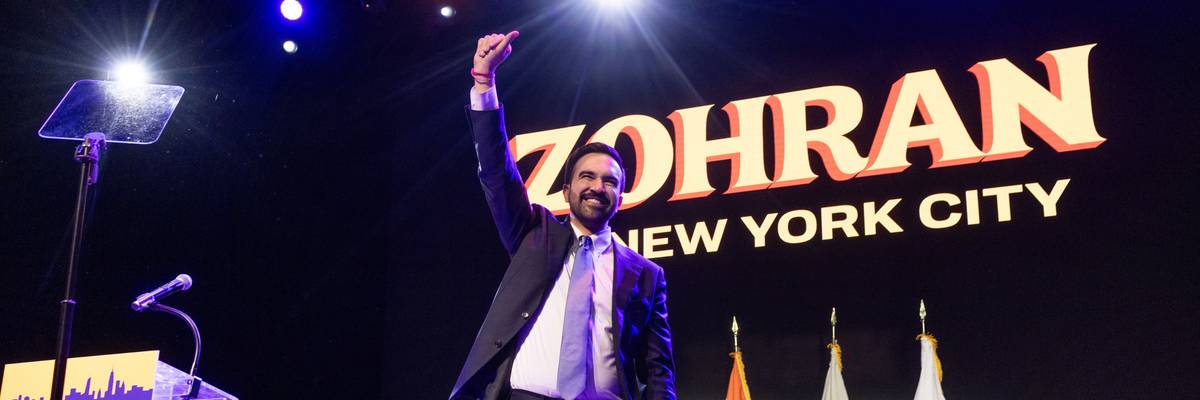
Democratic New York City mayoral candidate Zohran Mamdani delivers remarks at his election night watch party at the Brooklyn Paramount Theater on November 4, 2025 in the Brooklyn borough in New York City.
Perhaps the most important takeaway from Mr. Mamdani’s campaign is this: Hope grounded in possibility is the fuel for democracy.
Zohran Mamdani’s stunning victory on Tuesday is a bright light in this otherwise terrifying political time, and the messages propelling his political ascendance offer many lessons. One particularly is music to our ears—indeed, it’s a song we’ve long been singing. We’ll let the words from his acceptance speech speak for themselves:
Tonight we have spoken in a clear voice. Hope is alive. Hope is a decision that tens of thousands of New Yorkers made day after day, volunteer shift after volunteer shift, despite attack ad after attack ad. And, while we cast our ballots alone, we choose hope together: hope over tyranny. Hope over big money and small ideas. Hope over despair. We won because New Yorkers allowed themselves to hope that the impossible could be made possible.
Right on!
Mr. Mamdani’s message is both powerful and incisive. To launch his campaign to become mayor of our largest city required hope—and great courage. A long-shot candidate—a 34-year-old South Asian Muslim and democratic socialist assemblyman—he is a departure from mayoral convention.
Nevertheless, he, and a dedicated team of volunteers, took the plunge, pouring heart and soul into one of the most impressive grassroots campaigns. Mr. Mamdani’s candidacy was an act of hope—rooted not only in a belief in the necessity of his ideas and capacity to govern but also of hope that the political landscape would embrace a leader like him.
We must challenge ourselves to hope! Why not run for office with a bold, hope-infused platform? Volunteer for a candidate we believe in? And cast our votes for a different and better future?
And that hope turned into victory—justifying itself. Adamantly and consistently, he worked to convince voters that a better New York is achievable—that hope need not be an abstract and ephemeral feeling but rooted in actual political possibility.
Doing so, Mr. Mamdani championed the concerns New Yorkers—but, really, most Americans—feel acutely: our affordability crisis in housing, food, and healthcare; the burden of wages failing to keep up with cost of living; the immense struggle required just to survive. At every step of his campaign, he addressed these deep structural problems with real, innovative policy solutions. He didn’t ask voters to find hope from his politicking. Rather, he offered real grounds for belief.
We have long said that hope is power. Mr. Mamdani’s political success is evidence of this truth.
So perhaps the most important takeaway from Mr. Mamdani’s campaign is this: Hope grounded in possibility is the fuel for democracy. We find this a particularly powerful line from Mr. Mamdani’s acceptance speech: “We won because we insisted that no longer would politics be something that is done to us. Now, it is something that we do.” This sentiment is, indeed, the crux of hope’s power. When we believe, the door to action opens. We become agents capable of making real the changes we so desperately. As Mr. Mamdani says, politics is not done to us, but what we do.
This spirit is contagious and key to fighting back successfully against the Trump administration’s fascist policies and reversing widespread democratic backsliding. We must challenge ourselves to hope! Why not run for office with a bold, hope-infused platform? Volunteer for a candidate we believe in? And cast our votes for a different and better future?
Organizations including Run for Something empower us to step up and consider ourselves as changemakers, and several other national groups such as Common Cause and Indivisible provide clear paths for citizen action. Who knows what may come from taking the next hopeful step in your community, whether its electoral or any other form of advocacy.
Remember hope is not for “wimps.” It requires courage to do what we thought we could not do. The root of the word courage is the French word for heart, “coeur.” So, when you step up and feel yours pounding, don’t doubt. It’s just your heart cheering you on!
Leading with hope, we can build the engaged and just “living democracy” we want and know is essential. We can become proud of our country again.
This country and this world are at a monumental crossroads. US voters have an opportunity to beat back the forces of fascism and confront the billionaires who are rigging the economy, our media system, and our democracy, making it increasingly impossible for ordinary people to get by. We’re not just talking about the election. We’re talking about what must be done once these fascist elements are vanquished from power. We need a bolder set of solutions than what either major party has so far been willing to offer and a working-class movement ready to fight like hell for it. Trump didn't emerge from nowhere. The conditions that fueled MAGA authoritarianism were created by decades of radical neoliberal economic policies and a corrupt political system dominated by corporate interests. They slashed taxes on the super-rich, promising that the benefits would trickle down. They said giveaways to the corporate titans would make life more affordable for the rest of us. It was all bullshit. And when a bitter, betrayed populace searches for someone to blame, right-wing demagogues have little trouble finding scapegoats. People know when they're being lied to, but you won't hear any of this from the corporate media. Only independent journalism—powered and funded by people who believe in building a better world—can deliver truly trustworthy daily news. If you share our vision, please contribute whatever you can to sustain our work. |
Zohran Mamdani’s stunning victory on Tuesday is a bright light in this otherwise terrifying political time, and the messages propelling his political ascendance offer many lessons. One particularly is music to our ears—indeed, it’s a song we’ve long been singing. We’ll let the words from his acceptance speech speak for themselves:
Tonight we have spoken in a clear voice. Hope is alive. Hope is a decision that tens of thousands of New Yorkers made day after day, volunteer shift after volunteer shift, despite attack ad after attack ad. And, while we cast our ballots alone, we choose hope together: hope over tyranny. Hope over big money and small ideas. Hope over despair. We won because New Yorkers allowed themselves to hope that the impossible could be made possible.
Right on!
Mr. Mamdani’s message is both powerful and incisive. To launch his campaign to become mayor of our largest city required hope—and great courage. A long-shot candidate—a 34-year-old South Asian Muslim and democratic socialist assemblyman—he is a departure from mayoral convention.
Nevertheless, he, and a dedicated team of volunteers, took the plunge, pouring heart and soul into one of the most impressive grassroots campaigns. Mr. Mamdani’s candidacy was an act of hope—rooted not only in a belief in the necessity of his ideas and capacity to govern but also of hope that the political landscape would embrace a leader like him.
We must challenge ourselves to hope! Why not run for office with a bold, hope-infused platform? Volunteer for a candidate we believe in? And cast our votes for a different and better future?
And that hope turned into victory—justifying itself. Adamantly and consistently, he worked to convince voters that a better New York is achievable—that hope need not be an abstract and ephemeral feeling but rooted in actual political possibility.
Doing so, Mr. Mamdani championed the concerns New Yorkers—but, really, most Americans—feel acutely: our affordability crisis in housing, food, and healthcare; the burden of wages failing to keep up with cost of living; the immense struggle required just to survive. At every step of his campaign, he addressed these deep structural problems with real, innovative policy solutions. He didn’t ask voters to find hope from his politicking. Rather, he offered real grounds for belief.
We have long said that hope is power. Mr. Mamdani’s political success is evidence of this truth.
So perhaps the most important takeaway from Mr. Mamdani’s campaign is this: Hope grounded in possibility is the fuel for democracy. We find this a particularly powerful line from Mr. Mamdani’s acceptance speech: “We won because we insisted that no longer would politics be something that is done to us. Now, it is something that we do.” This sentiment is, indeed, the crux of hope’s power. When we believe, the door to action opens. We become agents capable of making real the changes we so desperately. As Mr. Mamdani says, politics is not done to us, but what we do.
This spirit is contagious and key to fighting back successfully against the Trump administration’s fascist policies and reversing widespread democratic backsliding. We must challenge ourselves to hope! Why not run for office with a bold, hope-infused platform? Volunteer for a candidate we believe in? And cast our votes for a different and better future?
Organizations including Run for Something empower us to step up and consider ourselves as changemakers, and several other national groups such as Common Cause and Indivisible provide clear paths for citizen action. Who knows what may come from taking the next hopeful step in your community, whether its electoral or any other form of advocacy.
Remember hope is not for “wimps.” It requires courage to do what we thought we could not do. The root of the word courage is the French word for heart, “coeur.” So, when you step up and feel yours pounding, don’t doubt. It’s just your heart cheering you on!
Leading with hope, we can build the engaged and just “living democracy” we want and know is essential. We can become proud of our country again.

