
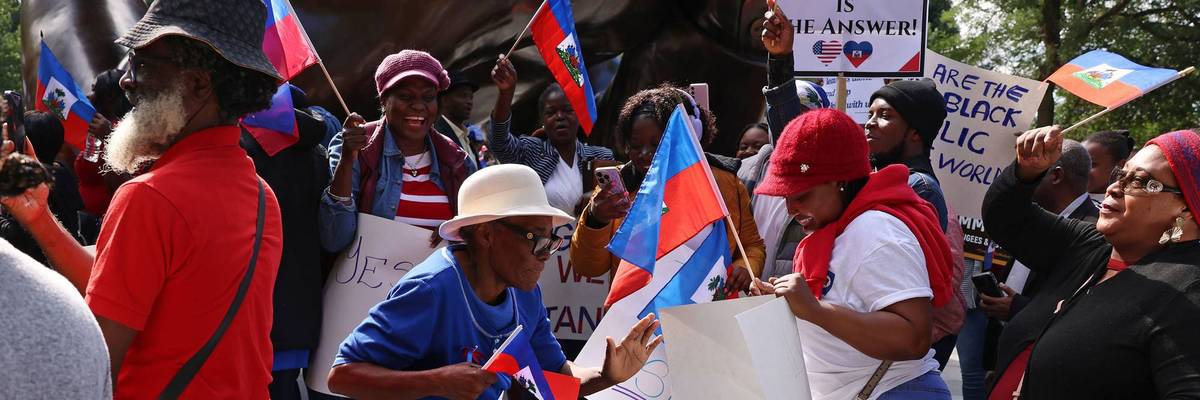
Members of the Haitian community and their allies marched and danced around The Embrace sculpture on the Boston Common after holding a rally to denounce the hateful rhetoric aimed towards Haitian migrants in Ohio and elsewhere in the United States.
Without Haitians There is No Collective Liberation
Two Haitian immigrant advocates chart out a path for what a truly liberatory policy toward Haitian and other Black immigrants could look like.
We started Black History Month with a critical—though potentially momentary—win for Haitian immigrants, specifically those with Temporary Protected Status. Although the Trump administration has appealed the decision, the current pause of the termination of TPS for Haitians has been a moment of reprieve for our community.
In this period of polycrisis, this victory also demonstrated the continued power of community organizing. But, in order to ensure this win is sustained and pushes us toward Black liberation and collective justice, we have to amplify the monumental role of Haiti and Haitians in our shared struggles for equity and justice in the US—past, present, and future. There’s a great deal for us to learn from Haiti and Haitians about collective liberation.
We felt momentary relief with the court ruling on TPS, but the unease we carry was not able to dissipate altogether because we know this government is undeterred from flouting the legal system. Living in limbo is already difficult for TPS holders, but like with all immigrant communities, there is the heightened fear of Immigration and Customs Enforcement and its inhumane and life-threatening tactics, which we see vis-a-vis their modern-day recreations of slave catchers.
Furthermore, Haitians live with another kind of fear—the fear of being both invisible and hyper-visible, but never fully human. This characterization has been deliberate and by design; a punitive response to Haiti’s successful revolt against slavery—the first in the world—and what it set in motion for Black and other colonized people across the world.
When we say we must continue to fight, we mean all of us. Anyone who says they are for justice and collective liberation must meet us on the streets and in the courtrooms.
The paradox of hyper-visibility paired with erasure is part of a larger pattern of anti-Blackness in this country. White supremacists tend to treat Haiti as symbolic of everything they intentionally mischaracterize or misrepresent about Black people, as a pretense to spew racialized anti-Black hatred. The public imagination they craft around Haiti is carefully curated to dehumanize us and to stoke fears around Black people rising up once again. We are an enduring threat to white supremacy and racial capitalism, which is why we continue to be punished and targeted as a people and a country.
This public imagination is exactly what the Trump administration leveraged to spread sensational lies that many Americans went on to accept as factual. It is why our community faces higher detention and deportation rates, and sees disproportionately lower rates of being granted asylum. And, it contributes to why philanthropy has not prioritized sustained giving to Haitian organizations. Even though we face unceasing attacks from the administration that have stripped over half a million Haitians of their statuses, targeted them repeatedly for halts on adjudication for almost all forms of relief, and imposed the most severe forms of travel bans for both non-immigrants and immigrants, we are not seeing a commensurate response to support us from the philanthropic community, to give us a fighting chance against these attacks.
Every day, there is a reminder of our invisibility. Language justice for Haitians is often an afterthought. We regularly have to advocate to immigrant rights organizations and grassroots organizing groups to provide Kreyòl interpretation for webinars, trainings, and materials that are directly applicable to hundreds of thousands of Haitians. Even though Haitian immigrants are the second-largest population with TPS, language access is usually not extended to Haitian TPS holders.
We are routinely rendered invisible by all factions of US society—policymakers, philanthropy, media, and even progressives—and yet we become hyper-visible in moments of crisis, political convenience, or scapegoating. We saw this hyper-visibility in the response to Haitians arriving in Del Rio, Texas, when Border Patrol agents were caught chasing Haitian refugees on horseback in 2021 and in the last presidential election when Haitian immigrants in Springfield, Ohio were thrust to the center of Republican political theater vis-a-vis the circulation of blatant misinformation designed to incite anti-immigrant sentiment.
Being left out of—or misrepresented in—mainstream narratives of immigration and American identity has real-life consequences. We feel it in the lack of services tailored to our community, insufficient language access, and more. We see it when we’re treated as an afterthought in immigrant rights advocacy and grossly underfunded compared to other immigrant communities—multiplying the unseen labor of the few Haitian migrant groups that exist. According to the National Committee for Responsive Philanthropy, “Black migrant justice groups received less than 2% of all funding for the movement, 0.04% of funding explicitly granted for Black communities in general, and overall less than 0.01% of all foundation grants given during 2016-2020,” which is why initiatives like the Black Migrant Power Fund—launched to address these gaps—are so crucial in this moment.
Our exclusion has also led to the distortion and flattening of our identity–we are often seen as victims with no agency, our significant present-day contributions have largely gone unnoticed, and centuries-old imperialist policies by the US and France continue to go unchecked despite playing a big role in the ongoing injustices in Haiti.
We reject this single story of victimhood and believe there is an urgent need to platform the pivotal leadership and perspectives of Haitian migrant rights’ leaders advocating for their communities across the region, which is why the Hemispheric Network for Haitian Migrants’ Rights was started. Haitian leaders’ initiatives and organizations are significantly under-resourced, yet they are undeterred in their battle against the anti-Blackness that knows no borders and confronts Haitians at every turn in their migration journeys.
In terms of contributions to the US, Haitian TPS holders alone contribute $5.8 billion to the US economy and pay $1.5 billion in taxes, but this is rarely considered in discussions about Haitian immigrants. Moreover, in our recent report from Haitian Women for Haitian Refugees, we shared that through the Cuba, Haiti, Nicaragua, and Venezuela (CHNV) Parole Program, a two-year humanitarian parole program, CHNV immigrants contributed an additional estimated $5.5 billion to the US economy annually through spending alone.
The February 3 verdict offered momentary relief for the 350,000 of us who have TPS status, but we must continue to fight tooth and nail for humanitarian protection. It remains to be seen whether the appellate or Supreme Court will grant the administration’s emergency appeal, and strip so many people of merited and necessary protections. Legislative efforts to protect TPS continue, with a discharge petition proposed by Rep. Ayanna Pressley (D-Mass.) with over 155 co-sponsors.
When we say we must continue to fight, we mean all of us. Anyone who says they are for justice and collective liberation must meet us on the streets and in the courtrooms as the next phase of our fight starts up to protect not only TPS, but to advocate for all forms of policy and practice that ensure Haitian migrants can be safe and thrive. Philanthropy must provide sustained support to our organizations because supporting Black migrant communities is a moral and social imperative, particularly for any institution that espouses a commitment to racial justice.
But above all, we must push back against white supremacy and fascism by finally recognizing that how we treat Haiti and Haitian immigrants, and really any group of people who occupy this paradoxical position of invisibility and hyper-visibility in our society, is a barometer of our commitment to collective liberation.
We are at a crossroads
This country and this world are at a monumental crossroads. In a few short weeks, US voters will have an opportunity to beat back the forces of fascism and confront the billionaires who are rigging the economy, our media system, and our democracy, making it increasingly impossible for ordinary people to get by. We’re not just talking about the election. We’re talking about what must be done once these fascist elements are vanquished from power. We need a bolder set of solutions than what either major party has so far been willing to offer and a working-class movement ready to fight like hell for it. Trump didn't emerge from nowhere. The conditions that fueled MAGA authoritarianism were created by decades of radical neoliberal economic policies and a corrupt political system dominated by corporate interests. They slashed taxes on the super-rich, promising that the benefits would trickle down. They said giveaways to the corporate titans would make life more affordable for the rest of us. It was all bullshit. And when a bitter, betrayed populace searches for someone to blame, right-wing demagogues have little trouble finding scapegoats. People know when they're being lied to, but you won't hear any of this from the corporate media. Only independent journalism—powered and funded by people who believe in building a better world—can deliver truly trustworthy daily news. Our Fall Campaign is underway, and we need your help. To power our newsroom through the rest of the year, we need to raise $125,000 by midnight on October 31. So if you share our vision, please contribute whatever you can to sustain our work. |
We started Black History Month with a critical—though potentially momentary—win for Haitian immigrants, specifically those with Temporary Protected Status. Although the Trump administration has appealed the decision, the current pause of the termination of TPS for Haitians has been a moment of reprieve for our community.
In this period of polycrisis, this victory also demonstrated the continued power of community organizing. But, in order to ensure this win is sustained and pushes us toward Black liberation and collective justice, we have to amplify the monumental role of Haiti and Haitians in our shared struggles for equity and justice in the US—past, present, and future. There’s a great deal for us to learn from Haiti and Haitians about collective liberation.
We felt momentary relief with the court ruling on TPS, but the unease we carry was not able to dissipate altogether because we know this government is undeterred from flouting the legal system. Living in limbo is already difficult for TPS holders, but like with all immigrant communities, there is the heightened fear of Immigration and Customs Enforcement and its inhumane and life-threatening tactics, which we see vis-a-vis their modern-day recreations of slave catchers.
Furthermore, Haitians live with another kind of fear—the fear of being both invisible and hyper-visible, but never fully human. This characterization has been deliberate and by design; a punitive response to Haiti’s successful revolt against slavery—the first in the world—and what it set in motion for Black and other colonized people across the world.
When we say we must continue to fight, we mean all of us. Anyone who says they are for justice and collective liberation must meet us on the streets and in the courtrooms.
The paradox of hyper-visibility paired with erasure is part of a larger pattern of anti-Blackness in this country. White supremacists tend to treat Haiti as symbolic of everything they intentionally mischaracterize or misrepresent about Black people, as a pretense to spew racialized anti-Black hatred. The public imagination they craft around Haiti is carefully curated to dehumanize us and to stoke fears around Black people rising up once again. We are an enduring threat to white supremacy and racial capitalism, which is why we continue to be punished and targeted as a people and a country.
This public imagination is exactly what the Trump administration leveraged to spread sensational lies that many Americans went on to accept as factual. It is why our community faces higher detention and deportation rates, and sees disproportionately lower rates of being granted asylum. And, it contributes to why philanthropy has not prioritized sustained giving to Haitian organizations. Even though we face unceasing attacks from the administration that have stripped over half a million Haitians of their statuses, targeted them repeatedly for halts on adjudication for almost all forms of relief, and imposed the most severe forms of travel bans for both non-immigrants and immigrants, we are not seeing a commensurate response to support us from the philanthropic community, to give us a fighting chance against these attacks.
Every day, there is a reminder of our invisibility. Language justice for Haitians is often an afterthought. We regularly have to advocate to immigrant rights organizations and grassroots organizing groups to provide Kreyòl interpretation for webinars, trainings, and materials that are directly applicable to hundreds of thousands of Haitians. Even though Haitian immigrants are the second-largest population with TPS, language access is usually not extended to Haitian TPS holders.
We are routinely rendered invisible by all factions of US society—policymakers, philanthropy, media, and even progressives—and yet we become hyper-visible in moments of crisis, political convenience, or scapegoating. We saw this hyper-visibility in the response to Haitians arriving in Del Rio, Texas, when Border Patrol agents were caught chasing Haitian refugees on horseback in 2021 and in the last presidential election when Haitian immigrants in Springfield, Ohio were thrust to the center of Republican political theater vis-a-vis the circulation of blatant misinformation designed to incite anti-immigrant sentiment.
Being left out of—or misrepresented in—mainstream narratives of immigration and American identity has real-life consequences. We feel it in the lack of services tailored to our community, insufficient language access, and more. We see it when we’re treated as an afterthought in immigrant rights advocacy and grossly underfunded compared to other immigrant communities—multiplying the unseen labor of the few Haitian migrant groups that exist. According to the National Committee for Responsive Philanthropy, “Black migrant justice groups received less than 2% of all funding for the movement, 0.04% of funding explicitly granted for Black communities in general, and overall less than 0.01% of all foundation grants given during 2016-2020,” which is why initiatives like the Black Migrant Power Fund—launched to address these gaps—are so crucial in this moment.
Our exclusion has also led to the distortion and flattening of our identity–we are often seen as victims with no agency, our significant present-day contributions have largely gone unnoticed, and centuries-old imperialist policies by the US and France continue to go unchecked despite playing a big role in the ongoing injustices in Haiti.
We reject this single story of victimhood and believe there is an urgent need to platform the pivotal leadership and perspectives of Haitian migrant rights’ leaders advocating for their communities across the region, which is why the Hemispheric Network for Haitian Migrants’ Rights was started. Haitian leaders’ initiatives and organizations are significantly under-resourced, yet they are undeterred in their battle against the anti-Blackness that knows no borders and confronts Haitians at every turn in their migration journeys.
In terms of contributions to the US, Haitian TPS holders alone contribute $5.8 billion to the US economy and pay $1.5 billion in taxes, but this is rarely considered in discussions about Haitian immigrants. Moreover, in our recent report from Haitian Women for Haitian Refugees, we shared that through the Cuba, Haiti, Nicaragua, and Venezuela (CHNV) Parole Program, a two-year humanitarian parole program, CHNV immigrants contributed an additional estimated $5.5 billion to the US economy annually through spending alone.
The February 3 verdict offered momentary relief for the 350,000 of us who have TPS status, but we must continue to fight tooth and nail for humanitarian protection. It remains to be seen whether the appellate or Supreme Court will grant the administration’s emergency appeal, and strip so many people of merited and necessary protections. Legislative efforts to protect TPS continue, with a discharge petition proposed by Rep. Ayanna Pressley (D-Mass.) with over 155 co-sponsors.
When we say we must continue to fight, we mean all of us. Anyone who says they are for justice and collective liberation must meet us on the streets and in the courtrooms as the next phase of our fight starts up to protect not only TPS, but to advocate for all forms of policy and practice that ensure Haitian migrants can be safe and thrive. Philanthropy must provide sustained support to our organizations because supporting Black migrant communities is a moral and social imperative, particularly for any institution that espouses a commitment to racial justice.
But above all, we must push back against white supremacy and fascism by finally recognizing that how we treat Haiti and Haitian immigrants, and really any group of people who occupy this paradoxical position of invisibility and hyper-visibility in our society, is a barometer of our commitment to collective liberation.
- Why the US Owes Haiti Billions - The Briefest History ›
- Somalis, Haitians, and Trump’s Crusade to Make America White Again ›
- 'Sigh of Relief' as Judge Blocks Trump Attack on Protected Status of Haitian Refugees ›
- Haitians Helping Haitians After Latest Quake ›
- To Defend Haitian Migrants, Oppose the US Policies That Forced Them to Flee ›
- From Revolution to Reparations: Black August and Haiti’s Ongoing Struggle for Freedom ›
We started Black History Month with a critical—though potentially momentary—win for Haitian immigrants, specifically those with Temporary Protected Status. Although the Trump administration has appealed the decision, the current pause of the termination of TPS for Haitians has been a moment of reprieve for our community.
In this period of polycrisis, this victory also demonstrated the continued power of community organizing. But, in order to ensure this win is sustained and pushes us toward Black liberation and collective justice, we have to amplify the monumental role of Haiti and Haitians in our shared struggles for equity and justice in the US—past, present, and future. There’s a great deal for us to learn from Haiti and Haitians about collective liberation.
We felt momentary relief with the court ruling on TPS, but the unease we carry was not able to dissipate altogether because we know this government is undeterred from flouting the legal system. Living in limbo is already difficult for TPS holders, but like with all immigrant communities, there is the heightened fear of Immigration and Customs Enforcement and its inhumane and life-threatening tactics, which we see vis-a-vis their modern-day recreations of slave catchers.
Furthermore, Haitians live with another kind of fear—the fear of being both invisible and hyper-visible, but never fully human. This characterization has been deliberate and by design; a punitive response to Haiti’s successful revolt against slavery—the first in the world—and what it set in motion for Black and other colonized people across the world.
When we say we must continue to fight, we mean all of us. Anyone who says they are for justice and collective liberation must meet us on the streets and in the courtrooms.
The paradox of hyper-visibility paired with erasure is part of a larger pattern of anti-Blackness in this country. White supremacists tend to treat Haiti as symbolic of everything they intentionally mischaracterize or misrepresent about Black people, as a pretense to spew racialized anti-Black hatred. The public imagination they craft around Haiti is carefully curated to dehumanize us and to stoke fears around Black people rising up once again. We are an enduring threat to white supremacy and racial capitalism, which is why we continue to be punished and targeted as a people and a country.
This public imagination is exactly what the Trump administration leveraged to spread sensational lies that many Americans went on to accept as factual. It is why our community faces higher detention and deportation rates, and sees disproportionately lower rates of being granted asylum. And, it contributes to why philanthropy has not prioritized sustained giving to Haitian organizations. Even though we face unceasing attacks from the administration that have stripped over half a million Haitians of their statuses, targeted them repeatedly for halts on adjudication for almost all forms of relief, and imposed the most severe forms of travel bans for both non-immigrants and immigrants, we are not seeing a commensurate response to support us from the philanthropic community, to give us a fighting chance against these attacks.
Every day, there is a reminder of our invisibility. Language justice for Haitians is often an afterthought. We regularly have to advocate to immigrant rights organizations and grassroots organizing groups to provide Kreyòl interpretation for webinars, trainings, and materials that are directly applicable to hundreds of thousands of Haitians. Even though Haitian immigrants are the second-largest population with TPS, language access is usually not extended to Haitian TPS holders.
We are routinely rendered invisible by all factions of US society—policymakers, philanthropy, media, and even progressives—and yet we become hyper-visible in moments of crisis, political convenience, or scapegoating. We saw this hyper-visibility in the response to Haitians arriving in Del Rio, Texas, when Border Patrol agents were caught chasing Haitian refugees on horseback in 2021 and in the last presidential election when Haitian immigrants in Springfield, Ohio were thrust to the center of Republican political theater vis-a-vis the circulation of blatant misinformation designed to incite anti-immigrant sentiment.
Being left out of—or misrepresented in—mainstream narratives of immigration and American identity has real-life consequences. We feel it in the lack of services tailored to our community, insufficient language access, and more. We see it when we’re treated as an afterthought in immigrant rights advocacy and grossly underfunded compared to other immigrant communities—multiplying the unseen labor of the few Haitian migrant groups that exist. According to the National Committee for Responsive Philanthropy, “Black migrant justice groups received less than 2% of all funding for the movement, 0.04% of funding explicitly granted for Black communities in general, and overall less than 0.01% of all foundation grants given during 2016-2020,” which is why initiatives like the Black Migrant Power Fund—launched to address these gaps—are so crucial in this moment.
Our exclusion has also led to the distortion and flattening of our identity–we are often seen as victims with no agency, our significant present-day contributions have largely gone unnoticed, and centuries-old imperialist policies by the US and France continue to go unchecked despite playing a big role in the ongoing injustices in Haiti.
We reject this single story of victimhood and believe there is an urgent need to platform the pivotal leadership and perspectives of Haitian migrant rights’ leaders advocating for their communities across the region, which is why the Hemispheric Network for Haitian Migrants’ Rights was started. Haitian leaders’ initiatives and organizations are significantly under-resourced, yet they are undeterred in their battle against the anti-Blackness that knows no borders and confronts Haitians at every turn in their migration journeys.
In terms of contributions to the US, Haitian TPS holders alone contribute $5.8 billion to the US economy and pay $1.5 billion in taxes, but this is rarely considered in discussions about Haitian immigrants. Moreover, in our recent report from Haitian Women for Haitian Refugees, we shared that through the Cuba, Haiti, Nicaragua, and Venezuela (CHNV) Parole Program, a two-year humanitarian parole program, CHNV immigrants contributed an additional estimated $5.5 billion to the US economy annually through spending alone.
The February 3 verdict offered momentary relief for the 350,000 of us who have TPS status, but we must continue to fight tooth and nail for humanitarian protection. It remains to be seen whether the appellate or Supreme Court will grant the administration’s emergency appeal, and strip so many people of merited and necessary protections. Legislative efforts to protect TPS continue, with a discharge petition proposed by Rep. Ayanna Pressley (D-Mass.) with over 155 co-sponsors.
When we say we must continue to fight, we mean all of us. Anyone who says they are for justice and collective liberation must meet us on the streets and in the courtrooms as the next phase of our fight starts up to protect not only TPS, but to advocate for all forms of policy and practice that ensure Haitian migrants can be safe and thrive. Philanthropy must provide sustained support to our organizations because supporting Black migrant communities is a moral and social imperative, particularly for any institution that espouses a commitment to racial justice.
But above all, we must push back against white supremacy and fascism by finally recognizing that how we treat Haiti and Haitian immigrants, and really any group of people who occupy this paradoxical position of invisibility and hyper-visibility in our society, is a barometer of our commitment to collective liberation.
- Why the US Owes Haiti Billions - The Briefest History ›
- Somalis, Haitians, and Trump’s Crusade to Make America White Again ›
- 'Sigh of Relief' as Judge Blocks Trump Attack on Protected Status of Haitian Refugees ›
- Haitians Helping Haitians After Latest Quake ›
- To Defend Haitian Migrants, Oppose the US Policies That Forced Them to Flee ›
- From Revolution to Reparations: Black August and Haiti’s Ongoing Struggle for Freedom ›