SUBSCRIBE TO OUR FREE NEWSLETTER
Daily news & progressive opinion—funded by the people, not the corporations—delivered straight to your inbox.
5
#000000
#FFFFFF
To donate by check, phone, or other method, see our More Ways to Give page.
Daily news & progressive opinion—funded by the people, not the corporations—delivered straight to your inbox.
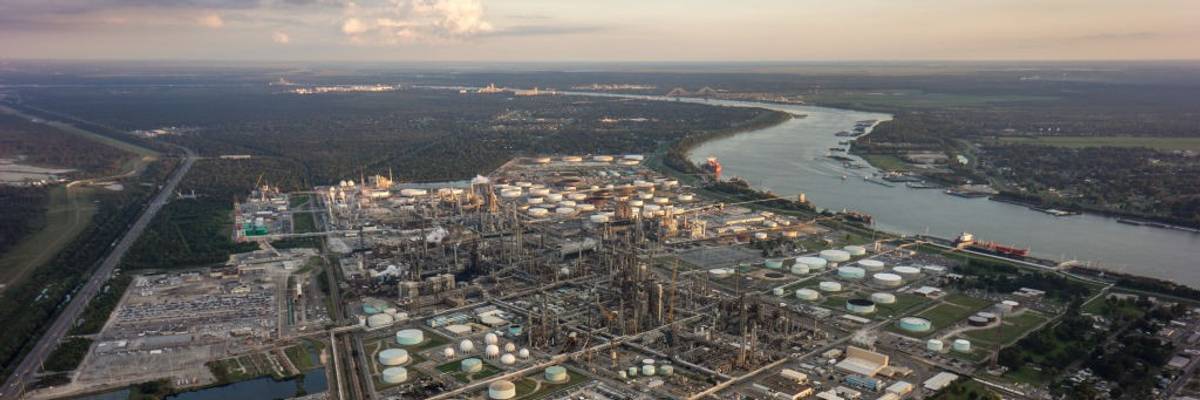
Chemical plants and factories line the roads and suburbs of the area known as "Cancer Alley" on October 15, 2013.
The Riverplex Megapark planned for Louisiana's Ascension Parish threatens both the history and future of the community with the destruction of former slave cabins and the construction of a polluting ammonia plant.
I was pleased to see Sinners have a good night at the Oscars, picking up four trophies. It didn’t win Best Picture, but to my mind, it is the movie of the year. Sinners had far and away the greatest cultural impact, especially among Black people.
Sinners is the rare blockbuster film that explores Black history from the perspective of Black people, but I believe the reason the film has touched such a nerve is that it’s much more than a period piece. When I watched Sinners, I didn’t just see a movie about the past. I saw a mirror. The horror in the film isn’t history; the blood-sucking vampires of racism, white supremacy, and cultural erasure still haunt us today.
For me, Sinners hit literally close to home. Although it is set in Mississippi, it was filmed entirely in southeastern Louisiana, where my roots trace back to a small community called Donaldsonville. The film reminded me of my childhood when grandpa and I walked the avenue to shop. We’d walk from Smoke Bend, up the avenue, to a warehouse on the edge of town to get syrup in a yellow can—perfect for eating with fry bread. What’s funny about the movie is that Michael B. Jordan’s characters’ names were Smoke and Stack. And my grandpa told me that Smoke Bend got its name from the Indian campfires travelers saw when they came around the river bend. The scenes where Smoke and Stack go to Clarksdale to buy supplies were shot on Railroad Avenue in Donaldsonville, where I live and work. Folks from around here remember hearing the alarm and radio announcements from Ascension Parish Barn on Church street as they shopped along the Avenue.
The Jim Crow era depicted in Sinners has ended, but here in Ascension Parish, we are in a struggle to protect Black lives and preserve Black heritage. In the name of economic growth, the Parish government is planning to create a massive, 17,000-acre industrial complex—the so-called Riverplex Megapark—featuring a Hyundai plant and other pollution-producing factories. The complex will decimate the historic predominantly Black community of Modeste and part of Donaldsonville, displacing as many as 800 people.
We will not be able to protect our communities unless more should-be allies come to recognize that environmental justice is a major civil rights issue of our time.
In October, Modeste residents reported that heavy machinery had demolished some of the slave cabins on the site of the former Germania and Mulberry Plantations. The purpose of the destruction was to make way for the Hyundai facility, which could destroy both plantations as well as the neighboring Zeringue Plantation.
Those cabins hold the stories of their enslaved ancestors, the people whose labor built this land and whose spirit still breathes through it. Among the destroyed cabins was one of deep significance to me: My uncle, Cloveste, was born in one of them. Like the juke joint in Sinners, those cabins are a sacred space; they are bloodline, legacy, and love—and they were bulldozed to make room for corporate profit.
While erasing our past, this industrial complex also threatens our future. Located in the heart of “Cancer Alley,” Ascension Parish is one of the most polluted counties in the United States. Less than 3 miles from my house is the world’s largest ammonia plant, the single worst polluting factory in the country. I am a breast cancer survivor. All three of my children were born prematurely, and one of them has had respiratory problems his whole life. These kinds of sicknesses are commonplace around here. Yet plans for the complex include another ammonia plant that will spew out thousands of tons of pollution.
Down here, corporate executives don’t wear hoods or burn crosses, but their greed can kill us just the same.
We are all for development, but we want economic growth that strengthens our communities, not that erases and endangers them while creating generational wealth for others. Rural Roots Louisiana, the organization I founded, is leading an effort to block the “megapark,” and a judge recently ruled in our favor, ordering the front group behind the project to turn over relevant public records.
But we are up against forces with bottomless resources, which they are using to try to buy out and pay off people in the community. This presents people with hard choices, but as we see in Sinners, there is a cost to accommodating your oppressor. As Director Ryan Coogler said, his film explores “the deals people in oppressive situations must rationalize.”
In this struggle, as in all my work, I take heart in the example of our ancestors, who persevered in the face of even steeper odds. Their efforts and sacrifices ended American apartheid, and it is important to remember how far the country has come. Sinners itself, the fact that it got made, is a form of progress. It serves as a rebuke to those trying to erase Black history.
I also draw inspiration from activists and organizers throughout southeast Louisiana. A few years ago, in Plaquemines Parish—where most of Sinners was shot—community members blocked an oil terminal that would have destroyed a cemetery where their enslaved ancestors were buried. In St. James Parish, community groups have made headway in their lawsuit seeking a landmark moratorium on petrochemical facilities, while in St. John Parish, a historic Black community waged a heroic battle against a proposed grain elevator.
Still, we will not be able to protect our communities unless more should-be allies come to recognize that environmental justice is a major civil rights issue of our time. Put another way, environmental racism might not seem like the scariest vampire—it dresses in suits and wears nice shoes—but none have more blood on their teeth.
Dear Common Dreams reader, It’s been nearly 30 years since I co-founded Common Dreams with my late wife, Lina Newhouser. We had the radical notion that journalism should serve the public good, not corporate profits. It was clear to us from the outset what it would take to build such a project. No paid advertisements. No corporate sponsors. No millionaire publisher telling us what to think or do. Many people said we wouldn't last a year, but we proved those doubters wrong. Together with a tremendous team of journalists and dedicated staff, we built an independent media outlet free from the constraints of profits and corporate control. Our mission has always been simple: To inform. To inspire. To ignite change for the common good. Building Common Dreams was not easy. Our survival was never guaranteed. When you take on the most powerful forces—Wall Street greed, fossil fuel industry destruction, Big Tech lobbyists, and uber-rich oligarchs who have spent billions upon billions rigging the economy and democracy in their favor—the only bulwark you have is supporters who believe in your work. But here’s the urgent message from me today. It's never been this bad out there. And it's never been this hard to keep us going. At the very moment Common Dreams is most needed, the threats we face are intensifying. We need your support now more than ever. We don't accept corporate advertising and never will. We don't have a paywall because we don't think people should be blocked from critical news based on their ability to pay. Everything we do is funded by the donations of readers like you. When everyone does the little they can afford, we are strong. But if that support retreats or dries up, so do we. Will you donate now to make sure Common Dreams not only survives but thrives? —Craig Brown, Co-founder |
I was pleased to see Sinners have a good night at the Oscars, picking up four trophies. It didn’t win Best Picture, but to my mind, it is the movie of the year. Sinners had far and away the greatest cultural impact, especially among Black people.
Sinners is the rare blockbuster film that explores Black history from the perspective of Black people, but I believe the reason the film has touched such a nerve is that it’s much more than a period piece. When I watched Sinners, I didn’t just see a movie about the past. I saw a mirror. The horror in the film isn’t history; the blood-sucking vampires of racism, white supremacy, and cultural erasure still haunt us today.
For me, Sinners hit literally close to home. Although it is set in Mississippi, it was filmed entirely in southeastern Louisiana, where my roots trace back to a small community called Donaldsonville. The film reminded me of my childhood when grandpa and I walked the avenue to shop. We’d walk from Smoke Bend, up the avenue, to a warehouse on the edge of town to get syrup in a yellow can—perfect for eating with fry bread. What’s funny about the movie is that Michael B. Jordan’s characters’ names were Smoke and Stack. And my grandpa told me that Smoke Bend got its name from the Indian campfires travelers saw when they came around the river bend. The scenes where Smoke and Stack go to Clarksdale to buy supplies were shot on Railroad Avenue in Donaldsonville, where I live and work. Folks from around here remember hearing the alarm and radio announcements from Ascension Parish Barn on Church street as they shopped along the Avenue.
The Jim Crow era depicted in Sinners has ended, but here in Ascension Parish, we are in a struggle to protect Black lives and preserve Black heritage. In the name of economic growth, the Parish government is planning to create a massive, 17,000-acre industrial complex—the so-called Riverplex Megapark—featuring a Hyundai plant and other pollution-producing factories. The complex will decimate the historic predominantly Black community of Modeste and part of Donaldsonville, displacing as many as 800 people.
We will not be able to protect our communities unless more should-be allies come to recognize that environmental justice is a major civil rights issue of our time.
In October, Modeste residents reported that heavy machinery had demolished some of the slave cabins on the site of the former Germania and Mulberry Plantations. The purpose of the destruction was to make way for the Hyundai facility, which could destroy both plantations as well as the neighboring Zeringue Plantation.
Those cabins hold the stories of their enslaved ancestors, the people whose labor built this land and whose spirit still breathes through it. Among the destroyed cabins was one of deep significance to me: My uncle, Cloveste, was born in one of them. Like the juke joint in Sinners, those cabins are a sacred space; they are bloodline, legacy, and love—and they were bulldozed to make room for corporate profit.
While erasing our past, this industrial complex also threatens our future. Located in the heart of “Cancer Alley,” Ascension Parish is one of the most polluted counties in the United States. Less than 3 miles from my house is the world’s largest ammonia plant, the single worst polluting factory in the country. I am a breast cancer survivor. All three of my children were born prematurely, and one of them has had respiratory problems his whole life. These kinds of sicknesses are commonplace around here. Yet plans for the complex include another ammonia plant that will spew out thousands of tons of pollution.
Down here, corporate executives don’t wear hoods or burn crosses, but their greed can kill us just the same.
We are all for development, but we want economic growth that strengthens our communities, not that erases and endangers them while creating generational wealth for others. Rural Roots Louisiana, the organization I founded, is leading an effort to block the “megapark,” and a judge recently ruled in our favor, ordering the front group behind the project to turn over relevant public records.
But we are up against forces with bottomless resources, which they are using to try to buy out and pay off people in the community. This presents people with hard choices, but as we see in Sinners, there is a cost to accommodating your oppressor. As Director Ryan Coogler said, his film explores “the deals people in oppressive situations must rationalize.”
In this struggle, as in all my work, I take heart in the example of our ancestors, who persevered in the face of even steeper odds. Their efforts and sacrifices ended American apartheid, and it is important to remember how far the country has come. Sinners itself, the fact that it got made, is a form of progress. It serves as a rebuke to those trying to erase Black history.
I also draw inspiration from activists and organizers throughout southeast Louisiana. A few years ago, in Plaquemines Parish—where most of Sinners was shot—community members blocked an oil terminal that would have destroyed a cemetery where their enslaved ancestors were buried. In St. James Parish, community groups have made headway in their lawsuit seeking a landmark moratorium on petrochemical facilities, while in St. John Parish, a historic Black community waged a heroic battle against a proposed grain elevator.
Still, we will not be able to protect our communities unless more should-be allies come to recognize that environmental justice is a major civil rights issue of our time. Put another way, environmental racism might not seem like the scariest vampire—it dresses in suits and wears nice shoes—but none have more blood on their teeth.
I was pleased to see Sinners have a good night at the Oscars, picking up four trophies. It didn’t win Best Picture, but to my mind, it is the movie of the year. Sinners had far and away the greatest cultural impact, especially among Black people.
Sinners is the rare blockbuster film that explores Black history from the perspective of Black people, but I believe the reason the film has touched such a nerve is that it’s much more than a period piece. When I watched Sinners, I didn’t just see a movie about the past. I saw a mirror. The horror in the film isn’t history; the blood-sucking vampires of racism, white supremacy, and cultural erasure still haunt us today.
For me, Sinners hit literally close to home. Although it is set in Mississippi, it was filmed entirely in southeastern Louisiana, where my roots trace back to a small community called Donaldsonville. The film reminded me of my childhood when grandpa and I walked the avenue to shop. We’d walk from Smoke Bend, up the avenue, to a warehouse on the edge of town to get syrup in a yellow can—perfect for eating with fry bread. What’s funny about the movie is that Michael B. Jordan’s characters’ names were Smoke and Stack. And my grandpa told me that Smoke Bend got its name from the Indian campfires travelers saw when they came around the river bend. The scenes where Smoke and Stack go to Clarksdale to buy supplies were shot on Railroad Avenue in Donaldsonville, where I live and work. Folks from around here remember hearing the alarm and radio announcements from Ascension Parish Barn on Church street as they shopped along the Avenue.
The Jim Crow era depicted in Sinners has ended, but here in Ascension Parish, we are in a struggle to protect Black lives and preserve Black heritage. In the name of economic growth, the Parish government is planning to create a massive, 17,000-acre industrial complex—the so-called Riverplex Megapark—featuring a Hyundai plant and other pollution-producing factories. The complex will decimate the historic predominantly Black community of Modeste and part of Donaldsonville, displacing as many as 800 people.
We will not be able to protect our communities unless more should-be allies come to recognize that environmental justice is a major civil rights issue of our time.
In October, Modeste residents reported that heavy machinery had demolished some of the slave cabins on the site of the former Germania and Mulberry Plantations. The purpose of the destruction was to make way for the Hyundai facility, which could destroy both plantations as well as the neighboring Zeringue Plantation.
Those cabins hold the stories of their enslaved ancestors, the people whose labor built this land and whose spirit still breathes through it. Among the destroyed cabins was one of deep significance to me: My uncle, Cloveste, was born in one of them. Like the juke joint in Sinners, those cabins are a sacred space; they are bloodline, legacy, and love—and they were bulldozed to make room for corporate profit.
While erasing our past, this industrial complex also threatens our future. Located in the heart of “Cancer Alley,” Ascension Parish is one of the most polluted counties in the United States. Less than 3 miles from my house is the world’s largest ammonia plant, the single worst polluting factory in the country. I am a breast cancer survivor. All three of my children were born prematurely, and one of them has had respiratory problems his whole life. These kinds of sicknesses are commonplace around here. Yet plans for the complex include another ammonia plant that will spew out thousands of tons of pollution.
Down here, corporate executives don’t wear hoods or burn crosses, but their greed can kill us just the same.
We are all for development, but we want economic growth that strengthens our communities, not that erases and endangers them while creating generational wealth for others. Rural Roots Louisiana, the organization I founded, is leading an effort to block the “megapark,” and a judge recently ruled in our favor, ordering the front group behind the project to turn over relevant public records.
But we are up against forces with bottomless resources, which they are using to try to buy out and pay off people in the community. This presents people with hard choices, but as we see in Sinners, there is a cost to accommodating your oppressor. As Director Ryan Coogler said, his film explores “the deals people in oppressive situations must rationalize.”
In this struggle, as in all my work, I take heart in the example of our ancestors, who persevered in the face of even steeper odds. Their efforts and sacrifices ended American apartheid, and it is important to remember how far the country has come. Sinners itself, the fact that it got made, is a form of progress. It serves as a rebuke to those trying to erase Black history.
I also draw inspiration from activists and organizers throughout southeast Louisiana. A few years ago, in Plaquemines Parish—where most of Sinners was shot—community members blocked an oil terminal that would have destroyed a cemetery where their enslaved ancestors were buried. In St. James Parish, community groups have made headway in their lawsuit seeking a landmark moratorium on petrochemical facilities, while in St. John Parish, a historic Black community waged a heroic battle against a proposed grain elevator.
Still, we will not be able to protect our communities unless more should-be allies come to recognize that environmental justice is a major civil rights issue of our time. Put another way, environmental racism might not seem like the scariest vampire—it dresses in suits and wears nice shoes—but none have more blood on their teeth.