Public Education Is Free to All Students. Now Do Their Lunch
It's outrageous that we ensure taxpayer-funded public classrooms and teacher salaries as well as roads, parks, libraries, firefighters, paramedics, and more, but draw the line at something for our kids to eat in the middle of the day.
During the pandemic, the government embarked on a beautiful experiment: expanding public programs to stave off poverty. One critical component was ensuring that public school students had free lunches regardless of family income.
During the 2020-2021 school year, 98 percent of all school lunches were free to students. All of a sudden, public schools were allowed to treat the idea of feeding students to be as essential as educating them.
These pandemic-era programs — which also included a monthly Child Tax Credit, a pause in student loan repayments, and expansions of SNAP and Medicaid — not only kept people from falling into deep poverty but actually led to a record reduction in poverty levels.
But as those programs expire, poverty is rising again. And with an end to federally funded free school lunches, kids living in the world’s richest nation will go hungry again.
Republicans say they would cut federal funding for school lunches altogether, declaring it a priority for 2024. In this dystopian worldview, kids don’t have an unconditional right to food.
When the temporary free lunch program that fed 50 million students ended in June 2022, participation in school meal programs plummeted and income-based qualifications for free meals resumed. Public school meal debt has ballooned to $262 million per year, with an estimated 30.4 million students unable to pay for their meals.
Shameful stories abound.
For example, Donovan Elementary School in Lebanon, Ohio, announced “Ice Cream Friday,” a fun activity that expressly excluded students with debt. “If a student has a negative balance they will not be able to purchase an ice cream even if they bring their $1,” the school said. “Students are only allowed to purchase [one] ice cream and are not permitted to buy an ice cream for a friend.”
“Just give the kids ice cream!!!” one person replied to the school on Facebook. “The part that kids can’t buy ice cream for their friends is disgusting.”
At a district in Philadelphia, sixth through 12th graders in debt will no longer be fed at school. Among the impacted parents is a single mother of three who cannot pay off her kids’ $400 lunch debt. In North Carolina, the Charlotte-Mecklenburg School District has nearly $500,000 in unpaid school lunch debts.
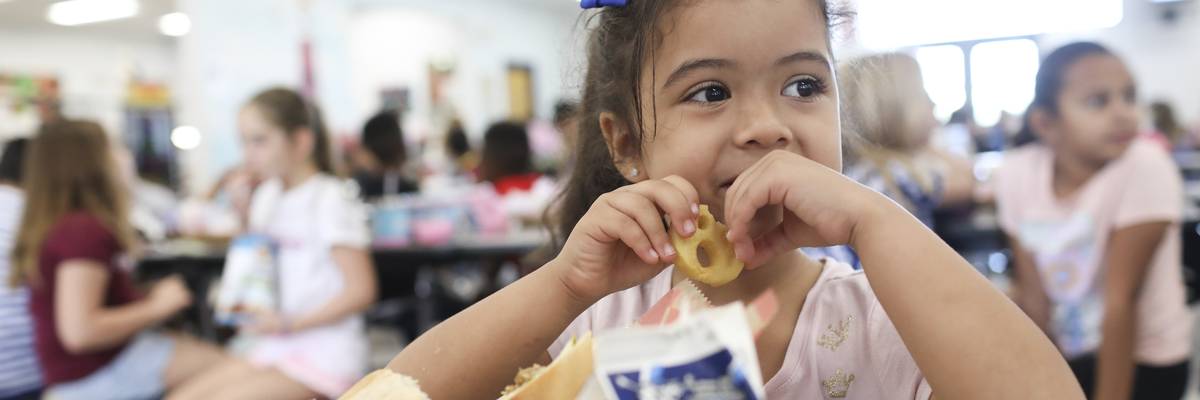
Even in school districts where meals are free for low-income families, there is a deep stigma when kids are singled out. There are horror stories of “lunch shaming,” such as kids forgoing meals in order to not be outed as too poor to pay out-of-pocket.
Additionally, according to one analysis, many kids “are part of families who earn too much to be considered for free or reduced lunch, but also earn too little to afford regular school meals.”
This is outrageous. We ensure taxpayer-funded public classrooms and teacher salaries as well as roads, parks, libraries, firefighters, paramedics, and more. None of these have income or work-based requirements. They’re free at the point of use for everyone.
But we draw the line at school lunches?
Republicans say they would cut federal funding for school lunches altogether, declaring it a priority for 2024. In this dystopian worldview, kids don’t have an unconditional right to food. But some Democratic-run states actually learned from the federal government’s pandemic experiment.
California’s Department of Education this year boasted about being “the first state to implement a statewide Universal Meals Program for school children.” Colorado, Illinois, Maine, Massachusetts, Michigan, Minnesota, New Mexico, and Vermont have implemented similar programs.
“‘School lunch debt’ is a term so absurd that it shouldn’t even exist,” declared Senator John Fetterman (D-PA). Fetterman’s federal School Lunch Debt Cancelation Act would direct the Department of Agriculture to pay off all school meal debts.
But it isn’t enough to pay off the debt once. Modeled on California’s approach, Rep. Ilhan Omar’s (D-MN) Universal School Meals Program Act would permanently offer free meals for all kids with no income restriction.
I asked my 16-year-old son, who attends a public school in California, how he would respond if kids at his school were required to pay for meals. “That would be pretty dumb,” he said. He’s right. It’s that simple.
We are at a crossroads
This country and this world are at a monumental crossroads. In a few short weeks, US voters will have an opportunity to beat back the forces of fascism and confront the billionaires who are rigging the economy, our media system, and our democracy, making it increasingly impossible for ordinary people to get by. We’re not just talking about the election. We’re talking about what must be done once these fascist elements are vanquished from power. We need a bolder set of solutions than what either major party has so far been willing to offer and a working-class movement ready to fight like hell for it. Trump didn't emerge from nowhere. The conditions that fueled MAGA authoritarianism were created by decades of radical neoliberal economic policies and a corrupt political system dominated by corporate interests. They slashed taxes on the super-rich, promising that the benefits would trickle down. They said giveaways to the corporate titans would make life more affordable for the rest of us. It was all bullshit. And when a bitter, betrayed populace searches for someone to blame, right-wing demagogues have little trouble finding scapegoats. People know when they're being lied to, but you won't hear any of this from the corporate media. Only independent journalism—powered and funded by people who believe in building a better world—can deliver truly trustworthy daily news. Our Fall Campaign is underway, and we need your help. To power our newsroom through the rest of the year, we need to raise $125,000 by midnight on October 31. So if you share our vision, please contribute whatever you can to sustain our work. |
During the pandemic, the government embarked on a beautiful experiment: expanding public programs to stave off poverty. One critical component was ensuring that public school students had free lunches regardless of family income.
During the 2020-2021 school year, 98 percent of all school lunches were free to students. All of a sudden, public schools were allowed to treat the idea of feeding students to be as essential as educating them.
These pandemic-era programs — which also included a monthly Child Tax Credit, a pause in student loan repayments, and expansions of SNAP and Medicaid — not only kept people from falling into deep poverty but actually led to a record reduction in poverty levels.
But as those programs expire, poverty is rising again. And with an end to federally funded free school lunches, kids living in the world’s richest nation will go hungry again.
Republicans say they would cut federal funding for school lunches altogether, declaring it a priority for 2024. In this dystopian worldview, kids don’t have an unconditional right to food.
When the temporary free lunch program that fed 50 million students ended in June 2022, participation in school meal programs plummeted and income-based qualifications for free meals resumed. Public school meal debt has ballooned to $262 million per year, with an estimated 30.4 million students unable to pay for their meals.
Shameful stories abound.
For example, Donovan Elementary School in Lebanon, Ohio, announced “Ice Cream Friday,” a fun activity that expressly excluded students with debt. “If a student has a negative balance they will not be able to purchase an ice cream even if they bring their $1,” the school said. “Students are only allowed to purchase [one] ice cream and are not permitted to buy an ice cream for a friend.”
“Just give the kids ice cream!!!” one person replied to the school on Facebook. “The part that kids can’t buy ice cream for their friends is disgusting.”
At a district in Philadelphia, sixth through 12th graders in debt will no longer be fed at school. Among the impacted parents is a single mother of three who cannot pay off her kids’ $400 lunch debt. In North Carolina, the Charlotte-Mecklenburg School District has nearly $500,000 in unpaid school lunch debts.
Even in school districts where meals are free for low-income families, there is a deep stigma when kids are singled out. There are horror stories of “lunch shaming,” such as kids forgoing meals in order to not be outed as too poor to pay out-of-pocket.
Additionally, according to one analysis, many kids “are part of families who earn too much to be considered for free or reduced lunch, but also earn too little to afford regular school meals.”
This is outrageous. We ensure taxpayer-funded public classrooms and teacher salaries as well as roads, parks, libraries, firefighters, paramedics, and more. None of these have income or work-based requirements. They’re free at the point of use for everyone.
But we draw the line at school lunches?
Republicans say they would cut federal funding for school lunches altogether, declaring it a priority for 2024. In this dystopian worldview, kids don’t have an unconditional right to food. But some Democratic-run states actually learned from the federal government’s pandemic experiment.
California’s Department of Education this year boasted about being “the first state to implement a statewide Universal Meals Program for school children.” Colorado, Illinois, Maine, Massachusetts, Michigan, Minnesota, New Mexico, and Vermont have implemented similar programs.
“‘School lunch debt’ is a term so absurd that it shouldn’t even exist,” declared Senator John Fetterman (D-PA). Fetterman’s federal School Lunch Debt Cancelation Act would direct the Department of Agriculture to pay off all school meal debts.
But it isn’t enough to pay off the debt once. Modeled on California’s approach, Rep. Ilhan Omar’s (D-MN) Universal School Meals Program Act would permanently offer free meals for all kids with no income restriction.
I asked my 16-year-old son, who attends a public school in California, how he would respond if kids at his school were required to pay for meals. “That would be pretty dumb,” he said. He’s right. It’s that simple.
During the pandemic, the government embarked on a beautiful experiment: expanding public programs to stave off poverty. One critical component was ensuring that public school students had free lunches regardless of family income.
During the 2020-2021 school year, 98 percent of all school lunches were free to students. All of a sudden, public schools were allowed to treat the idea of feeding students to be as essential as educating them.
These pandemic-era programs — which also included a monthly Child Tax Credit, a pause in student loan repayments, and expansions of SNAP and Medicaid — not only kept people from falling into deep poverty but actually led to a record reduction in poverty levels.
But as those programs expire, poverty is rising again. And with an end to federally funded free school lunches, kids living in the world’s richest nation will go hungry again.
Republicans say they would cut federal funding for school lunches altogether, declaring it a priority for 2024. In this dystopian worldview, kids don’t have an unconditional right to food.
When the temporary free lunch program that fed 50 million students ended in June 2022, participation in school meal programs plummeted and income-based qualifications for free meals resumed. Public school meal debt has ballooned to $262 million per year, with an estimated 30.4 million students unable to pay for their meals.
Shameful stories abound.
For example, Donovan Elementary School in Lebanon, Ohio, announced “Ice Cream Friday,” a fun activity that expressly excluded students with debt. “If a student has a negative balance they will not be able to purchase an ice cream even if they bring their $1,” the school said. “Students are only allowed to purchase [one] ice cream and are not permitted to buy an ice cream for a friend.”
“Just give the kids ice cream!!!” one person replied to the school on Facebook. “The part that kids can’t buy ice cream for their friends is disgusting.”
At a district in Philadelphia, sixth through 12th graders in debt will no longer be fed at school. Among the impacted parents is a single mother of three who cannot pay off her kids’ $400 lunch debt. In North Carolina, the Charlotte-Mecklenburg School District has nearly $500,000 in unpaid school lunch debts.
Even in school districts where meals are free for low-income families, there is a deep stigma when kids are singled out. There are horror stories of “lunch shaming,” such as kids forgoing meals in order to not be outed as too poor to pay out-of-pocket.
Additionally, according to one analysis, many kids “are part of families who earn too much to be considered for free or reduced lunch, but also earn too little to afford regular school meals.”
This is outrageous. We ensure taxpayer-funded public classrooms and teacher salaries as well as roads, parks, libraries, firefighters, paramedics, and more. None of these have income or work-based requirements. They’re free at the point of use for everyone.
But we draw the line at school lunches?
Republicans say they would cut federal funding for school lunches altogether, declaring it a priority for 2024. In this dystopian worldview, kids don’t have an unconditional right to food. But some Democratic-run states actually learned from the federal government’s pandemic experiment.
California’s Department of Education this year boasted about being “the first state to implement a statewide Universal Meals Program for school children.” Colorado, Illinois, Maine, Massachusetts, Michigan, Minnesota, New Mexico, and Vermont have implemented similar programs.
“‘School lunch debt’ is a term so absurd that it shouldn’t even exist,” declared Senator John Fetterman (D-PA). Fetterman’s federal School Lunch Debt Cancelation Act would direct the Department of Agriculture to pay off all school meal debts.
But it isn’t enough to pay off the debt once. Modeled on California’s approach, Rep. Ilhan Omar’s (D-MN) Universal School Meals Program Act would permanently offer free meals for all kids with no income restriction.
I asked my 16-year-old son, who attends a public school in California, how he would respond if kids at his school were required to pay for meals. “That would be pretty dumb,” he said. He’s right. It’s that simple.