SUBSCRIBE TO OUR FREE NEWSLETTER
Daily news & progressive opinion—funded by the people, not the corporations—delivered straight to your inbox.
5
#000000
#FFFFFF
To donate by check, phone, or other method, see our More Ways to Give page.
Daily news & progressive opinion—funded by the people, not the corporations—delivered straight to your inbox.
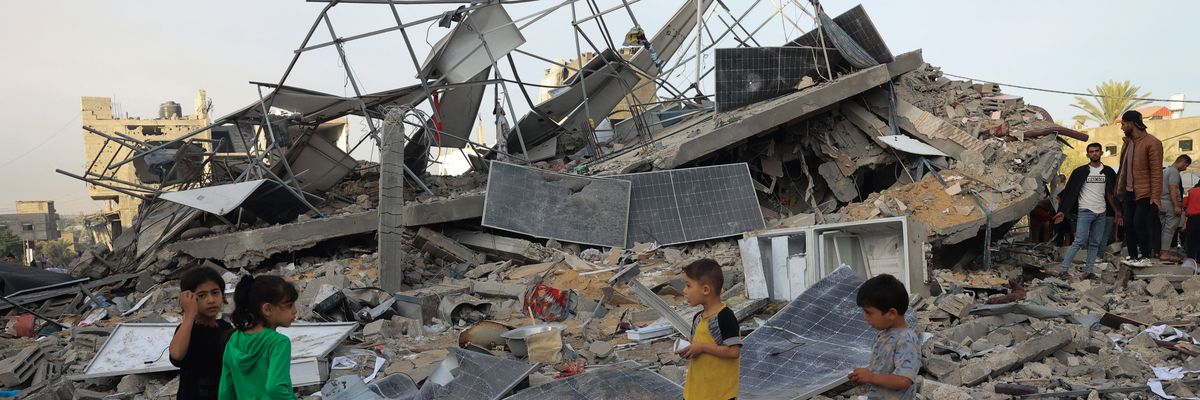
Children stand next to solar panels destroyed following Israeli bombing on Rafah in the southern Gaza Strip, on November 11, 2023.
Destruction to the environment and acceleration of the climate crisis happen silently under the veil of "national security," despite the fact that the environmental toll of war is the most significant threat.
As Earth Day approaches, prepare for the annual spectacle of U.S. lawmakers donning their environmentalist hats, waxing poetic about their love for the planet while disregarding the devastation their actions wreak. The harsh reality is that alongside their hollow pledges lies a trail of destruction fueled by military aggression and imperial ambitions, all under the guise of national security.
Take Gaza, for instance. Its once-fertile farmland now lies barren, its water sources poisoned by conflict and neglect. The grim statistics speak volumes: 97% of Gaza's water is unfit for human consumption, leading to a staggering 26% of illnesses, particularly among vulnerable children. Israel's decades-long colonial settler project and ethnic cleansing of Palestine have caused irrefutable damage to the land, air, and water, consequently contributing to the climate crisis. In fact, in the first two months of the current genocide campaign in Gaza, Israel's murderous bombardment, which has killed nearly 35,000 people, also generated more planet-warming emissions than the annual carbon footprint of the world's top 20 climate-vulnerable nations. Yet, despite these dire circumstances, U.S. lawmakers persist in funneling weapons to Israel, perpetuating a cycle of violence and environmental degradation.
The ripple effects of militarism extend far beyond Gaza's borders. In Ukraine, the Russia-Ukraine War has left a staggering $56.4 billion environmental bill, with widespread contamination of air, water, and soil. Landmines and unexploded ordnance litter 30% of the country, posing long-term risks to both the environment and human health. The United States' answer to all this has been to reject diplomacy and fuel a long, protracted war with a seemingly endless supply of weapons and military support—a war that most experts will tell you is not a winnable war. The proxy war the United States is funding not only leaves Ukrainians at risk of never achieving peace but also significantly contributes to the ever-growing climate crisis.
At the heart of this destructive cycle lies a perverse economic incentive, in which war becomes a lucrative business at the expense of both people and the planet.
Then, there is our government's desire to go to war with China. The U.S. military's heavy footprint already looms large in the Pacific, and with the war drums now beating harder for war than ever before, the footprint is growing. With over 200 bases dotting the region, the Pentagon's voracious energy consumption fuels greenhouse gas emissions and environmental degradation, from polluted drinking water in Okinawa to severe contamination near military installations in Guam. Yet, our government insists that it is China that is our greatest enemy and not the looming threat of climate destruction. The U.S. military's presence in the Pacific is destroying natural, Indigenous ecosystems, favoring the idea of environmental destruction over attempting any form of diplomacy and cooperation with China.
All of this destruction to the environment and acceleration of the climate crisis happen silently under the veil of "national security," while discussions on how the environmental toll of war is the most significant national security threat are absent in D.C. While the threat of nuclear annihilation and civilian casualties rightfully dominate headlines, the ecological fallout remains an underreported tragedy. The Pentagon is the planet's largest institutional emitter of fossil fuels; Its insatiable appetite for conflict exacerbates climate change and threatens ecosystems worldwide. To make matters worse, the U.S. government wants to fund this destruction to the tune of nearly a trillion dollars a year while poor and low-wealth communities worldwide bear the brunt of climate catastrophes with little to no resources to protect themselves.
At the heart of this destructive cycle lies a perverse economic incentive, in which war becomes a lucrative business at the expense of both people and the planet. The narrative of GDP growth masks the actual cost of conflict, prioritizing financial profit over genuine progress in education, healthcare, and biodiversity. However, instead of war-economy metrics such as the GDP, we could embrace alternative metrics such as the Genuine Progress Indicator (GPI)that reckon with the actual toll of war on our world. We can shift from endless growth toward genuine well-being by valuing air quality, food security, and environmental sustainability.
This Earth Day, let us reject the empty rhetoric of environmentalism without action. Let us demand accountability from our lawmakers and insist on an end to the cycle of violence and ecological devastation. By prioritizing peace and sustainability, we can protect our planet and safeguard future generations.
Dear Common Dreams reader, It’s been nearly 30 years since I co-founded Common Dreams with my late wife, Lina Newhouser. We had the radical notion that journalism should serve the public good, not corporate profits. It was clear to us from the outset what it would take to build such a project. No paid advertisements. No corporate sponsors. No millionaire publisher telling us what to think or do. Many people said we wouldn't last a year, but we proved those doubters wrong. Together with a tremendous team of journalists and dedicated staff, we built an independent media outlet free from the constraints of profits and corporate control. Our mission has always been simple: To inform. To inspire. To ignite change for the common good. Building Common Dreams was not easy. Our survival was never guaranteed. When you take on the most powerful forces—Wall Street greed, fossil fuel industry destruction, Big Tech lobbyists, and uber-rich oligarchs who have spent billions upon billions rigging the economy and democracy in their favor—the only bulwark you have is supporters who believe in your work. But here’s the urgent message from me today. It's never been this bad out there. And it's never been this hard to keep us going. At the very moment Common Dreams is most needed, the threats we face are intensifying. We need your support now more than ever. We don't accept corporate advertising and never will. We don't have a paywall because we don't think people should be blocked from critical news based on their ability to pay. Everything we do is funded by the donations of readers like you. When everyone does the little they can afford, we are strong. But if that support retreats or dries up, so do we. Will you donate now to make sure Common Dreams not only survives but thrives? —Craig Brown, Co-founder |
As Earth Day approaches, prepare for the annual spectacle of U.S. lawmakers donning their environmentalist hats, waxing poetic about their love for the planet while disregarding the devastation their actions wreak. The harsh reality is that alongside their hollow pledges lies a trail of destruction fueled by military aggression and imperial ambitions, all under the guise of national security.
Take Gaza, for instance. Its once-fertile farmland now lies barren, its water sources poisoned by conflict and neglect. The grim statistics speak volumes: 97% of Gaza's water is unfit for human consumption, leading to a staggering 26% of illnesses, particularly among vulnerable children. Israel's decades-long colonial settler project and ethnic cleansing of Palestine have caused irrefutable damage to the land, air, and water, consequently contributing to the climate crisis. In fact, in the first two months of the current genocide campaign in Gaza, Israel's murderous bombardment, which has killed nearly 35,000 people, also generated more planet-warming emissions than the annual carbon footprint of the world's top 20 climate-vulnerable nations. Yet, despite these dire circumstances, U.S. lawmakers persist in funneling weapons to Israel, perpetuating a cycle of violence and environmental degradation.
The ripple effects of militarism extend far beyond Gaza's borders. In Ukraine, the Russia-Ukraine War has left a staggering $56.4 billion environmental bill, with widespread contamination of air, water, and soil. Landmines and unexploded ordnance litter 30% of the country, posing long-term risks to both the environment and human health. The United States' answer to all this has been to reject diplomacy and fuel a long, protracted war with a seemingly endless supply of weapons and military support—a war that most experts will tell you is not a winnable war. The proxy war the United States is funding not only leaves Ukrainians at risk of never achieving peace but also significantly contributes to the ever-growing climate crisis.
At the heart of this destructive cycle lies a perverse economic incentive, in which war becomes a lucrative business at the expense of both people and the planet.
Then, there is our government's desire to go to war with China. The U.S. military's heavy footprint already looms large in the Pacific, and with the war drums now beating harder for war than ever before, the footprint is growing. With over 200 bases dotting the region, the Pentagon's voracious energy consumption fuels greenhouse gas emissions and environmental degradation, from polluted drinking water in Okinawa to severe contamination near military installations in Guam. Yet, our government insists that it is China that is our greatest enemy and not the looming threat of climate destruction. The U.S. military's presence in the Pacific is destroying natural, Indigenous ecosystems, favoring the idea of environmental destruction over attempting any form of diplomacy and cooperation with China.
All of this destruction to the environment and acceleration of the climate crisis happen silently under the veil of "national security," while discussions on how the environmental toll of war is the most significant national security threat are absent in D.C. While the threat of nuclear annihilation and civilian casualties rightfully dominate headlines, the ecological fallout remains an underreported tragedy. The Pentagon is the planet's largest institutional emitter of fossil fuels; Its insatiable appetite for conflict exacerbates climate change and threatens ecosystems worldwide. To make matters worse, the U.S. government wants to fund this destruction to the tune of nearly a trillion dollars a year while poor and low-wealth communities worldwide bear the brunt of climate catastrophes with little to no resources to protect themselves.
At the heart of this destructive cycle lies a perverse economic incentive, in which war becomes a lucrative business at the expense of both people and the planet. The narrative of GDP growth masks the actual cost of conflict, prioritizing financial profit over genuine progress in education, healthcare, and biodiversity. However, instead of war-economy metrics such as the GDP, we could embrace alternative metrics such as the Genuine Progress Indicator (GPI)that reckon with the actual toll of war on our world. We can shift from endless growth toward genuine well-being by valuing air quality, food security, and environmental sustainability.
This Earth Day, let us reject the empty rhetoric of environmentalism without action. Let us demand accountability from our lawmakers and insist on an end to the cycle of violence and ecological devastation. By prioritizing peace and sustainability, we can protect our planet and safeguard future generations.
As Earth Day approaches, prepare for the annual spectacle of U.S. lawmakers donning their environmentalist hats, waxing poetic about their love for the planet while disregarding the devastation their actions wreak. The harsh reality is that alongside their hollow pledges lies a trail of destruction fueled by military aggression and imperial ambitions, all under the guise of national security.
Take Gaza, for instance. Its once-fertile farmland now lies barren, its water sources poisoned by conflict and neglect. The grim statistics speak volumes: 97% of Gaza's water is unfit for human consumption, leading to a staggering 26% of illnesses, particularly among vulnerable children. Israel's decades-long colonial settler project and ethnic cleansing of Palestine have caused irrefutable damage to the land, air, and water, consequently contributing to the climate crisis. In fact, in the first two months of the current genocide campaign in Gaza, Israel's murderous bombardment, which has killed nearly 35,000 people, also generated more planet-warming emissions than the annual carbon footprint of the world's top 20 climate-vulnerable nations. Yet, despite these dire circumstances, U.S. lawmakers persist in funneling weapons to Israel, perpetuating a cycle of violence and environmental degradation.
The ripple effects of militarism extend far beyond Gaza's borders. In Ukraine, the Russia-Ukraine War has left a staggering $56.4 billion environmental bill, with widespread contamination of air, water, and soil. Landmines and unexploded ordnance litter 30% of the country, posing long-term risks to both the environment and human health. The United States' answer to all this has been to reject diplomacy and fuel a long, protracted war with a seemingly endless supply of weapons and military support—a war that most experts will tell you is not a winnable war. The proxy war the United States is funding not only leaves Ukrainians at risk of never achieving peace but also significantly contributes to the ever-growing climate crisis.
At the heart of this destructive cycle lies a perverse economic incentive, in which war becomes a lucrative business at the expense of both people and the planet.
Then, there is our government's desire to go to war with China. The U.S. military's heavy footprint already looms large in the Pacific, and with the war drums now beating harder for war than ever before, the footprint is growing. With over 200 bases dotting the region, the Pentagon's voracious energy consumption fuels greenhouse gas emissions and environmental degradation, from polluted drinking water in Okinawa to severe contamination near military installations in Guam. Yet, our government insists that it is China that is our greatest enemy and not the looming threat of climate destruction. The U.S. military's presence in the Pacific is destroying natural, Indigenous ecosystems, favoring the idea of environmental destruction over attempting any form of diplomacy and cooperation with China.
All of this destruction to the environment and acceleration of the climate crisis happen silently under the veil of "national security," while discussions on how the environmental toll of war is the most significant national security threat are absent in D.C. While the threat of nuclear annihilation and civilian casualties rightfully dominate headlines, the ecological fallout remains an underreported tragedy. The Pentagon is the planet's largest institutional emitter of fossil fuels; Its insatiable appetite for conflict exacerbates climate change and threatens ecosystems worldwide. To make matters worse, the U.S. government wants to fund this destruction to the tune of nearly a trillion dollars a year while poor and low-wealth communities worldwide bear the brunt of climate catastrophes with little to no resources to protect themselves.
At the heart of this destructive cycle lies a perverse economic incentive, in which war becomes a lucrative business at the expense of both people and the planet. The narrative of GDP growth masks the actual cost of conflict, prioritizing financial profit over genuine progress in education, healthcare, and biodiversity. However, instead of war-economy metrics such as the GDP, we could embrace alternative metrics such as the Genuine Progress Indicator (GPI)that reckon with the actual toll of war on our world. We can shift from endless growth toward genuine well-being by valuing air quality, food security, and environmental sustainability.
This Earth Day, let us reject the empty rhetoric of environmentalism without action. Let us demand accountability from our lawmakers and insist on an end to the cycle of violence and ecological devastation. By prioritizing peace and sustainability, we can protect our planet and safeguard future generations.