SUBSCRIBE TO OUR FREE NEWSLETTER
Daily news & progressive opinion—funded by the people, not the corporations—delivered straight to your inbox.
5
#000000
#FFFFFF
To donate by check, phone, or other method, see our More Ways to Give page.
Daily news & progressive opinion—funded by the people, not the corporations—delivered straight to your inbox.
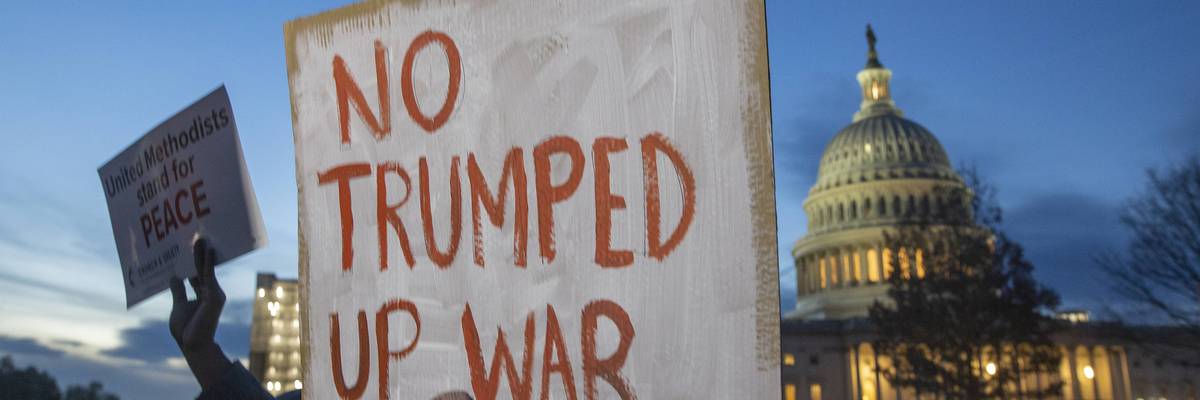
Protesters hold signs at the US Capitol to for the Anti-Iran War Rally on January 9, 2020 in Washington DC, United States.
Some critics say that party leadership has emphasized process and consultation over clear opposition to military escalation, leaving individual lawmakers to articulate their own responses.
In the days surrounding an Axios report last week suggesting that a large-scale conflict with Iran was “imminent,” the US surged additional naval forces and air assets into the region, a posture that reports say amounts to the largest buildup of US airpower in the Middle East since the invasion of Iraq in 2003, raising warnings of another potential war in the region.
Since then, congressional Democrats have issued a growing number of statements criticizing the Trump administration’s moves toward war. Yet some critics say that party leadership has emphasized process and consultation over clear opposition to military escalation, leaving individual lawmakers to articulate their own responses. Those responses have ranged from opposing a war outright, to narrower procedural critiques centered on congressional authorization, to tacit or explicit support for President Donald Trump to have the flexibility to go to war.
There currently exists one legislative vehicle in each chamber through which members can express their position. This month, six new Democratic House members have signed onto a War Powers Resolution aimed at constraining President Trump’s ability to deploy US forces without congressional approval, bringing the total to 82. The legislation, led by Reps. Ro Khanna (D-Calif.) and Thomas Massie (R-Ky.), was first introduced prior to the Trump administration’s unauthorized strikes against Iranian nuclear targets last June. The GOP appears to be largely unified behind a possible war, with Massie being the only Republican House member signed on to the House legislation. Sens. Tim Kaine (D-Va.) and Rand Paul (R-Ky.) have introduced a similar effort in the Senate.
Yet despite the resolution’s growing support, Democratic leadership has not clearly rallied behind it. House Minority Leader Hakeem Jeffries (D-NY) has issued public concerns about Trump’s rush to war, but has not said whether or not he supports the Khanna-Massie bill.
The Democratic Party’s disjointedness in countering Trump’s foreign policy, particularly with regards to Iran, has been evident since before his return to office in 2024.
Senate Minority Leader Chuck Schumer’s (D-NY) statement did not oppose a war, but instead noted the “risks” involved and called for confronting Iran’s “ruthless campaign of terror, nuclear ambitions, regional aggression, and horrific oppression” with “strength, resolve, regional coordination, and strategic clarity” and urged the administration “to consult with Congress and explain to the American people the objectives and exactly why he is risking more American lives.” Following the Trump administration’s Tuesday briefing to the Gang of 8, Schumer added, “This is serious. The administration has to make its case to the American people," fueling criticism that he was prepared to accept the president’s justifications.
“Leader Schumer’s statements are insufficient. Democratic voters want leadership that’s willing to take a clear stand and oppose the president on major issues like this,” Dylan Williams, vice president for government affairs at the Center for International Policy, told Responsible Statecraft.
Two recent reports suggest that this lack of pushback could be intentional. A Tuesday story from journalist Aida Chavez’s substack Capital and Empire says top Democrats have worked to block consideration of legislation that would force members to go on record regarding potential military action against Iran.
“The evidence, so far, is that leadership is trying to discourage that vote,” one activist and former congressional staffer familiar with dynamics on the Hill told RS. “And the primary people that serve are the few dozen Democrats whose donors are hawks, but whose voters don’t want regime change war. That’s who the party is trying to protect from having to take a vote, because it's painful for those members to vote against their donors.”
Drop Site News reported last week that some Democrats on the Hill might support pursuing a military intervention in Iran but, understanding a war would likely be politically catastrophic, would rather not go on the record and instead let Trump and the Republicans bear the responsibility and the costs.
“Cynically, Schumer may also have the midterms in mind," the Drop Site report says. “If Trump manages to topple the Iranian government, the ensuing chaos could prove a drag on Trump as the country heads into the November elections.” As a result, party leaders may choose to stand by or tepidly oppose military action as opposed to forcefully weighing in one way or the other. (The Schumer aide who laid out this calculus in the Drop Site story said that the minority leader himself does not subscribe to that logic.)
Two party members have already explicitly said they will not support the war powers effort. Rep. Josh Gottheimer (D-NJ), in a joint statement with GOP Rep. Mike Lawler of New York, said it “would restrict the flexibility needed to respond to real and evolving threats and risks signaling weakness at a dangerous moment.”
Rep. Jared Moskowitz (D-Fla.), meanwhile, told Jewish Insider that the sponsors of the legislation “should just rename it the Ayatollah Protection Act because that’s what it does.”
Some Democratic lawmakers, however, have issued stronger warnings against escalation and pushed instead for a diplomatic solution.
“This recent wave of statements against a potential war is a reflection of pressure coming from both constituents and members within the caucus,” CIP’s Williams said. “There’s an important distinction here: Some lawmakers are making a more legalistic case that the administration hasn’t formally made the case for war, while others are being much more direct about the stakes and consequences of entering into another military conflict.”
Indeed, Rep. Rashida Tlaib (D-Mich.), for example, has taken the latter route. “No war with Iran!” she wrote in a post on X. “Trump's illegal warmongering will only bring death and destruction. This is a disaster in the making, and we must do everything in our power to stop it.”
Meanwhile, a joint statement from Reps. Gregory Meeks (D-NY), the ranking member on the House Foreign Affairs Committee, House Armed Service Committee ranking member Adam Smith (D-Wash.), and Jim Himes (D-Conn.), the ranking member on the House Intelligence Committee urged a diplomatic approach.
“Diplomacy is the most effective tool available to durably constrain Iran’s nuclear program and reduce the risk of a broader regional war,” they said. “Renewed talks with Tehran show that a diplomatic path remains open, which President Trump should not abandon for a short-term, unauthorized show of military force that leaves Americans less secure.”
The Democratic Party’s disjointedness in countering Trump’s foreign policy, particularly with regards to Iran, has been evident since before his return to office in 2024. The party’s platform that summer criticized the president for his “fecklessness and weakness” when dealing with Tehran during his first term, without mentioning the fact that Trump brought the United States to the brink of war with Iran with the January 2020 killing of Qassem Soleimani. In the lead-up to the strikes against Iranian nuclear facilities last June, Schumer released a video accusing Trump of not being hawkish enough by negotiating “side deals” and “folding on Iran.”
Meanwhile, public opinion polling has consistently shown that going to war with Iran is unpopular, especially among Democratic voters. A January poll from Quinnipiac University showed that 70% of Americans, including 79% of Democrats, 53% of Republicans, and 80% of independents opposed military action against Iran if protesters were killed by the government during demonstrations. Trump named the killing of citizens as a “red line” at the height of protests in January, and it has been one of a number of half-baked reasonings for a potential war. A more recent poll from the University of Maryland found that nearly three-quarters of Democrats opposed a war “under the current circumstances.”
Dear Common Dreams reader, It’s been nearly 30 years since I co-founded Common Dreams with my late wife, Lina Newhouser. We had the radical notion that journalism should serve the public good, not corporate profits. It was clear to us from the outset what it would take to build such a project. No paid advertisements. No corporate sponsors. No millionaire publisher telling us what to think or do. Many people said we wouldn't last a year, but we proved those doubters wrong. Together with a tremendous team of journalists and dedicated staff, we built an independent media outlet free from the constraints of profits and corporate control. Our mission has always been simple: To inform. To inspire. To ignite change for the common good. Building Common Dreams was not easy. Our survival was never guaranteed. When you take on the most powerful forces—Wall Street greed, fossil fuel industry destruction, Big Tech lobbyists, and uber-rich oligarchs who have spent billions upon billions rigging the economy and democracy in their favor—the only bulwark you have is supporters who believe in your work. But here’s the urgent message from me today. It's never been this bad out there. And it's never been this hard to keep us going. At the very moment Common Dreams is most needed, the threats we face are intensifying. We need your support now more than ever. We don't accept corporate advertising and never will. We don't have a paywall because we don't think people should be blocked from critical news based on their ability to pay. Everything we do is funded by the donations of readers like you. When everyone does the little they can afford, we are strong. But if that support retreats or dries up, so do we. Will you donate now to make sure Common Dreams not only survives but thrives? —Craig Brown, Co-founder |
In the days surrounding an Axios report last week suggesting that a large-scale conflict with Iran was “imminent,” the US surged additional naval forces and air assets into the region, a posture that reports say amounts to the largest buildup of US airpower in the Middle East since the invasion of Iraq in 2003, raising warnings of another potential war in the region.
Since then, congressional Democrats have issued a growing number of statements criticizing the Trump administration’s moves toward war. Yet some critics say that party leadership has emphasized process and consultation over clear opposition to military escalation, leaving individual lawmakers to articulate their own responses. Those responses have ranged from opposing a war outright, to narrower procedural critiques centered on congressional authorization, to tacit or explicit support for President Donald Trump to have the flexibility to go to war.
There currently exists one legislative vehicle in each chamber through which members can express their position. This month, six new Democratic House members have signed onto a War Powers Resolution aimed at constraining President Trump’s ability to deploy US forces without congressional approval, bringing the total to 82. The legislation, led by Reps. Ro Khanna (D-Calif.) and Thomas Massie (R-Ky.), was first introduced prior to the Trump administration’s unauthorized strikes against Iranian nuclear targets last June. The GOP appears to be largely unified behind a possible war, with Massie being the only Republican House member signed on to the House legislation. Sens. Tim Kaine (D-Va.) and Rand Paul (R-Ky.) have introduced a similar effort in the Senate.
Yet despite the resolution’s growing support, Democratic leadership has not clearly rallied behind it. House Minority Leader Hakeem Jeffries (D-NY) has issued public concerns about Trump’s rush to war, but has not said whether or not he supports the Khanna-Massie bill.
The Democratic Party’s disjointedness in countering Trump’s foreign policy, particularly with regards to Iran, has been evident since before his return to office in 2024.
Senate Minority Leader Chuck Schumer’s (D-NY) statement did not oppose a war, but instead noted the “risks” involved and called for confronting Iran’s “ruthless campaign of terror, nuclear ambitions, regional aggression, and horrific oppression” with “strength, resolve, regional coordination, and strategic clarity” and urged the administration “to consult with Congress and explain to the American people the objectives and exactly why he is risking more American lives.” Following the Trump administration’s Tuesday briefing to the Gang of 8, Schumer added, “This is serious. The administration has to make its case to the American people," fueling criticism that he was prepared to accept the president’s justifications.
“Leader Schumer’s statements are insufficient. Democratic voters want leadership that’s willing to take a clear stand and oppose the president on major issues like this,” Dylan Williams, vice president for government affairs at the Center for International Policy, told Responsible Statecraft.
Two recent reports suggest that this lack of pushback could be intentional. A Tuesday story from journalist Aida Chavez’s substack Capital and Empire says top Democrats have worked to block consideration of legislation that would force members to go on record regarding potential military action against Iran.
“The evidence, so far, is that leadership is trying to discourage that vote,” one activist and former congressional staffer familiar with dynamics on the Hill told RS. “And the primary people that serve are the few dozen Democrats whose donors are hawks, but whose voters don’t want regime change war. That’s who the party is trying to protect from having to take a vote, because it's painful for those members to vote against their donors.”
Drop Site News reported last week that some Democrats on the Hill might support pursuing a military intervention in Iran but, understanding a war would likely be politically catastrophic, would rather not go on the record and instead let Trump and the Republicans bear the responsibility and the costs.
“Cynically, Schumer may also have the midterms in mind," the Drop Site report says. “If Trump manages to topple the Iranian government, the ensuing chaos could prove a drag on Trump as the country heads into the November elections.” As a result, party leaders may choose to stand by or tepidly oppose military action as opposed to forcefully weighing in one way or the other. (The Schumer aide who laid out this calculus in the Drop Site story said that the minority leader himself does not subscribe to that logic.)
Two party members have already explicitly said they will not support the war powers effort. Rep. Josh Gottheimer (D-NJ), in a joint statement with GOP Rep. Mike Lawler of New York, said it “would restrict the flexibility needed to respond to real and evolving threats and risks signaling weakness at a dangerous moment.”
Rep. Jared Moskowitz (D-Fla.), meanwhile, told Jewish Insider that the sponsors of the legislation “should just rename it the Ayatollah Protection Act because that’s what it does.”
Some Democratic lawmakers, however, have issued stronger warnings against escalation and pushed instead for a diplomatic solution.
“This recent wave of statements against a potential war is a reflection of pressure coming from both constituents and members within the caucus,” CIP’s Williams said. “There’s an important distinction here: Some lawmakers are making a more legalistic case that the administration hasn’t formally made the case for war, while others are being much more direct about the stakes and consequences of entering into another military conflict.”
Indeed, Rep. Rashida Tlaib (D-Mich.), for example, has taken the latter route. “No war with Iran!” she wrote in a post on X. “Trump's illegal warmongering will only bring death and destruction. This is a disaster in the making, and we must do everything in our power to stop it.”
Meanwhile, a joint statement from Reps. Gregory Meeks (D-NY), the ranking member on the House Foreign Affairs Committee, House Armed Service Committee ranking member Adam Smith (D-Wash.), and Jim Himes (D-Conn.), the ranking member on the House Intelligence Committee urged a diplomatic approach.
“Diplomacy is the most effective tool available to durably constrain Iran’s nuclear program and reduce the risk of a broader regional war,” they said. “Renewed talks with Tehran show that a diplomatic path remains open, which President Trump should not abandon for a short-term, unauthorized show of military force that leaves Americans less secure.”
The Democratic Party’s disjointedness in countering Trump’s foreign policy, particularly with regards to Iran, has been evident since before his return to office in 2024. The party’s platform that summer criticized the president for his “fecklessness and weakness” when dealing with Tehran during his first term, without mentioning the fact that Trump brought the United States to the brink of war with Iran with the January 2020 killing of Qassem Soleimani. In the lead-up to the strikes against Iranian nuclear facilities last June, Schumer released a video accusing Trump of not being hawkish enough by negotiating “side deals” and “folding on Iran.”
Meanwhile, public opinion polling has consistently shown that going to war with Iran is unpopular, especially among Democratic voters. A January poll from Quinnipiac University showed that 70% of Americans, including 79% of Democrats, 53% of Republicans, and 80% of independents opposed military action against Iran if protesters were killed by the government during demonstrations. Trump named the killing of citizens as a “red line” at the height of protests in January, and it has been one of a number of half-baked reasonings for a potential war. A more recent poll from the University of Maryland found that nearly three-quarters of Democrats opposed a war “under the current circumstances.”
In the days surrounding an Axios report last week suggesting that a large-scale conflict with Iran was “imminent,” the US surged additional naval forces and air assets into the region, a posture that reports say amounts to the largest buildup of US airpower in the Middle East since the invasion of Iraq in 2003, raising warnings of another potential war in the region.
Since then, congressional Democrats have issued a growing number of statements criticizing the Trump administration’s moves toward war. Yet some critics say that party leadership has emphasized process and consultation over clear opposition to military escalation, leaving individual lawmakers to articulate their own responses. Those responses have ranged from opposing a war outright, to narrower procedural critiques centered on congressional authorization, to tacit or explicit support for President Donald Trump to have the flexibility to go to war.
There currently exists one legislative vehicle in each chamber through which members can express their position. This month, six new Democratic House members have signed onto a War Powers Resolution aimed at constraining President Trump’s ability to deploy US forces without congressional approval, bringing the total to 82. The legislation, led by Reps. Ro Khanna (D-Calif.) and Thomas Massie (R-Ky.), was first introduced prior to the Trump administration’s unauthorized strikes against Iranian nuclear targets last June. The GOP appears to be largely unified behind a possible war, with Massie being the only Republican House member signed on to the House legislation. Sens. Tim Kaine (D-Va.) and Rand Paul (R-Ky.) have introduced a similar effort in the Senate.
Yet despite the resolution’s growing support, Democratic leadership has not clearly rallied behind it. House Minority Leader Hakeem Jeffries (D-NY) has issued public concerns about Trump’s rush to war, but has not said whether or not he supports the Khanna-Massie bill.
The Democratic Party’s disjointedness in countering Trump’s foreign policy, particularly with regards to Iran, has been evident since before his return to office in 2024.
Senate Minority Leader Chuck Schumer’s (D-NY) statement did not oppose a war, but instead noted the “risks” involved and called for confronting Iran’s “ruthless campaign of terror, nuclear ambitions, regional aggression, and horrific oppression” with “strength, resolve, regional coordination, and strategic clarity” and urged the administration “to consult with Congress and explain to the American people the objectives and exactly why he is risking more American lives.” Following the Trump administration’s Tuesday briefing to the Gang of 8, Schumer added, “This is serious. The administration has to make its case to the American people," fueling criticism that he was prepared to accept the president’s justifications.
“Leader Schumer’s statements are insufficient. Democratic voters want leadership that’s willing to take a clear stand and oppose the president on major issues like this,” Dylan Williams, vice president for government affairs at the Center for International Policy, told Responsible Statecraft.
Two recent reports suggest that this lack of pushback could be intentional. A Tuesday story from journalist Aida Chavez’s substack Capital and Empire says top Democrats have worked to block consideration of legislation that would force members to go on record regarding potential military action against Iran.
“The evidence, so far, is that leadership is trying to discourage that vote,” one activist and former congressional staffer familiar with dynamics on the Hill told RS. “And the primary people that serve are the few dozen Democrats whose donors are hawks, but whose voters don’t want regime change war. That’s who the party is trying to protect from having to take a vote, because it's painful for those members to vote against their donors.”
Drop Site News reported last week that some Democrats on the Hill might support pursuing a military intervention in Iran but, understanding a war would likely be politically catastrophic, would rather not go on the record and instead let Trump and the Republicans bear the responsibility and the costs.
“Cynically, Schumer may also have the midterms in mind," the Drop Site report says. “If Trump manages to topple the Iranian government, the ensuing chaos could prove a drag on Trump as the country heads into the November elections.” As a result, party leaders may choose to stand by or tepidly oppose military action as opposed to forcefully weighing in one way or the other. (The Schumer aide who laid out this calculus in the Drop Site story said that the minority leader himself does not subscribe to that logic.)
Two party members have already explicitly said they will not support the war powers effort. Rep. Josh Gottheimer (D-NJ), in a joint statement with GOP Rep. Mike Lawler of New York, said it “would restrict the flexibility needed to respond to real and evolving threats and risks signaling weakness at a dangerous moment.”
Rep. Jared Moskowitz (D-Fla.), meanwhile, told Jewish Insider that the sponsors of the legislation “should just rename it the Ayatollah Protection Act because that’s what it does.”
Some Democratic lawmakers, however, have issued stronger warnings against escalation and pushed instead for a diplomatic solution.
“This recent wave of statements against a potential war is a reflection of pressure coming from both constituents and members within the caucus,” CIP’s Williams said. “There’s an important distinction here: Some lawmakers are making a more legalistic case that the administration hasn’t formally made the case for war, while others are being much more direct about the stakes and consequences of entering into another military conflict.”
Indeed, Rep. Rashida Tlaib (D-Mich.), for example, has taken the latter route. “No war with Iran!” she wrote in a post on X. “Trump's illegal warmongering will only bring death and destruction. This is a disaster in the making, and we must do everything in our power to stop it.”
Meanwhile, a joint statement from Reps. Gregory Meeks (D-NY), the ranking member on the House Foreign Affairs Committee, House Armed Service Committee ranking member Adam Smith (D-Wash.), and Jim Himes (D-Conn.), the ranking member on the House Intelligence Committee urged a diplomatic approach.
“Diplomacy is the most effective tool available to durably constrain Iran’s nuclear program and reduce the risk of a broader regional war,” they said. “Renewed talks with Tehran show that a diplomatic path remains open, which President Trump should not abandon for a short-term, unauthorized show of military force that leaves Americans less secure.”
The Democratic Party’s disjointedness in countering Trump’s foreign policy, particularly with regards to Iran, has been evident since before his return to office in 2024. The party’s platform that summer criticized the president for his “fecklessness and weakness” when dealing with Tehran during his first term, without mentioning the fact that Trump brought the United States to the brink of war with Iran with the January 2020 killing of Qassem Soleimani. In the lead-up to the strikes against Iranian nuclear facilities last June, Schumer released a video accusing Trump of not being hawkish enough by negotiating “side deals” and “folding on Iran.”
Meanwhile, public opinion polling has consistently shown that going to war with Iran is unpopular, especially among Democratic voters. A January poll from Quinnipiac University showed that 70% of Americans, including 79% of Democrats, 53% of Republicans, and 80% of independents opposed military action against Iran if protesters were killed by the government during demonstrations. Trump named the killing of citizens as a “red line” at the height of protests in January, and it has been one of a number of half-baked reasonings for a potential war. A more recent poll from the University of Maryland found that nearly three-quarters of Democrats opposed a war “under the current circumstances.”