

If You're a Democrat Annoyed by Outraged Voters, You Are Doing It Wrong
To most registered Democrats, there’s nothing more important for lawmakers with a “D” after their names to do than battle tooth-and-nail against the Trump-Musk agenda for gutting the government while enriching the wealthy at everyone else’s expense.
The Capitol’s phone lines have been overwhelmed this month, and some Democrats are complaining about the deluge of calls from voters who implore them to fight the Trump administration. Too often the responses to the calls have amounted to passing the buck rightward.
“It's been a constant theme of us saying, ‘Please call the Republicans,’" Virginia Democratic Rep. Don Beyer explained. Rep. Ritchie Torres (D-N.Y.) is offended by what he’s hearing from constituents. “I reject and resent the implication that congressional Democrats are simply standing by passively,” he said.
Such reactions are political copouts. Those two congressmembers represent deep-blue districts, and both of their states are represented by Democratic senators. Responding to outraged constituents by telling them to “call the Republicans” is a way of dodging responsibility and accountability.
Mere shrugs from Democrats that they’re in the minority won’t wash.
It's easy enough for Torres, Beyer and others in the Democratic caucus to gripe about the volume of irate calls to their offices. And at first glance, telling constituents to contact Republicans instead might seem logical. But that’s actually a way of telling an angry Democratic base not to be a nuisance to Democratic lawmakers.
What’s more, as a practical matter, their constituents often have no way to message GOP members of Congress. The congressional email system doesn’t allow non-constituents to send a message to a representative or senator. And the first thing that a staffer wants to confirm on the phone is whether the caller is in fact a constituent.
Fully half of the nation’s citizens—and a large majority of Democrats—live in states with two Democratic senators. And so, routinely, when Democratic officeholders say that their agitated constituents should leave them alone and “call the Republicans,” it amounts to a brushoff that can be translated from politician-talk as “Stop bugging us already.”
But in primaries next year, some are liable to be held accountable. Few serving Democrats with blue electorates will face tight races in the 2026 general election—but if they’re perceived as wimps who failed to really put up a fight against President Trump, Vice President JD Vance and Elon Musk, incumbents risk facing primary challenges propelled by grassroots anger.
The anger might seem overheated inside Capitol Hill bubbles. But it’s real for millions of engaged activists—the ones who volunteer in droves and can get behind insurgency campaigns with plenty of fundraising, canvassing power and social-media impacts.
Mere shrugs from Democrats that they’re in the minority won’t wash. “The rules of the Senate are designed to protect the rights of the minority, and Democrats have tools to grind Senate business to a halt to delay and defy the Trump-Musk coup,” the activist group Indivisible points out. “The three biggest weapons? Blanket opposition, quorum calls, and blocking unanimous consent -- parliamentary guerrilla tactics that can slow, stall, and obstruct at every turn.”
The needed opposition goes way beyond procedural maneuvers. The tenor and vehemence of public statements every day, from the hundreds of Democrats in the House and Senate, set a tone and convey messages beyond mere words on paper and screens.
The week after Trump’s return to the Oval Office, House Minority Leader Hakeem Jeffries (D-N.Y.) traveled to California and met with donor powerhouses in Silicon Valley, where he reportedly “said Democrats were reaching toward the center, while Trump will swing harder right.” Here we have the prospective next House speaker pledging to move in the direction of a president whom Gen. Mark Milley has described as “fascist to the core.”
Jeffries’ goal of hugging “the center” may play well with rich tech executives, but it shows notable indifference to the large bulk of Democratic voters. Early this month, CBS News reported that its polling shows “the nation's rank-and-file Democrats are increasingly looking for more opposition to President Trump from their congressional delegation.” The trend has been emphatic. Only 35 percent want Democrats in Congress to “try to find common ground with Trump,” while 65 percent want them to “oppose Trump as much as possible.”
Hugging “the center” may play well with rich tech executives, but it shows notable indifference to the large bulk of Democratic voters.
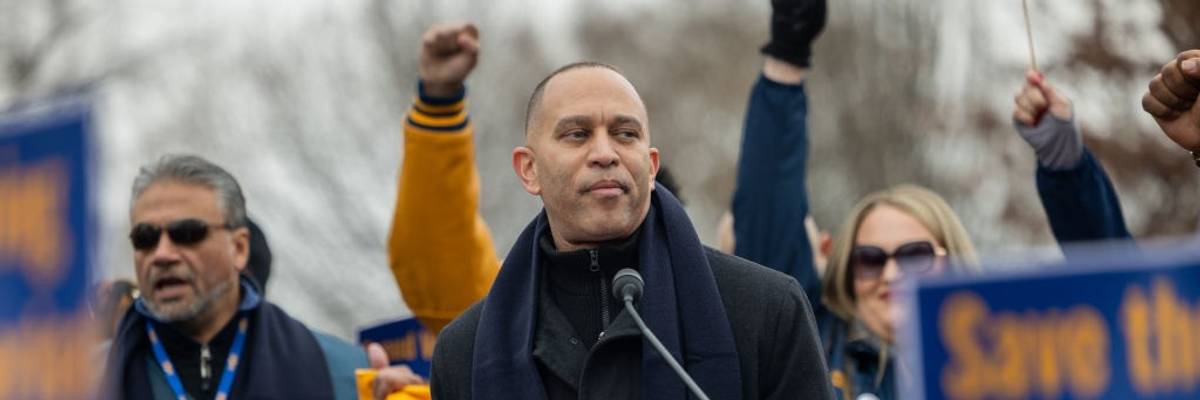
A rally last Thursday at Jeffries’ central Brooklyn office drew hundreds of protesters. One of them, Molly Ornati, an activist with the group 350 Brooklyn Water, said: “He’s acting as though this is a normal part of the political process, when this is a completely never before seen violation of the Constitution, of federal laws, separation of power, democratic principle—all of the key American values. He’s not standing up with the level of outrage that people meant to see, that Democrats want to see.”
The next day, on his latest California trip, Jeffries spoke in the Bay Area and generated headlines like “Hundreds Protest Outside Event With House Minority Leader” and “Oakland to Hakeem Jeffries: Do Your Job!” One of the local TV news reports summed up a theme of the demonstration this way: “Democratic Party has been paying lip service to the working class.”
To most registered Democrats, there’s nothing more important for lawmakers with a “D” after their names to do than battle tooth-and-nail against the Trump-Musk agenda for gutting the government while enriching the wealthy at everyone else’s expense. While Trump’s forces are setting fire to the basic structures of American democracy, Democrats in Congress are widely perceived to be wielding squirt guns. That’s no way to prevent tyranny or win the next elections.
We are at a crossroads
This country and this world are at a monumental crossroads. In a few short weeks, US voters will have an opportunity to beat back the forces of fascism and confront the billionaires who are rigging the economy, our media system, and our democracy, making it increasingly impossible for ordinary people to get by. We’re not just talking about the election. We’re talking about what must be done once these fascist elements are vanquished from power. We need a bolder set of solutions than what either major party has so far been willing to offer and a working-class movement ready to fight like hell for it. Trump didn't emerge from nowhere. The conditions that fueled MAGA authoritarianism were created by decades of radical neoliberal economic policies and a corrupt political system dominated by corporate interests. They slashed taxes on the super-rich, promising that the benefits would trickle down. They said giveaways to the corporate titans would make life more affordable for the rest of us. It was all bullshit. And when a bitter, betrayed populace searches for someone to blame, right-wing demagogues have little trouble finding scapegoats. People know when they're being lied to, but you won't hear any of this from the corporate media. Only independent journalism—powered and funded by people who believe in building a better world—can deliver truly trustworthy daily news. Our Fall Campaign is underway, and we need your help. To power our newsroom through the rest of the year, we need to raise $125,000 by midnight on October 31. So if you share our vision, please contribute whatever you can to sustain our work. |
Norman Solomon is the national director of RootsAction.org and executive director of the Institute for Public Accuracy. The paperback edition of his latest book, War Made Invisible: How America Hides the Human Toll of Its Military Machine, includes an afterword about the Gaza war.
The Capitol’s phone lines have been overwhelmed this month, and some Democrats are complaining about the deluge of calls from voters who implore them to fight the Trump administration. Too often the responses to the calls have amounted to passing the buck rightward.
“It's been a constant theme of us saying, ‘Please call the Republicans,’" Virginia Democratic Rep. Don Beyer explained. Rep. Ritchie Torres (D-N.Y.) is offended by what he’s hearing from constituents. “I reject and resent the implication that congressional Democrats are simply standing by passively,” he said.
Such reactions are political copouts. Those two congressmembers represent deep-blue districts, and both of their states are represented by Democratic senators. Responding to outraged constituents by telling them to “call the Republicans” is a way of dodging responsibility and accountability.
Mere shrugs from Democrats that they’re in the minority won’t wash.
It's easy enough for Torres, Beyer and others in the Democratic caucus to gripe about the volume of irate calls to their offices. And at first glance, telling constituents to contact Republicans instead might seem logical. But that’s actually a way of telling an angry Democratic base not to be a nuisance to Democratic lawmakers.
What’s more, as a practical matter, their constituents often have no way to message GOP members of Congress. The congressional email system doesn’t allow non-constituents to send a message to a representative or senator. And the first thing that a staffer wants to confirm on the phone is whether the caller is in fact a constituent.
Fully half of the nation’s citizens—and a large majority of Democrats—live in states with two Democratic senators. And so, routinely, when Democratic officeholders say that their agitated constituents should leave them alone and “call the Republicans,” it amounts to a brushoff that can be translated from politician-talk as “Stop bugging us already.”
But in primaries next year, some are liable to be held accountable. Few serving Democrats with blue electorates will face tight races in the 2026 general election—but if they’re perceived as wimps who failed to really put up a fight against President Trump, Vice President JD Vance and Elon Musk, incumbents risk facing primary challenges propelled by grassroots anger.
The anger might seem overheated inside Capitol Hill bubbles. But it’s real for millions of engaged activists—the ones who volunteer in droves and can get behind insurgency campaigns with plenty of fundraising, canvassing power and social-media impacts.
Mere shrugs from Democrats that they’re in the minority won’t wash. “The rules of the Senate are designed to protect the rights of the minority, and Democrats have tools to grind Senate business to a halt to delay and defy the Trump-Musk coup,” the activist group Indivisible points out. “The three biggest weapons? Blanket opposition, quorum calls, and blocking unanimous consent -- parliamentary guerrilla tactics that can slow, stall, and obstruct at every turn.”
The needed opposition goes way beyond procedural maneuvers. The tenor and vehemence of public statements every day, from the hundreds of Democrats in the House and Senate, set a tone and convey messages beyond mere words on paper and screens.
The week after Trump’s return to the Oval Office, House Minority Leader Hakeem Jeffries (D-N.Y.) traveled to California and met with donor powerhouses in Silicon Valley, where he reportedly “said Democrats were reaching toward the center, while Trump will swing harder right.” Here we have the prospective next House speaker pledging to move in the direction of a president whom Gen. Mark Milley has described as “fascist to the core.”
Jeffries’ goal of hugging “the center” may play well with rich tech executives, but it shows notable indifference to the large bulk of Democratic voters. Early this month, CBS News reported that its polling shows “the nation's rank-and-file Democrats are increasingly looking for more opposition to President Trump from their congressional delegation.” The trend has been emphatic. Only 35 percent want Democrats in Congress to “try to find common ground with Trump,” while 65 percent want them to “oppose Trump as much as possible.”
Hugging “the center” may play well with rich tech executives, but it shows notable indifference to the large bulk of Democratic voters.
A rally last Thursday at Jeffries’ central Brooklyn office drew hundreds of protesters. One of them, Molly Ornati, an activist with the group 350 Brooklyn Water, said: “He’s acting as though this is a normal part of the political process, when this is a completely never before seen violation of the Constitution, of federal laws, separation of power, democratic principle—all of the key American values. He’s not standing up with the level of outrage that people meant to see, that Democrats want to see.”
The next day, on his latest California trip, Jeffries spoke in the Bay Area and generated headlines like “Hundreds Protest Outside Event With House Minority Leader” and “Oakland to Hakeem Jeffries: Do Your Job!” One of the local TV news reports summed up a theme of the demonstration this way: “Democratic Party has been paying lip service to the working class.”
To most registered Democrats, there’s nothing more important for lawmakers with a “D” after their names to do than battle tooth-and-nail against the Trump-Musk agenda for gutting the government while enriching the wealthy at everyone else’s expense. While Trump’s forces are setting fire to the basic structures of American democracy, Democrats in Congress are widely perceived to be wielding squirt guns. That’s no way to prevent tyranny or win the next elections.
Norman Solomon is the national director of RootsAction.org and executive director of the Institute for Public Accuracy. The paperback edition of his latest book, War Made Invisible: How America Hides the Human Toll of Its Military Machine, includes an afterword about the Gaza war.
The Capitol’s phone lines have been overwhelmed this month, and some Democrats are complaining about the deluge of calls from voters who implore them to fight the Trump administration. Too often the responses to the calls have amounted to passing the buck rightward.
“It's been a constant theme of us saying, ‘Please call the Republicans,’" Virginia Democratic Rep. Don Beyer explained. Rep. Ritchie Torres (D-N.Y.) is offended by what he’s hearing from constituents. “I reject and resent the implication that congressional Democrats are simply standing by passively,” he said.
Such reactions are political copouts. Those two congressmembers represent deep-blue districts, and both of their states are represented by Democratic senators. Responding to outraged constituents by telling them to “call the Republicans” is a way of dodging responsibility and accountability.
Mere shrugs from Democrats that they’re in the minority won’t wash.
It's easy enough for Torres, Beyer and others in the Democratic caucus to gripe about the volume of irate calls to their offices. And at first glance, telling constituents to contact Republicans instead might seem logical. But that’s actually a way of telling an angry Democratic base not to be a nuisance to Democratic lawmakers.
What’s more, as a practical matter, their constituents often have no way to message GOP members of Congress. The congressional email system doesn’t allow non-constituents to send a message to a representative or senator. And the first thing that a staffer wants to confirm on the phone is whether the caller is in fact a constituent.
Fully half of the nation’s citizens—and a large majority of Democrats—live in states with two Democratic senators. And so, routinely, when Democratic officeholders say that their agitated constituents should leave them alone and “call the Republicans,” it amounts to a brushoff that can be translated from politician-talk as “Stop bugging us already.”
But in primaries next year, some are liable to be held accountable. Few serving Democrats with blue electorates will face tight races in the 2026 general election—but if they’re perceived as wimps who failed to really put up a fight against President Trump, Vice President JD Vance and Elon Musk, incumbents risk facing primary challenges propelled by grassroots anger.
The anger might seem overheated inside Capitol Hill bubbles. But it’s real for millions of engaged activists—the ones who volunteer in droves and can get behind insurgency campaigns with plenty of fundraising, canvassing power and social-media impacts.
Mere shrugs from Democrats that they’re in the minority won’t wash. “The rules of the Senate are designed to protect the rights of the minority, and Democrats have tools to grind Senate business to a halt to delay and defy the Trump-Musk coup,” the activist group Indivisible points out. “The three biggest weapons? Blanket opposition, quorum calls, and blocking unanimous consent -- parliamentary guerrilla tactics that can slow, stall, and obstruct at every turn.”
The needed opposition goes way beyond procedural maneuvers. The tenor and vehemence of public statements every day, from the hundreds of Democrats in the House and Senate, set a tone and convey messages beyond mere words on paper and screens.
The week after Trump’s return to the Oval Office, House Minority Leader Hakeem Jeffries (D-N.Y.) traveled to California and met with donor powerhouses in Silicon Valley, where he reportedly “said Democrats were reaching toward the center, while Trump will swing harder right.” Here we have the prospective next House speaker pledging to move in the direction of a president whom Gen. Mark Milley has described as “fascist to the core.”
Jeffries’ goal of hugging “the center” may play well with rich tech executives, but it shows notable indifference to the large bulk of Democratic voters. Early this month, CBS News reported that its polling shows “the nation's rank-and-file Democrats are increasingly looking for more opposition to President Trump from their congressional delegation.” The trend has been emphatic. Only 35 percent want Democrats in Congress to “try to find common ground with Trump,” while 65 percent want them to “oppose Trump as much as possible.”
Hugging “the center” may play well with rich tech executives, but it shows notable indifference to the large bulk of Democratic voters.
A rally last Thursday at Jeffries’ central Brooklyn office drew hundreds of protesters. One of them, Molly Ornati, an activist with the group 350 Brooklyn Water, said: “He’s acting as though this is a normal part of the political process, when this is a completely never before seen violation of the Constitution, of federal laws, separation of power, democratic principle—all of the key American values. He’s not standing up with the level of outrage that people meant to see, that Democrats want to see.”
The next day, on his latest California trip, Jeffries spoke in the Bay Area and generated headlines like “Hundreds Protest Outside Event With House Minority Leader” and “Oakland to Hakeem Jeffries: Do Your Job!” One of the local TV news reports summed up a theme of the demonstration this way: “Democratic Party has been paying lip service to the working class.”
To most registered Democrats, there’s nothing more important for lawmakers with a “D” after their names to do than battle tooth-and-nail against the Trump-Musk agenda for gutting the government while enriching the wealthy at everyone else’s expense. While Trump’s forces are setting fire to the basic structures of American democracy, Democrats in Congress are widely perceived to be wielding squirt guns. That’s no way to prevent tyranny or win the next elections.